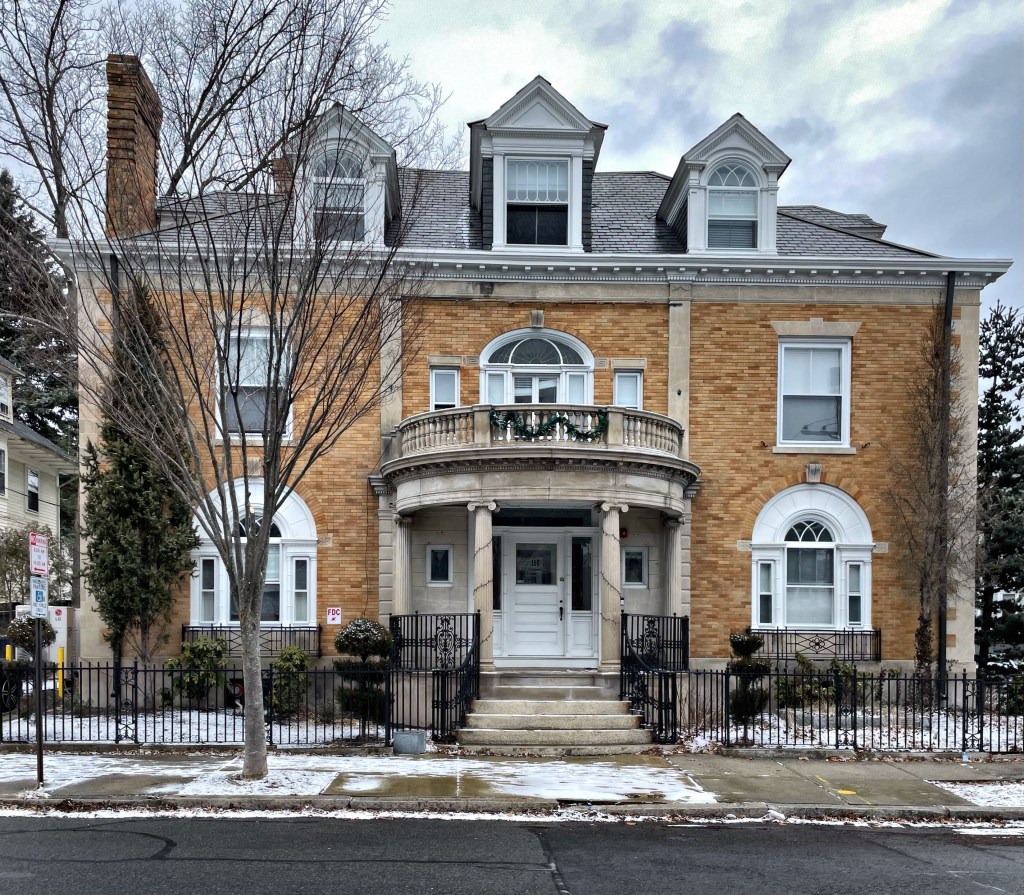
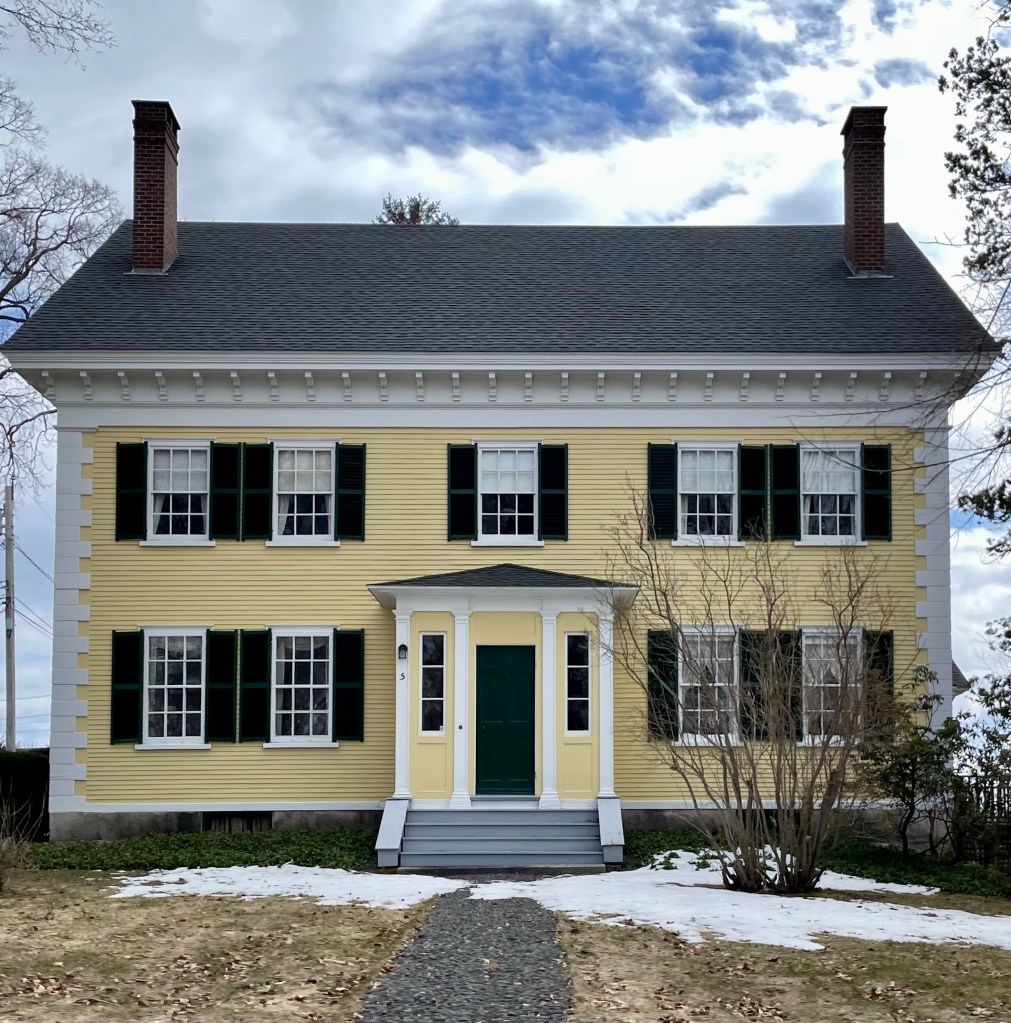
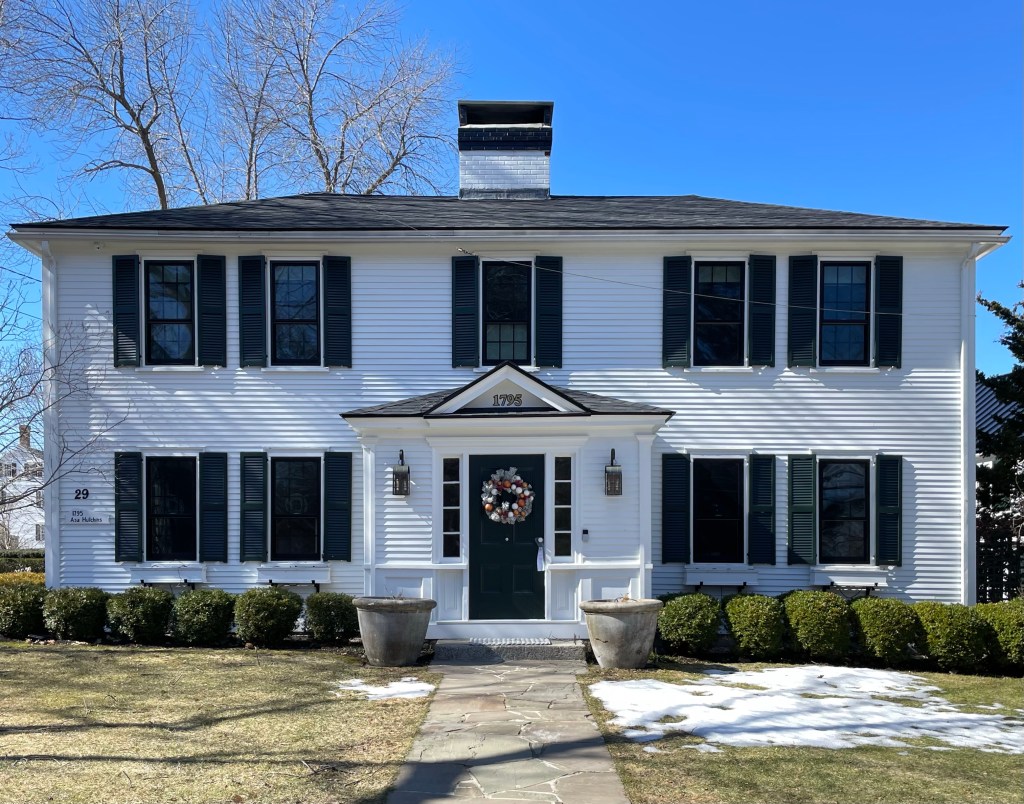
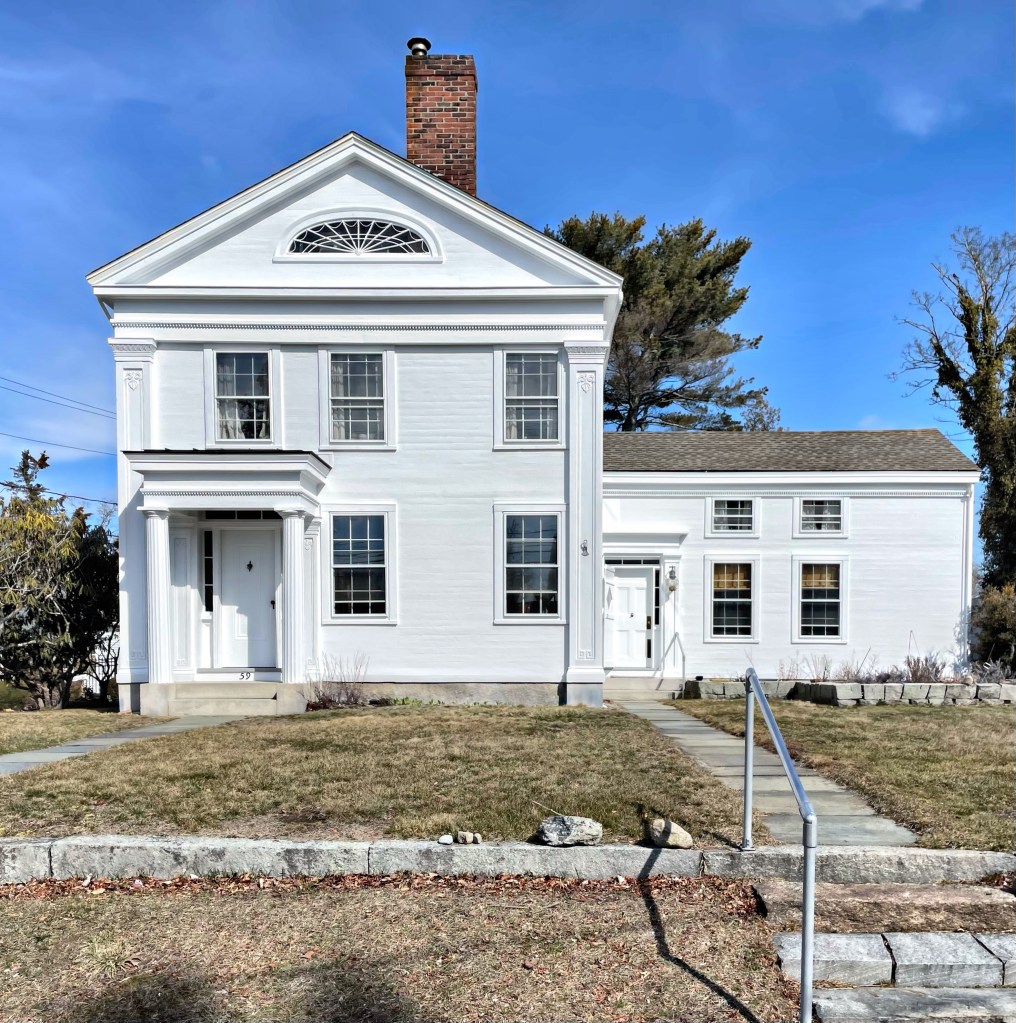
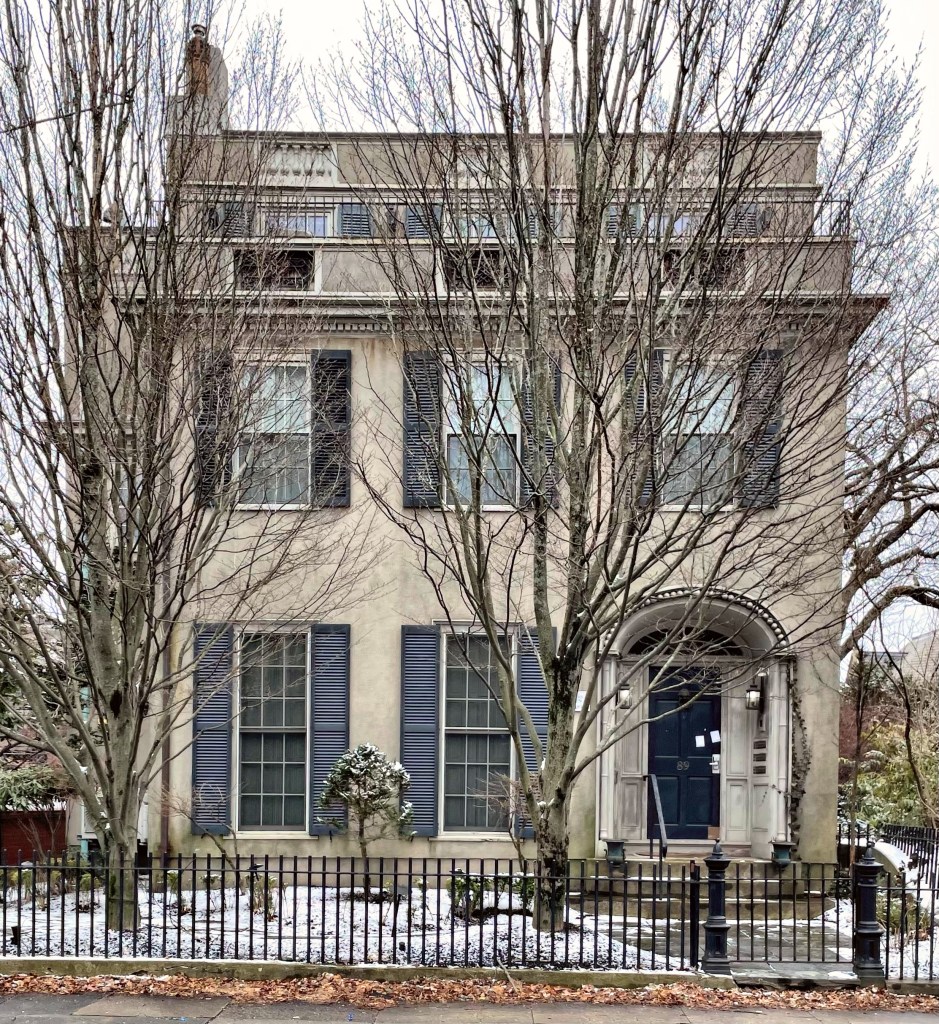
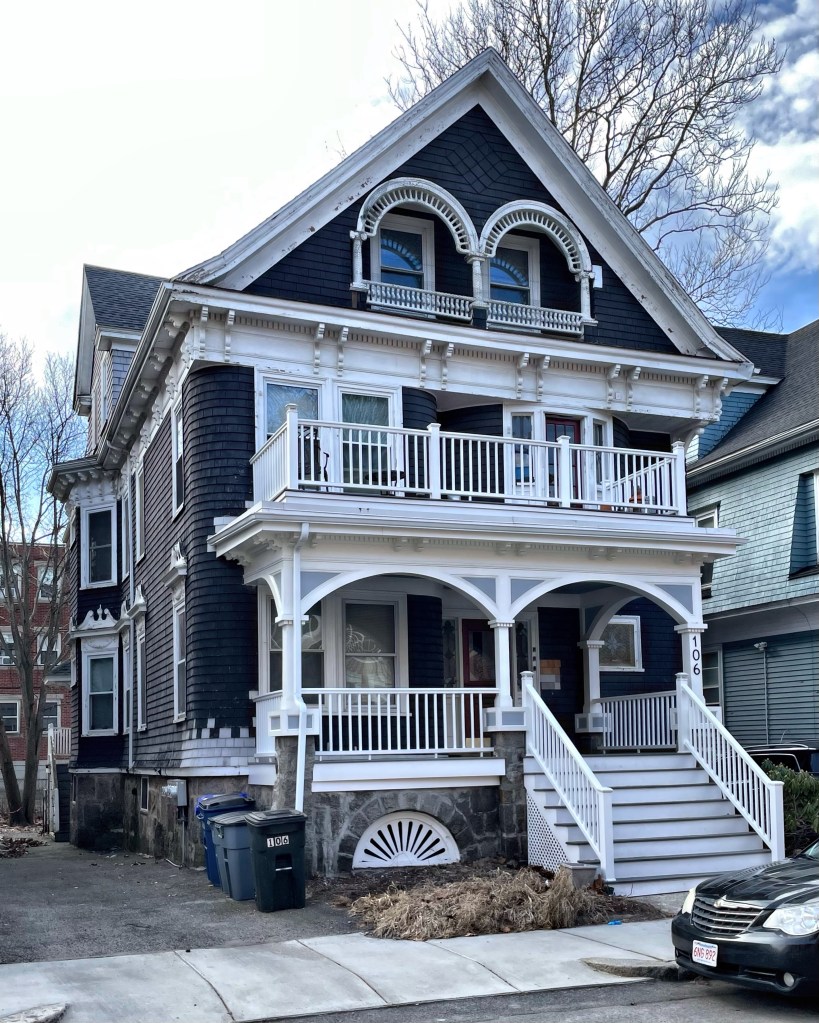
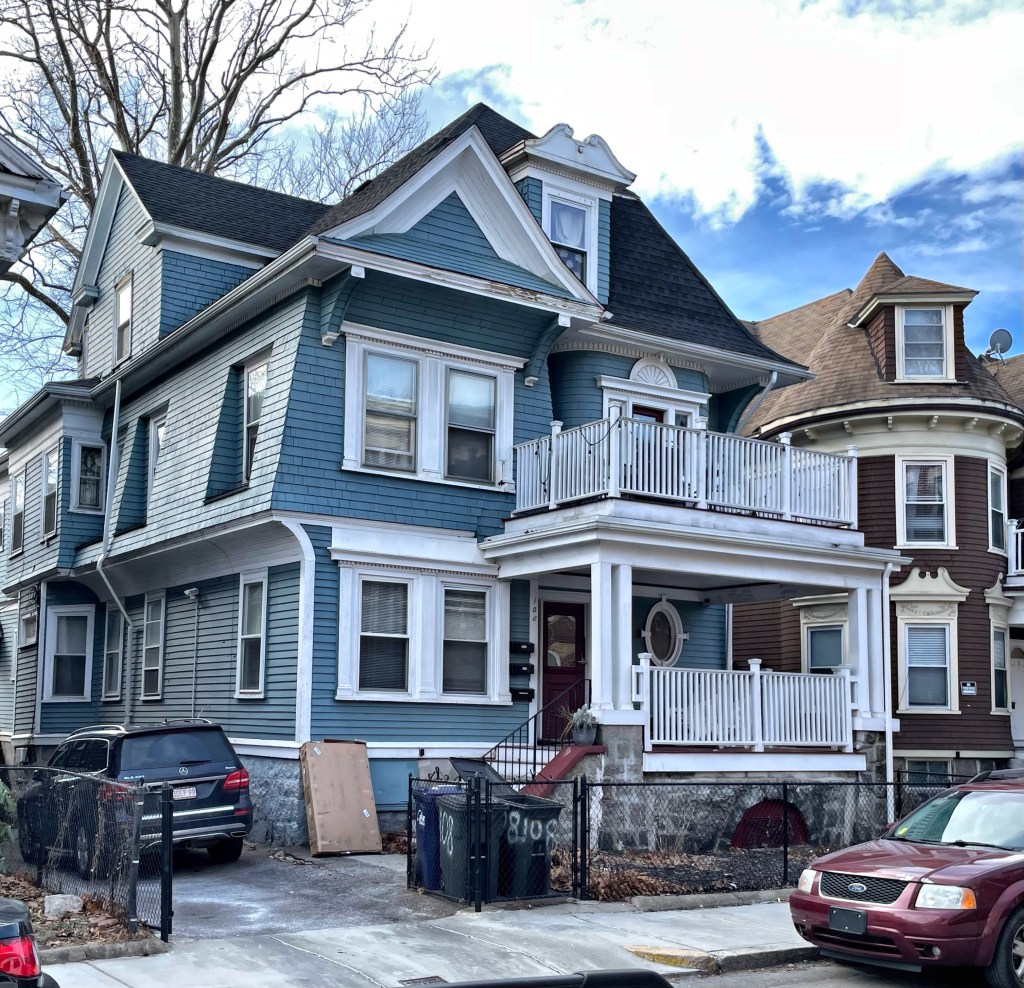
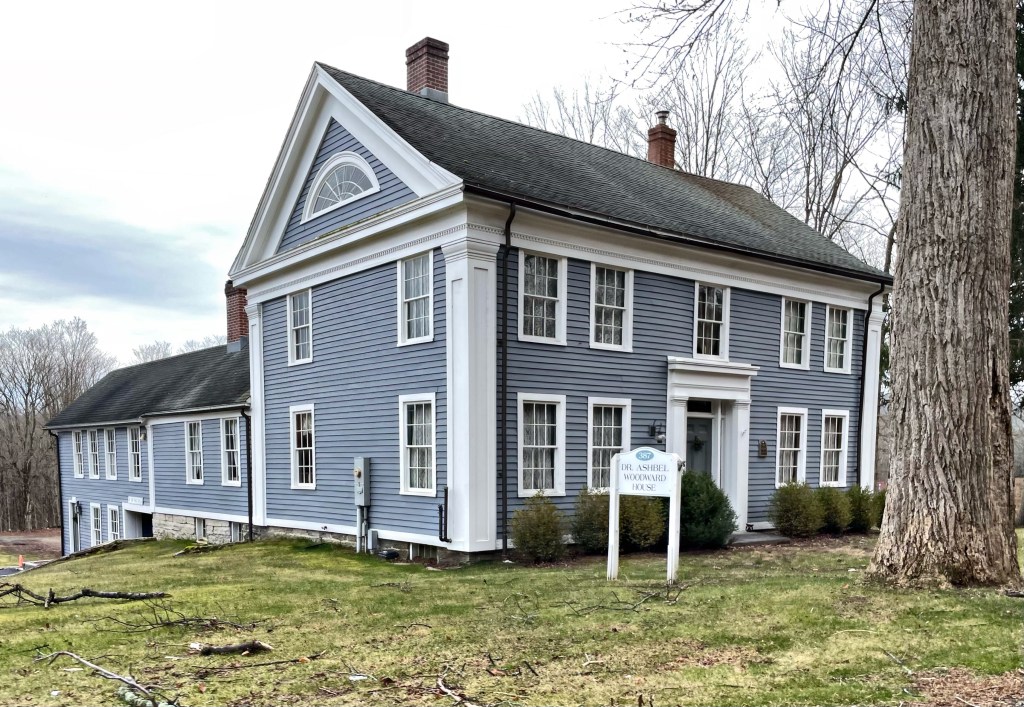
This stunning Greek Revival house in Dorset Village was built around 1850 and was long the home of Gilbert Mortier Sykes (1834-1920). Gilbert Sykes operated a general store in Dorset and held various public offices in town and later in the Vermont House of Representatives and Senate. The house has fully embellished entrance with paneled pilasters carrying an entablature and an amazing triangular window with diamond panes in the gable.
Sitting on the banks of Utley Brook, which meanders through the Clarksville village in Landgrove, Vermont, you will find this gorgeous Cape home in a perfect yellow color (seemingly to blend in with the turning leaves every Fall). The home dates to the early 19th century, possibly earlier, and was owned by the Harlow Family, who operated a saw mill across the street. The house was listed for sale in 2019 and is absolutely stunning inside and out!
One of the largest pre-Revolution houses in Barnstable is this stunning Georgian manse, known as the Crocker Tavern. The c.1754 home was built along Main Street in Barnstable Village by Cornelius Crocker (1704-1784), who operated it as a tavern along the Old King’s Highway, the main stagecoach route through Cape Cod. Cornelius died in 1784, and he left the eastern half of his house and land to his grandsons Robert, Uriah, and Joseph Crocker; the western half of land and house went to his daughter Lydia, widow of Captain Samuel Sturgis who died at 25, she never remarried. The house was “to be divided through by the middle of the great chimney“, a feature which was likely removed under separate ownership. Lydia eventually acquired the other half of the house, and continued operation of the tavern as her father did before her, though it was known as Aunt Lydia’s Tavern. The property was passed down through the family until 1925, when the property was left to the Society for the Preservation of New England Antiquities (later renamed Historic New England) as a historic house museum. The Georgian house and property were eventually de-accessioned by Historic New England and the tavern can be rented out on AirBnb!
In 1725, the second or eastern parish of Barnstable separated from the first (or west) and the congregation had a 25 year old pastor to lead them in Reverend Joseph Green. Joseph Green(e)(1701-1770) attended Harvard and trained in theology, graduating and accepting the call to lead a new congregation in Barnstable Village on Cape Cod. Green would must have had this house built around the time of his arrival, which was a modest, full-cape Georgian home. Reverend Green remained in his position until his death in 1770.
Waban Village in Newton, Massachusetts has dozens of amazing examples of early 20th century residential architecture, possibly the best collection in the Boston area! This Arts and Crafts style residence was built around 1908 for William and Delia Wilkinson the former of the two owned the William H. Wilkinson Company, which manufactured oiling devices and oil cups for steam engines. Delia, his wife, owned their family home under her name. The home is an excellent example of the Craftsman style, with stucco siding, thick rounded column supporting the inset porch, oh and that catslide roof!!
Benjamin H. Davidson, a wool merchant had this stunning property built in Waban for his family in 1897. Benjamin and his architect envisioned a large, Shingle style mansion, set back off the street. The house obviously exhibits shingle cladding along all surfaces including stone piers coming up from the ground at the porch, giving the house an organic feeling. The design also includes a large stairhall Palladian window, which is obscured from the street by a balustrade.
Reverend Abel Fiske (1752-1802) was born in Pepperell, Massachusetts and graduated from Harvard College in the class of 1774. Four years later in 1778, at 26 years old, he was ordained as the successor of Reverend Jonathan Livermore at Wilton, New Hampshire, where he remained until his death. During his time in Wilton, Rev. Fiske built this Federal style home for his family. The house is a short walk to the old church where he gave sermons to the growing rural community.
This beautiful farmhouse in Cavendish, Vermont is located along a winding dirt road and has ties to one of the town’s original family’s. A home was built here in 1785 and changed hands numerously over the first few decades of its existence. The farmhouse that was built also served as a tavern for travellers along the newly laid out Wethersfield Turnpike. It is possible that the cheap land and rural character of the new town was appealing to some, but reality away from true commerce may have made many sell the farm after a few years, which could explain why the property was bought and sold so often early on. The property was purchased by Jonathan Atherton, a Revolutionary War veteran, farmer, surveyor and lawyer, who acquired large landholdings in Cavendish. In 1821, Jonathan Atherton was sued in court by his neighbor, Jedediah Tuttle for beating Tuttle’s wife Lydia. In order to finance the bonds, Atherton mortgaged all his real estate in Cavendish to his brother Joseph, and Elihu Ives, Jonathan Atherton Jr.’s father-in-law. Atherton St. lost the case and had to pay a fine. The property was eventually inherited by Stedman Atherton, the youngest son of Jonathan, who seems to have demolished the old homestead and constructed the present home on the site. The original dwelling was also the childhood home of Henry B. Atherton, a staunch abolitionist and soldier in the American Civil War, who later served as a lawyer and state legislator for New Hampshire, and his sister Eliza (Atherton) Aiken, a Civil War nurse who has been referred to as America’s own “Florence Nightingale”. The old Atherton farmstead was recently renovated.
What a treat it was to stumble upon one of the most beautiful homes in Vermont, and all the best houses have names! Glimmerstone is located in the small town of Cavendish, and is possibly the finest Snecked Ashlar constructed home in the state. The house was built in 1845 for Henry Fullerton, manager of the Black River Manufacturing and Canal Company mill in Cavendish. The stone used to build the house was quarried less than a mile away, and hauled to the site. The construction style consists of stone facing on either side of rubble fill, with slabs and snecks sometimes laid across the fill to provide strength, a method brought to the region by Scottish immigrant masons. The house’s design is by a local carpenter, Lucius Paige, and is based on designs published by Andrew Jackson Downing, who depicted many Gothic style designs in pattern books which were built all over the country. The house has had a number of owners after Mr. Fullerton died. During the prohibition era, Art Hadley, who would later become extremely wealthy as the inventor of the expansion bracelet, used the home as part of a rum running operation. Glimmerstone was purchased in 2010 by the current owners, who underwent a massive restoration of the home, converting it into a bed and breakfast, allowing the public to experience the property as well.
Located next to the Reverend Thomas Hawley House (last post), this gingerbread cottage on Ridgefield’s Main Street looks straight out of a fairy tale! The home appears to have been built around the Civil War (or a renovation of an earlier house) and blends Italianate and Gothic detailing elegantly under one roof. The home was built on land that was owned by the Hawley descendants and was occupied by a few members of the family until it sold out of Hawley ownership in the 20th century. The house was purchased in 2002 by Gregory and Valerie Jensen who restored the home. Mrs. Jensen is the founder of the Prospector Theatre, a non-profit cinema dedicated to providing a higher quality of life through meaningful employment to people with disabilities.
Built in 1850, likely as a late-Greek Revival or Italianate style home, this property on Main Street in Ridgefield was completely “modernized” in the 1880s in the Queen Anne style popular at the time. The home was originally built for Francis Asbury Rockwell (1818-1881), a tin-smith, wine-maker and inventor who married Mary Lee Everest, who also had deep roots in the community and was a daughter of a local Revolutionary War captain. The couple built a home on Main Street and raised their children there until Francis and Mary died in 1881 and 1883 respectively. The family home was inherited by their eldest son, Charles Lee Rockwell, who became the director of the First National Bank in town. Charles updated the house to give it the Queen Anne Victorian flair we see today.
After the American Revolution, Lt. Joshua King settled in Ridgefield and built the King Mansion in 1801, a Federal style home that commanded the Main Street lot. King was born in Bridgewater, Massachusetts and fought in the Revolutionary War near the border of Connecticut and New York. After the war, he settled in Ridgefield and married one of the most eligible bachelorettes in town Anne Ingersoll. Anne was the daughter of the Rev. Jonathan Ingersoll, pastor of the Congregational Church of Ridgefield. After a long life running a store and raising a family, Joshua died in 1839, a year after his wife. The mansion was inherited by their son Joshua Jr. until his death in 1887. In 1889, a fire destroyed much of the house. When it burned down, The New York Times described it as “the grandest old mansion in the village.” It was quickly replaced by the current house, modeled after the original but larger, which was placed much farther back from the road in the Colonial Revival style. Fire damaged the house again in the 1990s, and the present structure was restored and enlarged from 2002-2004, its HUGE!
William Wanton Dunnell (1850-1933) was born in Pawtucket, Rhode Island and was educated in Rhode Island schools. He eventually helped run his family’s cotton goods business, which grew over the next decades. The Dunnell Finishing Works factory was a success in Apponaug (Warwick) Rhode Island, and he had over 500 employees turning out over 1,000,000 yards of printed cloth a week! Before all this, William had this amazing house built in College Hill, Providence for his family. The local architectural firm of Stone, Carpenter & Willson was hired and blended Shingle, Queen Anne, and Colonial Revival styles elegantly under one roof. I am particularly fond of the sawtooth shingles, Palladian motif windows in the gable, and undulating facade. The house is owned today by RISD.
When visiting Downtown Providence, I couldn’t help myself but to cross the river into College Hill, a neighborhood of such architectural diversity I could run this entire page just featuring that area. This beautiful Federal style home was built onto the downward slope of the hill in 1798 for William Holroyd, a merchant and active Baptist in town. The home sits atop a raised basement with brick end walls and clapboard siding on the front and rear. The property exhibits a symmetrical facade, splayed lintels above the windows, and a perfect center entry with fluted pilasters and pediment containing a fanlight. The building today appears to be a part of the Brown-RISD Hillel.