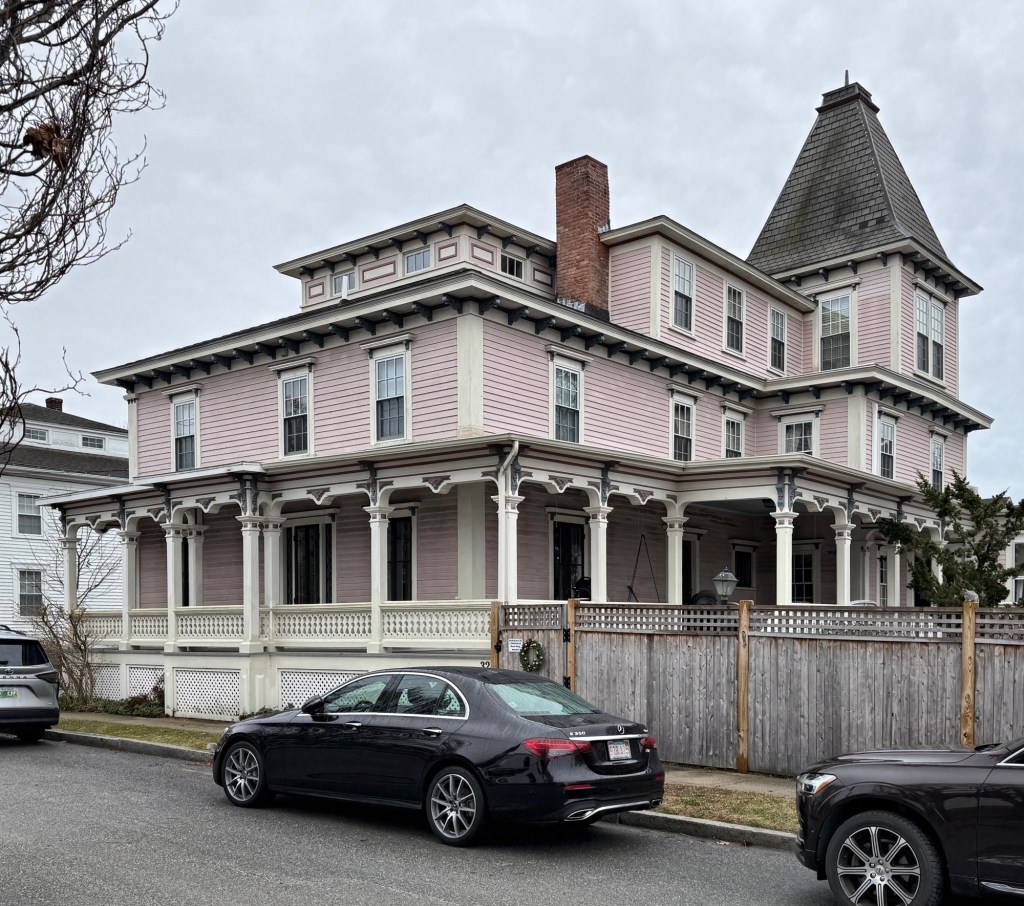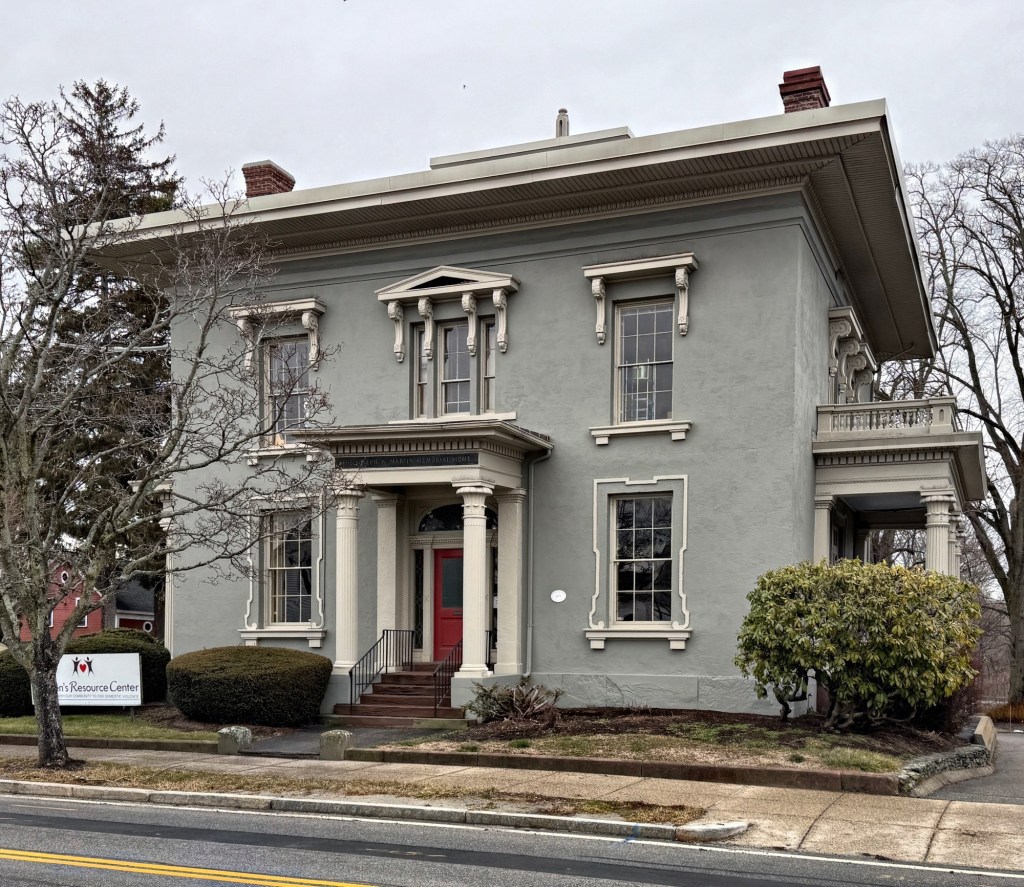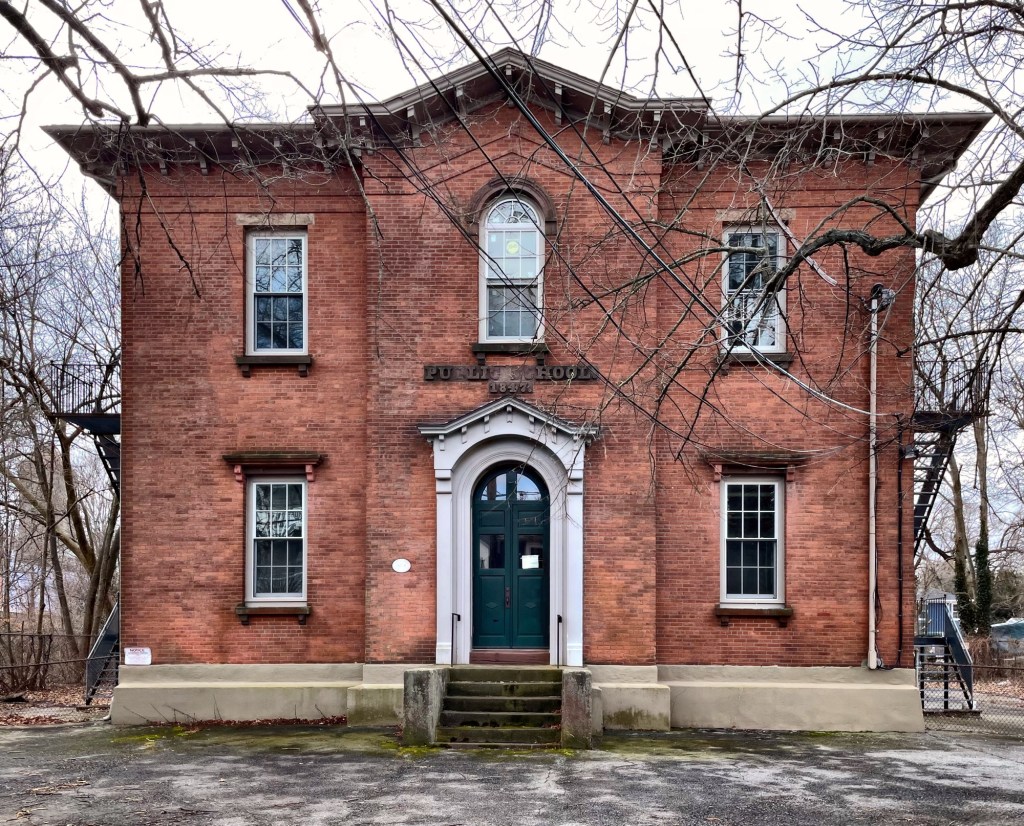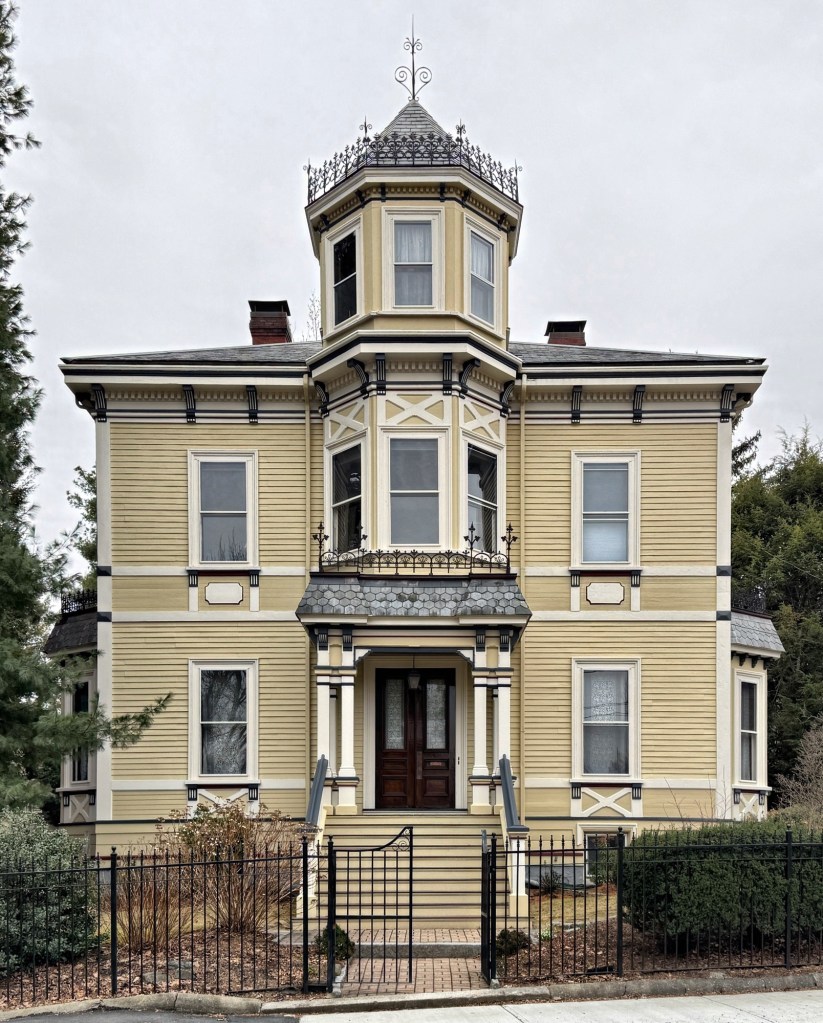
George Risley House // c.1870

This unique residence in Wayland, Massachusetts, is tucked away on Corman’s Lane, a dead-end street near Snake Brook, a small stream leading into Lake Cochituate. The house was built around 1870 for George William Risley (1836-1913), a shoe manufacturer and Civil War veteran who settled in Cochituate Village and ran a factory there. Risley was active in town affairs and served as Selectman in 1872, the year in which the annual meeting authorized the selectmen to petition the General Court for Cochituate to separate from Wayland. The petition was ultimately never was filed and Cochituate remains a part of Wayland. The Risley House has five bays and a shallow side gable roof with broad, overhanging eaves supported by brackets. A central porch runs along part of the facade and has intricate turned posts and spindlework. The home remains in great shape and is evocative of mid-late 19th century industrial housing built for factory managers.

Robbins & Marsh Store // c.1858

Located in the Chester Depot Village, a commercial and civic assortment of buildings constructed in the mid-19th century between the often feuding North and South villages in Chester, Vermont, this handsome commercial building contributes to the character and history of the once thriving commercial center of town. Built across the tracks of the Central Vermont Railroad from the town’s depot, this Italianate style building dates to about 1858 when a P. H. Robbins opened an all-in-one store, selling everything from groceries to hardware and building products. Mr. Marsh was later joined by Frederick W. Marsh, who entered into the business, then named the Robbins & Marsh Store. The business thrived with the close proximity to the railroad depot with later alterations to the building including the addition of plate glass storefronts and a massive side awning porch. Business slowed after WWII, as rail service slowed and ultimately stopped in town. Today, the handsome building remains as an important visual anchor to the depot village. 

Chester Academy – Chester Historical Society // 1884

The town of Chester, Vermont, is one of the best small towns in the state for architecture lovers! Don’t believe me? I will prove it in this upcoming series. Located in Chester Village, the town’s center, this handsome brick building set off the main street, was built in 1884 as the town’s high school, replacing an 1814 private academy formerly on the site. The private academy closed in 1881, and the building was sold to the town, who by 1884, demolished the original structure and erected the current Italianate style building. The building served as the town high school until 1911, when a new high school was constructed nearby. The elementary and junior high school operated from here until the 1950s, when a modern school was constructed in town. Since 1950, the former academy building has been used by the Chester Art Guild, and currently is leased from the Town by the Chester Historical Society. The structure retains its architectural character down to the segmental arched windows and cupola.

Tully Bowen House // 1853

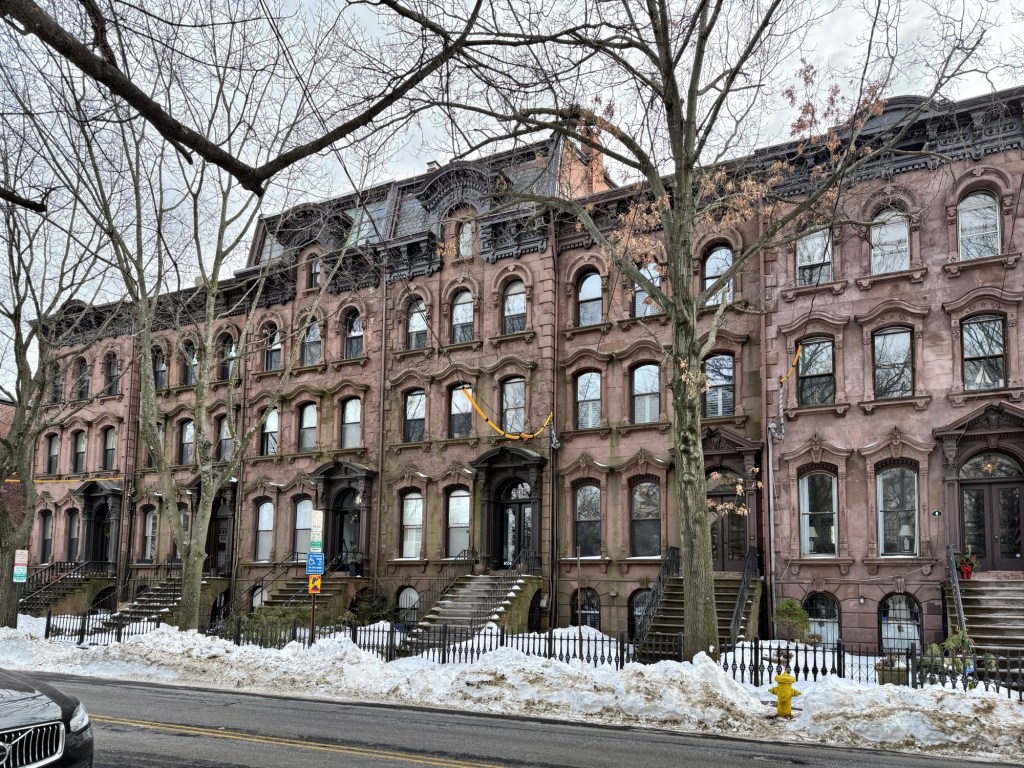
Designed by great architect, Thomas Tefft, this three-bay, three-story brownstone house located at 389 Benefit Street in Providence, was built for Tully D. Bowen, a cotton manufacturer. The house, one of the finest Italianate style mansions in the state, is constructed of brownstone and features a recessed arched entrance surrounded by a flat-headed Doric-pilastered frame, pedimented first-floor windows resting on brackets with the alternation of flat and pedimented heads at the second story, and quoining at the corners. The property also retains its original Tefft-designed brick and brownstone carriage house. Thomas Tefft, who was just 27 at the time of designing this house and corresponding brownstone and iron gate, would become one of America’s finest architects before he died in Florence with a fever in 1859 at just 33 years old. The residence was converted to 12 apartments in 1941 and the carriage house was converted to residential use as well. Even with the subdividing the interior spaces of the residence and carriage house, the Bowen property remains in a great state of preservation and is one of the finest homes in Providence.

Henry Block // 1873

Mid-late 19th century commercial blocks provide human-scaled density, high quality design, and often contain intimate storefronts providing reasonable rent to local businesses. The Henry Block in Westborough, Massachusetts, is one great example of a historic commercial building that checks all of these boxes. The brick building was constructed in 1873 by its namesake, Samuel Gates Henry (1813-1877), a pharmacist and dentist who rented space in an earlier building on the site. When a fire destroyed the old structure, Samuel Henry had this block erected on the site and leased out spaces in the building to other businesses and tenants in the floors above. The block is Italianate/Italian Renaissance Revival in style with the typical round arched windows and bracketed cornice. The granite storefronts even retain some of the original cast-iron supports.

Zenas Lane House // c.1860

The Zenas Lane House on Union Street in Rockland, Massachusetts, was built circa 1860 for its namesake, a shoe manufacturer who later engaged in real estate and local politics. Zenas Meriet Lane married Emeline Morse and had this handsome Italianate style residence built on the town’s main street. The two-story house is capped with a shallow hip roof with eyebrow window heads breaking the eaves. At the rear of the site, there is a preserved carriage house which echoes design details from the main structure.

Arnold Shoe Factory // 1875

Moses Noyes Arnold (1844-1919) was born in Abington, Massachusetts and began making shoes in his free time, a task that would make him his fortune later as an adult. After serving in the Civil War and mustering out in 1863, he began a shoe-making business from his father’s property before renting a small factory space in town to increase operations. His company continued to grow and it was decided that Arnold would build his own factory in town. In 1875, Moses N. Arnold began the building of the main wing of the present brick shoe factory near the railroad station in North Abington. As the M. N. Arnold Shoe Company grew, five additions were made until it attained its present capacity of 3,000 pairs of shoes daily. The company weathered the collapse of the stock market in 1929 but the economic instability took its toll on the company, leading the company to sell in 1931 to the Stetson Shoe Company of South Weymouth. This factory was sold at auction and later in 1943, was purchased by The Abington Company which manufactured, installed, and serviced vacuum cleaning systems for textile factories. The handsome brick, Italianate style factory remains in a great state of preservation, and showcases the type of factories built all over New England following the Civil War. 

George Washington Smith House // c.1886

This house on Westminster Road in Canterbury, Connecticut, is architecturally distinguished by its extensive and imaginative detailing, which reflects the widespread availability of manufactured architectural ornament in the Victorian period. The porch columns, archways, bay window, and round-arched windows all reflect an Italianate influence and the work of its original owner, Mr. George Washington Smith (1857-1937). The house dates to about 1886 when George W. Smith, built it from his workshop formerly located across the street. Smith manufactured mast-hoops, the wooden fixtures for attaching sails to the masts of sailing ships, and utilized his woodworking skills to build and decorate the exterior of his family home.


Nathan S. Horton House // c.1860

This modest, Italianate style house was built around 1860 by a carpenter and builder as his own residence. Nathan S. Horton (1819-1916) was a busy builder in Central Falls, Rhode Island in the mid-late 19th century as the population boomed along with the industrial growth and wealth that the city saw. For his own residence, Horton built this two-story wood-frame house with side entrances and porches, paired brackets in the eaves, and arched top windows, all commonly found in the Italianate style, popular around the time of the Civil War. Mr. Horton lived to his late 90s and likely remained in this home until his death.

Former Broad Street School // 1861

The oldest extant school building in present-day Central Falls, Rhode Island, is this brick schoolhouse, constructed in 1861, to serve as the main village school. The rather plain two-story brick building was built just before the Civil War, during a period of rapid industrialization and growth in Central Falls, when it was then the dense core of the town of Smithfield, Rhode Island. The building contained classrooms for pupils from elementary through high school. Italianate in style, the rather unadorned building does feature oversized windows with some containing rounded tops, deep eaves, and a subtle recessed arch in the central bay on the facade. The school has been vacated for some time, and in 2024, plans materialized to convert this building into affordable housing. Hopefully the renovation/restoration is thoughtful for such a significant piece of the city’s history.