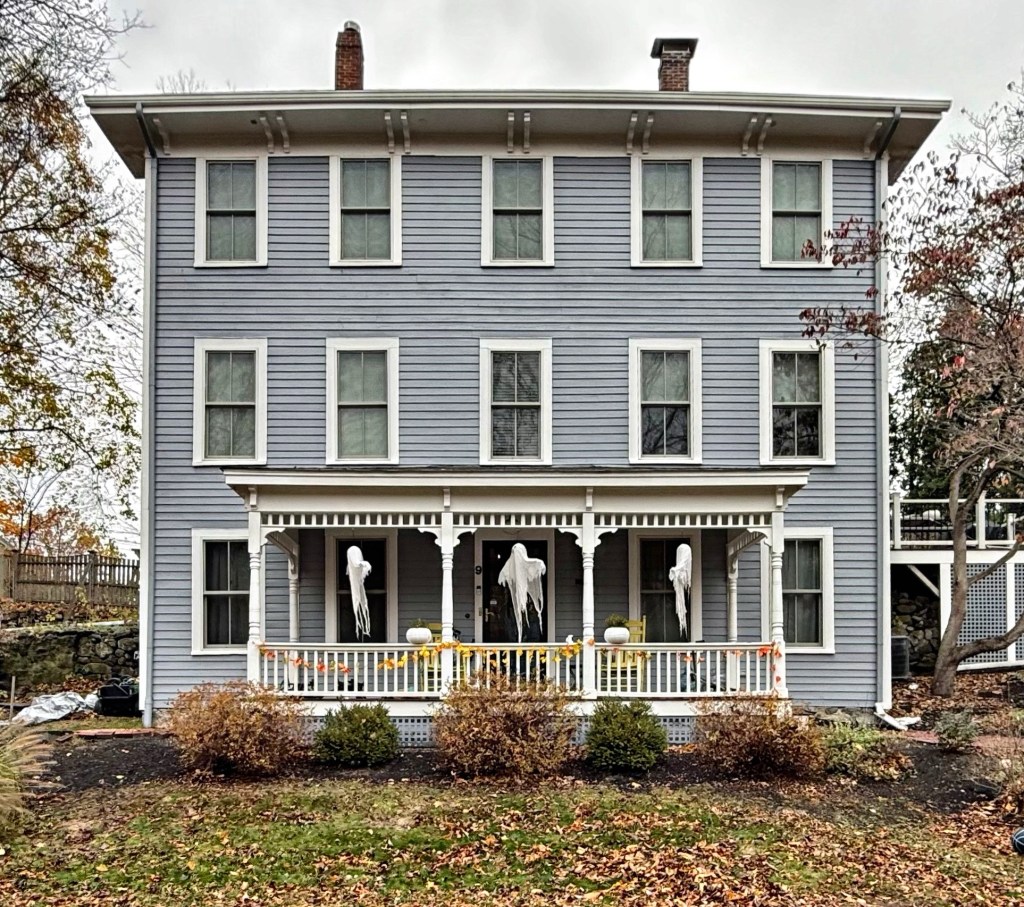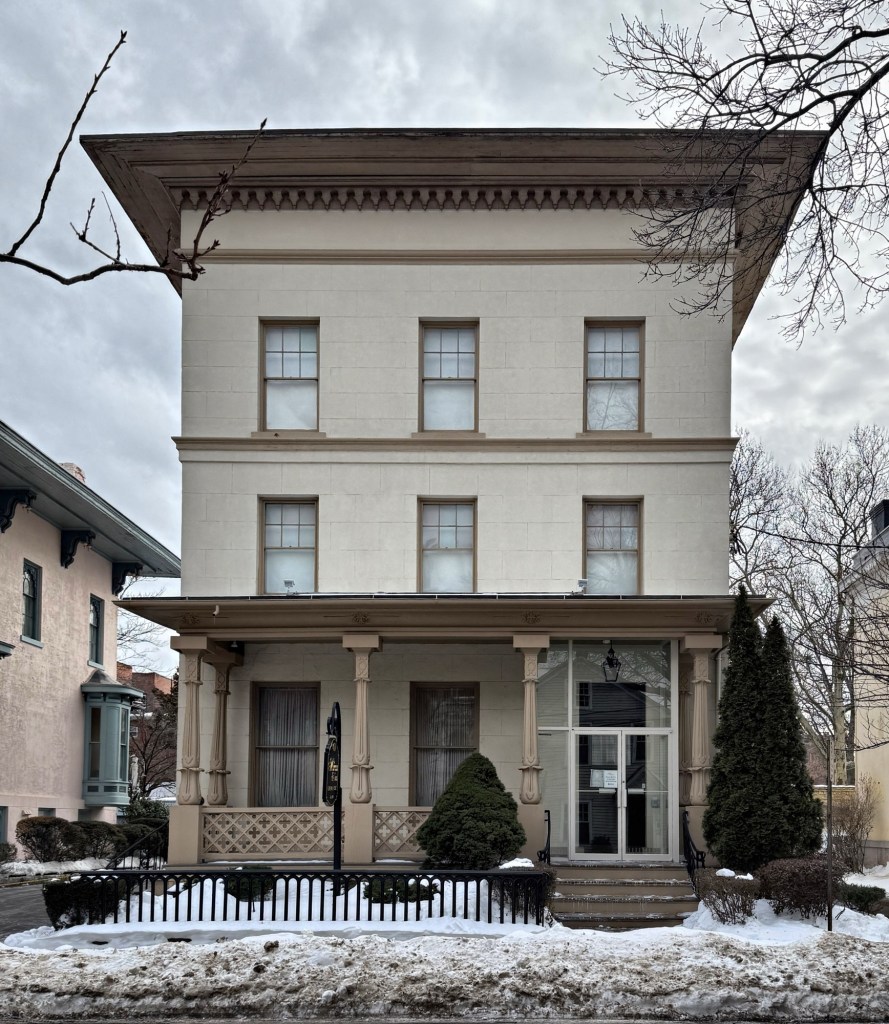
George Risley House // c.1870

This unique residence in Wayland, Massachusetts, is tucked away on Corman’s Lane, a dead-end street near Snake Brook, a small stream leading into Lake Cochituate. The house was built around 1870 for George William Risley (1836-1913), a shoe manufacturer and Civil War veteran who settled in Cochituate Village and ran a factory there. Risley was active in town affairs and served as Selectman in 1872, the year in which the annual meeting authorized the selectmen to petition the General Court for Cochituate to separate from Wayland. The petition was ultimately never was filed and Cochituate remains a part of Wayland. The Risley House has five bays and a shallow side gable roof with broad, overhanging eaves supported by brackets. A central porch runs along part of the facade and has intricate turned posts and spindlework. The home remains in great shape and is evocative of mid-late 19th century industrial housing built for factory managers.

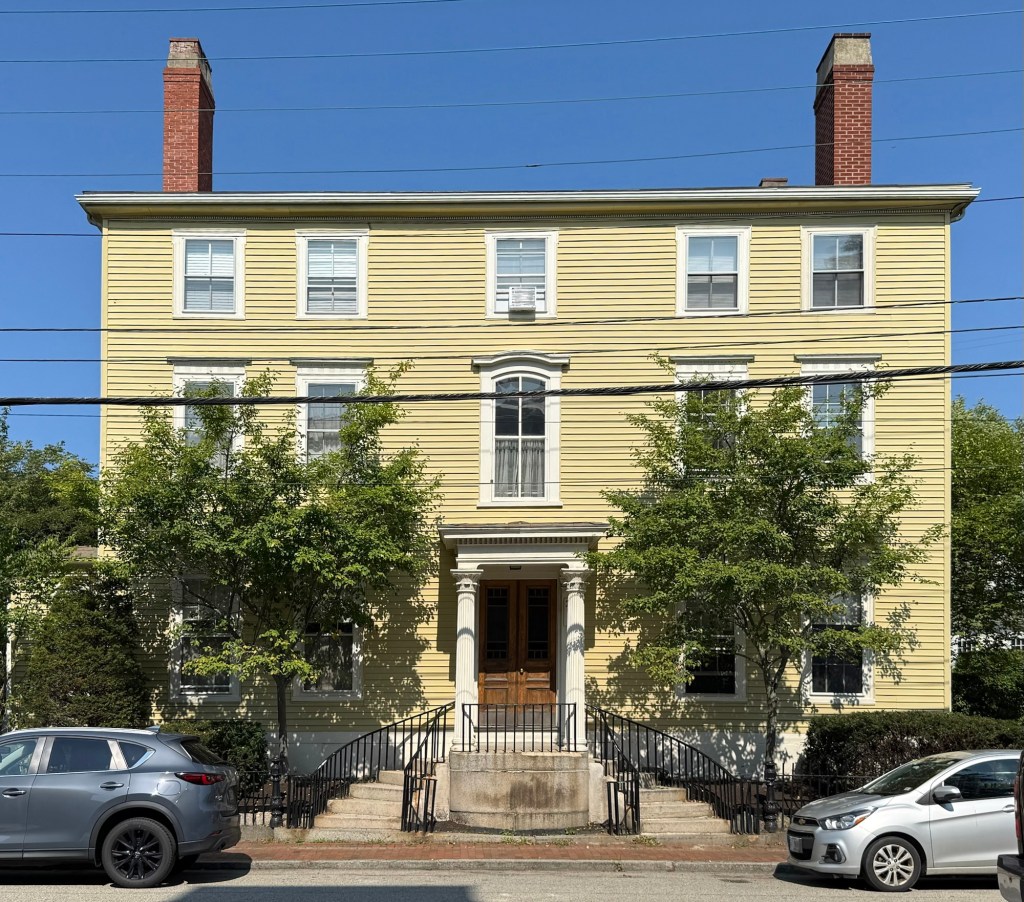
William Haven House // c.1807

William Haven (1770-1856) was the youngest son of Reverend Samuel Haven (1727-1806), the Pastor of South Church, and Mehitable Appleton Haven, daughter of Rev. Nathaniel Appleton. William was a merchant that traveled extensively with his brothers, who employed him as their accountant, later working as a cashier of the New Hampshire Bank in Portsmouth, and later an accountant for the Portsmouth Savings Bank. William married Sophia Henderson in 1807, and soon-after, had this large residence on Middle Street built for his new family. By the 1870s, the residence was owned by William H. Hackett, who likely modernized the home with the Italianate style stair-hall window on the second floor, and portico and entry. 

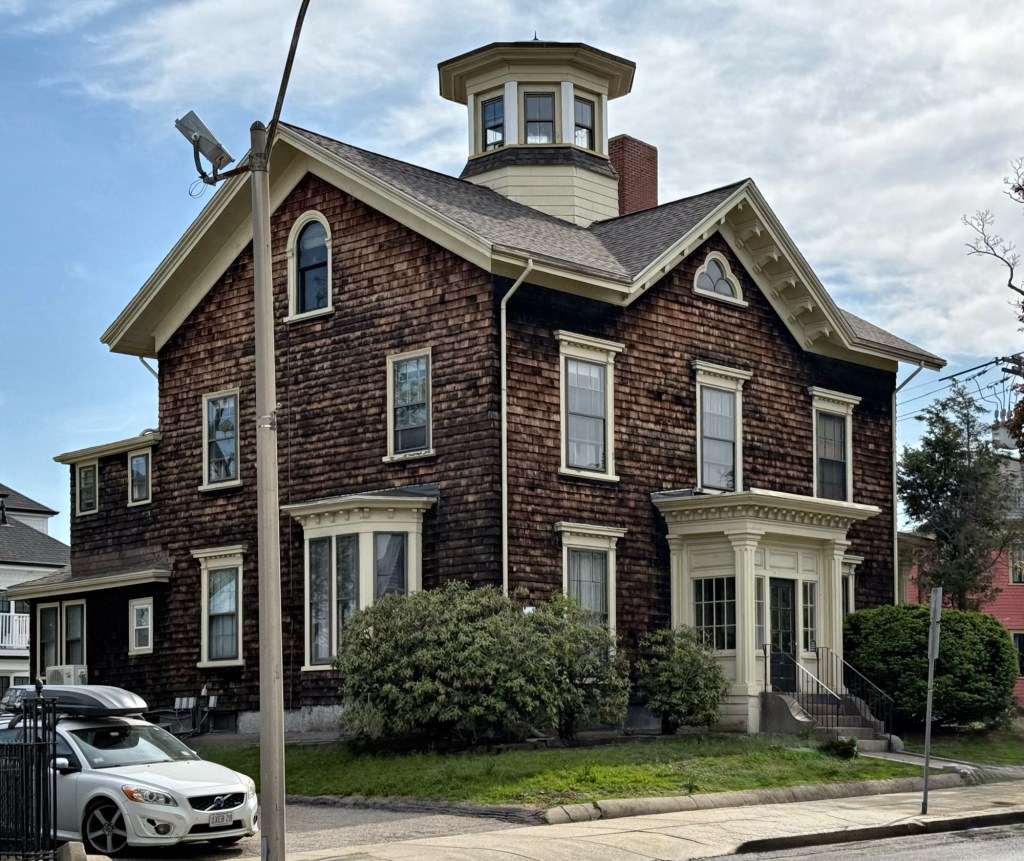
Samuel & Susan Gaut House // c.1855

Built in the 1850s, the Samuel and Susan Gaut House on Highland Avenue in Somerville, Massachusetts, is one of the finest examples of a symmetrical, three-bay, Italianate style house in the city. Samuel Norton Gaut (1816-1891) worked as a baker with shops in downtown Boston, and married Susan Dutton (1824-1892), the daughter of a wealthy shipbuilder in Newburyport. The Gaut House was listed on the National Register of Historic Places for its architectural significance as an intact example of a gabled Italianate style home. Special details include the brackets in the gable, trefoil window in the peak, and the octagonal cupola at the roof. Early 20th century alterations include the shingle siding, replacement windows, and enclosed portico, but neither truly detract from the beautiful home.

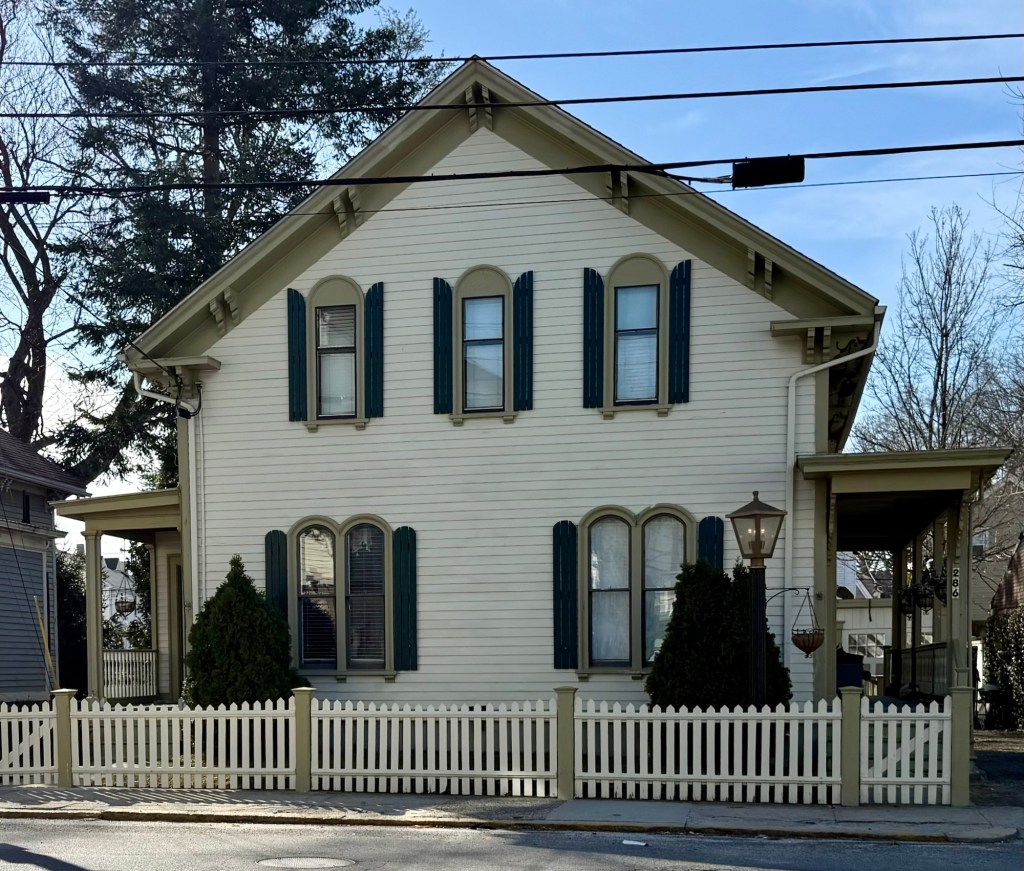
Nathan S. Horton House // c.1860

This modest, Italianate style house was built around 1860 by a carpenter and builder as his own residence. Nathan S. Horton (1819-1916) was a busy builder in Central Falls, Rhode Island in the mid-late 19th century as the population boomed along with the industrial growth and wealth that the city saw. For his own residence, Horton built this two-story wood-frame house with side entrances and porches, paired brackets in the eaves, and arched top windows, all commonly found in the Italianate style, popular around the time of the Civil War. Mr. Horton lived to his late 90s and likely remained in this home until his death.

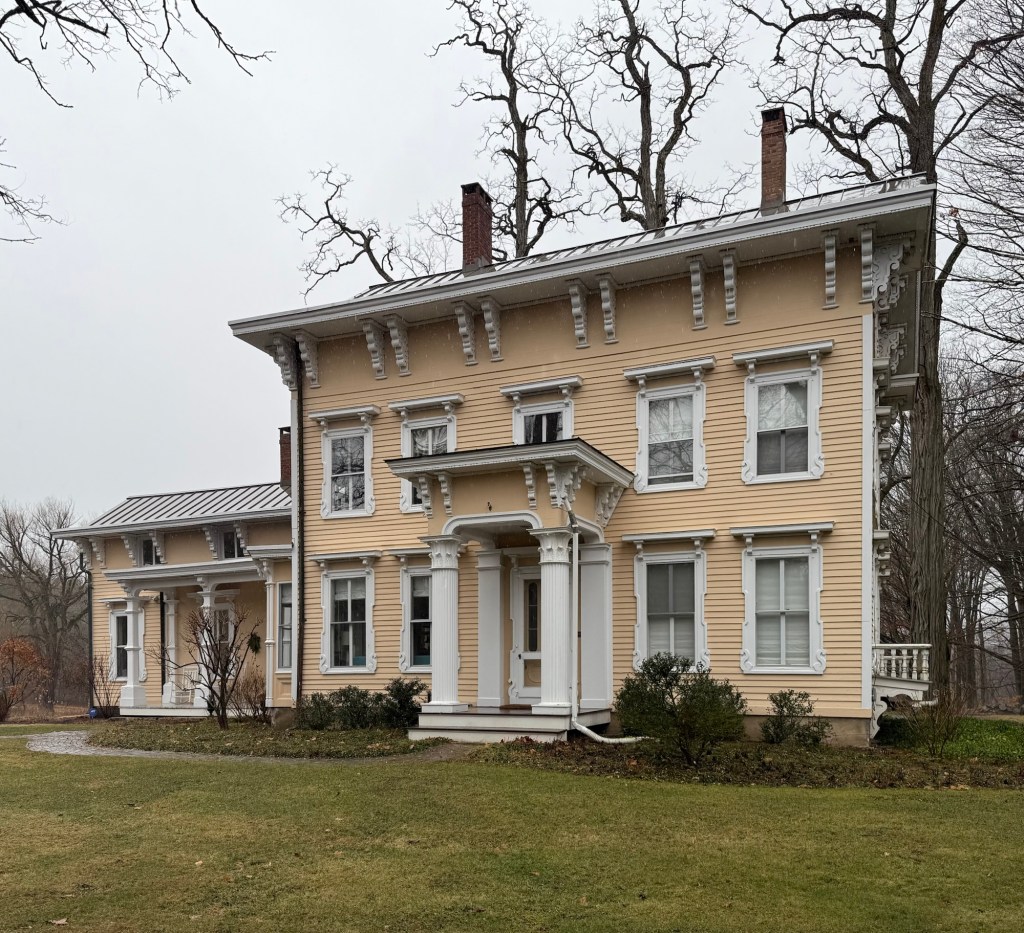
General John Sedgwick House // 1860

The Major General John Sedgwick House is located in Cornwall Hollow, Connecticut, and stands out as one of the finest residences in this part of the state in a rural setting. The house was built by 1860 for General John Sedgwick (1813-1864), who was born in a house standing on this site, which had been built by his grandfather, a veteran of the Revolutionary War. In 1859, the Sedgwick family homestead burned to the ground. Sedgwick, then already well established in his military career, took leave to oversee construction of its replacement. This house was built, apparently on the foundation of the old house, in 1859–60. The work was done by Cyrus Marsh, a local builder, in the Italianate style with decorative brackets, window mouldings, hoods, and a large columned entry portico. Major General Sedgwick was active in many campaigns, and during the American Civil War, he was killed by a sharpshooter at the 1864 Battle of Spotsylvania Court House, he was the Union Army’s highest-ranking casualty of the war and never got to reside in his Cornwall home.

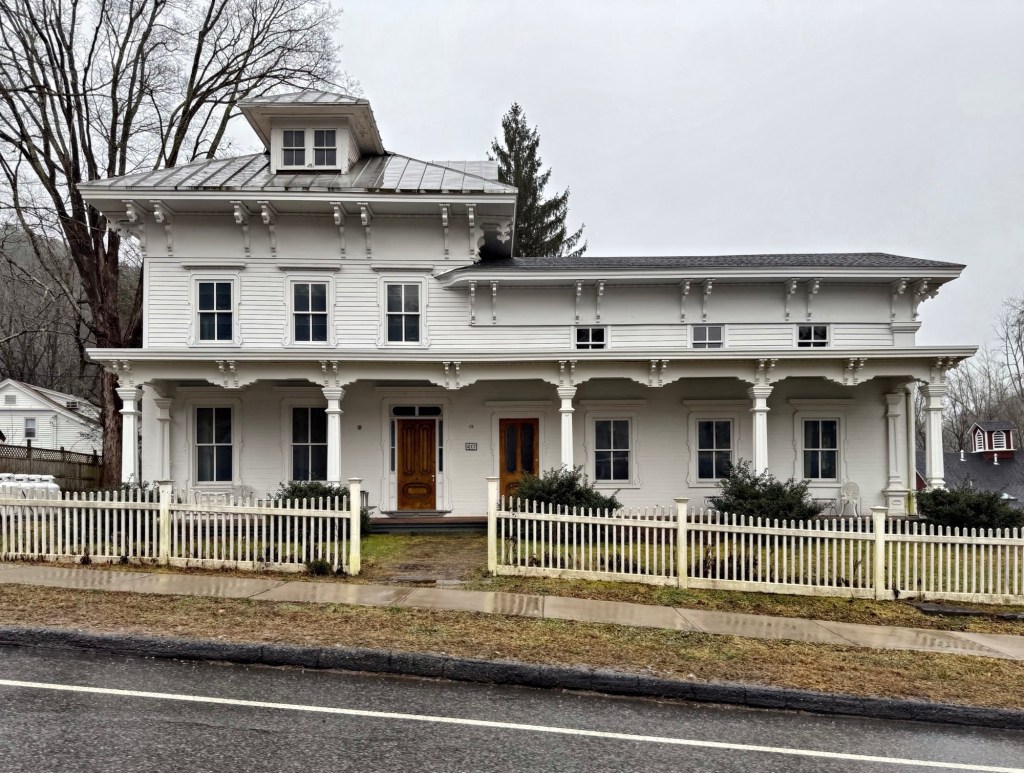
Foster Mansion // c.1860

This large, Italianate style mansion is located at 417 Sharon-Goshen Turnpike, the main street through West Cornwall Village, Connecticut. The house was built around 1860 for Stephen Foster (c.1816-1863) a merchant and railroad contractor who had constructed a portion of the Housatonic Line railroad near West Cornwall. He and his wife, Helen, previously lived in a Greek Revival style house across the road until they moved into this stately residence. Mr. Foster would not get to enjoy his mansion long as he died in 1863. Helen Foster remained at the home until her death in 1875. The high-style Italianate residence was likely built by master-carpenter C. W. Marsh, and features all the hallmarks of the style: overhanging eaves with decorative brackets, elaborate window and door moulding, two-over-two windows, and a shallow hipped roof with dormer.

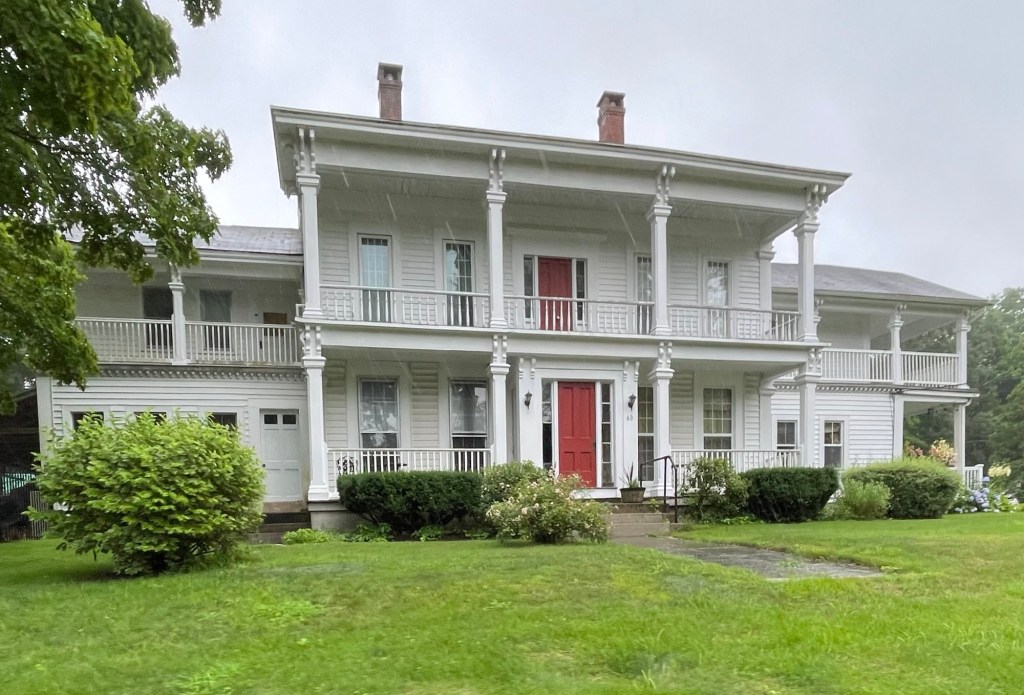
Harris Sayles House // c.1860

This handsome Italianate style house is located on Dog Hill Road in Killingly Center, Connecticut. The house appears to date to the years just before the Civil War and historic maps show that the property was owned by Harris Sayles, a co-owner of the large woolen mill in nearby Dayville. The home was built for Harris and his wife, Phebe. The house stands out for its two-tiered gallery of porches with large chamfered posts and paired brackets and has some Classical corner pilasters and door surrounds noting the transitional period from Classical Greek Revival style to the romantic Italianate style.

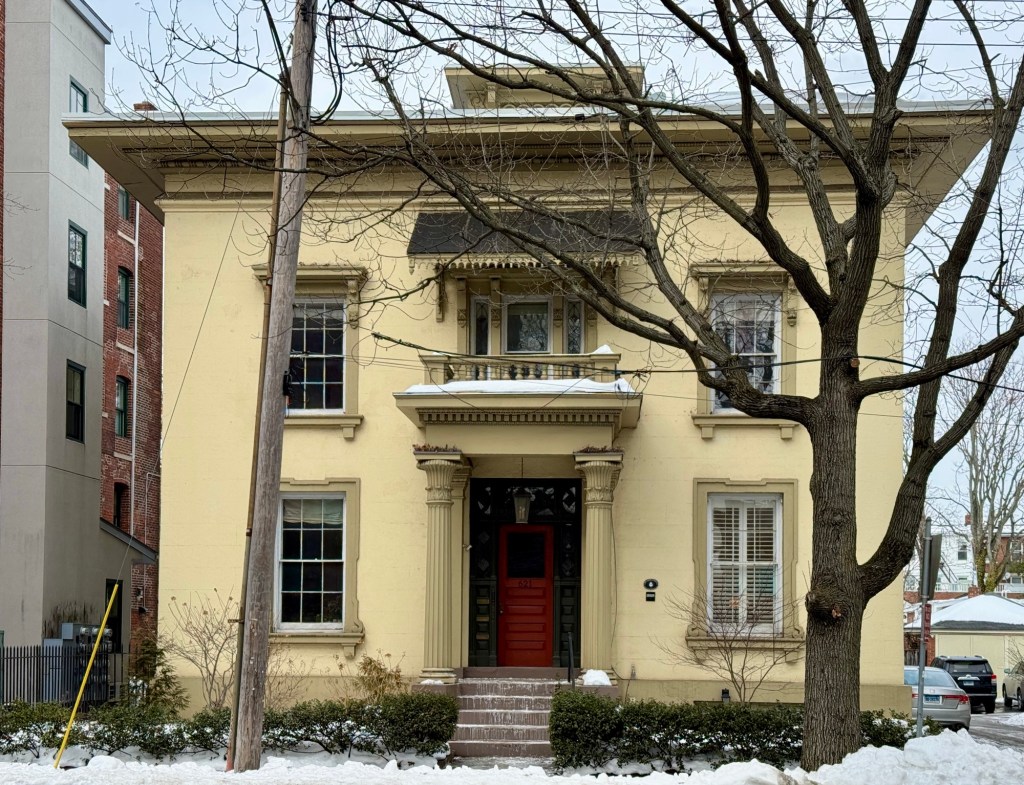
Warren Potter Mansion // 1865

In 1865, Warren Potter, a Rhode Island-based manufacturer, built this Italianate style mansion in the Dayville section of Killingly, Connecticut for his family. Potter was employed at the Sayles Woolen Mill in a manager role and clearly did well for himself to afford such a home. Characteristic of the style, the Potter mansion features bracketed eaves and window lintels and round-arched tripartite windows over the center entrance. At the entry, the original round-arched doorway with glazed surround has survived in good condition and is a showstopper!