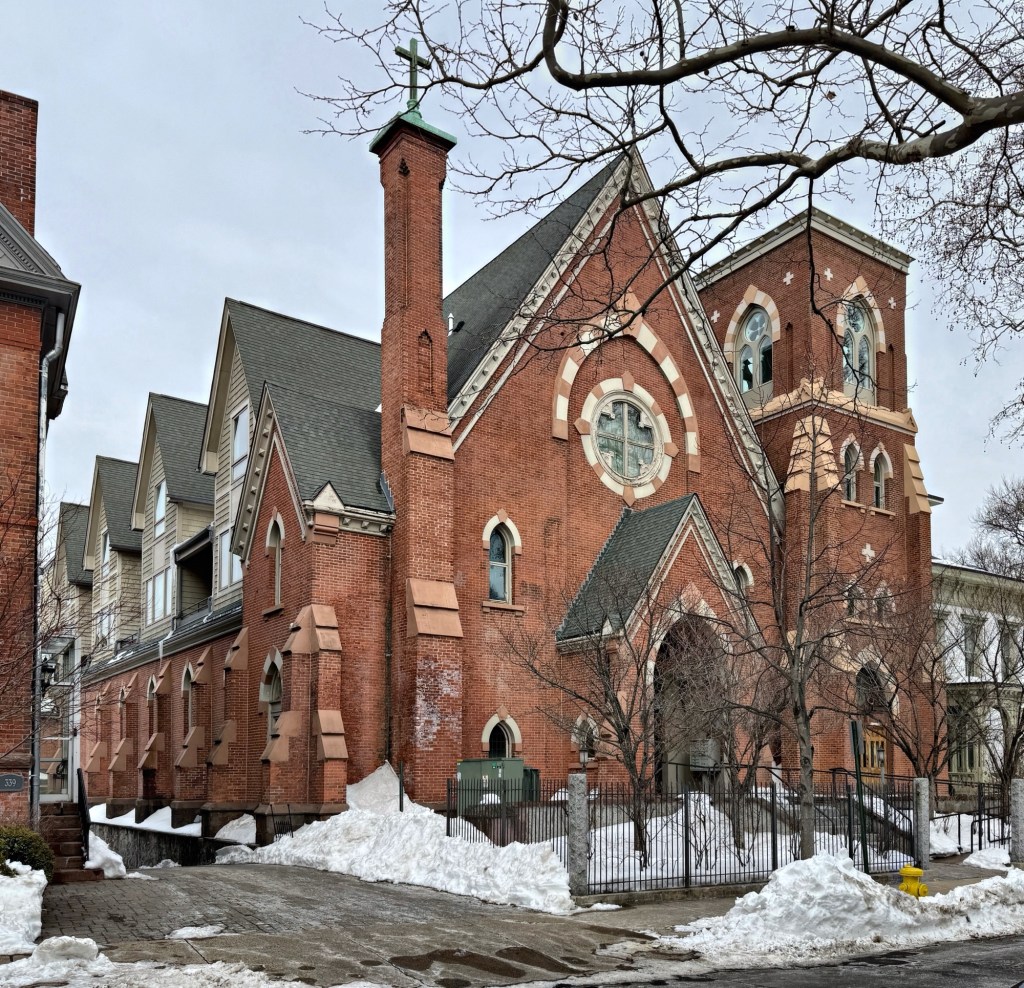
Pratt, Read and Company Factory // 1881

The Pratt, Read & Company Factory, located on Main Street in Deep River, Connecticut, was once the largest producer of ivory products in the world. The company was established in 1863, when Julius Pratt, George Read and their corresponding companies, merged to become Pratt, Read and Co. In 1866, the newly organized company built a new factory on this site. The business manufactured ivory combs, collar buttons, and toothpicks and specialized in the production of piano and organ keys. That factory burned in 1881 and as a result, over 160 employees were out of work. A year later, in 1882, the present factory was built of fireproof brick construction. The company, like many others, imported ivory from King Leopold’s Congo, where atrocities against indigenous people were common. The original Pratt, Read and Co. factory had an ornate pyramidal tower, which was removed in 1914. In 1936, the company merged with Comstock, Cheney & Co. and moved all operations to Ivoryton, CT. The Deep River factory was used for various manufacturing purposes throughout the rest of the 20th century until it was converted to condominiums as the appropriately named Piano Lofts.

Congregational Church of Deep River // 1833

The town of Deep River, Connecticut, was originally a part of the Saybrook Colony, a large area at the mouth of the Connecticut River that was settled by English colonists. As what has become Old Saybrook grew, settlers moved further and further away from the original settlement and, eventually they received permission to form their own parishes so that they would not have to travel so far on Sundays to attend church services. As these outlying parishes grew, they separated from Saybrook and became the present day towns of Lyme, Old Lyme, Westbrook, Chester, Essex, and Deep River. Residents of present-day Deep River traveled to church services in Centerbrook, a village in Essex until this church was built in 1833. First services were held here the following December. The Greek Revival style church is ecovative of many similar 1830s village churches in New England, employing elements of the Greek Revival architecture style, with large doric columns, corner pilasters, and square belfry also with pilasters. The congregation here has been active for nearly 200 years.

John Gladding House // c.1825

This vernacular, Federal period house on Union Street in Deep River, Connecticut, was built around 1825 for (and likely by) John Gladding. John worked in town as a joiner, a historic carpenter/woodworker, who either built houses or ships in the nearby Connecticut River. The Gladding House was likely originally built as a half cape, with a side hall entry and the two window bays to its left. As the family grew, the house was probably added onto to the right of the entry with the irregularly spaced bays. Houses like these that modestly grow and adapt to modernizations over time are what makes many New England villages great.

Deep River Town Hall // 1893

The town of Deep River, in Middlesex County, is located in the lower Connecticut River Valley and was originally colonized as part of the Saybrook Colony. The community was incorporated in 1859 as Saybrook and renamed Deep River in 1947. An early shipbuilding and quarrying town, it later manufactured wire goods, lace, glass, ivory combs, and piano keys and is today a small community of just over 4,500 residents. The original town hall for Saybrook (Deep River) was used until it was destroyed by fire in 1891. The community, which was bolstered by a vibrant industrial community, began planning for a new, stately town hall at a triangular lot at the corner of Elm and Main streets. Plans were completed by Springfield architect, Francis R. Richmond, who laid out the flatiron building with town offices on the ground floor with an auditorium/opera house space on the upper floors. The Romanesque Revival style building features prominent rounded corners with arched openings, a granite string course, and overhanging bracketed eaves.

George P. Davis House // 1893

This Colonial Revival style single-family house on Emerson Street in Brookline Village, was built in 1893 on the former Emerson Estate, that was subdivided by the heirs of Elijah Emerson as Brookline Village filled in during the late 19th century. This house was seemingly built for Elijah’s daughter, Sarah C. Emerson Davis, and her husband, George Peabody Davis from plans by Boston architect, Olin Wesley Cutter. Of particular note, the Davis House features a symmetrical facade with round entry portico, Palladian stairhall window with leaded glass, and pedimented dormers, with the center dormer in a swan’s neck pediment. The oddly proportioned pilasters with tiny Ionic capital on the corners of the house were great to see as well!

Charles H. Rutan House // 1889

In 1889, prestigious architect Charles H. Rutan, purchased a house lot from the heirs of Elijah Emerson on the family estate and oversaw construction of his own residence in Brookline Village. Charles Hercules Rutan (1851-1914) was born in New Jersey and moved to Brookline in 1874, where he worked in the office of famed American architect, Henry Hobson Richardson. After Richardson’s death in April 1886, at the height of his career, Rutan and two other senior employees, George Foster Shepley and Charles Allerton Coolidge, took charge of the studio and its uncompleted work. Soon after, the three formed a formal partnership, Shepley, Rutan & Coolidge, to succeed to Richardson’s practice, and in 1887 moved the office to Boston. From his new position as head of a prominent firm, Rutan designed this handsome Queen Anne/Shingle style mansion for his family, where he lived until he suffered from two debilitating strokes in 1912, when he and his wife moved to an apartment on a nearby street. Besides the blue color, the house retains so much of its original architectural integrity and is one of the most significant residences in the Brookline Village neighborhood.

Emerson-Arnold Double-House // c.1875

Elijah Carleton Emerson (1807-1888) was a wealthy Boston merchant, making his fortune as Director of the Second National Bank and President of the Middlesex Horse Railroad. In his late 30s, he purchased land in Brookline Village and established his estate on the land that is now Emerson Park in 1846. The bucolic setting of his estate included a pond, boathouse and adjacent cottage, but as the surrounding area continued to develop with easy access to Downtown Boston, Elijah Emerson began to develop his estate. Emerson began to build residences on his land for supplemental income. This handsome Stick style double-house was built around 1880 and rented by Mr. Emerson and was eventually occupied by his granddaughter, Tirzah and her husband, George Francis Arnold. The residence features a mansard roof, decorative brackets and applied stickwork, and a handsome porch with turned posts.

Elijah Emerson House // 1846

Elijah Carleton Emerson (1807-1888) was a wealthy Boston merchant, making his fortune as Director of the Second National Bank and President of the Middlesex Horse Railroad. In his late 30s, he purchased land in Brookline Village and established his estate on the land that is now Emerson Park in 1846. The bucolic setting of his estate included a pond, boathouse and adjacent cottage, but as the surrounding area continued to develop with easy access to Downtown Boston, Elijah Emerson began to develop his estate. Emerson began to build residences on his land for supplemental income. After his death in 1888, Emerson’s two daughters, Sarah Davis and Tirzah Snell Arnold, maintained the property but sold it to the Town of Brookline in 1907. Brookline officials originally sought to build a new library on the site, but ultimately built it on Washington Street in 1910. The Emerson house and carriage barn were moved across Davis Street from their original site and Emerson Park was established. Emerson’s granddaughter, Mrs.Katharine Snell and her husband, inventor, Cullen B. Snell moved into the relocated house. The Elijah Emerson House (and carriage house at the rear) is a great, well-preserved example of a suburban Boston residence designed in the Gothic Revival style.

Graham Apartments // 1904

This handsome, and unique example of a three-decker in the English Revival style is located on a corner lot at 128 Davis Avenue in the Emerson/Brookline Village neighborhood of Brookline, Massachusetts. Built in 1904 from plans by architect and genealogist, J. Gardner Bartlett, whose work focused on colonial New England and the English origins of colonial families. Trained as an architect at MIT, he gave up architecture for genealogy, but still occasionally designed buildings in the Boston area. The building here was developed for Richard Graham, an Irish immigrant, who along with his wife, operated a laundry business in the village. The use of a shingle and stone entrance porch and entrance bay with stucco half-timbering and diamond-pane casement windows stand out architecturally as one of the few examples of a three-decker built in this style in New England.

Brookline Village Fire Station // 1908

Built in 1908 from plans by the architectural firm of Freeman, Funk and Wilcox, the Brookline Village Fire Station is a massive, red brick structure with white sandstone trim and a copper cornice. Located on Washington Street in Brookline Village, the station stands out for its high-style Italian Renaissance style, notable for the use of brackets and off-center hose-drying tower with arched openings. The station replaced an earlier hose house, and was built before the fire department shifted to fire trucks, but was adapted later for larger fire apparatus. The station is one of the finest in the Boston area, and the Town of Brookline have done a great job preserving this significant structure.