Griggs House // 1891

This fancy Queen Anne Victorian residence can be found in Chicopee Falls, Massachusetts, and is one of the most unique houses in the industrial city. This property was built and occupied by David B. Griggs, a builder in Chicopee under the firm D. B. Griggs & Sons. The firm was very busy in the late 19th and early 20th centuries, as Chicopee saw rapid industrial prosperity followed by a population boom, growing in population from over 9,000 residents in 1870 to 36,000 in 1920. Builders like David Griggs were able to grow to upper-middle class and buy property on desirable house lots and build large homes for their family, as was the case here. David Griggs died in 1896, five years after his home was built, and the property was inherited by his son, Millard Griggs. While the residence is covered in vinyl siding (original siding and trim is likely underneath the present siding), the house retains much of its original fabric including the brackets, delicate open friezes at the porches, and four-story tower.

Justin and Sarah Spaulding House // 1886

Justin Spaulding and his wife, Sarah (Cooley) Spaulding erected this house on Springfield Street in Chicopee, Massachusetts, in 1886, and would later be known for their philanthropic gifts to their home city. Justin Spaulding (1838-1906) was a wealthy grocer who amassed a small fortune operating stores in the industrial Lower Pioneer Valley. The Spaulding House is one of the finest Queen Anne style buildings in Chicopee, and is notable for its asymmetrical form, tower, ornate gable detailing, porches with original balustrade, and the chimney with inlaid terracotta tiles. Justin Spaulding died in 1906, and Sarah C. Spaulding (1840-1907) would pass away a year later. They had no children. In her will, Sarah bequeathed funds for the first purpose-built library in Chicopee and money for a memorial chapel in a local cemetery. The Spaulding House was acquired by the Academy of Our Lady of the Elms (now Elms College), moved to its present location in 1920, and was converted to the Office of Admissions for the College. Besides the need for a new coat of paint, the house is lovingly preserved!

Old Goshen Town Hall – Goshen Players // 1895

The first purpose-built official town building of Goshen, Connecticut, was this wood-frame structure at the main junction in the central village as the town’s first town hall. Built in 1895, the structure originally housed offices for the selectmen and town clerk, a fireproof vault for records, and a large audience-room with stage for town meetings and ceremonies. The building employs a more traditional form similar to the old Greek Revival meetinghouses built in New England in the first half of the 19th century, but with a shingled, Victorian entry tower with bell roof. When the Town of Goshen moved into its present town hall building, this structure became the home to the Goshen Players, a community theatre established in 1949, and is the second oldest continuously performing theatre group in the state.

George H. Dart House // 1893

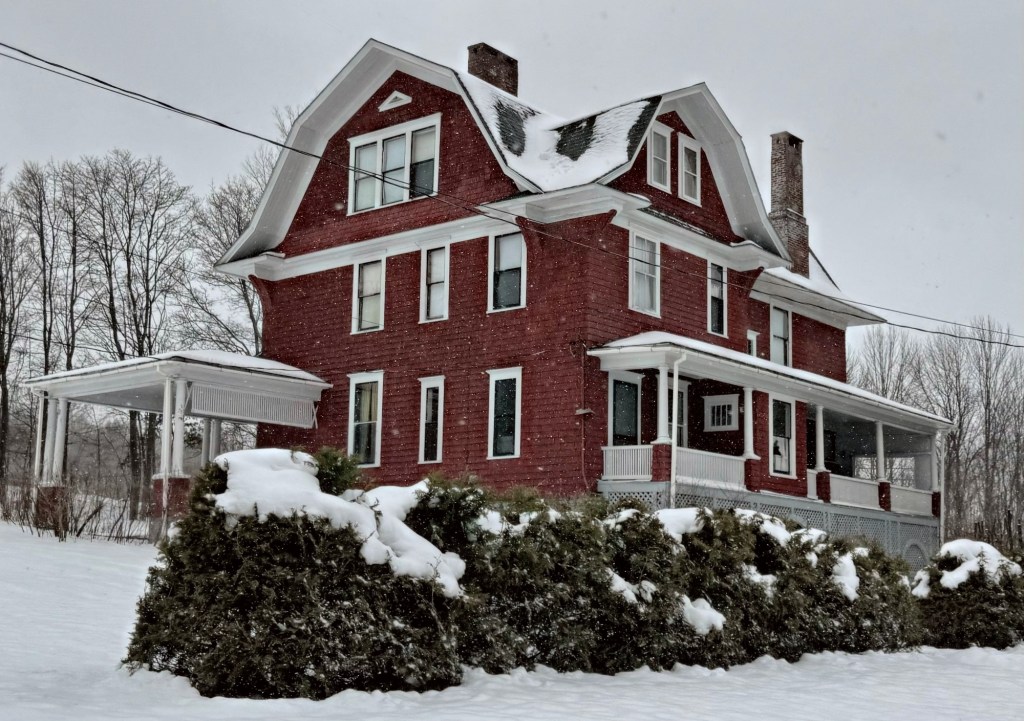
Arguably the most restrained and modestly detailed residence on Stimson Avenue in Providence is this residence, the George H. Dart House, a late-Queen Anne dwelling built in 1893. The original owner, George H. Dart (1845-1897) worked as the President of the Rhode Island Tool Company before his unexpected death in 1897.  Four years prior to his death, Mr. Dart hired the local architectural firm of Stone, Carpenter & Willson, to design this single-family residence, which employs Shingle and Queen Anne detailing under a two-story gambrel roof with overhanging eaves sheltering recessed porches and bay windows.

Thurston-Gladding House // 1886

One of the finest Victorian-era houses in the College Hill/East Side area of Providence is this stately residence at 30 Stimson Avenue, known as the Thurston-Gladding House. The house was built for newlyweds, John Russell Gladding and Ellen (Thurston), on land given to the couple by Ellen’s father, attorney and judge, Benjamin Thurston. John Gladding was originally from Connecticut and the couple split their time between their Providence home and a country retreat in Thompson, Connecticut. Architects Thomas J. Gould and Frank W. Angell (Gould & Angell) furnished the plans for the home, which features a ground floor faced with textured brick and walls adorned by continuous wood shingle siding above. A rounded tower, projecting bays and dormers, and a elongated front porch break up the massing into a pleasing composition.

Louis E. Robinson House // 1892

Built in 1892, at the height of the convergence of tastes of the Queen Anne Victorian and more traditional Colonial Revival architectural styles, the Louis E. Robinson House at 60 Stimson Avenue in Providence, Rhode Island, showcases the intricacies and whimsy that can be designed when a house is a blending of styles. The residence was built for Louis Elmer Robinson (not Robertson like so many sources claim), a cotton dealer and merchant, from plans by architect Frank W. Angell of the firm, Gould & Angell of Providence. The Robinson House is a gambrel-roofed mass, set gable end to the street, leaving only the ground story and side elevations in clapboard. The polygonal half-tower attached to the side elevation and its paneled grouping of windows retains the older medieval allusion of the early Queen Anne style, but with a swans neck pediment topping the stair hall window showcased the Colonial influence. I am imagining the home with a more period-appropriate color palette, but it still shines!

Henry A. Waldron House // 1893

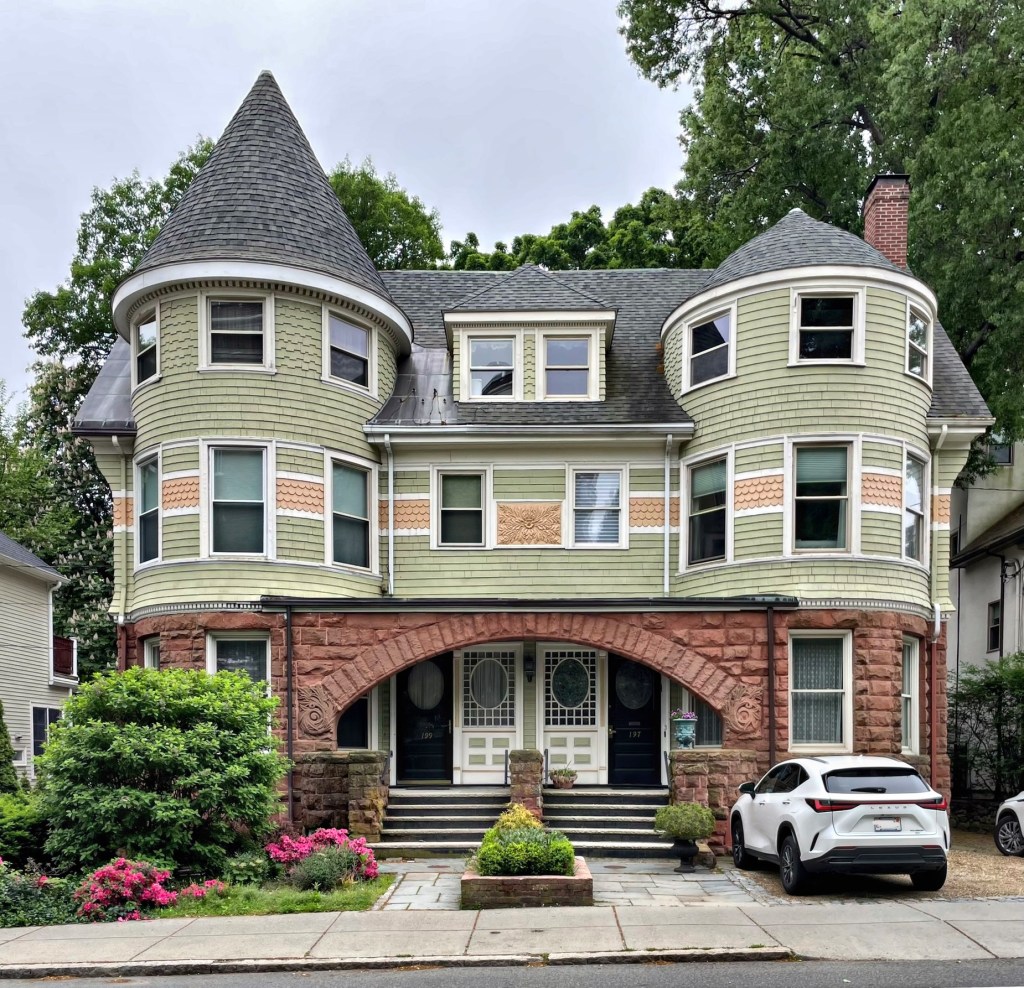
The period of the late 19th through early 20th centuries provided architects the opportunity of blending the two prominent styles, Queen Anne and Colonial Revival into a single composition, and as a result, this period has provided some of the most whimsical yet stately homes in New England. This modestly sized residence sits on Stimson Avenue, one of the finest streets in Providence, and despite its unassuming size, packs an architectural punch with its materials and detailing. The Henry Waldron House was built in 1893 for Henry A. Waldron, a clerk in Providence. From deed research, it appears a member of his family, Nathan Waldron, a wealthy grocer, purchased the site in 1891 and likely funded some or all of the construction of the residence there. The architectural firm of Hoppin, Read & Hoppin is credited with the design of the residence, which employs a Colonial Revival form with the gambrel roof and Columned and ornate entrance porch with fan motif, while the use of varied siding materials and octagonal tower with pyramidal roof veers into the Queen Anne style.

Newton D. Arnold House // 1888

Behold, a Queen Anne Victorian house in all her majesty! This residence, the Newton D. Arnold House, is located at 24 Stimson Avenue in Providence, and is one of the finest examples of its style in the city. Newton Darling Arnold (1843-1916) was employed at the Rumford Chemical Works serving as Treasurer for the company and from this position, accepted additional roles in banking and fraternal organizations, like the Freemasons, where he served a term as Grand Master of the secret society. Newton and his wife, Caroline, purchased a house lot on Stimson Avenue and set out to build one of the finest homes in Providence. To achieve this, they hired local architect, Edward I. Nickerson, to furnish designs. The Arnold House is covered by clapboard and shingle siding beneath a complex, cross-gabled roof of slate, with an ornate gable end and two-story corner tower.

Ellen and Charles Baker House // 1898

The versatility of the Queen Anne style of architecture is unmatched! This stunning example is located at 67 Stimson Avenue in Providence, Rhode Island, and was built in 1898 for Charles H. Baker and his wife, Ellen. Mr. Baker was a superintendent at the Gorham Manufacturing Company, one of the largest manufacturers of sterling and silverplate tableware in America. Sadly, Charles Baker would not get to enjoy the house for long as he died within a year of the house being finished. Ellen and the couple’s daughter, Maude, would reside here for years later. The Providence architectural firm of Gould and Angell designed the house with a large brick Flemish gable breaking the shingled mass of the house in a really abrupt, yet pleasing way.

Goodwin House // 1886

Queen Anne style buildings are a favorite as they are all so different and interesting to look at with all the ornate details, asymmetrical forms, varied siding, and rooflines. This example on Stimson Avenue in Providence is a great example of the style. The house was built in 1886 for William P. Goodwin (1852-1921), a banker, insurance executive, and author, who never married and lived in the house with his sister, Sarah Jane Goodwin. Keeping it in the family, William hired his brother, architect, John Bray Goodwin, to design his residence, with little expense spared. Interestingly, the house is built right at the street with its front door accessed up a stair and a brick base adjacent to enclose the property from the sidewalk, creating a high garden wall with gate. There is so much to look at here, it is spectacular.