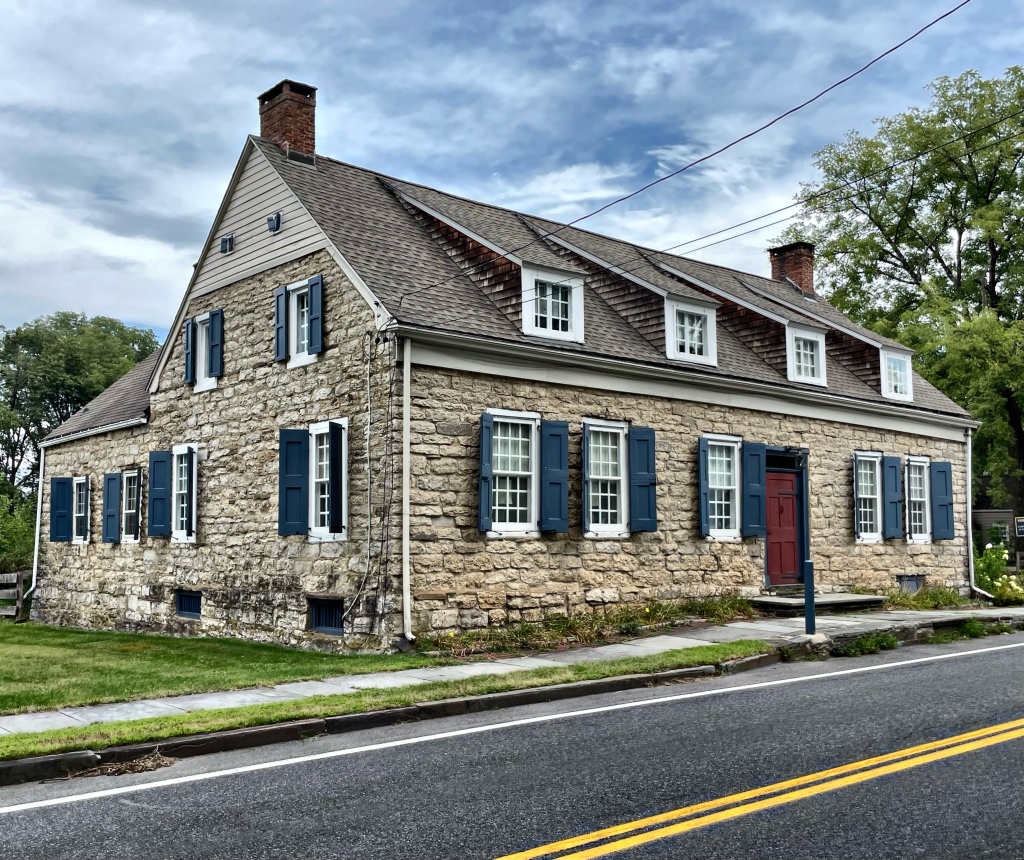
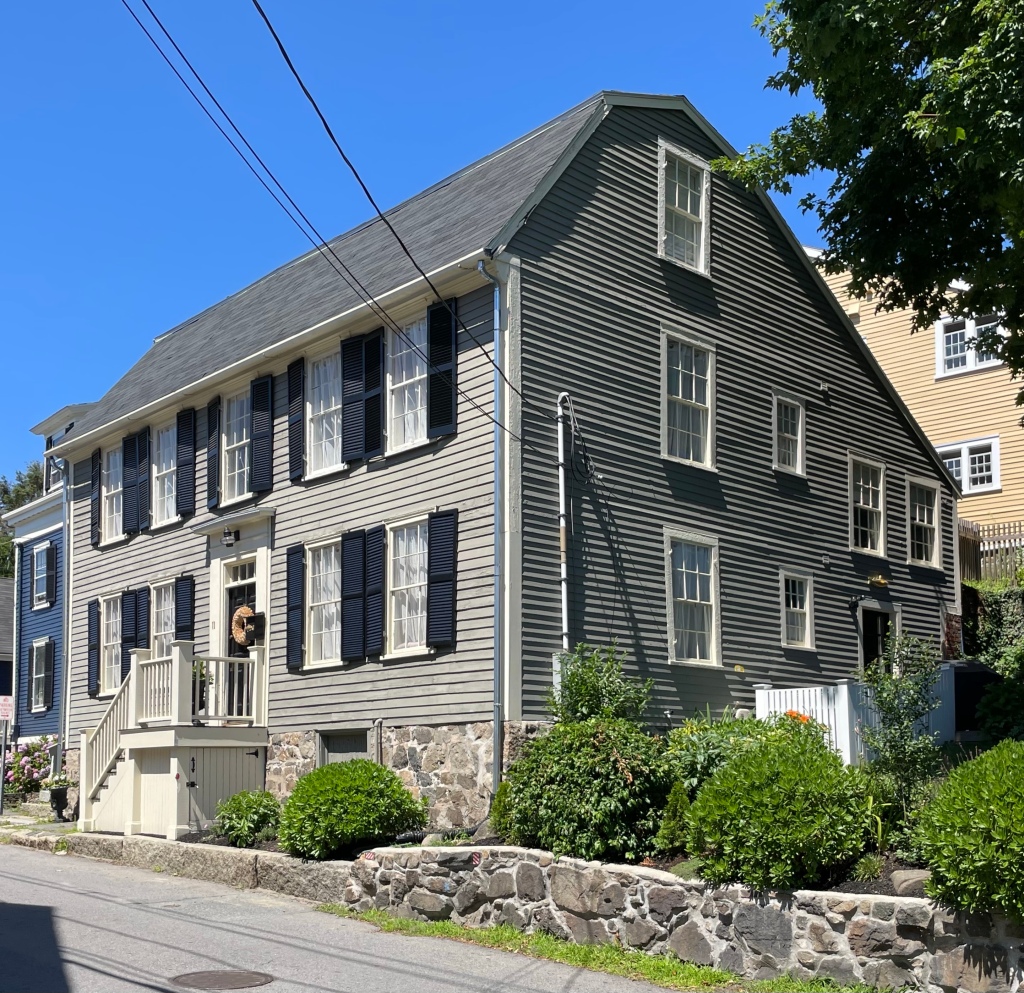
Simon Bradstreet House // 1723

Walking the warren of tight streets and hidden alleys of Marblehead, Massachusetts, you are taken back centuries to a simple time, and of a town that has largely maintained its pre-automobile urban fabric. Many pre-Revolution homes still stand in town and have survived cycles of the coastal town’s prosperity and economic hardship, and the increased pressure of gentrification in more recent years! The Simon Bradstreet House sits right in the village and is a well-preserved Georgian-period home. The house was built in 1723 (earlier reports said in 1738) and it was later owned by Rev. Simon Bradstreet (1709-1771), who arrived to Marblehead to serve as the second minister of the Second Congregational Church a year prior. Reverend Bradstreet was the great-grandson of the last Bay Colony Governor of the same name. Chance Bradstreet, an enslaved African that was a subject of the “within these walls” exhibit at the National Museum of American History was born in this home in 1762. He was later sold to Abraham Dodge of Ipswich by Isaac Story, the third minister of the Second Congregational Church. Stories like this are necessary for us to remember that slavery was a huge part of New England’s economy historically.

Enoch Fuller Octagon // c.1850

Oh the Octagon! The very rare Octagon house was a unique house style briefly popular in the 1850s in the United States and Canada. The style can generally be traced to the influence of one man, amateur architect and phrenologist Orson Squire Fowler. In his book, The Octagon House: A Home for All of 1848 (and reprinted with more photos in 1853), Fowler advocated for the shape’s benefits for buildings in that the octagon allowed for additional living space, received more natural light, was easier to heat, and remained cooler in the summer. These benefits all derive from the geometry of an octagon: the shape encloses space efficiently, minimizing external surface area and consequently heat loss and gain, building costs etc. Some were convinced and built Octagon houses, but the style and its brief period of popularity, died by the 1860s. This example in Stoneham, Massachusetts was built around 1850 for and by Enoch Fuller, a close personal friend of P. T. Barnum, founder of the Barnum & Bailey Circus. Fuller visited Barnum’s octagonal home in Bridgeport, Connecticut and he decided to construct an octagon house in Stoneham. The home was owned by Col. Gerrry Trowbridge not long after completion. The home was built with a fireplace in every room, a spiral, “flying” staircase, and a sweeping veranda.

Doucette Ten-Footer // c.1850

Here is a building type many of you may not know of… the Ten-Footer! This 10 x 10-foot square building is a well preserved example of a kind of shop historically used by many shoemakers in the late-18th to mid-19th centuries. In Stoneham during the 19th century there were many such shops scattered throughout the town as the area became a sort of hub for shoemaking. In the age before and just after the Industrial Revolution, many Massachusetts residents had home shops in the yards where family and neighbors could earn extra part-time money by doing piece work on shoes. These cottage industry shoe workers were paid for each pair of shoes delivered to the local distributor. Usually, the owner-shoemaker worked alone or with family members in the cramped space with materials like leathers, rubber, and straps stored in the attic space in a loft in the gable. This ten-footer was built in the mid 19th century and later owned by Peter Doucette, who ran a shoe shop here. The small building was eventually acquired by the Stoneham Historical Society and was moved behind their building, restored and it can better tell the story of the town’s rich shoemaking history.

Spot Pond Gatehouse // 1900

The Middlesex Reservoir and Spot Pond are located just north of Boston and have long been a little piece of the outdoors near the heart of New England’s largest metropolitan area. In 1894, the Massachusetts Legislature established the Metropolitan Parks Commission, which was endowed with the authority to acquire, maintain, and make recreational spaces available to the public. By 1900 the new commission had acquired 1,881 acres for the reservation. Part of this reservation, Spot Pond, is a natural water feature that for a number of years was integrated into the Boston area public drinking water supply, servicing the towns of Stoneham, Melrose, and Malden with drinking water. As part of this, gatehouses were built with hardware to open and close the pipes delivering the water to the adjacent towns. This gatehouse is in Stoneham was built in 1900 by the architectural firm of Shepley, Rutan & Coolidge, to not only protect the machinery inside, but to beautify the parkland, then maintained by the Metropolitan Parks Commission. The Renaissance Revival style building is today surrounded by a tall chain link fence, which really diminishes its presence in the landscape (but it does help prevent graffiti).

Barncastle // 1884

Barncastle, located in the Town of Blue Hill, Maine, is an elaborate and distinctive house. Designed by George A. Clough and built in 1884, the building is a sprawling complex in the Shingle style with additional eccentric details. As Blue Hill and other coastal communities of Down East Maine saw popularity as summer colonies of wealthy city-dwellers flocking to the rugged coastline, many new residents either built new “cottages” or renovated older (often ancestral) homes. Effie Hinckley Ober (1843-1927) who was born in town, married Virgil P. Kline, personal attorney to John D. Rockefeller, and for thirty years worked as attorney for the Standard Oil Co. of Ohio. Effie founded the Boston Ideal Opera Company in 1879 and traveled with the group extensively, retiring in 1885, upon that time, she would move into Barncastle for summers (then named “Ideal Lodge” after her opera company). In 1884, before her retirement, Effie hired her childhood friend, architect George A. Clough, who was born in Blue Hill and worked in Boston, to completely redesign her ancestral home. Clough’s design engulfed a smaller Cape Cod-style house owned by Effie’s mother Mary Peters Hinckley Ober Atherton, a descendant of early Blue Hill settlers, creating an absolutely elegant Shingle-style summer cottage. The house is highly visible on a main street, but what many do not see is the arch-and-turret link between kitchen wing and carriage barn. “Barncastle” is now home to an elegant inn and restaurant!

Parker House // 1814

Wrapping up this series on a tour of buildings in Blue Hill, Maine, we have two stunning old homes left! 

This landmark Federal style house was built sometime between 1812 and 1816 by Robert Parker, whose wife was a daughter of Joseph Wood, one of the first two white settlers of Blue Hill. The home is significant not only architecturally, but for its connections to a number of old settlers to Blue Hill and their families.

By the turn of the 20th century the farming, mining and granite producing town of Blue Hill had been discovered. Writers, artists, musicians, and wealthy urban families from all over the East Coast found inspiration or retreat in many coastal Maine communities including Blue Hill, building “cottages” to summer at. Not all those who arrived to Maine were ‘from away’, as many built new or renovated their old ancestral homes to be occupied when seeking the peace and tranquility of coastal Maine. The Parker House was no different. In 1900, it was renovated in the Colonial Revival style as a summer home for Frederick A. Merrill and his wife, Elizabeth, residents of Boston. The couple hired George A. Clough, who worked as the first City Architect of Boston, but grew up locally in Blue Hill. Mrs. Merrill was descended from Mrs. Robert Parker’s sister. The current owner, the Merrill’s great-grandson, has undertaken a restoration of the house which pays homage to its Colonial Revival past. The stunning house can even be rented!

Clough-Hinckley House // 1832

This charming Federal style cape in Blue Hill Maine was built in 1832 by Moses P. Clough, a sea captain seemingly as a wedding gift to his new bride of that year, Sally Prince. He resided in the home off-and-on between excursions and trips at sea until his untimely death at sea in 1836 of bilious fever, possibly caused by malaria. After his death, his widow Sally, remarried and moved to Cherryfield, Maine. The old family home was sold to Bushrod W. Hinckley, an attorney who was involved in the town affairs. Today, the old Clough-Hinckley home is known as Arborvine, a great restaurant known for using local, farm-to-table ingredients. The home is excellently preserved by the owners, down to the leaded glass fanlight and sidelights at the entrance. Swoon!

St. John the Evangelist Church // 1885

One of the most bucolic and beautiful buildings I have ever seen is this church in the Catskills, just outside of Elka Park, NY. Wow I wish New England could claim this one! The St. John the Evangelist Chapel was developed as part of a smaller enclave of summer cottages for rusticators from the Philadelphia-area, which was largely established by Mr. Alexander Hemsley (1834-1904) a chemist from Philadelphia who would later die from anaccidental chemical explosion at his factory. In 1883, Hemsley sold cottage lots to friends and family to erect summer houses in the Catskills and in 1884, decided to develop a lot for an Episcopal summer chapel. In that same year, Hemsley hired his future son-in-law, William Halsey Wood, to design the chapel. The Stick-style Victorian chapel blends the rustic use of natural materials found on the property with an elegant siting and attention to detail, not typically found in rural chapels. The native stone and stylized half-timbering really stood out to me. The church is used still in the summer with regular services on Sundays in July and August.

Keuffel Cottage // 1893

Built nextdoor to his business partner’s summer cottage (last post), Wilhelm (William) J. D. Keuffel, a German immigrant from Saxony, erected this summer cottage in the fashionable German-developed summer colony Elka Park in upstate New York. Keuffel & Esser Company (K&E) was founded by German immigrants Wilhelm J. D. Keuffel and Hermann Esser and manufactured high-quality surveying, drafting, and calculating tools for architects, engineers, surveyors, and building contractors in Hoboken, New Jersey with a sales office in Manhattan. By the early twentieth century, it was one of the largest manufacturers of scientific instruments in the world. Keuffel made good money, and summered in Elka Park for years until his death in 1908. The Queen Anne style Victorian “cottage” features the typical asymmetrical plan, corner towers, varied siding and detailing, and many porches to provide the residents with sweeping views of the distant mountains.

Old Platte Clove Post Office // c.1885

Believe it or not, but I occasionally venture out of New England, and a favorite place of mine to explore is Upstate New York. On a recent trip, I ended up driving through the tiny town of Hunter, New York, located in the middle of the Catskills. This charming little building was constructed c.1885 as the Platte Clove Post Office. The building was constructed to serve a rural portion of the town and was built as an early mixed-use building with the post office at the ground floor and small residence upstairs for the postmaster to live. The exterior cladding features both shingle and clapboard siding with overhanging eaves. The post office here ceased by 1911 and the use reverted solely to residential.