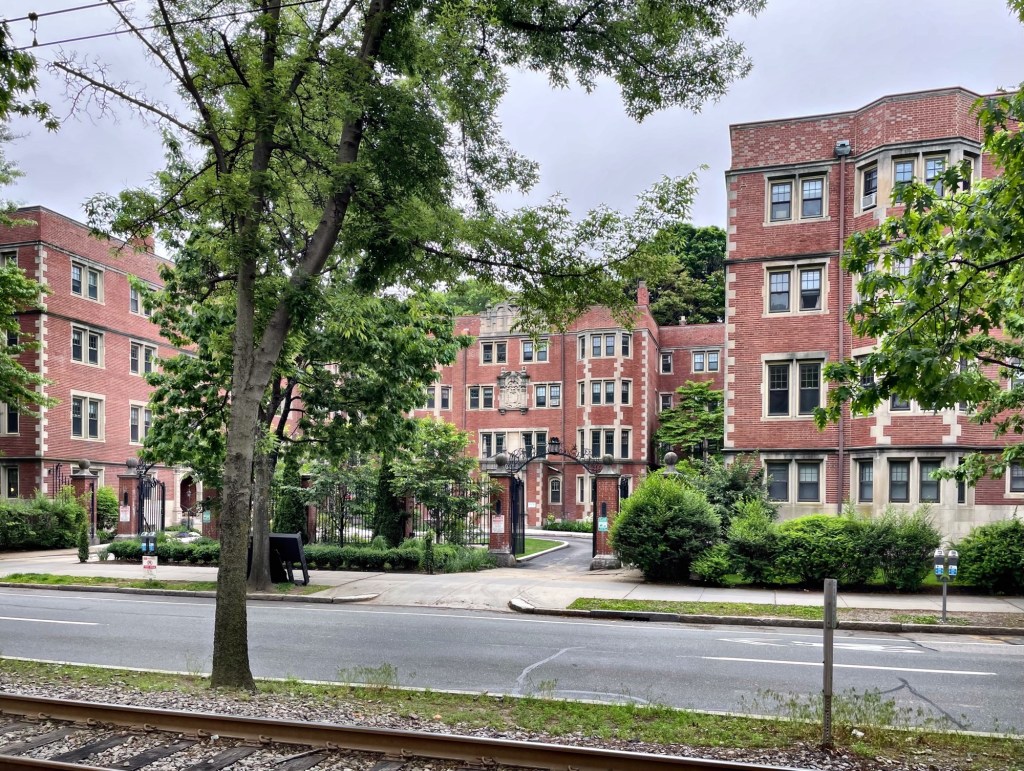
Abbotsford Mansion // 1872

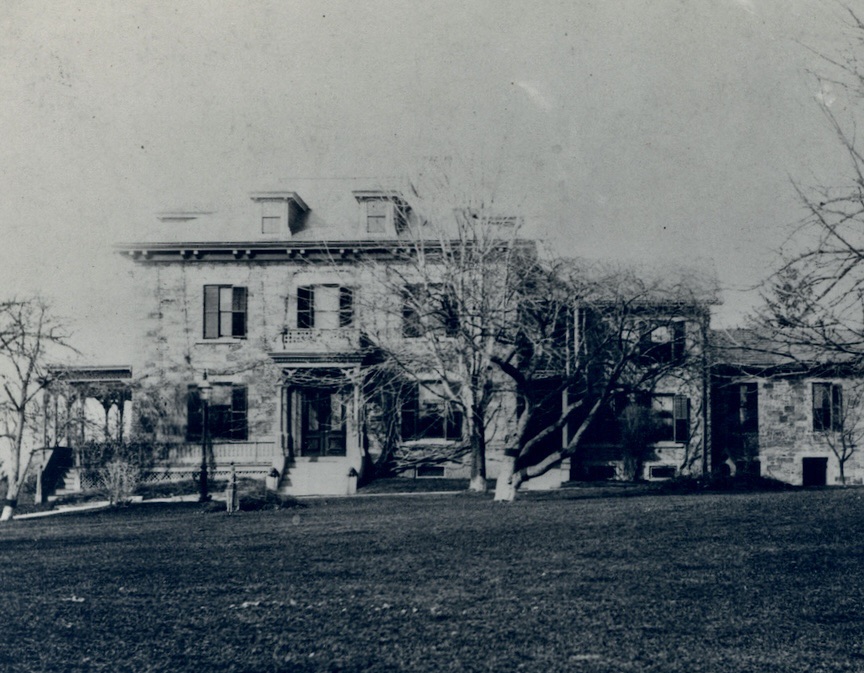
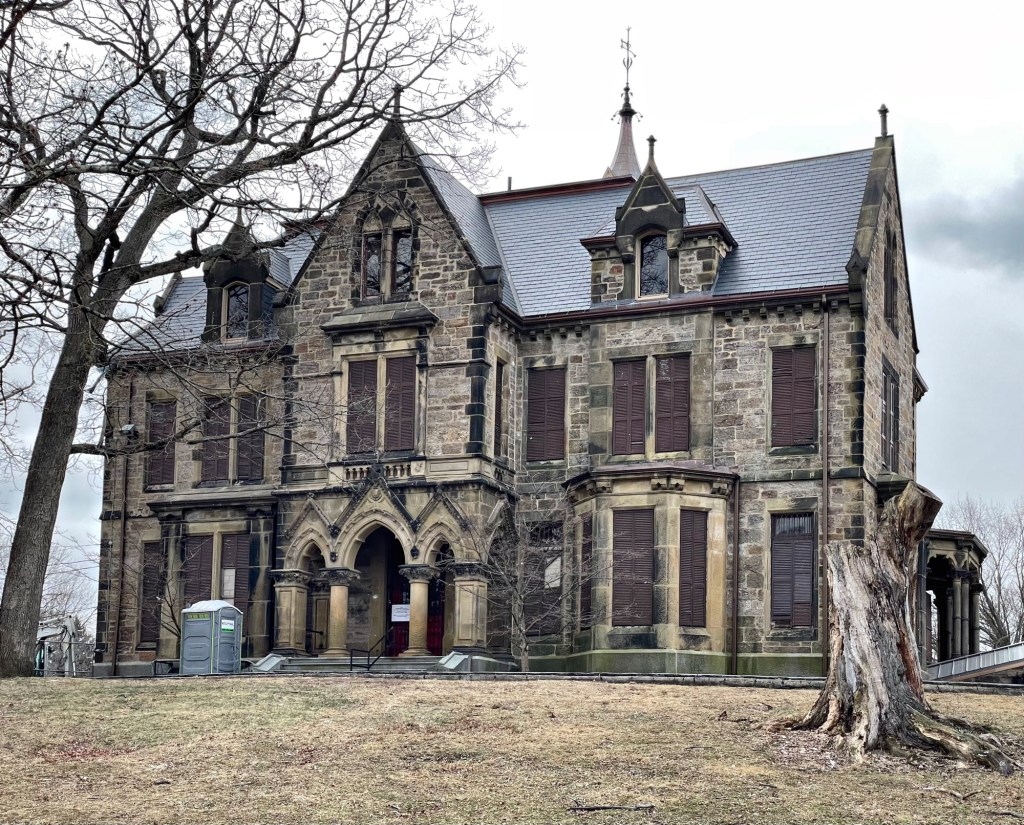
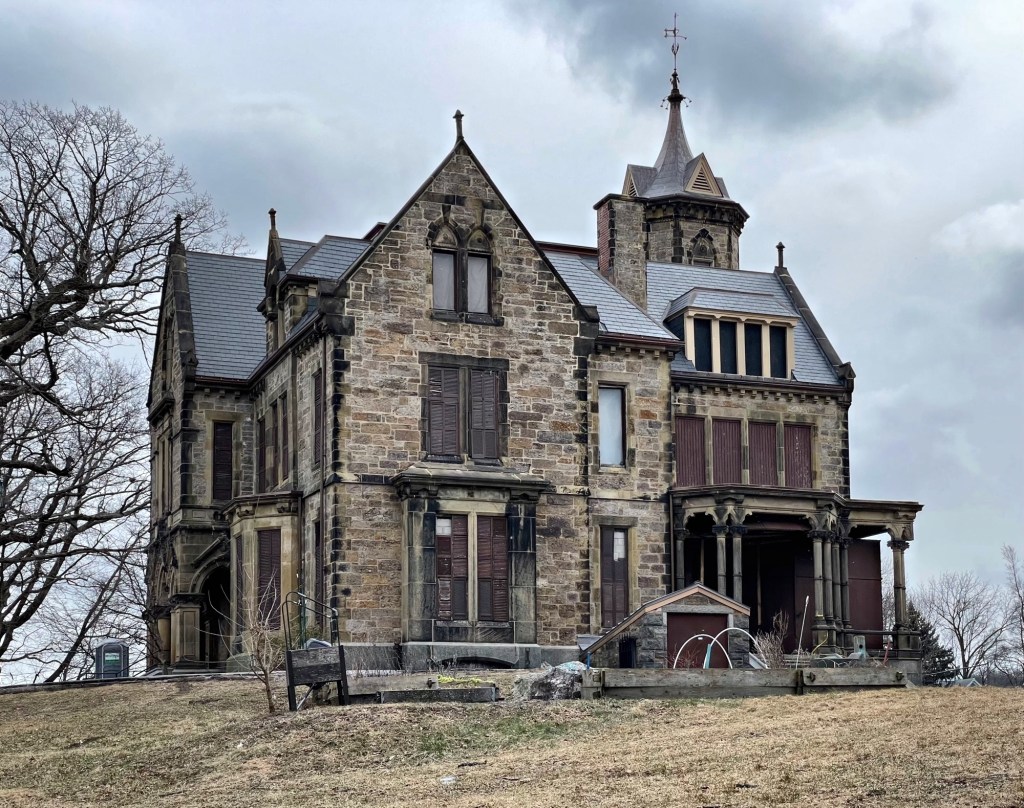
The Abbotsford Mansion in the Roxbury neighborhood of Boston was designed in the High Victorian Gothic style and was built of Roxbury puddingstone, which was quarried locally. Abbotsford, originally named “Oakbend”, was built in 1872 as the residence of Aaron Davis Williams, Jr., (1821-1899) an industrialist and son of the founder of the Roxbury Institution for Savings. Roxbury-based architect Alden Frink designed the country estate and it is his most notable work. When Davis lost his fortune, James M. Smith, a brewer who had a passion for Sir Walter Scott, acquired the estate and renamed the house Abbotsford after Sir Walter Scott’s ancestral keep of the same name. The house continued to serve as a private residence until 1924, when the City of Boston acquired it for use as an elementary school and a disciplinary school for boys. The parcel was subdivided and the David A. Ellis School was built on the former grounds. After the building slipped into decline in the 1970s, the National Center for Afro-American Artists purchased the property, filling in the windows to create exhibit space. They have maintained the building to this day.

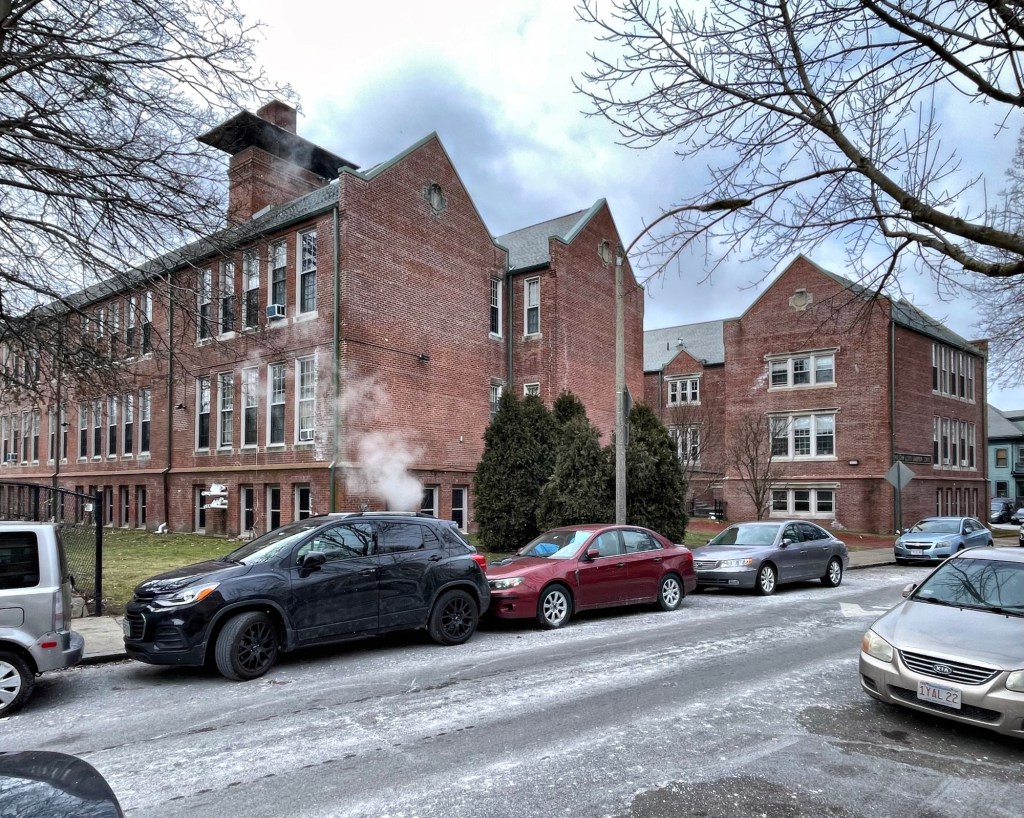
David A. Ellis School // 1932

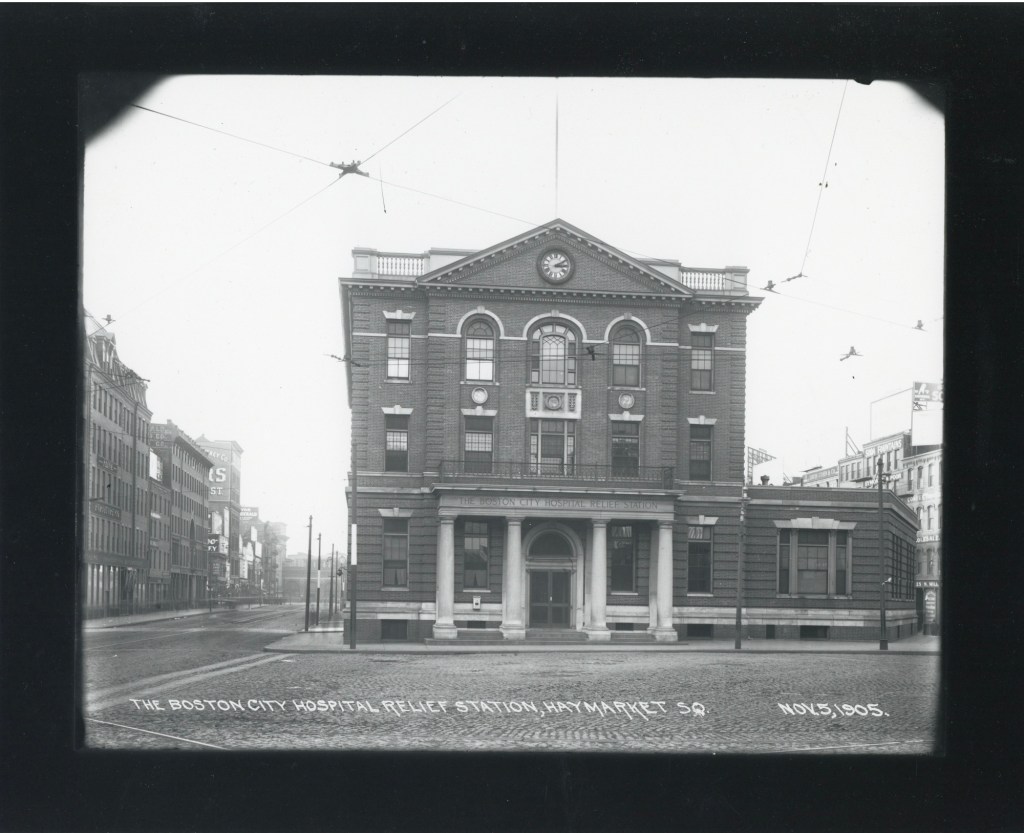
In the early decades of the 20th century, Boston’s population grew to a point that existing infrastructure was becoming an issue. The Boston School Committee as a result, acquired sites via eminent domain, and built ten new school buildings citywide in 1932 alone! The City of Boston acquired this site a decade earlier, but finally broke ground on the David A. Ellis Elementary School in 1931 from plans by architect Ralph Templeton Cushman Jackson. The building is a rare example of a Art Moderne style school building in Boston, and it was named for David Ellis (1873–1929), former chairman of the School Committee. The brick building stands out for its brickwork and sections of terracotta tiles in geometric designs. They don’t make them like they used to.

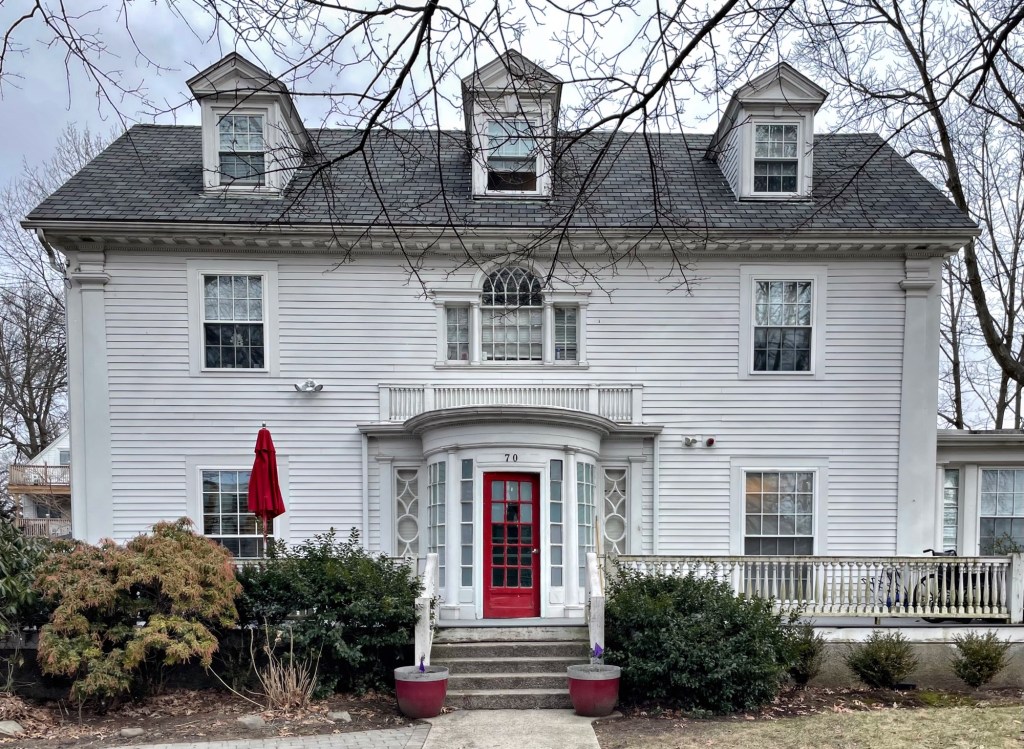
H. H. Fitch House // c.1870

Henry Hubbard Fitch (1833-1888) was born in Cornish, New Hampshire, but made Roxbury, Massachusetts his home. He moved to Boston at an early age and later entered into business with Francis V. B. Kern under the firm Kern & Fitch, working as a conveyancer. By 1873, he was also a justice of the peace, notary public, and was Boston manager of the Equitable Mortgage Company. In about 1870, he and his wife, Eliza Anne, had this charming Second Empire style cottage built in the Washington Park neighborhood of Roxbury, a fashionable part of the “suburbs” at the time. They would later relocate, before Henry died in 1888 at the age of 55. The house is one of the best preserved in the neighborhood and a survivor from the wrecking ball that destroyed much of Washington Park.

Hooper Mansion // 1889

One of the finest Richardsonian Romanesque style mansions in America is this stunner at the corner of Beacon and Hereford streets in Boston’s Back Bay neighborhood. Built in 1889, the mansion was commissioned as a private residence for Robert Chamblet Hooper (1849-1908) and his wife, Helen Angier Ames Hooper. Helen’s father, Frederick Lothrop Ames one of the wealthiest men in Massachusetts and major benefactor to in the town of Easton, funded and oversaw construction of the Ames Free Library and the Easton Town Hall both by H. H. Richardson in his namesake Romanesque style. It was likely her family’s prevalence for the style that led to her own home in Boston’s Back Bay to follow suit. The firm of Andrews and Jacques are credited with designing the stately mansion which in 1889, cost over $100,000 to build. Robert Chamblet Hooper was treasurer and later president of the Constitution Wharf Company. A noted dog fancier, he was owner of “Judge” (also known as “Hooper’s Judge”), credited as the ancestor of the Boston Terrier breed. So we have the Hooper’s to thank for Boston’s iconic mascot! In 1913, the building transferred from the Hoopers to Mabel Slater, daughter of painter William Morris Hunt (and niece of architect Richard Morris Hunt) an eccentric widow and inventor. Mrs. Slater is credited with developing an ice-cooled refrigerator, a sleeping bag that doubled as a garment used by soldiers in World War I, and a doll head with movable eyes. Mabel routinely left open a rear door of the mansion in order to encourage the poor to find their way into the kitchen for shelter and food. She had a one-story ballroom built at the rear of the mansion in 1914. The house was converted into 6 condominium units in 2016 and restored at the exterior thanks to the architecture and design studio, Hacin.

Pope-Barron Townhouse // 1871

Merry Christmas to those who celebrate! As there is no snow on the ground in Boston, I wanted to share a house with a prominent pine tree, which resembles an oversized urban Christmas tree on Beacon Street. This house at the corner of Beacon and Fairfield streets was built in 1871 by architect and builder Frederick B. Pope on speculation. It did not sell as quickly as he would have hoped, and it took two years for it to finally sell at public auction in 1873. The relatively modest brick Second Empire style house was bought and sold numerous times until March 1905, when the residence was purchased by Clarence Walker Barron, a prominent publisher and journalist. In 1903, he purchased Dow Jones & Company and from 1912 until his death in 1928, he was its president. During this period, he was also de facto manager of The Wall Street Journal, he expanded its daily circulation, modernized its printing press operations, and deepened its reporting capabilities. In 1921, he founded Barron’s National Financial Weekly, later renamed Barron’s Magazine. Barron pushed for the intense scrutiny of corporate financial records, and for this reason is considered by many to be the founder of modern financial journalism. In 1920, he investigated Charles Ponzi, inventor of the “Ponzi scheme”. His aggressive questioning and common-sense analysis helped lead to Ponzi’s arrest and conviction. For his Boston townhouse, Barron hired the firm of Cram, Goodhue & Ferguson to completely renovate the dwelling with an extra floor, limestone facades, and more bold roof design.

Cushing-Gay Townhouse // 1862

The Cushing-Gay Townhouse at 170 Beacon Street in the Back Bay neighborhood of Boston stands out as one of the most unique and pleasing early remodeled homes to look at. 170 Beacon was built by 1862 as one of two contiguous houses (168-170 Beacon) built for John Gardiner Cushing and his younger brother, Robert Maynard Cushing. John Gardiner Cushing built this house, which was originally a Second Empire style home similar to the dark gray residence nextdoor. The Cushing Family owned the property until 1894 and the property was sold to Helen (Ellis) Brooke, the the wife of Rev. Stopford Wentworth Brooke a British politician and later a minister of the First Church (Unitarian) of Boston. The Brooke’s moved back to England in 1900 and this home was sold to Eben Howard Gay, a banker and note broker. Eben’s wife of less than two years died just before he purchased this house on Beacon Street, she was just 26 years old. As a bachelor, Eben Gay hired architect and interior designer Ogden Codman, Jr., to remodel the 1860s house, giving it the present Adamesque front façade and new interiors to provide a setting for his collection of Chippendale furniture. The after being bought and sold numerous times following Gay’s financial struggles and selling of his prized home, the Cushing-Gay Townhome was purchased by the German Government in 1966 and is today the Goethe Institute, Boston, a cultural center and language school for the German language.

Cushing-Fearing Townhouse // 1862

168 Beacon in the Back Bay was built ca. 1861, one of two contiguous houses for Robert Maynard Cushing and his older brother, John Gardiner Cushing (more on the house nextdoor in the next post). This home was Robert Cushing’s home for him and his new wife Olivia Donaldson Dulany (m.1863). They also maintained a home, The Ledges, in Newport. The Cushing Family owned the townhouse until 1908, when it was sold following Robert’s death in 1907 by his estate to George Richmond Fearing, Jr., an investment banker. He also served as President of the Free Hospital for Women from 1910 to 1936. The home was recently renovated with a darker, brownstone facade, new copper gutters and downspouts and slate roof. It presently houses three condo units inside.

Skinner Mansion // 1886

One of the best early examples of Classical Revival residential architecture in Boston can be found on Beacon Street in the Back Bay, at the Skinner Mansion. Built in 1886 for dry goods merchant Francis Skinner (1840-1905) and his wife, Eliza Blanchard (Gardner) Skinner (1846-1898), the house exhibits a light stone facade with carved detailed panels and fluted pilasters, stone parapet with urns at the corners and a decorative wooden entrance with ironwork. Eliza was the sister-in-law of Isabella Stewart Gardner who herself lived on Beacon Street until erecting what is now the Isabella Stewart Gardner Museum, in the early 1900s. The Skinners hired architects Shaw & Hunnewell to furnish plans for their Boston townhouse, and they did not disappoint! Today, the mansion is occupied by medical offices, but retains the residential charm and character as it is located in a local historic district.

Wales-Amory Townhouses // 1860

This is why preservation matters! These two townhouses on Beacon Street in the Back Bay of Boston were constructed in 1859-60 for Gardner Brewer (on the right) and George W. Wales (left). Brewer, an extremely wealthy merchant built the house on the right for his son-in-law and daughter, William and Ellen (Brewer) Amory, as a wedding gift following their February 1860 marriage. The symmetrical pair of houses were both originally clad with a brownstone facade with Second Empire style trim details and a continuous mansard roof. Both houses were renovated by the early 20th century with Colonial influence, as Victorian styles started to wane popularity amongst wealthy circles. The former Amory house (right) was purchased by Della Saul and was operating as a boarding house by the 1930s. It was converted to an apartment building (like condos) and the building was renovated with a new facade in 1935 by brothers and architects George Nelson Jacobs and William Nelson Jacobs with a more modern/Art Deco appearance. The house on the left remained with its more Colonial facade until a 2018 renovation by architect Guy Grassi giving it a cast stone facade, restoring the three-condo house closer to its original appearance.

Derby Townhouse // 1886

Hasket Derby (1835-1914), was the grandson of Elias Hasket Derby, a prominent trader in Salem, MA., who was thought at one time to be the richest man in the United States. Hasket married Sarah Mason and the family lived in Boston. Dr. Hasket Derby was a renowned opthamologist and had this townhouse built in the Back Bay of Boston in 1886. He hired architect William Ralph Emerson, who ditched his prototypical Shingle style for the urban townhouse in the Colonial Revival style. The townhouse exhibits a brownstone swans neck pediment at the entry, three-story rounded bow, dentilled cornice and brick pilasters framing the bays. Its an often overlooked house in Back Bay, but so very special.

John and Gertrude Parkinson House // 1902

Teardowns have always been a common occurrence in cities, though replacement buildings from before WWII tended to be more substantially designed and built. This stately manse on Beacon Street in the Back Bay was built in 1902 on a lot previously comprised of two townhouses! This residence was built in 1902 for John and Gertrude Weld Parkinson from plans by the renowned firm of Peabody and Stearns. The Classical Revival style house has a limestone face and chunky stone lintels at the second floor to break up the facade. After income tax was introduced in the early 1900s and changing economic conditions for wealthy homeowners shifted, large single-family homes were no longer the norm. This home (and many others in Back Bay) was converted to a multi-family apartment building and today is home to eight condo units.

Peleg Chandler House // 1860

One of the most ingeniously symmetrical and academic facades on Beacon Street in the Back Bay neighborhood of Boston can be found at the Peleg Chandler House. Built in 1860 for Peleg Whitman Chandler (1816-1889), the two-bay bow-front townhouse appears to have been designed by architect Charles Kirk Kirby, a relatively unknown architect of Boston in this time period. The brownstone home originally had a mansard roof, but it was removed and replaced with a flat roof with parapet during the Great Depression, possibly to reduce the property taxes. Peleg Chandler was an attorney and publisher of the Law Reporter, which he established in 1838. He served as a member of the Massachusetts House of Representatives from 1845 to 1847 and as Boston City Solicitor from 1846 to 1853. He was an early advocate of the Public Garden and led efforts in 1859 to prevent the construction of houses on the eastern side of Arlington Street. The house has been divided up inside and now five fortunate families get to call this stunning building home!

Wales House // 1883

Built in 1883 for a member of the Thomas Wales family, this house in Clam Point, Dorchester, possesses a compact essentially rectangular clapboard and wood shingle-clad form. The architect, John A. Fox, designed the main façade elegantly with an open Stick style porch projecting from the center of the first floor which is enclosed by a steeply-pitched roof. The pitch of the porch roof is echoed in the small and shallow gable-like lintels which are really unique to the area. The treatment makes the facade read somewhat like a face.

Piotti Three-Decker // 1911

One of the features that sets the Clam Point neighborhood apart from other Dorchester neighborhoods is that the majority of its houses are still surrounded by ample yards. In most Dorchester neighborhoods, the electric streetcar triggered explosive growth in the form of three-deckers, which have arguably become the symbol of the neighborhood’s housing. Three-deckers (also called triple-deckers) are housing types that surged in popularity in the late 19th and early 20th centuries as they provided housing where each floor usually consists of a single apartment. Frequently, extended families lived in two, or all three floors, providing access and generational wealth to immigrant families who otherwise may not be able to afford land and building a single-family home. This example was built in 1911 by Italian-born contractor Ambrogio Piotti, who lived in a large mansion on Melville Avenue nearby. The three flats were rented out to families and the three-decker is clad in wood shingles, has polygonal bays with three-leveled porches with monumental Classical Revival columns.

Elisha T. Loring House // c.1840

Elisha T. Loring (1804-1889) was born on Cape Cod and began his career in the Chilean tin and copper trades, moving to Boston in 1839. His house at 21 Mill Street in Dorchester’s Harrison Square neighborhood was built in the early 1840s, showcasing his wealth and stature in the community. Based out of this house, Loring made a large fortune in the Lake Superior mines, also known as the Calumet and Hecla mines. By 1862 he was the treasurer to the Pewabic and Franklin Mining Companies, and a decade later is listed as “President, National Dock Company.” Loring’s Dorchester mansion is Greek Revival in style and consists of a three bay by three bay main block and a substantial rear ell. The house’s original clapboards were replaced by wood shingles sometime in the 20th century. The main elevation’s pedimented center pavilion exhibits a small front porch whose Ionic columns support a heavy, cornice-headed entablature. The porch’s roof is set off by an ornate cast iron railing. The side elevation is unusually wide and culminates in broad pedimented attics containing elliptical lunette windows.