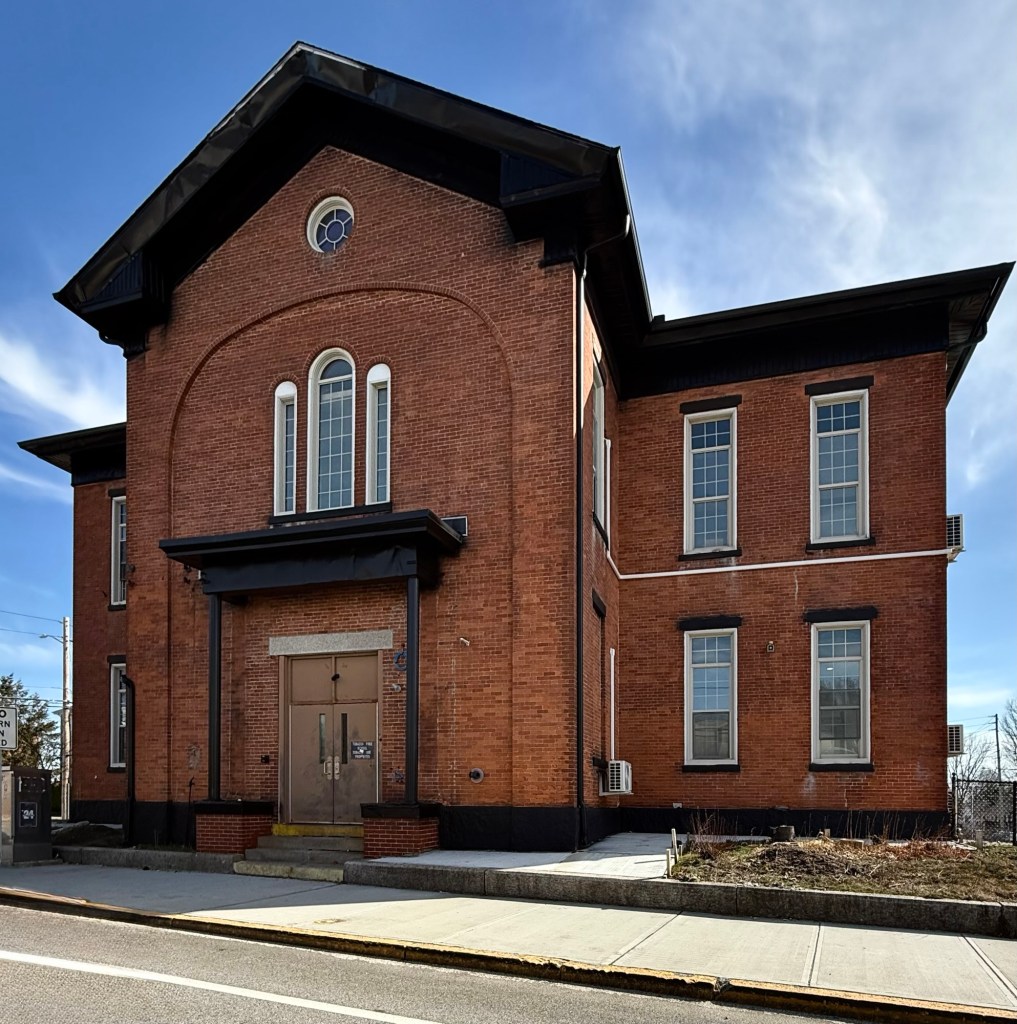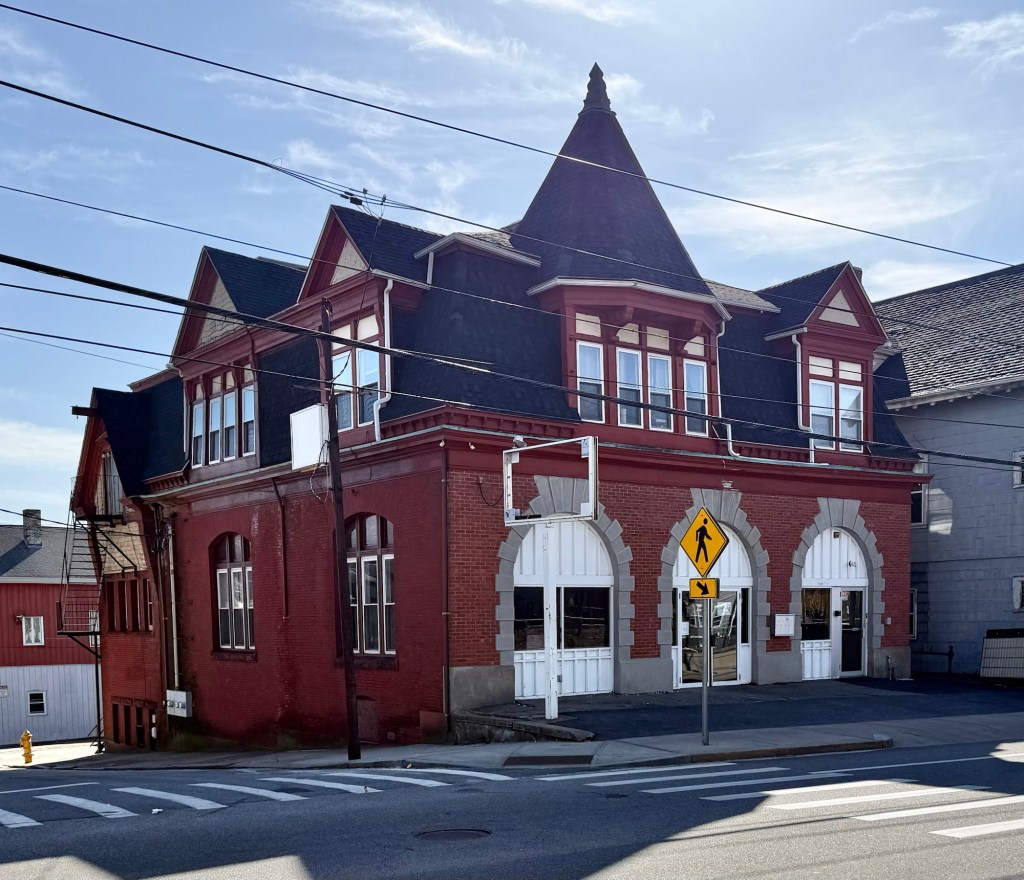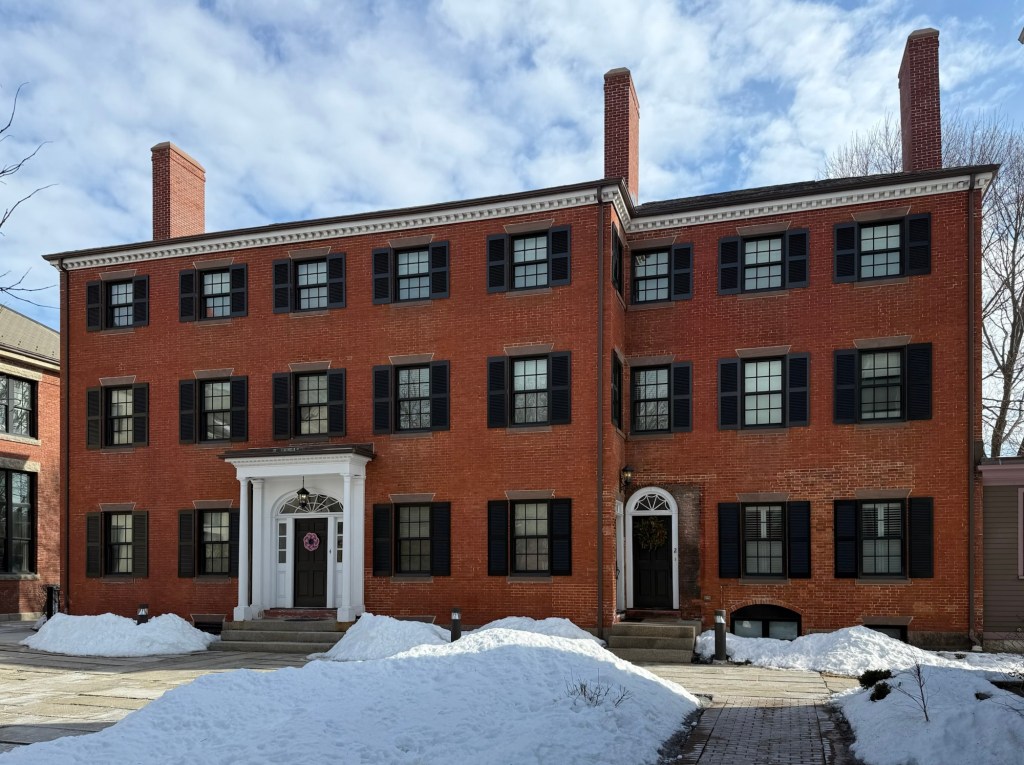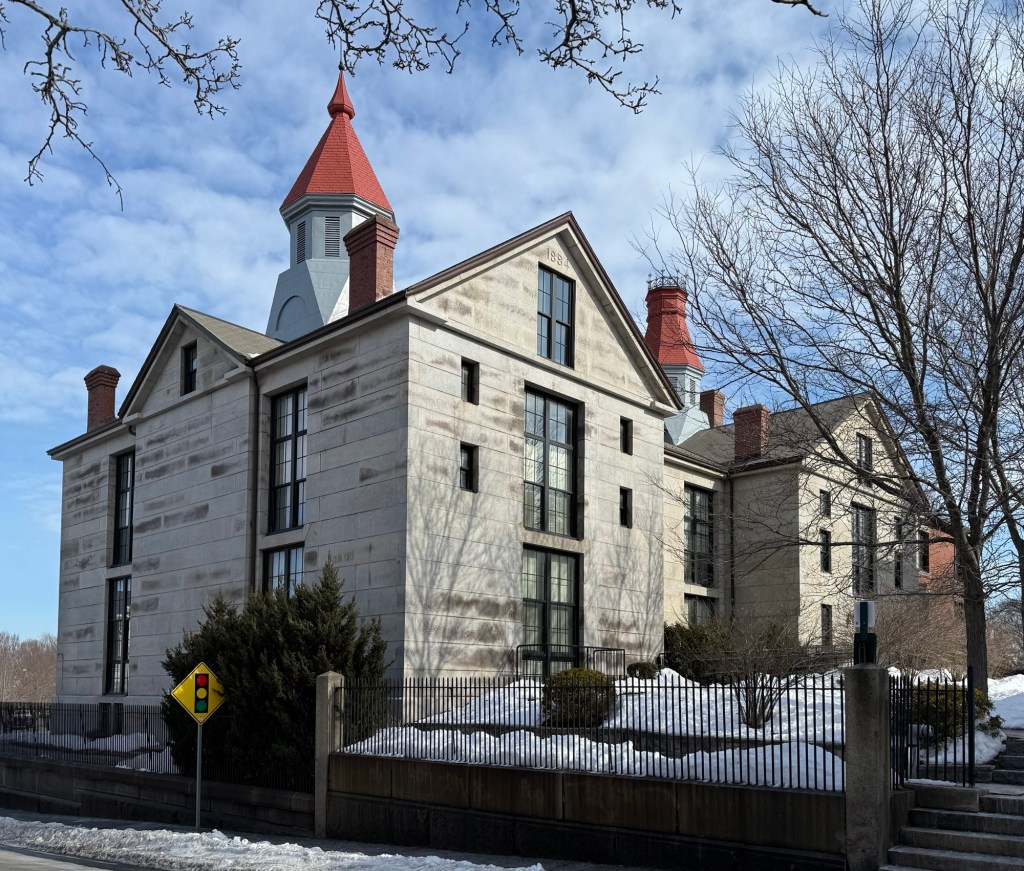
Newport Old Fire Station Hose No. 8 // 1887

One of the charming converted old fire stations of Newport, Rhode Island, can be found tucked away on Prospect Hill Street. This is Hose No. 8 Fire Station, built in 1887 by the City of Newport as a neighborhood station to battle fires in the dense network of streets and homes Downtown. The design blends Romanesque Revival and Victorian Gothic elements into a compact, two-story brick building. The station was closed in 1912 as the structure no-longer was compatible with larger fire apparatus and gasoline-powered trucks. The building would suffer from neglect and was crumbling, before being reconstructed, brick-by-brick, and restored by Hacin Architects of Boston as a private residence. The structure is essentially new on the interior but provides a significant preserved exterior that was long part of the eclectic streetscape of Prospect Hill Street.

Rockland Railroad Station // 1917

Welcome to Rockland, Maine! Originally called Catawamteak by the Abenaki, meaning “great landing place”, Rockland was first settled by European settlers in In 1769 as a camp to produce oak staves and pine lumber. In 1777, when Thomaston was incorporated, present-day Rockland became a district called Shore village. In 1848, it was set off as the town of East Thomaston and renamed Rockland in 1850. The coastal community grew quickly as a shipbuilding and lime production center, with upwards of 300 vessels to transport the mineral to various ports in the country for the building of communities all down the coast. The opening of the Knox and Lincoln Railroad in 1871 brought an influx of tourists and businesses, creating a development boom for the community. The line was leased to the Maine Central Railroad in 1891, which took over ownership in 1901. The Rockland Railroad Station, seen here, was built in 1917, just before the government took over the railroads during World War IArchitects Coolidge and Shattuck designed the station in the Romanesque Revival style with the oversized arched openings at the windows and main entrance. The rise of the automobile industry would further harm rail service and usage, and the Rockland Branch officially closed in 1959. The old Rockland branch station operated as the Rockland Town Hall for decades and is now occupied by a local restaurant, Trackside Station.

Wadsworth School // 1897

The former Wadsworth School of Danvers, Massachusetts, was built in 1897 as a district schoolhouse for the growing town and is one of the finest examples of a school building designed in the Colonial Revival style in the state. The large building held four classrooms (two on each floor) for over 200 pupils with stairhalls at either entrance and was designed by local architect, William H. Pearce. The school was in use until the 1970s when the town consolidated many of the schools, selling this building as excess. The property was converted to offices and given a preservation restriction by the town, protecting it as a local landmark for generations to come!

Former Weeks Junior High School – Weeks House // 1931

Adaptive reuse projects will ALWAYS get love on here!

Originally constructed in 1931 as the Weeks Junior High School in Newton Centre, Newton, this architecturally significant school building is the finest local example of the Tudor Revival style in that use. The Weeks School was designed by Ralph Coolidge Henry and Henry Parsons Richmond, architects who were draftsmen for Guy Lowell, one of the greats, and the successors to his practice upon his death in 1927. The design for the Weeks School is of traditional brick and cast stone, with its main entrance through a large Gothic arch at the center of the building. Two wings extend parallel to the tower and then bend back at 45-degree angles, creating the distinctive U-shaped form, which provided ample natural light in all classrooms. After a consolidation of local schools in the mid-20th century, the Weeks School closed, but was beautifully rehabbed in 1984 into housing as the Weeks House. Today, the building is comprised of mixed income housing of about 75, one-, two- and three-bedroom units.

Former Newton Centre Methodist Episcopal Church // 1899

This building, the former Newton Centre Methodist Episcopal Church, is Romanesque in style, and is one of the more notable adaptive reuse projects in Newton. The church was designed by the esteemed architectural firm of Andrews, Jacques & Rantoul and completed in 1899 for the local Methodist Episcopal congregation. The edifice is built of locally quarried rubblestone, often called Roxbury Puddingstone, and trimmed with rough cut Milford granite. The granite is used at the windows, forming the arches and heads, and most strikingly in the large arched entrance. The church eventually closed and was renovated with modern windows, additions, and more, and currently houses a restaurant, bank, book store, and professional offices.

New Gloucester Old High School – New Gloucester Public Library // 1902

This building, the present New Gloucester Public Library, was originally constructed in 1902 as the town’s high school, a use that remained until 1962, when pupils would go to a modern school building in nearby Gray, Maine. The building is an excellent example of the Colonial Revival style with a symmetrical facade dominated by a row of multi-light windows separated by paneling, a segmental-arched dormer, and cupola at the roof with a bell. When the high school moved to its present location, this building sat vacant for some time and would be occupied by the New Gloucester Historical Society for storage and display of their collections until the public library moved into the building by the early 1990s.

Former Schrafft’s Candy Factory – Converse HQ // 1907

Possibly my favorite building in the Bulfinch Triangle/North Station area of Boston is this brick behemoth. Known as the Schrafft’s Candy Factory, Hoffman Building, Lovejoy Wharf, Submarine Signal Building, etc., the building was constructed in 1907 from plans by Codman & Despradelle and first-occupied by the Schrafft’s Candy Company. It held the candy makers until 1928, when Schrafft’s moved to Charlestown, building their massive factory in Sullivan Square. A landmark in the Panel Brick style of architecture, prevalent in industrial and multi-family structures in the late 19th and early 20th centuries, the old factory saw many later uses from cold storage, to a Submarine Signal Co. before it was largely vacant by the end of the 20th century. Through Preservation Tax Credits and grants, developer Related Beal was able to reimagine the building, restoring it to its former glory. The Architectural Team (TAT) oversaw the renovations and expansion of the building with a glass crown with the project accommodating the corporate headquarters for world-renowned sneaker manufacturer, Converse.

Norwood Press Complex // 1897

Now that is an interesting example of adaptive use… What do you think of this?

The Norwood Press was formed in 1894 by several companies which consolidated to form a company that covered all aspects of the book-making process. AII three companies had been located in Boston, but were lured to Norwood by free land offered by the local Business Association along with tax incentives that were too good to pass up. The underutilized land was quickly redeveloped in the 1890s with the several-building complex built on Washington Street in Norwood, Massachusetts with the largest building (pictured) constructed in 1897. By 1904,the press room of this plant was one of the largest in the U.S.,producing nearly seven million volumes ranging from 100 to 1,600 pages each. By 1917, the Norwood Press employed 600 workers in town! The Romanesque Revival style brick factory stands out for its five-story clocktower with (now enclosed) arches and corbelling. The Norwood Press closed after WWII and the plant was purchased by the Northrup Company. Today, the warehouse is under new ownership and is used as a storage facility, with many of the windows enclosed for the storage units.

Peep Toad Mill // c.1850

The Peep Toad Mill (also known as the Elliottville Lower Mill) was built in Killingly, Connecticut, around 1850 by the Elliottville Manufacturing Company, whose larger main mill was upstream from this complex. The Elliottville Manufacturing Company was formed in the 1830s and later acquired by Albert Elliott and Nelson Eddy, who expanded operations here. This structure, the lower Mill was used for spinning and preparing the warps for cotton sheetings, the firm’s principal product. In 1870, the two mills employed 18 women, 18 children and 13 men. The business closed in the 1880s, and the building was vacant for some time before being converted to a residence and artist studio. The old mill is a rare surviving example of a wood-frame textile mill, many of which were built but few of which survive, due to fires and/or later expansion of the premises. The present owners have done an amazing job restoring and maintaining this rare treasure!

Former St. Mary’s of the Bay Catholic Church // 1928

Catholic residents of Hull, Massachusetts surged in the early 20th century with many well-to-do Irish families settling in town as year-round or summer residents. As a result, the cramped original St. Mary’s of the Bay Catholic Church was deemed too cramped, and a site in Hull Village was selected for a new church. In 1927, ground was broken for the new stucco church, which was partially funded by the Kennedy Family, who had a summer house nearby. The first service took place in 1928 and the church was in use as a religious building until the 1990s when it was sold to a private owner. The church was converted to a single-family residence and recently sold to new owners, who preserve the significant Spanish Colonial Revival style edifice.