William Hunt Double-House // c.1858

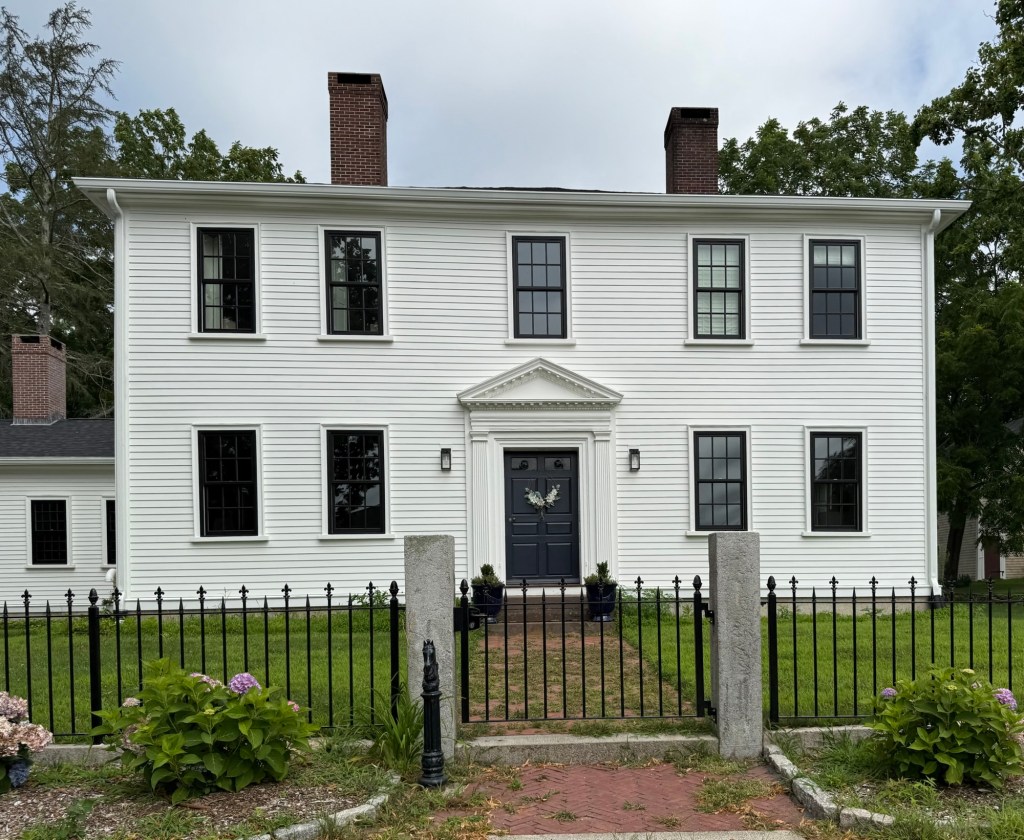
The William Hunt Double House, located at 10-12 Lynde Street in Salem, is a 2 ½ story wood-frame Italianate building that showcases the emerging presence of the Victorian style on residential buildings in the mid-19th century, even in cities with strong support for Colonial and Federal period styles. The two-family house was built by William Hunt, a prominent Salem merchant, as a rental property with occupants of the building in 1859 including: John W. Lefavour, a cashier, and Benjamin F. Faber, a merchant. The property remained in the Hunt Family for three generations, and was converted to a boarding house in the 1930s. In November 2018, a fire gutted much of the building, displacing the residents, and concerned neighbors as to the future of this great property. Luckily for us, the owners hired  Seger Architects, Epsilon Associates and Groom Construction to fully restore the building to its former glory. The resulting project won a Salem Preservation Award and received Federal and State Tax Credits to offset restoration costs. What a great success story!

Old Salem Central Fire House // 1861

This mid-19th century brick structure on Church Street in Salem, Massachusetts, was built as the Central Fire House for the City. The Salem Fire Engine House was erected in 1861 from plans by an unidentified architect, in an eclectic style focused on function over frills. The façade is dominated by three engine bays with five windows on the second floor, surmounted by a decorative brick cornice. The hidden feature of the fire house is the three-story hose-drying tower capped by a slate mansard roof at the rear of the building. This building remained a fire house for 115 years until 1976, when due to larger fire engines and the tight constraints of the lot and surrounding streets, made use of the building a burden for fire-fighting. The City of Salem sold the building to private owners in 1976  for $24,000, and they underwent renovations to the building from designs by David Jaquith undertaken under the direction of the Salem Redevelopment Authority which sought to promote renovation of select historic buildings within the Downtown Salem Historic District. The recessed entrances through the old engine doors is a nice touch and retains the original fabric of the building. The old Salem Central Fire House is now occupied by Crazy Good Kitchen and the East Regiment Beer Company.

Salem Water Company Offices // 1879

Salem, Massachusetts, was first settled by Europeans in 1626, and it would take 170 years until in 1796, an organization of citizens was established for the purpose of supplying the inhabitants generally of Salem and Danvers with pure spring water. The Salem and Danvers Aqueduct Company was incorporated in 1797  “for the purpose of conveying fresh water by subterraneous pipes into the towns of Salem & Danvers.” As Salem grew, the need for a more central water district and distribution network became a necessity for the health and prosperity of the city. A 1864 law allowed Salem to construct its own water works, and it formed a Board of Water Commissioners who designed and constructed the system. From this, funding was acquired and paid for the laying of tens of thousands of feet of subterranean water distribution pipes connecting the reservoir to buildings and hydrants in Salem. Offices of the Waterworks were scattered and obsolete until 1877, when funds for the construction of this structure at 32-34 Church Street were set aside as the new Water Department Offices. Completed by 1879, the building is a great example of a Romanesque/Italianate style masonry structure with corbelled cornice and arched openings. According to the city directories, this building continued to operate as the Salem Water Works into the late 1930s. By 1945, it was the headquarters of the United States War Price & Rationing Board. In 1964, it held a number of city offices including: Civil Defense headquarters, Fire Department headquarters, Licensing Board, Planning Board, and the City Veterans Service, before being sold by the City of Salem to private ownership in 1976.

Charles H. Farnam Mansion // 1884

Charles Henry Farnam (1846-1909) was a lawyer, genealogist, and the son of Henry Farnam, a wealthy railroad industrialist in New Haven, Connecticut. Following his father’s death in 1883, Charles, who may have inherited a small fortune in the will, purchased a house lot on the finest residential street in New Haven, Hillhouse Avenue. The existing house on the lot, the Benjamin Silliman House, was relocated to front Trumbull Street (and recently relocated again to 85 Trumbull Street), clearing the site for his new mansion. He hired esteemed architect J. Cleaveland Cady, who designed a large, Queen Anne/Romanesque masonry home unlike anything else on the Avenue. The house features an asymmetrical plan, corner tower, a Flemish style gable, fancy brickwork and terracotta detailing, and a slate mansard roof. Charles H. Farnam would sell the property to Henry S. Parmelee, a noted businessman and piano manufacturer, who also is credited with inventing the first automated sprinkler head and as a result, owning the first building in the United States to be equipped with a fire suppression system, his piano factory. Parmelee hired local architect Leoni Robinson, to design a rear addition for the house. Parmelee died in 1902, and the property was maintained by his widow and daughter, until it was acquired by Yale University in 1920. Today, the Farnam Mansion is occupied by the Economics Department.

Norton Mansion – Steinbach Hall // 1849

John Pitkin Norton (1822-1852) was a successful educator, chemist, and author, who at just 27-years-old, built this stately mansion on Hillhouse Avenue in New Haven, Connecticut, for his young family. John P. Norton studied chemistry under Benjamin Silliman at Yale College, and was eventually appointed Professor of Agricultural Chemistry at Yale in 1846. He helped to found the Department of Philosophy and the Arts at Yale College and authored many scientific papers, dealing with the chemistry of crops. Coming from an established family and beginning a successful career himself, John hired New Haven-based architect, Henry Austin, to design this large, Italianate villa. The window surrounds, canopies, and flamboyant Moorish entryway are typical of Austin, with the general form and detailing taking cues from architect Alexander Jackson Davis‘ work. The Norton Mansion was purchased by Yale University in 1923 and was long the home to the Yale School of Management and is now occupied by the Jackson School of Global Affairs.

Skinner-Boardman Mansion // 1832

One of the finest houses in New Haven is this stately residence, the Aaron Skinner Mansion on Hillhouse Avenue. The mansion was built in 1832 for Aaron Nichols Skinner (1800-1858) from plans by architect Alexander Jackson Davis. Skinner was a Mayor of New Haven (1850-1854), and for a short time, ran a boy’s boarding school out of this house. Skinner was also a CT State Representative, serving two terms. The house was originally built as a three-bay, two-story house with one-story side wings and a rear ell. After his death, the house was purchased by Judge William W. Boardman, who in 1859, modernized the property hiring architect, Henry Austin, who filled in the side wings and added Italianate window mouldings. The monumental portico supported by fluted, Ionic columns, creates such a stately presence for the early house on the street. In the early 20th century, the mansion was owned by Rutherford Trowbridge, who renovated the house for his own use. The house remained in the Trowbridge family until the death of his last daughter, Miss C. Rachel Trowbridge, when the estate became the property of Yale University.

Wheeler-English House // 1884

In about 1884, Edwin Saxton Wheeler purchased a house lot on the desirable suburban neighborhood on Hillhouse Avenue in New Haven, Connecticut, and began constructing an ornate, brick Queen Anne/Romanesque Revival style home there. In 1887, creditors went after Mr. Wheeler’s assets and the property was sold to Civil War General, Alfred Howe Terry. General Terry died in 1890 and the property remained under the ownership of heis heirs until around 1908 when the property was purchased and fully renovated by Lewis H. English. At this time, the ornate brick and terracotta detailing was largely covered by stucco siding, creating the clean facades we see today. The residence was purchased in 1954 by Yale University, and it now houses the Cowles Foundation for Research in Economics.

Farnam House – Yale President’s House // 1871

In 1871, wealthy engineer and philanthropist, Henry Farnam (1803-1883), purchased a house lot on the desirable Hillhouse Avenue in New Haven, Connecticut, where he would live out his final days in retirement. Mr. Farnam made his fortune beginning in 1839, when he was instrumental in building the railroad connecting New Haven to New York. In 1850, he moved to Illinois where he partnered with Joseph E. Sheffield to build the Chicago, Rock Island and Pacific Railroad, becoming that railroad’s president in 1854. In 1868, Farnam moved back to New Haven when he hired Russell Sturgis, Jr., to design and oversee construction on his home there. Henry Farnam also worked with Sturgis on Farnam Hall at Yale, where he is the benefactor and namesake of the building. Henry Farnam died in 1883, and in his will, he stipulated that he would gift his property to Yale College under the condition that his son, Henry W. Farnam, could live there until his death. Henry Walcott Farnam was an economist, and served as president of the American Economic Association. In 1933, the property ownership was officially transferred to Yale University, who in 1936, renovated the property, changing its appearance from Victorian Gothic to Colonial Revival. Architects, Richard A. Kimball and Ellery Husted furnished the designs for the stately residence. Since that time, the Farnam House has served as the residence of the Yale President.

George P. Fisher House // 1864

The George P. Fisher House is located at the corner of Hillhouse Avenue and Trumbull Street in Central New Haven, Connecticut. Built in 1864, the residence is one of the finest examples of the Italianate style in the state with its square, three-story form with gabled pediment, bracketed eaves, window hoods, and brick construction with stucco scored to resemble ashlar masonry. George Park Fisher (1827-1909) completed his education in Theology at Brown and Yale and would become a professor at the latter institution for much of his life. Additionally, Rev. Fisher was a frequent contributor to The New Englander (now the Yale Review) the oldest literary journal in the United States. Due to failing health at the turn of the 20th century, George Fisher relocated to Litchfield County for fresh air and relaxation for his health. The property was sold to John Wolcott Bristol, a wealthy attorney who never married. As with nearly all of the buildings on Hillhouse Avenue, the property was acquired by Yale in 1935 and is now occupied by the University’s Economic Growth Center.

Abigail Whelpley House // c.1826

The oldest extant building on Hillhouse Avenue in New Haven is this Federal-period house with later Victorian-era modifications. The Abigail Whelpley House was built by 1826 (with some estimates as early as 1800 and moved to the site) and was a traditional, five-bay, two-story Federal style residence. It is said that the house was built by James Abraham Hillhouse (1789-1841) for his widowed family member, Ms. Whelpley, and her two sons. As of 1849, the property was owned by Noah Porter, later President of Yale, who would alter the house in the 1860s with the addition of a mansard roof and trim, all designed by architect, Henry Austin. The house, now known as Allwin Hall, is maintained by Yale University and contains offices for the program on Ethics, Politics & Economics.

Pritchard House // 1836

One of the earliest houses built on Hillhouse Avenue in New Haven, Connecticut, is this stately Greek Revival mansion with monumental portico. The house was built in 1836 for Mary Pritchard from plans by great American architect, Alexander Jackson Davis. The mansion is two stories and is constructed of brick and stucco with a distinct two-story portico supported by fluted Corinthian columns. The architect also may have designed a barn at the rear of the house for Ms. Pritchard. Like many other former residences on Hillhouse Avenue, the house was acquired by Yale University, and is now the house of the Provost.

Perit House – Horchow Hall // 1859

This Italianate Villa style mansion on Hillhouse Avenue in New Haven, Connecticut, was built in 1859 for Pelatiah Webster Perit (1785-1864), a successful New York City shipping merchant and president of the New York Chamber of Commerce. Perit split his time between New York and New Haven and would hire architect, Sidney Mason Stone, to design this home on Hillhouse Avenue in New Haven. The brownstone residence is notable for its elaborate scroll brackets supporting the window pediments and front entry portico with arched doorway with rope moldings. The mansion was occupied by Perit for just four years until his death in 1864, and it was later owned by Henry Lucius Hotchkiss, a businessman. Like nearly all buildings on Hillhouse Avenue, the building was acquired by Yale University and is now known as Horchow Hall, and is part of the Yale School of Management.

Graves-Dwight House // c.1862

Hillhouse Avenue in New Haven, Connecticut is lined with stunning 19th- and 20th- century mansions showcasing the evolution of styles and architectural taste for the wealthiest residents. This is the Graves-Dwight House, a high-style Italianate mansion built around 1862. The residence was built for John Samuel Graves (1807-1892), a local businessman and politician who was a founder of the New Haven Gas Light Company. The architect is not known, but the house is the work of a skilled designer with immense attention to detail. The highly ornamented exterior features a symmetrical facade, bracketed cornice and window hoods, a recessed third-floor balconette with segmental arch pediment above, and bold, period-appropriate paint scheme. The residence was later owned by James McLaren Breed Dwight, a lawyer, and his wife, Cora Tallmadge Dwight. Since the 20th century, the property has been owned and preserved by Yale University, and is now home to the Archaeology Department.

Abercrombie Fine Arts Wing // 1974

Completed in 1974 for the now defunct Pine Manor College in Brookline, Massachusetts, this interesting Contemporary/Shed style building is modern, yet employs materials and a general form that fits into its surrounding context. When Pine Manor College received a grant by the Abercrombie Foundation, planning began immediately to design and build the Abercrombie Fine Arts Wing of the school. The building was designed by Paul J. Carroll & Associates, and features a bold roofline with clerestory windows, used to provide ample natural light for the classroom and art studio spaces inside. The building remains a part of the newly established Messina College, a Boston College campus enrolling first-generation high-financial need students, giving all an opportunity for education, no matter their circumstances.

Roughwood Estate Carriage House // 1891

Built on the expansive grounds of “Roughwood”, a country estate in Brookline, Massachusetts, this former carriage house has seen many iterations in its lifetime. Like the mansion house, the carriage house is a blending of Queen Anne/Shingle styles with fieldstone and shingle construction, designed by the architectural firm of Andrews, Jacques & Rantoul. When the Roughwood Estate was purchased and converted to Pine Manor College, the carriage house was adaptively reused and added onto as the Annenberg Library with a large imaginatively designed wing by Shepley, Bulfinch, Richardson and Abbott completed in 1986. The building remains as a library as part of the newly established Messina College, a campus of Boston College, which opened in July 2024 for over 100 first-generation college students. Gotta love adaptive reuse!