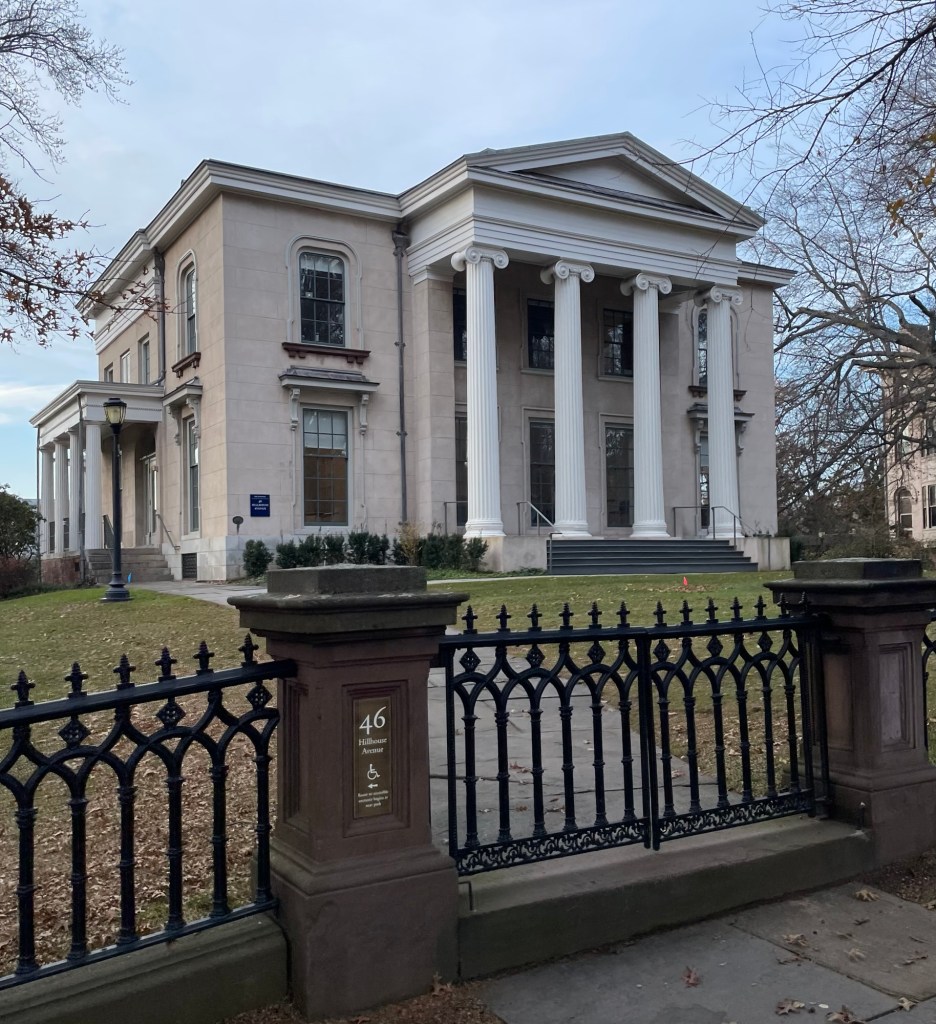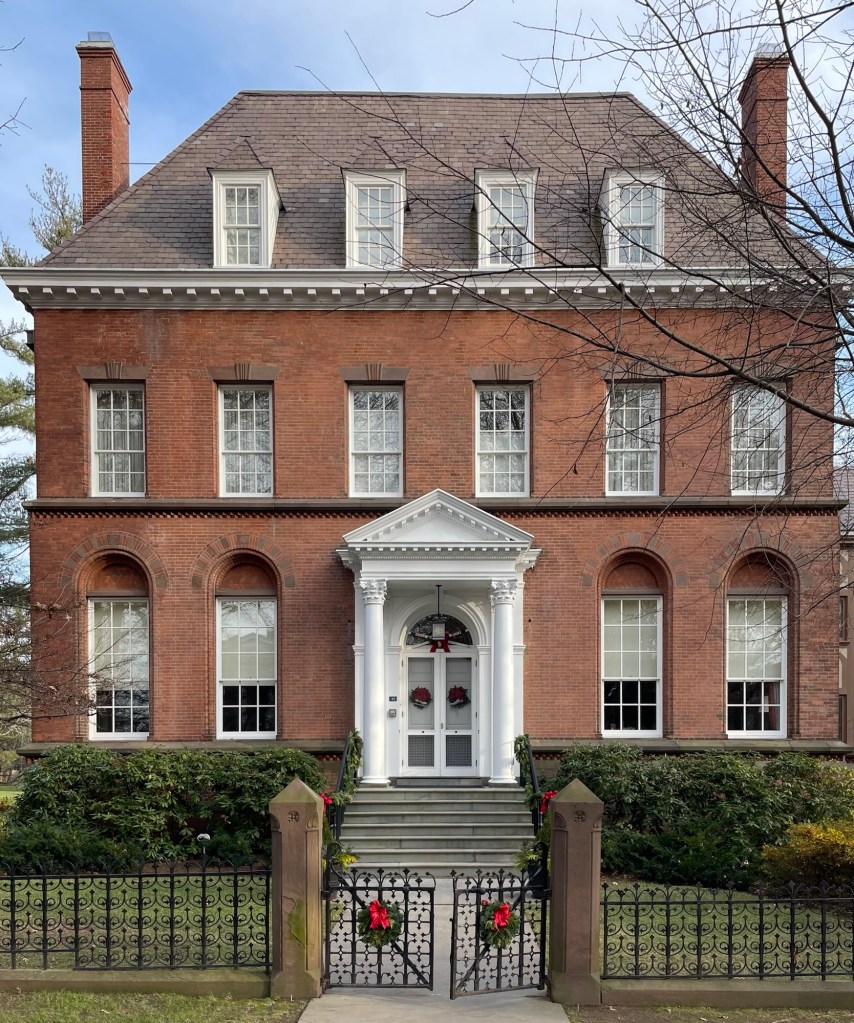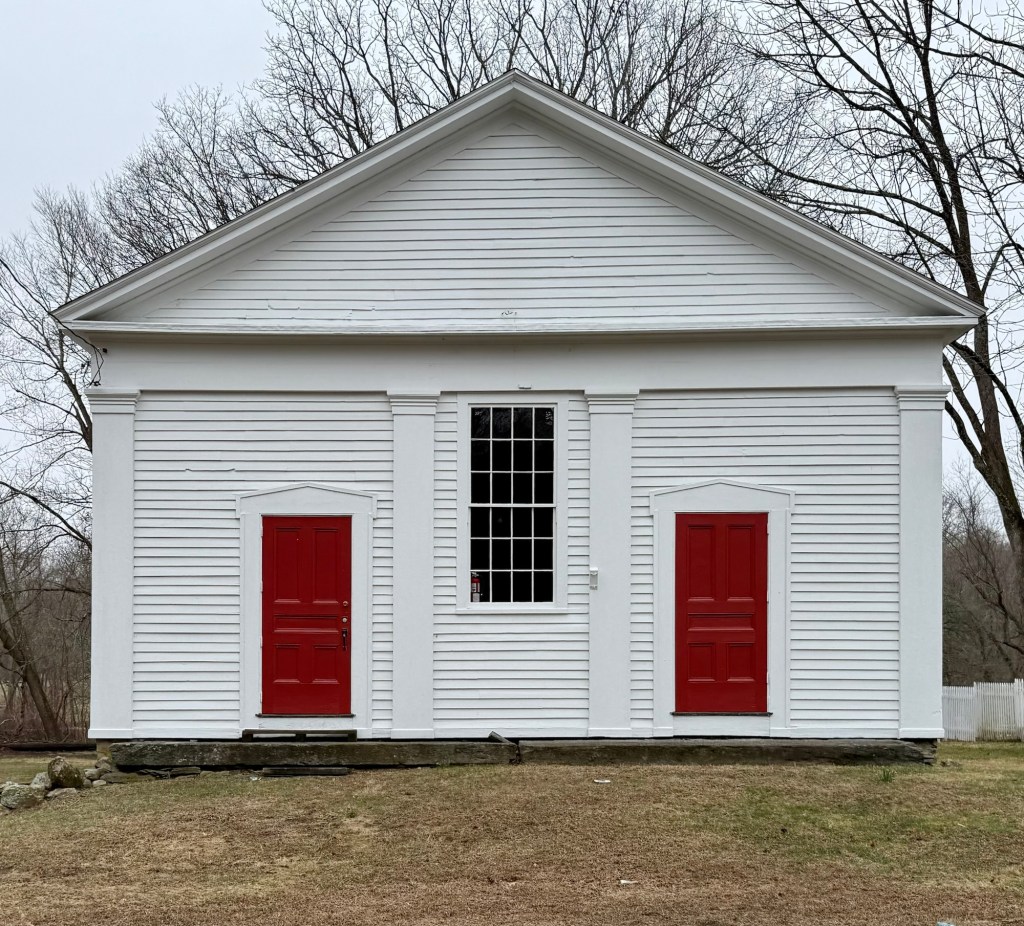
William H. Harrison House // c.1850

In about 1850, William Hopkins Harrison (1813-1878) purchased farmland from the Pierce Family of Cornwall, Connecticut, and built this stately Greek Revival style home upon it. The house was built around the same time as its neighbor, the Dwight W. Pierce House (last post), also an example of the Greek Revival style, but in a very different finish. The seven-bay residence has its main block at the end with a shallow hip roof and overhanging eaves, showcasing the emergence of the Italianate style form to come into popularity. The solidly Classical pilaster and entablature surround at the entry firmly places the house in the Greek Revival style.

Dwight W. Pierce House // c.1850

On land he acquired from family, Dwight Wellington Pierce (1816-1901) erected this large, temple-front Greek Revival estate just outside Cornwall Village in Litchfield County, Connecticut. Mr. Pierce farmed this land and built barns across the street from his residence on Popple Swamp Road, where he kept his livestock. The Pierce house is unique in Cornwall as a temple-front Greek Revival style house and features a two-story portico with four Doric columns, the center two are rounded and fluted with the ends square. The elongated house is seven bays wide and must have been quite the sight when it was built in the mid-19th century.

Pierce Homestead // c.1750

Built before the American Revolution, this large Georgian residence is one of the oldest extant houses in the charming town of Cornwall, Connecticut. Located on Popple Swamp Road just outside the central village, the Pierce Homestead dates to circa 1750 (the sign dates the house to 1768, but information from the town history mentions a house there earlier) and is a stellar example of a simple, two-story Georgian house with five-bay facade and 12-over-12 sash windows. This property was purchased by Joshua Pierce in 1748 and included over 300-acres of farmland, the farmhouse was likely built within a matter of years. The house was likely expanded and modernized by his son, Seth Pierce, who inherited the property in the 1790s. The farm remained in the Pierce Family for generations and was lovingly restored in the 20th century. It is a great example of a well-preserved 18th century farmhouse in Litchfield County, Connecticut.

Forest House // 1975

Photo courtesy of Bohlin Cywinski Jackson

While Cornwall, Connecticut is known for its 19th century architecture, there are some amazing Mid-Century Modern houses hidden away on forested lots there. This is the Eric and Anne Bohlin House (aka Forest House) designed by architect Peter Bohlin of Bohlin Cywinski Jackson for his parents as a summer retreat. The residence was completed in 1975 and sited between dense evergreens and bright deciduous woodland in a sparsely developed part of town. Camouflaged among the trees, the green-stained exterior hovers above a boulder-strewn landscape, resting on concrete piers, with large windows to take advantage of the glorious forest views. This is a great example of high-quality, site-specific house designs, which are becoming a rarity in recent years.

General John Sedgwick House // 1860

The Major General John Sedgwick House is located in Cornwall Hollow, Connecticut, and stands out as one of the finest residences in this part of the state in a rural setting. The house was built by 1860 for General John Sedgwick (1813-1864), who was born in a house standing on this site, which had been built by his grandfather, a veteran of the Revolutionary War. In 1859, the Sedgwick family homestead burned to the ground. Sedgwick, then already well established in his military career, took leave to oversee construction of its replacement. This house was built, apparently on the foundation of the old house, in 1859–60. The work was done by Cyrus Marsh, a local builder, in the Italianate style with decorative brackets, window mouldings, hoods, and a large columned entry portico. Major General Sedgwick was active in many campaigns, and during the American Civil War, he was killed by a sharpshooter at the 1864 Battle of Spotsylvania Court House, he was the Union Army’s highest-ranking casualty of the war and never got to reside in his Cornwall home.

Adelphic Institute Building // 1847

Located across from the North Cornwall Congregational Church in Cornwall, Connecticut, this vernacular, Greek Revival building was constructed by 1847 as the Adelphic Institute, a private school. The Adelphic Institute was founded by Ambrose Rogers, son of Deacon Noah Rogers of the Congregational Church in the village, on land and adjacent to the house he had inherited from his father. The school would eventually relocate to New Milford, Connecticut, in 1860 and this building was converted to a parsonage and meeting room for the church and village. It is now privately owned on the property of the old Rogers house.

North Cornwall Congregational Church // 1826

During the nineteenth century several small rural settlements dotted the landscape in Cornwall, Connecticut. In 1782, a group of “strict Congregationalists” seceded from the established Congregational church in town and constructed a “second” church in Cornwall Center. Following this, the town was divided into north and south parishes, with First Church built on the town center and the Second Church, this building, constructed in North Cornwall village in 1826. The North Congregational church is among the town’s finest Federal style buildings in the region and features three entrances with fanlight transoms and the bays of the facade are broken up by two-story fluted pilasters.

Cornwall Hollow Baptist Church // 1844

During the nineteenth century several small, rural settlements dotted the landscape of Cornwall, Connecticut. The hamlet of Cornwall Hollow this building, the Baptist Church, and contained a tannery, store, gristmill, sawmill and cemetery. The church at Cornwall Hollow was erected following dissolution of the Baptist congregation at nearby Cream Hill in 1843. A new church constitution was adopted in 1844 and this new meetinghouse erected the following year. At its height the congregation included 100 members. The Greek Revival style church once had a belfry, but it was removed sometime in the 20th century, likely due to repair costs. The interior included a curved ceiling, and windows line the side elevations. The congregation saw dwindling numbers and closed in the early 20th century. It is now privately owned, but lovingly preserved.

West Cornwall Congregational Church // 1877

One of the few Gothic style buildings in the enchanting town of Cornwall, Connecticut is this large church-turned-residence in West Cornwall village. As West Cornwall developed in the second half of the 19th century into the largest district in town, residents here began to discuss the idea of building their own Congregational church, rather than travel to the central village church to attend services. In the 1870s, West Cornwall congregationalists raised over $4,000 to acquire a building lot and erect this fine church. Dedicated in January 1878, the wood-frame church is a rare example of the Victorian Gothic/Stick styles with clapboard siding, lancet (pointed arched) windows, a corner tower with belfry, vertical sheathing in the gables, and ornamental applied stickwork. The church closed in the 20th century and was converted to a private residence, and is presently for sale!

Foster Mansion // c.1860

This large, Italianate style mansion is located at 417 Sharon-Goshen Turnpike, the main street through West Cornwall Village, Connecticut. The house was built around 1860 for Stephen Foster (c.1816-1863) a merchant and railroad contractor who had constructed a portion of the Housatonic Line railroad near West Cornwall. He and his wife, Helen, previously lived in a Greek Revival style house across the road until they moved into this stately residence. Mr. Foster would not get to enjoy his mansion long as he died in 1863. Helen Foster remained at the home until her death in 1875. The high-style Italianate residence was likely built by master-carpenter C. W. Marsh, and features all the hallmarks of the style: overhanging eaves with decorative brackets, elaborate window and door moulding, two-over-two windows, and a shallow hipped roof with dormer.