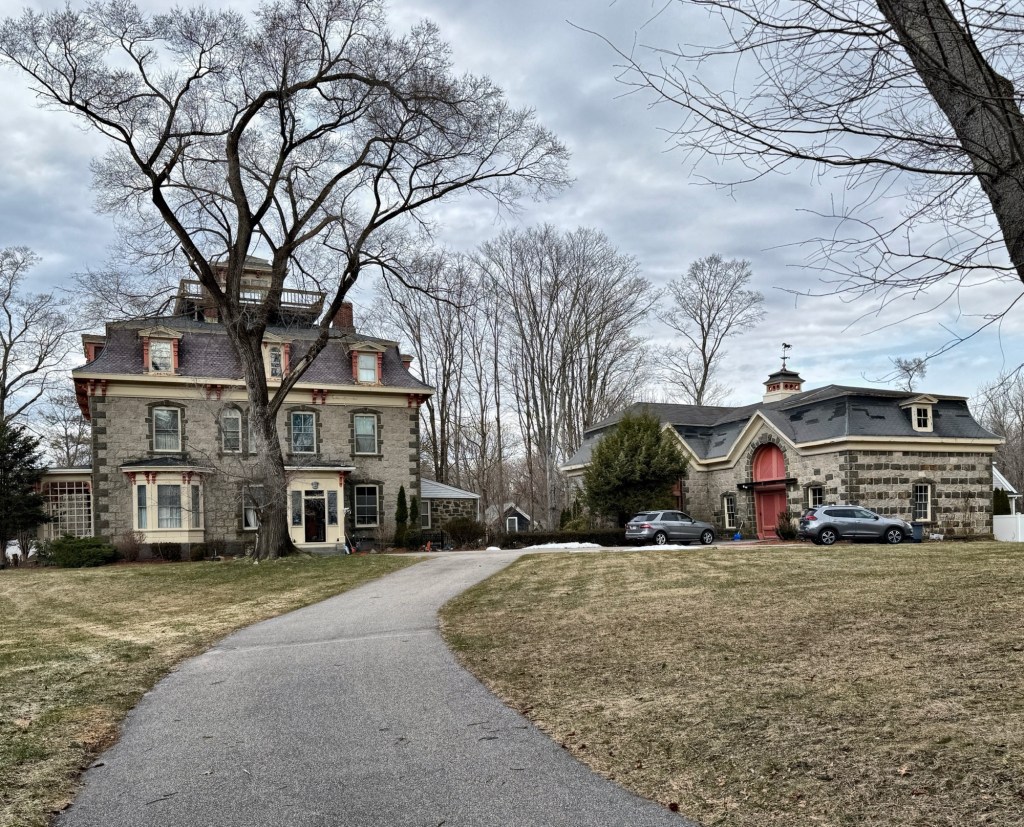
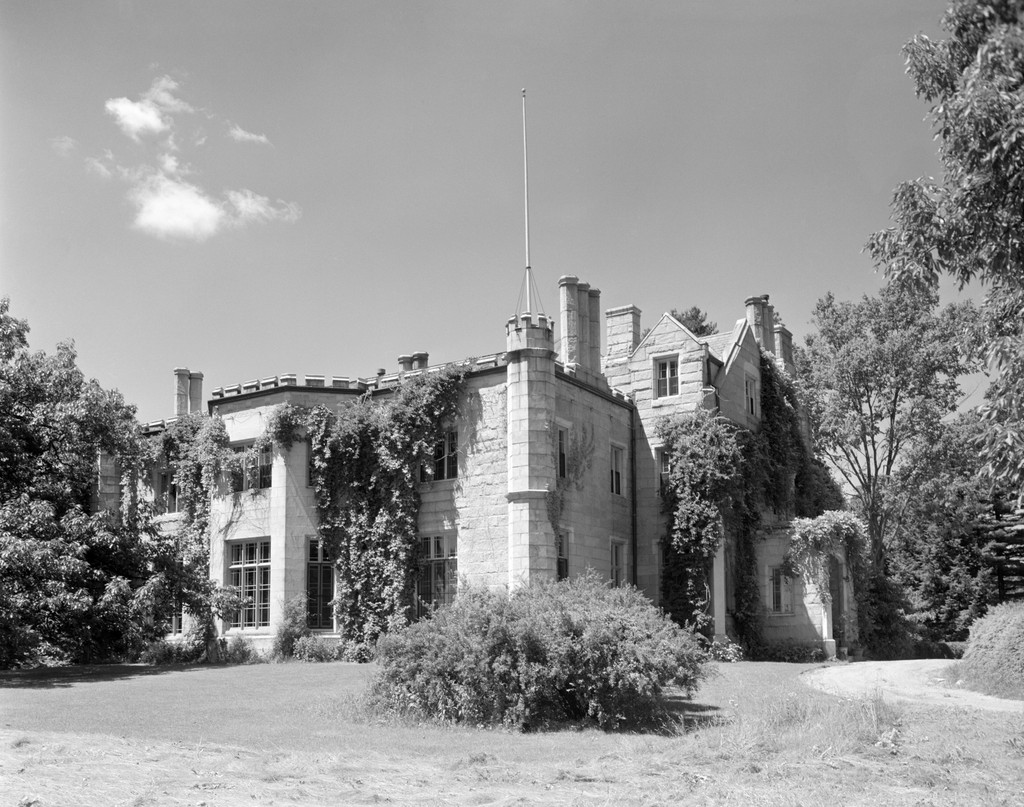
Stoneholm Manor is a historic estate tucked away in Sharon, Massachusetts, that remains one of the finest examples of a Second Empire style mansion and carriage house built of stone in New England. Stoneholm was built in 1865 for Horace Augustus Lothrop (1828-1898) within a year of his marriage to second wife, Sarah Gorham Swain. Horace A. Lothrop was a manufacturer and businessman with factories in Sharon and nearby towns and he invented innovative tools like hoes and wooden shanks for foot support in shoes and boots. He was also engaged in politics, serving in the state legislature and on the local school board. His country estate in Sharon is unique for its construction of locally quarried rock-face granite walls, fine mansard roof with cupola, and matching L-shaped carriage house, all in great condition. Stoneholm was listed on the National Register of Historic Places and remains a private residence.
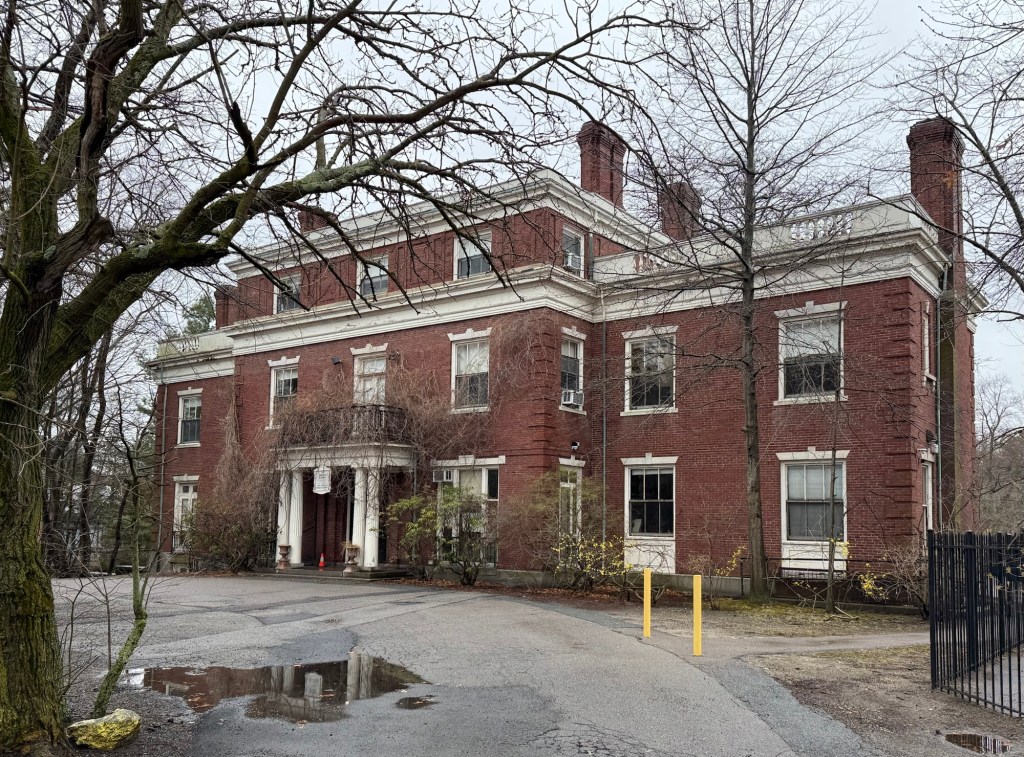
One of the finest estates in Brookline can be found here in the Cottage Farm neighborhood, just steps from Boston and the Charles River. This brick mansion was built in 1902 for Frederick Perry Fish (1855-1930), a prominent lawyer who also served as president of American Telephone & Telegraph Corporation from 1901 to 1907. One of the leading patent attorneys of his age, representing such clients as Alexander Graham Bell, Thomas Edison, and The Wright Brothers, by the time of his death he was believed to have appeared in more patent cases at the Supreme Court than any other lawyer. For his Brookline residence, Fish purchased an 1867 brick mansard-roofed home on the lot and hired the architectural firm of Winslow & Bigelow to ether modify the earlier home or demolish it and build entirely new. The result is this stately, three-story Neo-Classical mansion. Fish would die at his home in 1930, and the property would eventually be owned by the New England Hebrew Academy as a Jewish day school. While it is an institutional use, the facade is covered with climbing vines that are bad for the masonry and an asphalt paved front yard which detracts from the beauty of this estate. It appears to be near-original though, which is great to see!
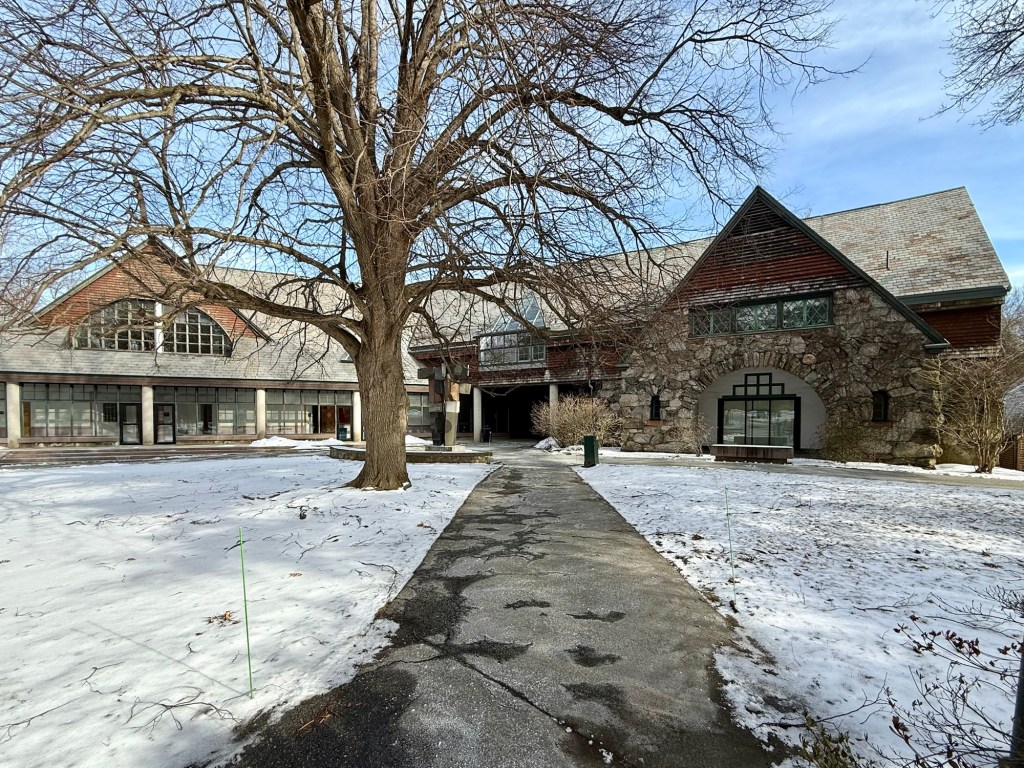
Built on the expansive grounds of “Roughwood”, a country estate in Brookline, Massachusetts, this former carriage house has seen many iterations in its lifetime. Like the mansion house, the carriage house is a blending of Queen Anne/Shingle styles with fieldstone and shingle construction, designed by the architectural firm of Andrews, Jacques & Rantoul. When the Roughwood Estate was purchased and converted to Pine Manor College, the carriage house was adaptively reused and added onto as the Annenberg Library with a large imaginatively designed wing by Shepley, Bulfinch, Richardson and Abbott completed in 1986. The building remains as a library as part of the newly established Messina College, a campus of Boston College, which opened in July 2024 for over 100 first-generation college students. Gotta love adaptive reuse!
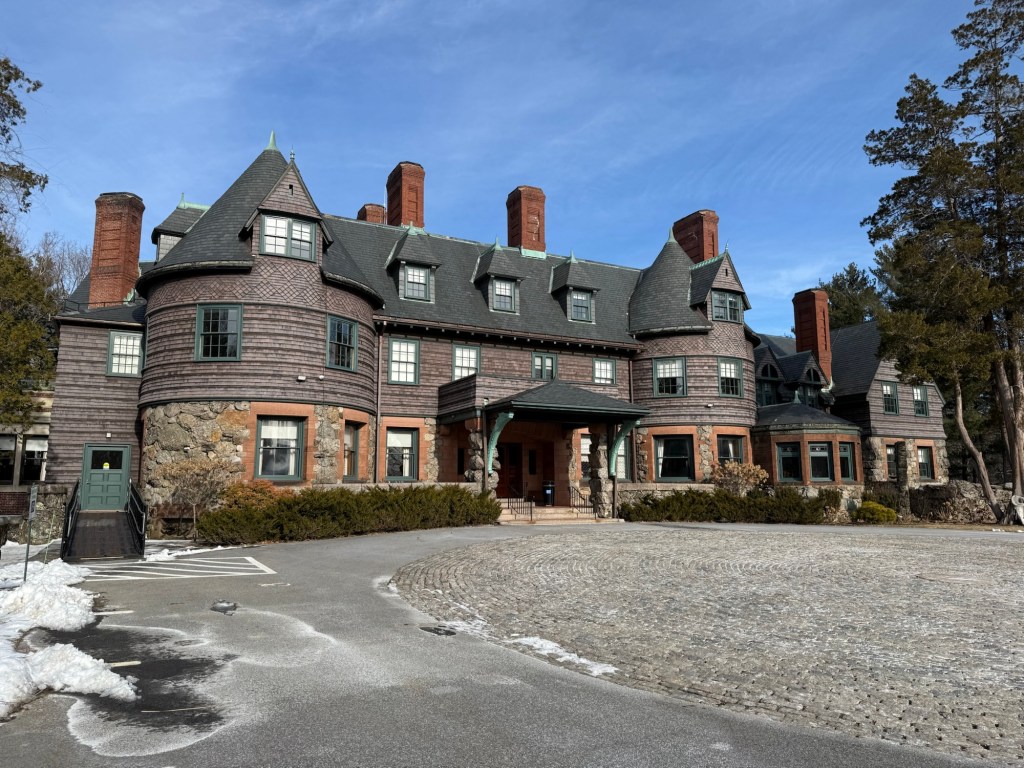
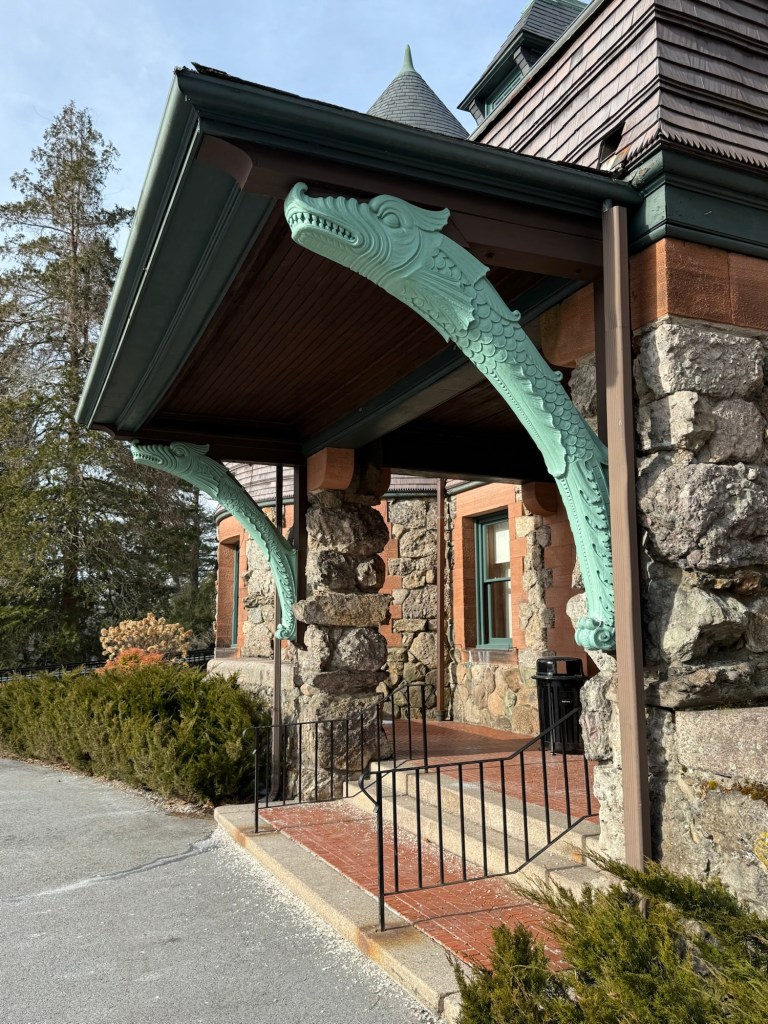
Roughwood is a historic estate house on Heath Street in Brookline, Massachusetts. The main residence and the various outbuildings on the grounds were designed by the Boston architectural firm of Andrews, Jaques and Rantoul, and built in 1891 as the summer estate of William Cox, a wholesale dealer in the footwear industry. Mr. Cox died in 1902 and the property was sold to Ernest Dane, the year before he married Helen Pratt, the daughter of Charles Pratt, a wealthy New York businessman and philanthropist. Mr. Dane was a banker who served as President of the Brookline Trust Company. The Dane’s owned the property for decades until the property was eventually purchased by Pine Manor Junior College in 1961. The estate house remained a centerpiece of the campus. In the early 21st century, Pine Manor College saw financial distress, and was saved by Boston College, who acquired the campus and its existing students as Messina College, which opened in July 2024 for over 100 first-generation college students. Architecturally, Roughwood is a high-style example of the Queen Anne/Shingle style of architecture. The mansion is built with a puddingstone and brownstone first floor and a second floor of varied patterns of wood shingles, all capped by a slate roof. The facade is dominated by towers and dormers and the great rustic entrance portico with dragon’s head brackets. To its side, a 1909 Tudor Revival addition served as a music room for the Dane’s family and while stylistically unique, is designed with impeccable proportions.
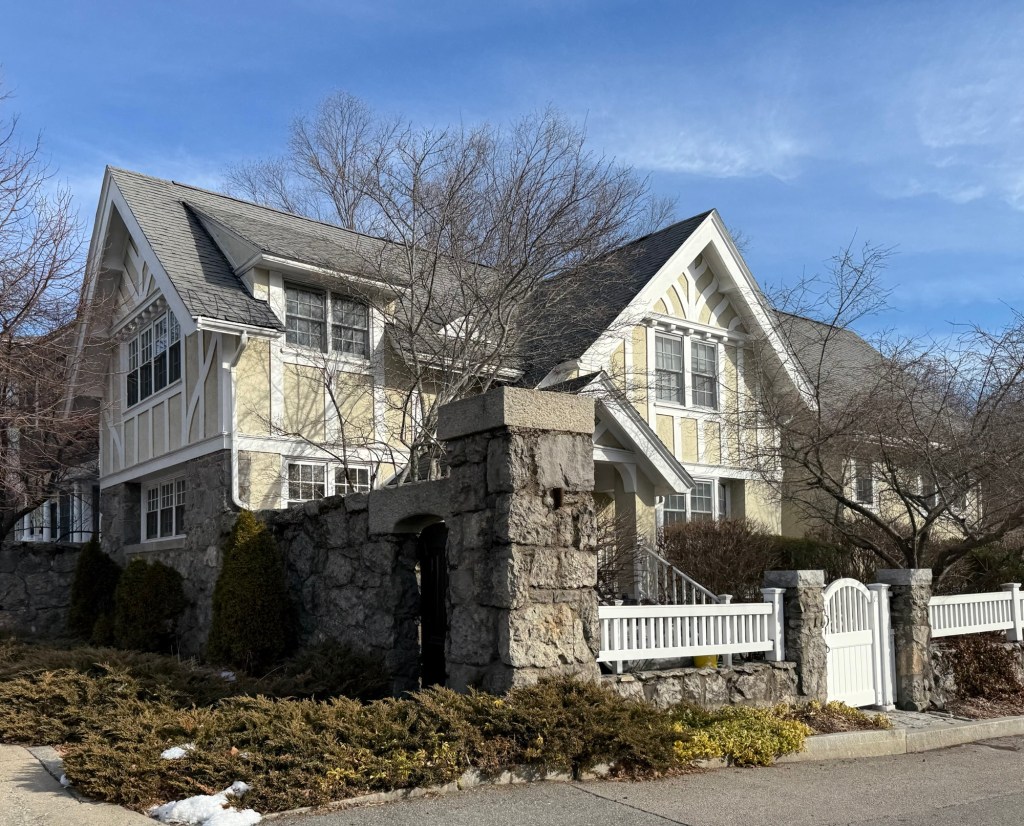
Besides the former Wright Carriage House (now the Soule Recreation Center), the only other extant building that was built on the grounds of the former John G. Wright Estate in Brookline, Massachusetts, is this structure, the historic gatehouse to the property. Built in 1907 at the same time as the manor house, the gatehouse was also designed by architects Chapman & Frazer and served as the entry to the expansive grounds with a room for the gatekeeper to sleep in overnight. The Tudor Revival style building is less ornate than the stone mansion, the half timbering and stucco work well to compliment the other buildings. While the formerly dark half timbering has since been painted a white, the building still maintains its character. While the remainder of the Wright Estate was subdivided and sold off by the heirs of next owner, wool merchant, Andrew Adie, the gatehouse remained and survived the destruction that befell the main manor. The old gatehouse was converted to a full-time residence and remains to this day.
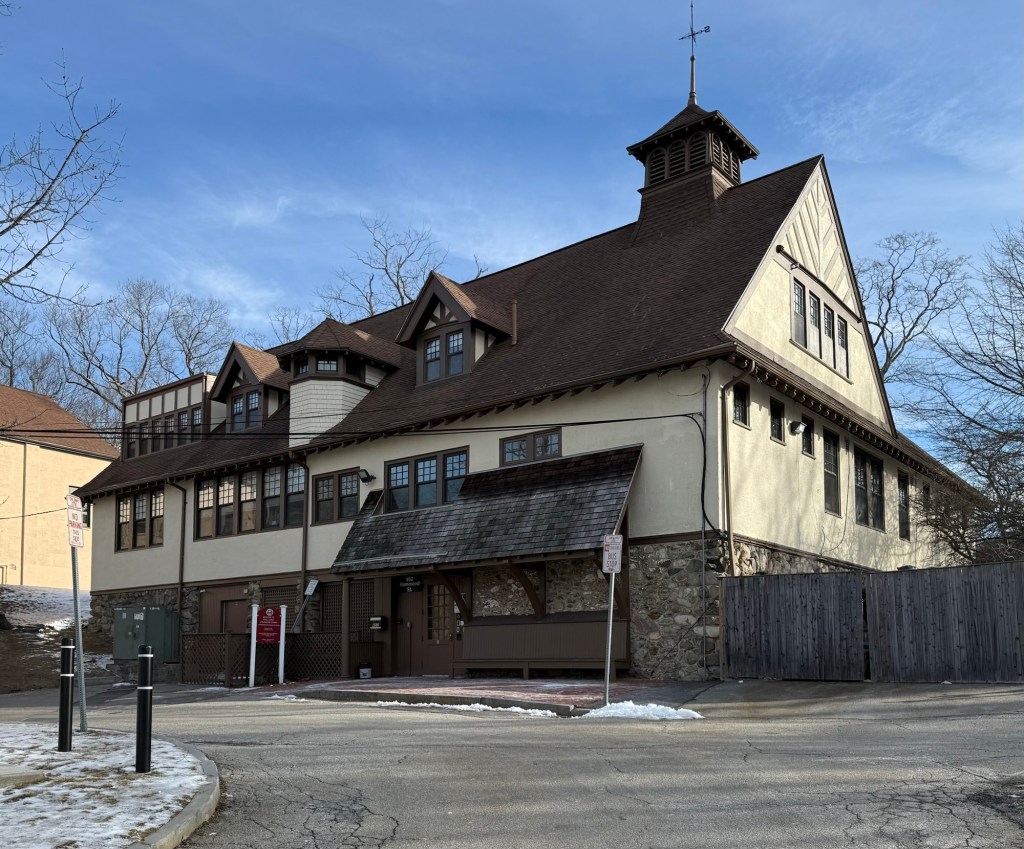
The Soule Recreation Center in Brookline, Massachusetts, was originally the stable and carriage house on the John G. Wright estate. John Gordon Wright (1843-1912), was a Boston wool merchant who purchased farmland on this site in the 1890s and hired architects Chapman & Frazer , to design an estate house (since demolished), and this building to serve as a carriage house and stable for horses. The stone Tudor Revival style mansion house was complemented by the earlier wood-frame Tudor carriage house, resembling an English manor with grounds designed and laid-out by the Olmsted firm. In 1942, the property was purchased by the Rivers School (now located in Weston) and converted into classrooms and administrative offices for the private school. When the school moved to Weston, the Town of Brookline in 1961 bought property for recreational purposes. Sadly, in 1967, the mansion house burned down, but the carriage house and gate lodge remain as lasting remnants of a once great Brookline estate.
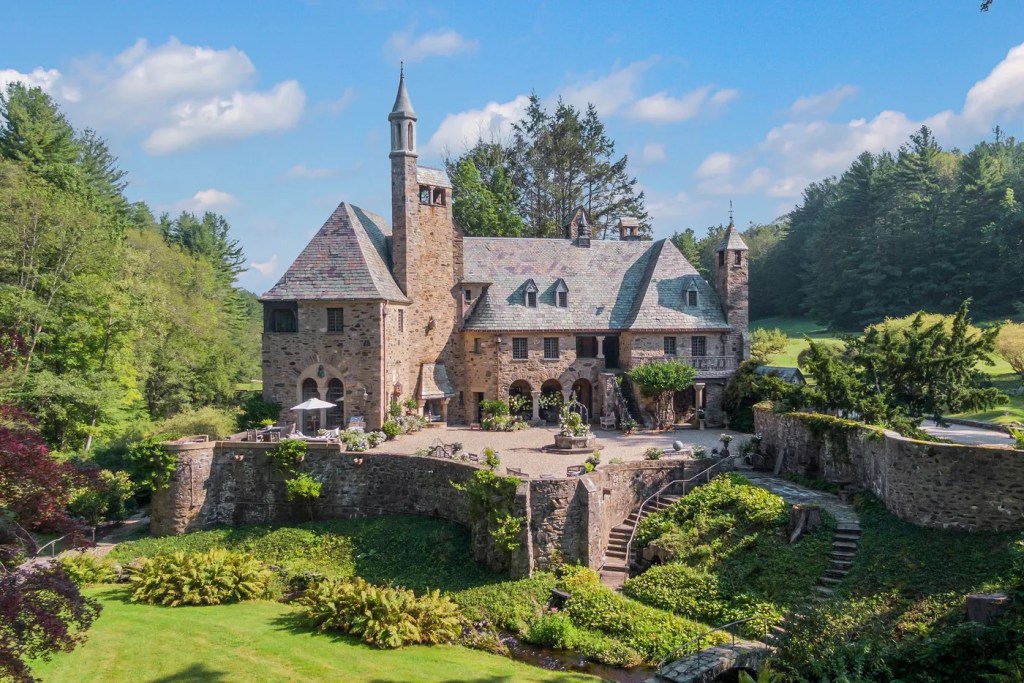
A castle can be found in the small town of Cornwall, Connecticut! Set amongst 275 acres of woodland and streams, with several outbuildings on the property, this whimsical castle looks like it was dropped here from Cornwall, England, but it actually dates to the 1920s. Hidden Valley Castle, had its beginnings when socialite Charlotte Bronson Hunnewell Martin envisioned building a unique country retreat for herself and her husband, Dr. Walton Martin, in the Litchfield Hills of Connecticut as a summer retreat. Just before this, Charlotte had bought a group of 20 brownstones in Manhattan on 48th and 49th Streets, between Second and Third Avenues, and converted them into charming townhouses around a central Italian-inspired garden. Called Turtle Bay Gardens, the houses were highly acclaimed and almost immediately attracted prominent and celebrated residents. The Cornwall Castle was designed by architect, Edward Clarence Dean, who also redesigned the Turtle Bay Gardens for the couple. Dr. Martin imported many of the materials as well as the 100 workmen required to build the castle, a project that lasted five years. Charlotte would also have a cottage built on the estate and hired young Italian artist, Vincenzo Rondinone, to be her resident artist on the estate to create unique vases, bowls, and pots to be used at the house and to be given as gifts to visitors and friends. The property was restored in recent years and put up for sale, with the cottage sold as a separate dwelling.
Tucked behind the Jesse Lee Memorial Church on Main Street in Ridgefield, you will find this stately Queen Anne/Tudor Revival estate. The ‘Ashton Croft’ Manor House, now called Wesley Hall, is part of the Jesse Lee Memorial United Methodist Church complex and it has been modified several times blending two distinct styles into a single, pleasing composition. This house was originally constructed by Henry and Elizabeth Hawley circa 1892 in the Queen Anne style. The house was later sold to Electa Matilda Ziegler, a wealthy New York City widow in 1912, who reconfigured the structure to include half-timbering on the gables and upper story walls in the Tudor Revival style. She spent summers at a mansion in Darien, Connecticut, and would sell her Ridgefield property to Sanford H.E. Freund, a New York City attorney. The local order of Odd Fellows bought the estate from the Freund family in 1956. Three years later, the organization sold most of the property — retaining the carriage house for its lodge — to Jesse Lee Methodist Church, which planned to eventually build a new church there to replace the old one at Main and Catoonah Streets. Today, the entire former Ashton Croft estate is owned by the local Methodist Church and is known as Wesley Hall.
A massive amount of land on the eastern edge of the Kennebec River was acquired by Sylvester Gardiner in the 18th century, but confiscated by the state during the American Revolutionary War (because Gardiner was a Loyalist who fled). Years later, the land was recovered by Gardiner’s grandson and heir, Robert Hallowell Gardiner. Upon coming to age, Robert Hallowell Gardiner returned to Maine in 1803, after graduating from Harvard, ready to straighten out and manage the holdings willed to him by his late grandfather Dr. Sylvester Gardiner, the founder of Gardiner, Maine. He came with no inclinations or training in business, but his cousin Charles Vaughan in Hallowell helped in steer him on the right course. Starting at the age of 25, Robert Hallowell Gardiner embarked on the task of developing an entire city, Gardiner, but with profit and investment in mind over the next sixty-one years. His business enterprises included: six dams, saw and gristmills, shipyards, foundries, a brick mill, broom making industries, furniture manufacture, paper making and the ice-harvesting business. He married Emma Jane Tudor of Boston (who he likely met during his time at Harvard, in 1805. They soon after built a home for their family and welcomed friends and family to stay there on the massive property. The first Oaklands estate burned in 1834 and the present Gothic Revival mansion on the site was built in 1835-37. Designed by English-born architect Richard Upjohn, Oaklands typifies an English country manor house and features a rectangular hip roof, hooded window moldings, turrets and elaborate stonework. Oaklands is among the first and finest 19th-century rural villas in the State of Maine and is among the most significant in the country. The home remains on over 310-acres of sprawling land which looks out over the Kennebec River, and is owned by the Gardiner family to this day!
Born into the heart of Boston Brahmin society (Boston’s elite class), Robert Gould Shaw II (1872-1930) had a life of great opportunity, but full of tragedy. Robert was born in Boston and was a first cousin of Robert Gould Shaw, the famed military officer who accepted command of the first all-Black regiment (the 54th Massachusetts) in the Northeast. Robert II had a life of leisure, and enjoyed his position in society by drinking and enjoying elite sporting events. He became a wealthy landowner around Boston, and international polo player of the Myopia Hunt Club in the North Shore. He gained a reputation for alcohol abuse and promiscuity and divorced his first wife after just four years, she would later move to England and marry Waldorf Astor, and become the first woman seated as a Member of Parliament. The couple’s only son Robert Gould Shaw III followed his mother to England, but was eventually imprisoned there for six months for “homosexual offenses”. His alcoholism and his mother’s death, may have led to his suicide in 1970. Robert Gould II in Boston, remarried and purchased land in Oak Hill, Newton to build a country estate. He hired James Lovell Little Jr. to design the Tudor style property with a mansion, and various outbuildings including a carriage house and stable. As the Gilded Age gave way to the Progressive Era and eventually the Great Depression, the Shaw fortune collapsed. Shaw died in New York in 1930. The estate was later purchased as the new home to Mt. Ida College, now a regional campus of UMass.
As another piece of this interesting family’s history… Louis Agassiz Shaw II, one of Robert’s four children in his second marriage, had all the opportunities of his father, as he attended Harvard, had a sizable bank account, but was a recluse and had some mental issues and paranoia. Like his elder half-brother Robert Gould Shaw III, and father, Louis struggled with depression and alcoholism and in 1964, he strangled his 64-year-old maid, who he said was plotting to murder him in his sleep. He confessed but plead not guilty; he was committed to Danvers State Hospital and later McLean, where he lived for 23 years until his death. After which, much of his art collection, which he intended to donate to the Fogg Museum at Harvard, was discovered to be fakes.


 Buildings of New England