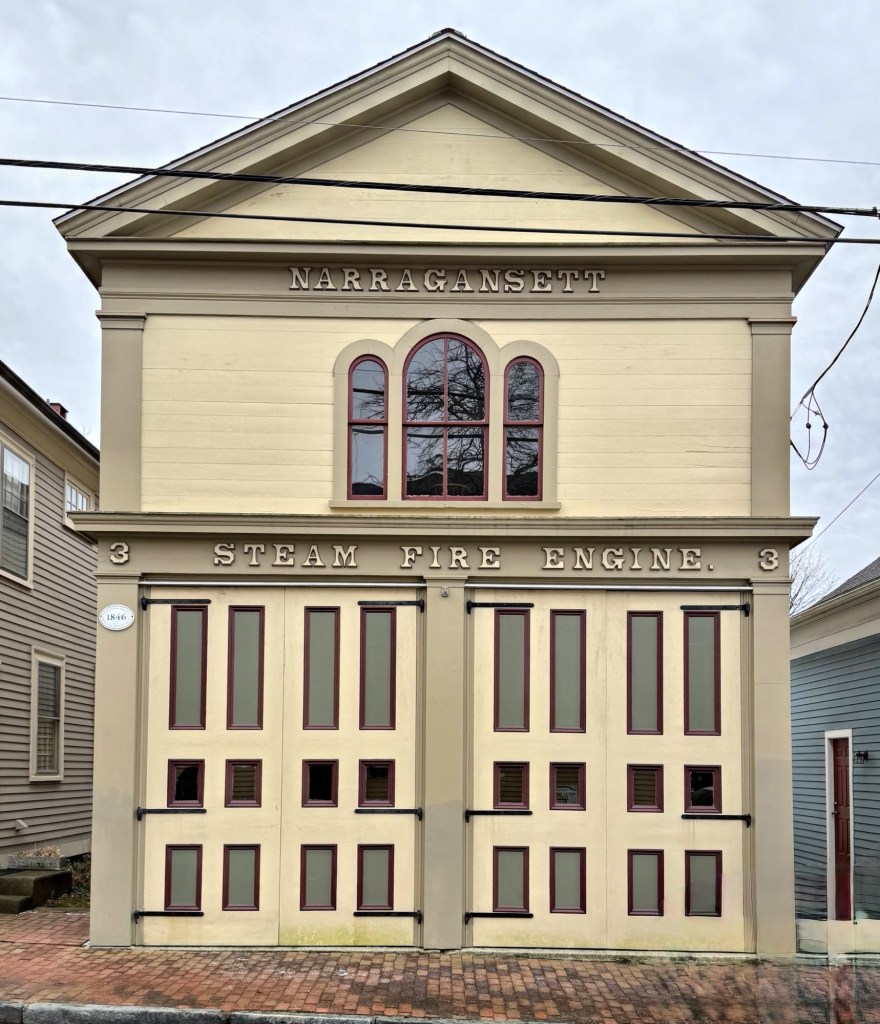
The Narragansett Engine Company No. 3 Station is an absolutely charming two-story building tucked away on Baker Street in Warren, Rhode Island, and is one of the oldest extant historic fire stations in New England. Built in 1846, the building features a flushboard-façade, pedimented-gable end oriented to the street, paneled double-leaf engine doors, and a rundbogenstil Palladianesque window centered on the second story. The small fire station was built to house, “Little Button”, a fire engine manufactured in Waterford, New York. This building served as a fire station well into the 20th century, and was restored decades ago by local preservationists. The building is open by appointment and houses the Warren Fire Department Museum.
Located next door to the Randall House (last post) on Baker Street in Warren, Rhode Island, this early building has some history! Constructed in 1796 by the Washington Association, Inc., this two-story Federal period building is an architectural and historic landmark in the immensely beautiful town of Warren. The elongated building is fairly plain in plan, but is adorned by corner quoins, elaborate pedimented entries, ornate cornice, and (now filled) ocular windows in the gable ends. It is believed that many of the timbers used in the building are oak beams that were formerly part of the British Frigate Juno and other ships which were sunk in Newport harbor during the American Revolution. Brother Sylvester Child, a member of the building committee purchased the old ships and floated the timbers up Narragansett Bay and into the Warren River and his shipyard at the base of Miller and Baker streets. The rib cuts in the oak plate beams can clearly be seen in the curvature of the ceiling in the lodge room.The Lodge was likely built by local carpenters using Asher Benjamin’s plan books for the detailing and was utilized as the Warren Town Hall and the Warren Academy, a private school, in the early 1800’s with meeting space for the local masonic lodge. The building has lost its original cupola at the roof, and its principal interior meeting room was redone in 1914 with elaborate murals by the Rhode Island artist Max Muller, some of which in Egyptian depictions.
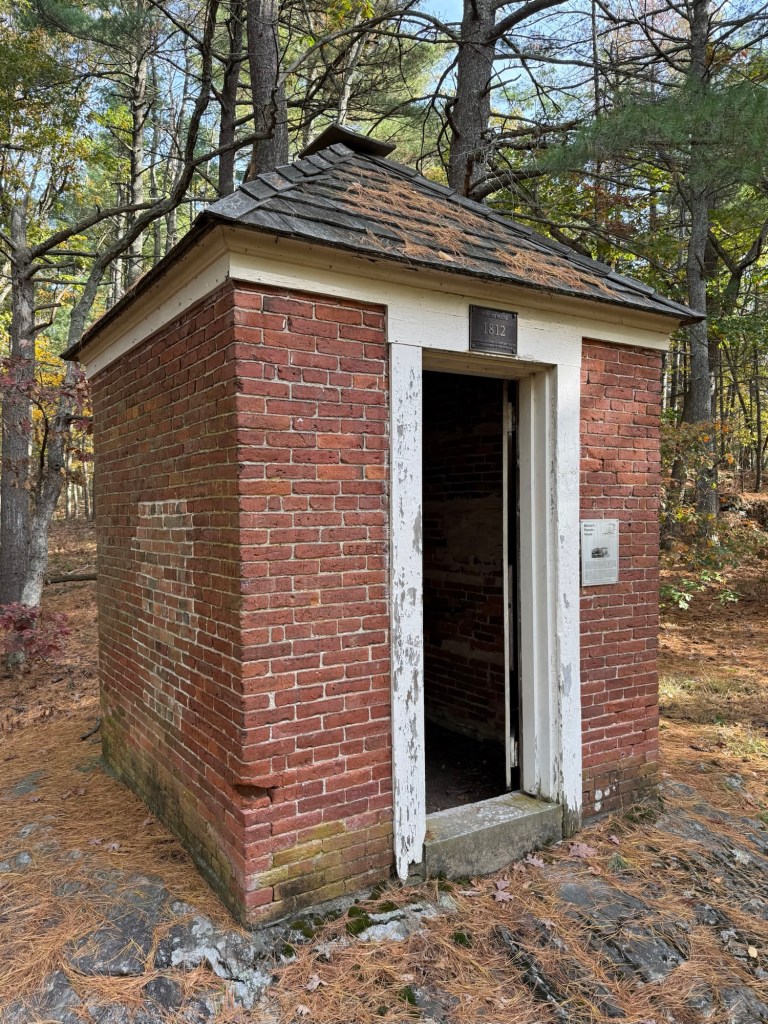
Hidden away in the woods behind the Bolton Town Hall, this small brick structure sits atop a rocky outcropping and showcases a piece of early history we often do not think about. Built in 1812 as a powder house, a storage facility far from homes and businesses to store the town’s supply of gunpowder, musketballs and cannonballs, the structure remains as the town’s oldest extant municipal building. Since the founding of the colonies, the procurement and storage of ammunition had been the responsibility of local governments. Before this structure was built in the forest, Bolton‘s gunpowder and ammunition had been kept under the meetinghouse pulpit, not the best place suitable for highly explosive storage. The structure is a well-preserved example of a typical early 19th-century powder house, built of brick manufactured in town, laid in common bond, measuring just over seven-feet square with a pyramidal wood shingle roof.
Near the entrance to the Brookside Cemetery in the charming village of Chester, Vermont, these two very different looking buildings were constructed for one purpose, death. Before the proliferation of funeral homes and cremation, infrastructure for the dead was a necessary piece of the built environment for towns and cities all over the region. The wood-frame building seen here was built as a hearse house, which would shelter the horse-drawn hearse for the town. Prior to the advent to funeral homes, most wakes were held at the home of the deceased, after-which, the body would be transported by the horse-drawn hearse to the cemetery for burial. This was followed by a memorial service at the nearby church. If the ground was frozen or if the family did not yet have the funds to bury their family member, the body would be held in the public tomb until the burial. The Chester Public Tomb dates to 1850 and was built by local mason, Arvin Earle from stone quarried near Gassetts, a hamlet in the north part of Chester that was shipped to Chester Depot by the newly completed railroad. While no longer in use, these two vernacular buildings hold a very important history of the town and have been lovingly preserved by local residents.
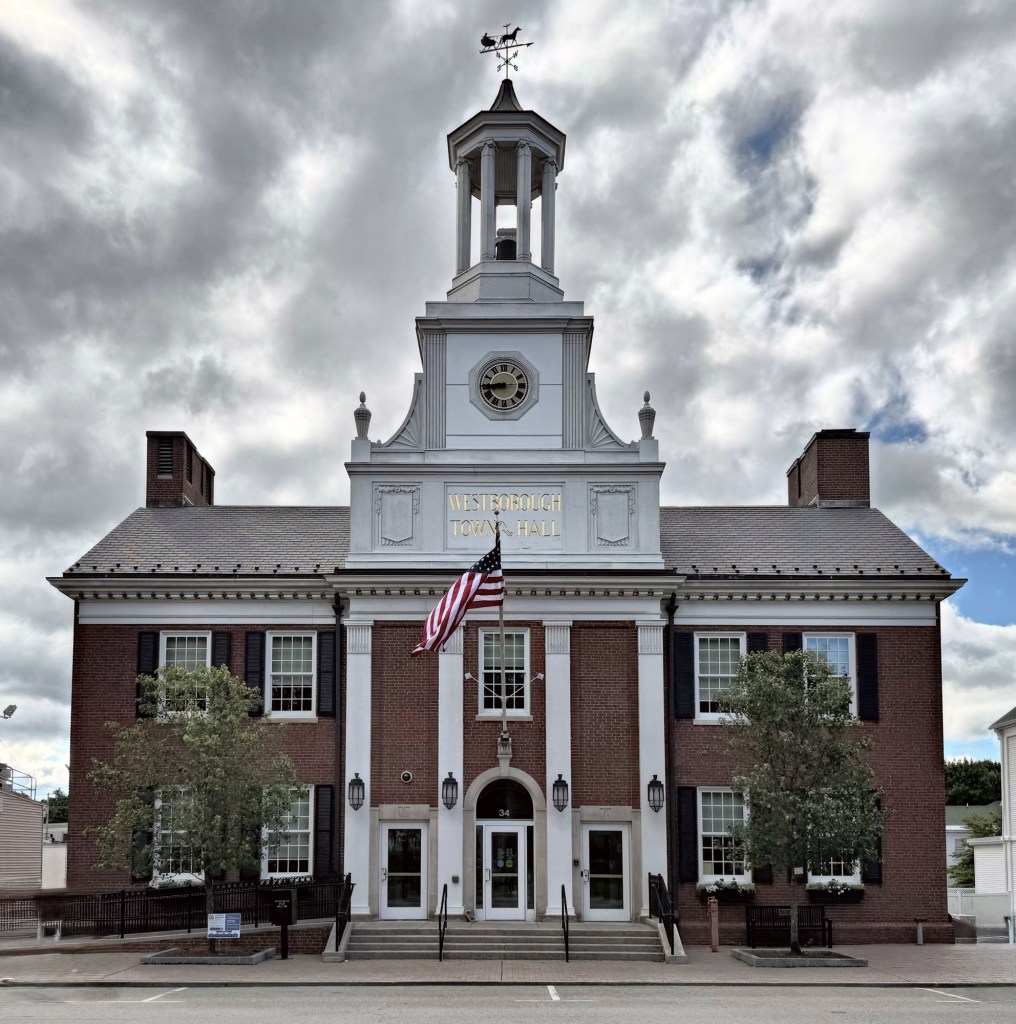
Welcome to Westborough (sometimes spelled Westboro), Massachusetts, a suburban town in Worcester County that has a lot of history! Westborough was first settled by colonists in 1675, when a few families had settled on land in the “west borough” of Marlborough, which was settled decades earlier. Before this, the land was occupied by the Nipmuc Indians, who hunted and fished near Cedar Swamp and Lake Hoccomocco. The town grew as an agricultural center with turnpikes crossing through connecting Boston to Worcester and other points. Later connections from rail and later the Mass Pike, had allowed for rapid growth and commercialization of the current population of over 22,000 residents. After WWI, the town’s outdated wood-frame meetinghouse was deemed inadequate for the growing population and higher demand for quality services. The meetinghouse was demolished and soon-after replaced with this handsome Town Hall in 1929. Designed by Boston architectural firm, Kilham, Hopkins & Greeley, who specialized in thoughtful infill developments and were among the best to design in the Colonial Revival style. The building was highlighted in architectural publications in 1930 with one stating, “An ultra-modernistic building on the elm shaded street of this Massachusetts town would have been an intrusion and would have been felt as such by the citizens, but the designers felt that it was entirely possible to combine the new ideas with the well-known red brick and white cupola of the native idiom, and the result is a modern building harmonizing perfectly within its environment.” I couldn’t agree more!
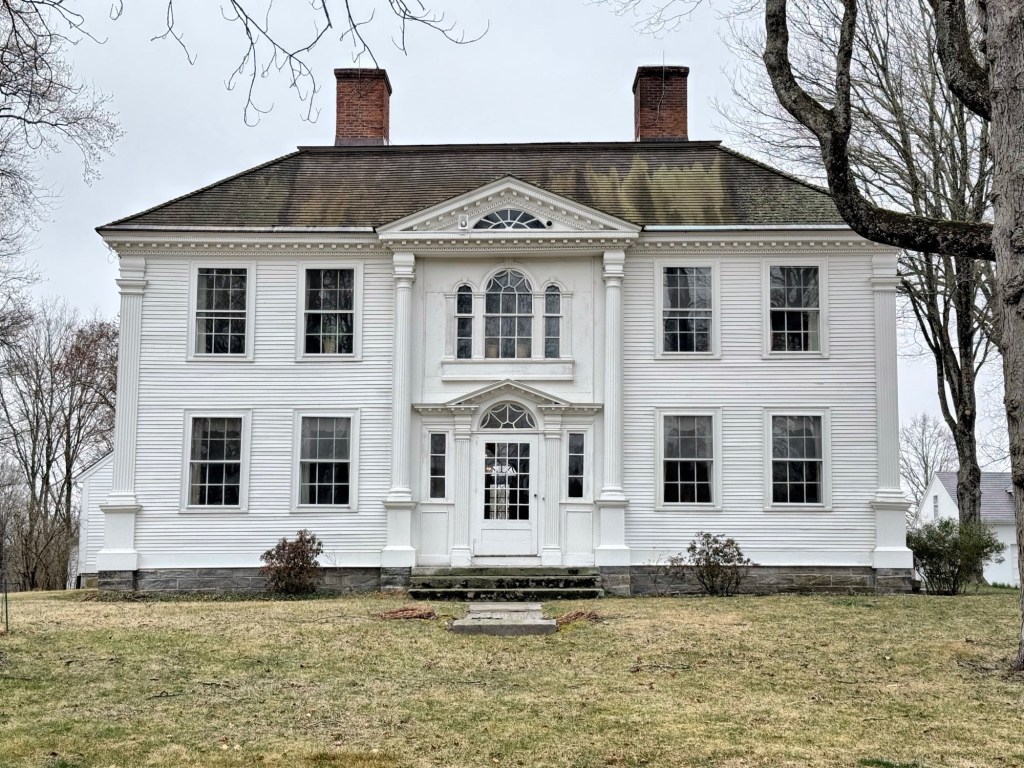
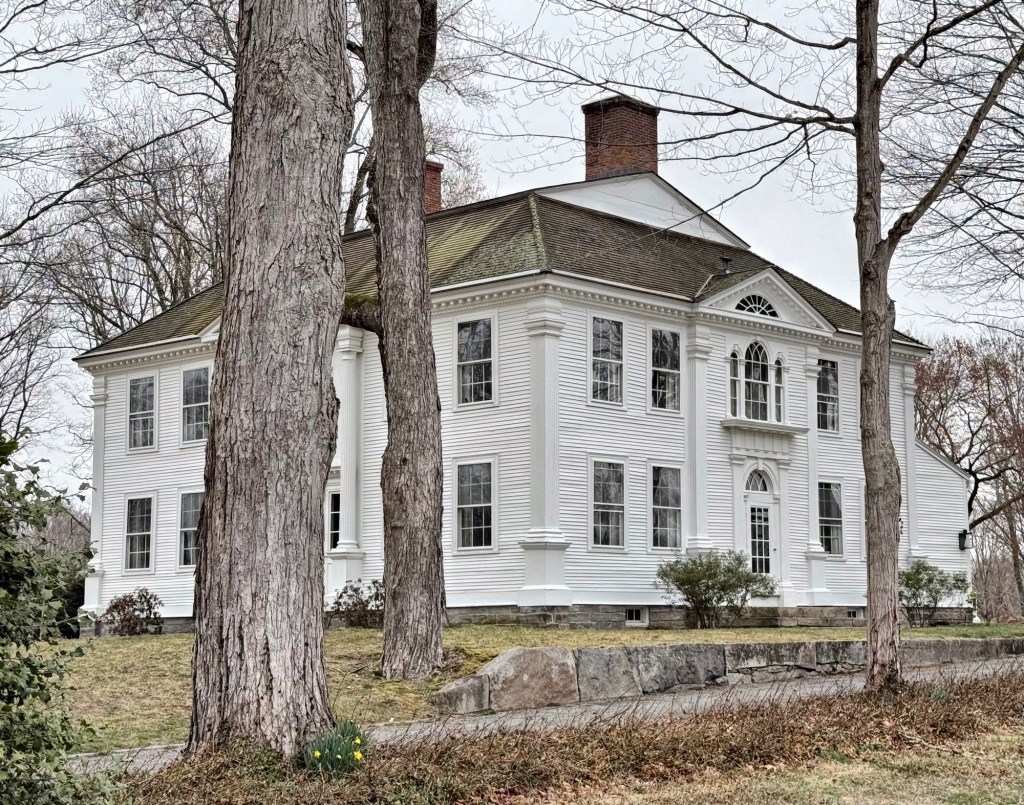
The Captain John Clark Housein Canterbury, Connecticut, is one of the finest examples of the Federal style of architecture in New England, and has remained in a fine state of preservation since its construction in the early 19th century. The house was built by 1802 for John Clark (1731-1834), who purchased an earlier home on the site from and had it either taken down or enlarged to its present appearance. The mansion is symmetrical with five bays, central entry and twin chimneys projecting through the hipped roof. The central bay is a showstopper with its triangular pediment at the roofline containing a fanlight, Palladian window at the second floor, and main entrance with its own pediment, sidelights, fanlight transom, all framed by two-story columns. The house’s south facade is equally beautiful with its own Palladian window and entrance.
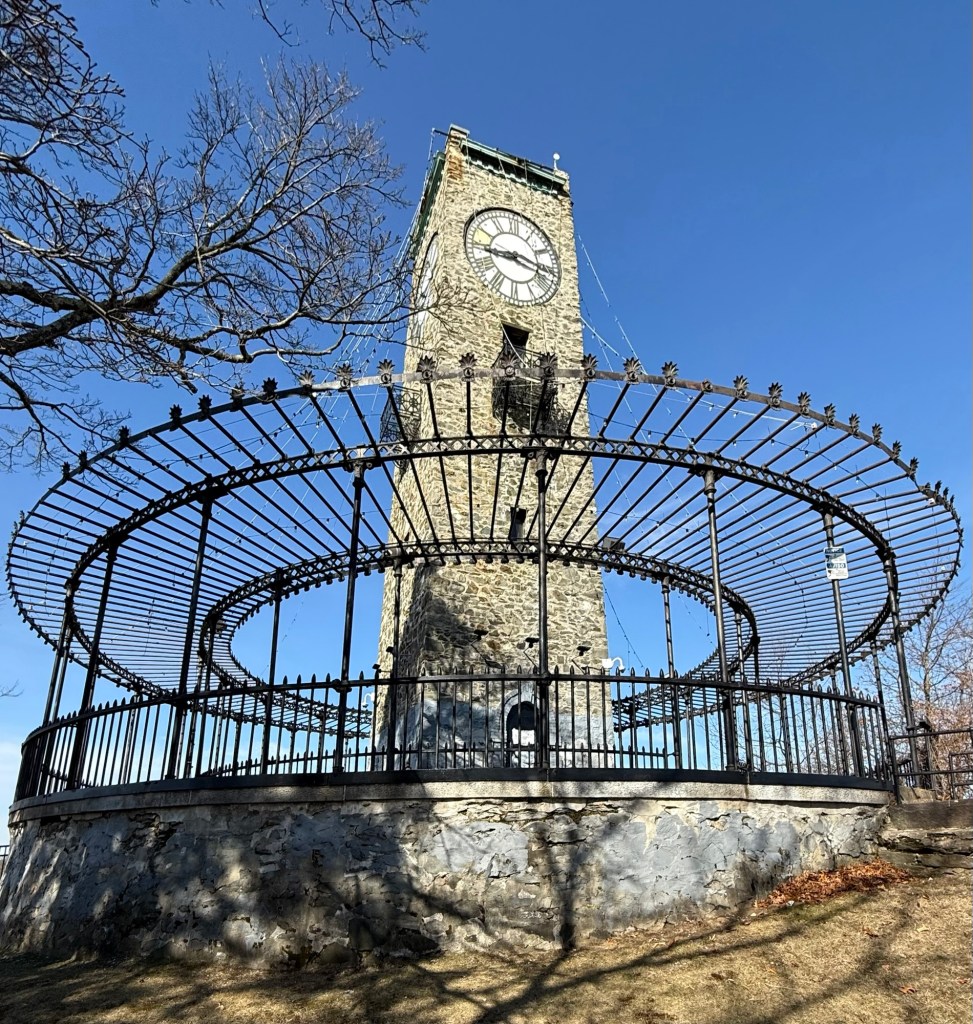
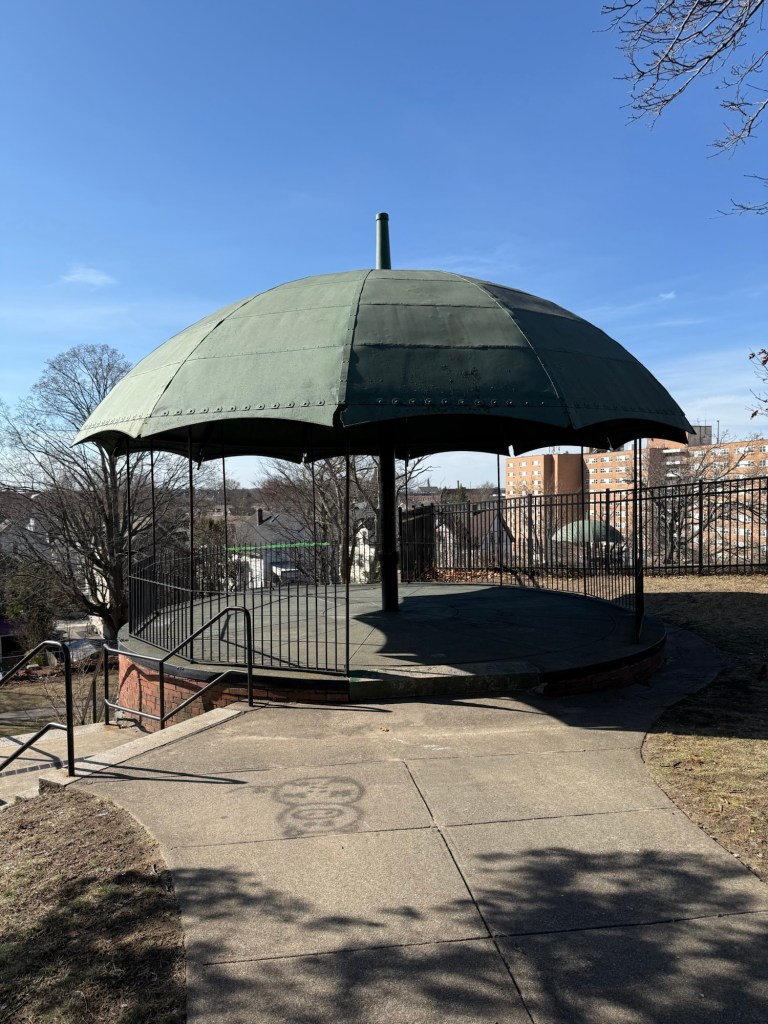
The crown jewel of the nearly one square mile city of Central Falls, Rhode Island, is Jenks Park, the only large park in one of the densest cities in America. The land was a gift of Alvin Jenks, a descendant of the family which had been among the town’s earliest settlers and one of its leading industrial families, and provided a much-needed recreational/open space for the dense industrial city. In 1890, planning began on the park with consists of hilly terrain cut through by paved paths, rocky outcroppings, and large metal gazebos which were fabricated at the nearby Fales and Jenks machinery works. At the crest of the park’s hill is Cogswell Tower, a clock and observation tower given by a former resident, Caroline E. Richards Cogswell. The stone tower was designed by architect Albert Humes, who ironically, was serving as mayor of Central Falls at the time, which may represent somewhat of a conflict of interest to gain the commission… The Cogswell Tower stands 70-feet-tall and is constructed of rough stone with a pyramidal roof that was once surmounted by an eagle. Its most remarkable aspect, a circular, iron structure which surrounds the base appearing from below as a sort of Hula-Hoop to the tower. Jenks Park and the iconic Cogswell Tower remain as a source of pride for the City of Central Falls.
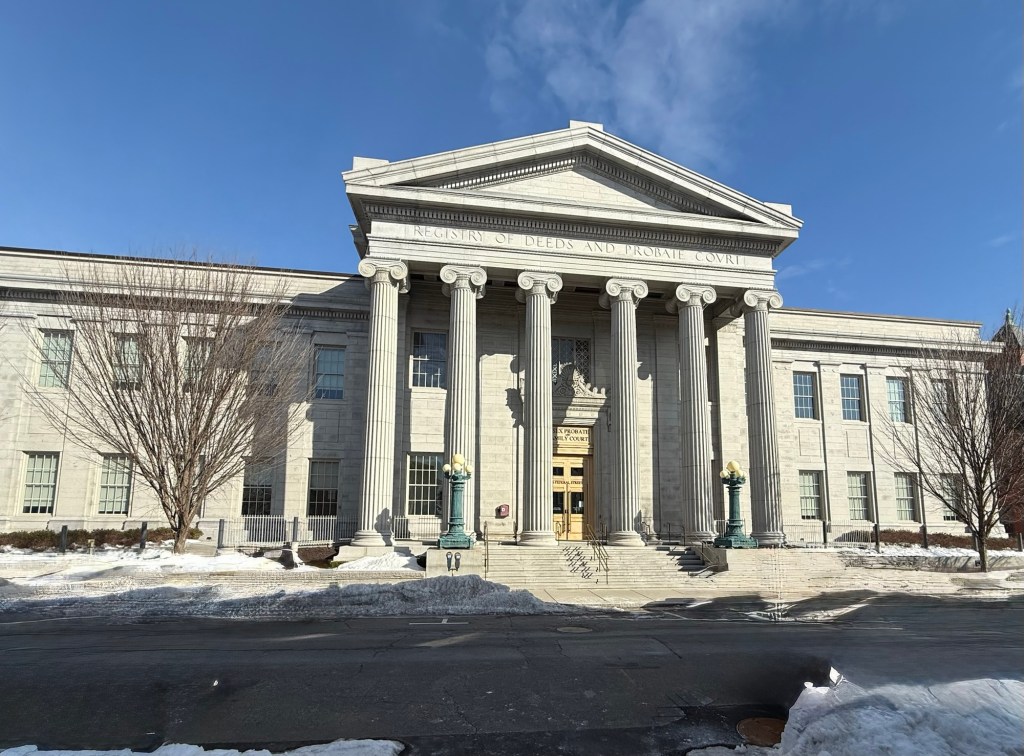
The Essex County Registry of Deeds and Probate Courthouse on Federal Street in Salem, Massachusetts, was built in 1909 from plans by Boston architect, Clarence Blackall. The Neo-Classical courthouse adds to the rich tapestry of Civic buildings there, showcasing the ever-evolving tastes in architecture as the buildings become more contemporary as you move westward down the street. The two-story granite and cast-stone faced brick masonry building is cross-shaped in plan, consisting of a three-bay wide gable-end entrance with Ionic porch of six fluted columns supporting a dentilled entablature and pediment. The central bay within the entry porch contains a large double-door entrance with elaborate architrave and a scrolling pediment incorporating Classical motifs and a Greek god bust. The building underwent a massive restoration in 2017, and was renamed the Thaddeus Buczko Building after retired First Justice Thaddeus M. Buczko.
The General Israel Putnam Housein Danvers, Massachusetts, was built circa 1648 by Lieutenant Thomas Putnam on farmland that then consisted of 100 acres. In 1692, his youngest son, Joseph Putnam, lived here, inheriting the property over his half-brother, Thomas Putnam, Jr. (1652-1699), causing friction within the family. During the infamous witch trials and hysteria in Salem Village, Joseph Putnam was one of two people who took notes during the examinations of the first three to be accused of witchcraft in 1692 – Sarah Good, Sarah Osborne, and Tituba. From that point forward, he was one of the most outspoken opponents of the proceedings, which put him in direct conflict with most of the Putnam family, especially that of his half-brother Thomas. Fearing accusations against him by his half-brother, Joseph was said to have kept horses saddled at all times, ready to escape at a moment’s notice. He was never accused, though Thomas Putnam was responsible for the accusations of 43 people, and his daughter was responsible for 62. In 1718, Israel Putnam, the son of Joseph Putnam, and later Commander of the colonial troops at the Battle of Bunker Hill, was born in this house. It is the only extant structure with direct ties to Commander Putnam. During the Battle of Bunker Hill, Putnam is thought to have ordered William Prescott to tell his troops, “Don’t fire until you see the whites of their eyes.” This command has since become one of the American Revolution’s notable quotations. It was given to make the best use of the low ammunition stocks that the troops had. The Putnam House remained in the family into the 20th century, and due to highway and commercial expansion, the property now sits in the middle of a cloverleaf intersection of two highways. The house was given by the Putnam family to the Danvers Historical Society in 1991, but as of 2020, the Putnam family once again owns the property. The house is not holding up well and I could not locate plans for restoration or preservation of it online. This house deserves to be preserved.
Presently owned and occupied by the New Ipswich Historical Society, this handsome brick building was originally constructed in 1829 as a schoolhouse for young students in town. The structure is located on Main Street and replaced wood-frame school that was located on the other side of the road. Almost immediately after it was built, the building and its location were heavily criticized as early as 1847. There were up to 92 pupils in its two rooms, both of which were accessed by a central entrance, causing those entering and leaving to disrupt both classrooms. Additionally, the closeness to the road caused noise and dust to enter the classrooms. The school closed in 1860 and was used for a time as a blacksmith shop before it was acquired by the New Ipswich Historical Society in 1939.






 Buildings of New England
