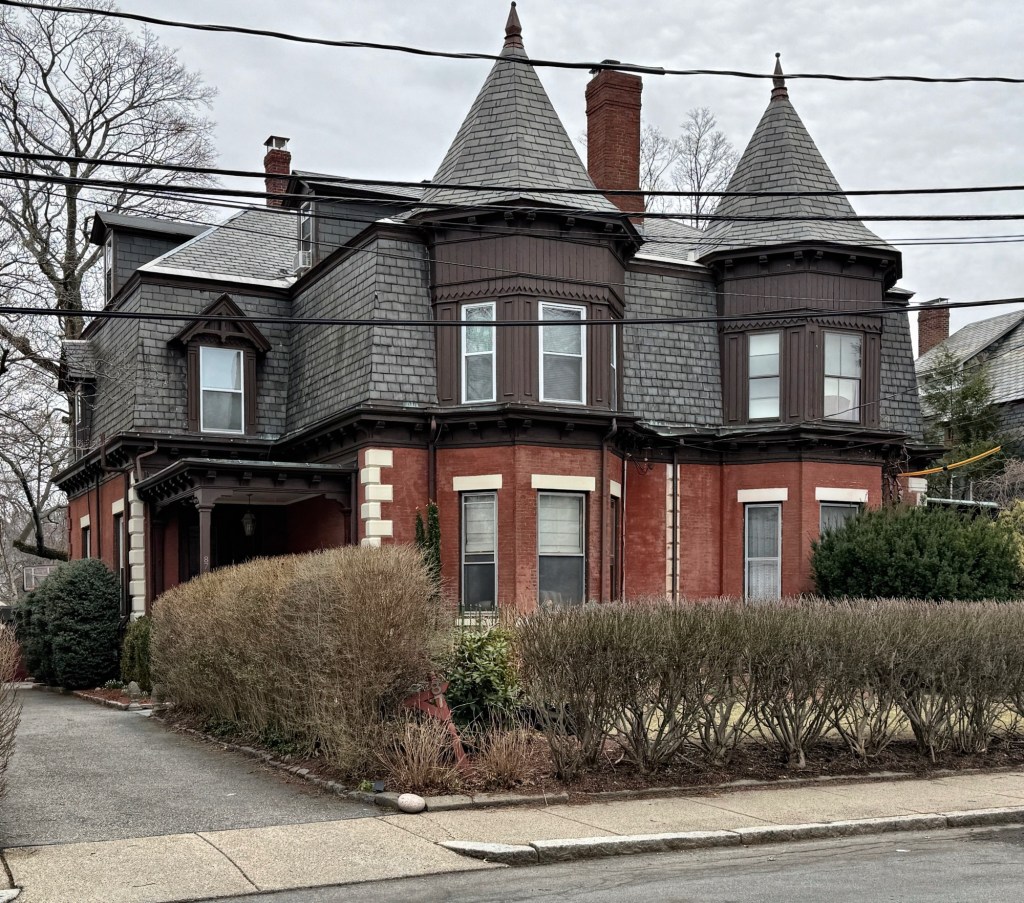
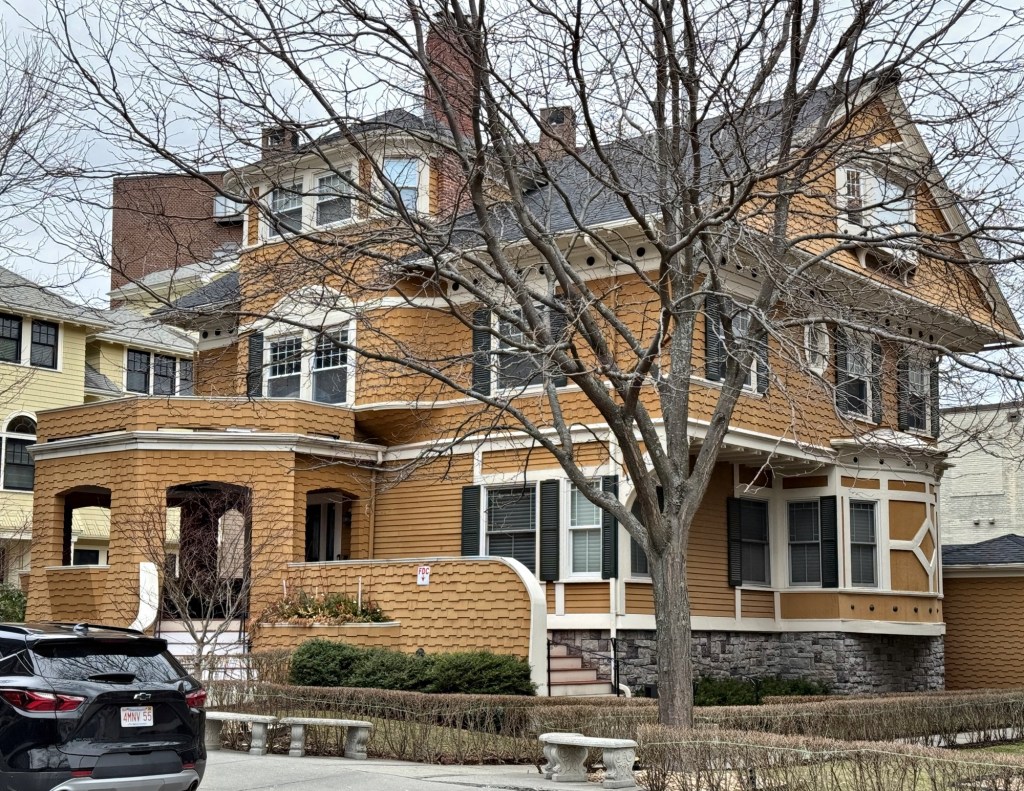
Built in 1881 as an eclectic example of a Second Empire and Queen Anne style Victorian double-house, this charming residence on quiet Perry Street in Brookline, Massachusetts, shows that gentle density like double-houses and three-deckers provides needed housing without disrupting neighborhood character. The property was built for George Gibson and subsequently rented to two families as an investment. In the mid-20th century, half of the double-house was purchased by Michael Dukakis and his wife, Katharine “Kitty” (Dickson) Dukakis. Michael Dukakis would become a prominent politician, first being elected as a Member of the Massachusetts House of Representatives in 1963 later serving two terms as Massachusetts Governor. He was later nominated by the Democratic Party for president in the 1988 election, but ultimately lost to the Republican nominee, George H. W. Bush.
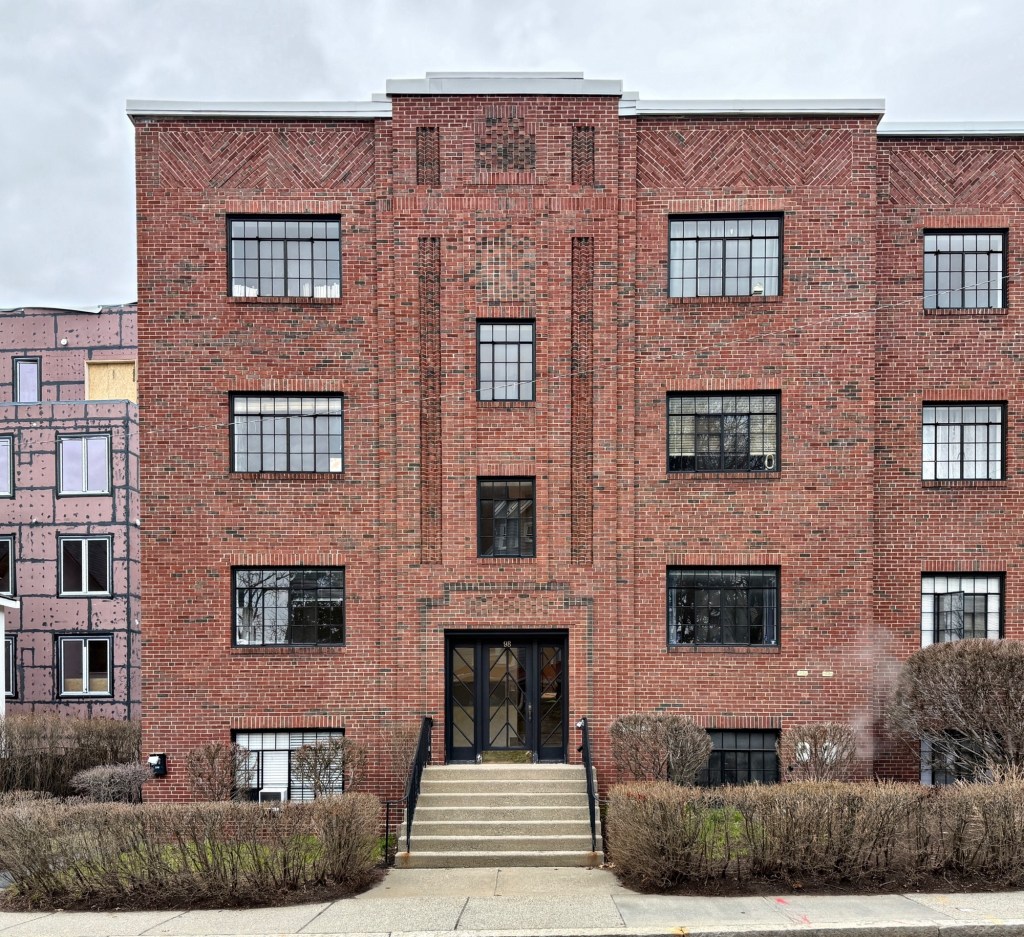
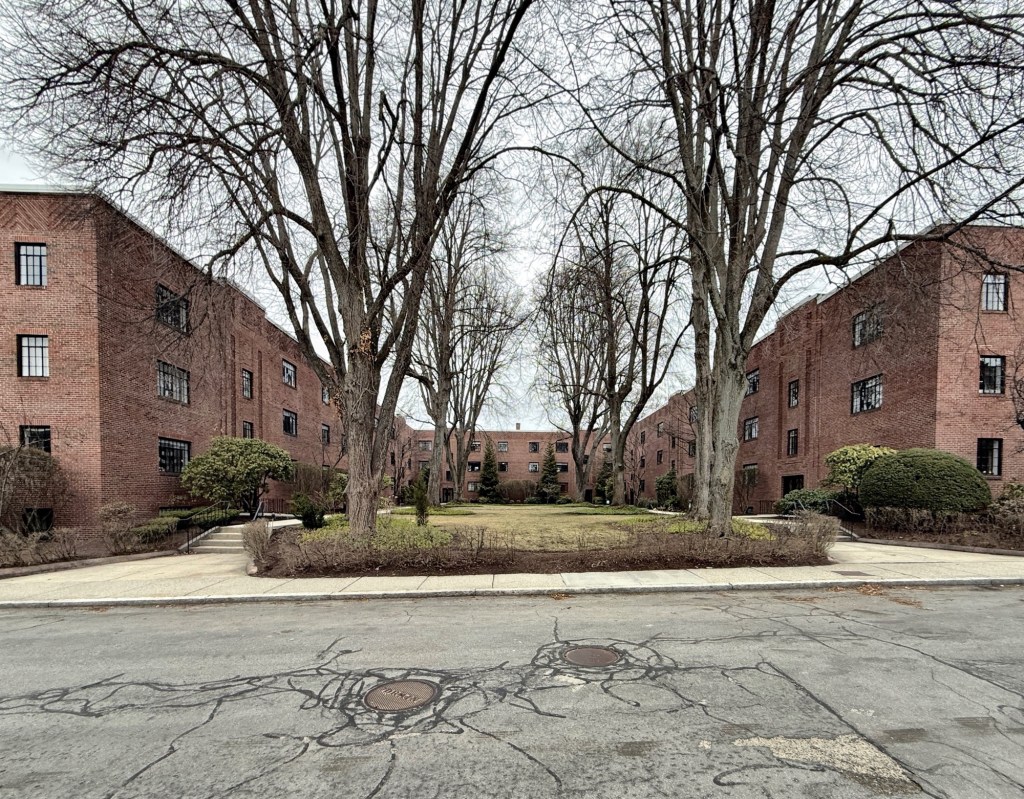
This garden apartment complex at 98-116 Sewall Avenue in Brookline is an excellent example of the Art Deco style which reached its height in popularity in the midst of the Great Depression, so fewer examples of the style are typically found. Here in Brookline, the city was seeing rapid development in the early decades of the 20th century, where large estates were subdivided and commercial areas expanded into once residential neighborhoods. U-shaped in plan and standing three-stories, this complex replaced a large property owned by the Stearns Family, a prominent local family with many properties around present-day Coolidge Corner. The apartments were developed by the G & S Investment Company, a real estate development firm, who hired architect, Saul Moffie, to design the building. Completed in 1938, the complex has richly articulated facades with a variety of geometric brick patterns, including chevrons, diapering, header courses and soldier courses with each entryway identified by a projecting pavilion with a stepped stone parapet above. The doors and sidelights are wood with glass panels in a chevron motif similar to the brickwork and all residential units have steel multi-pane windows. What a gem!
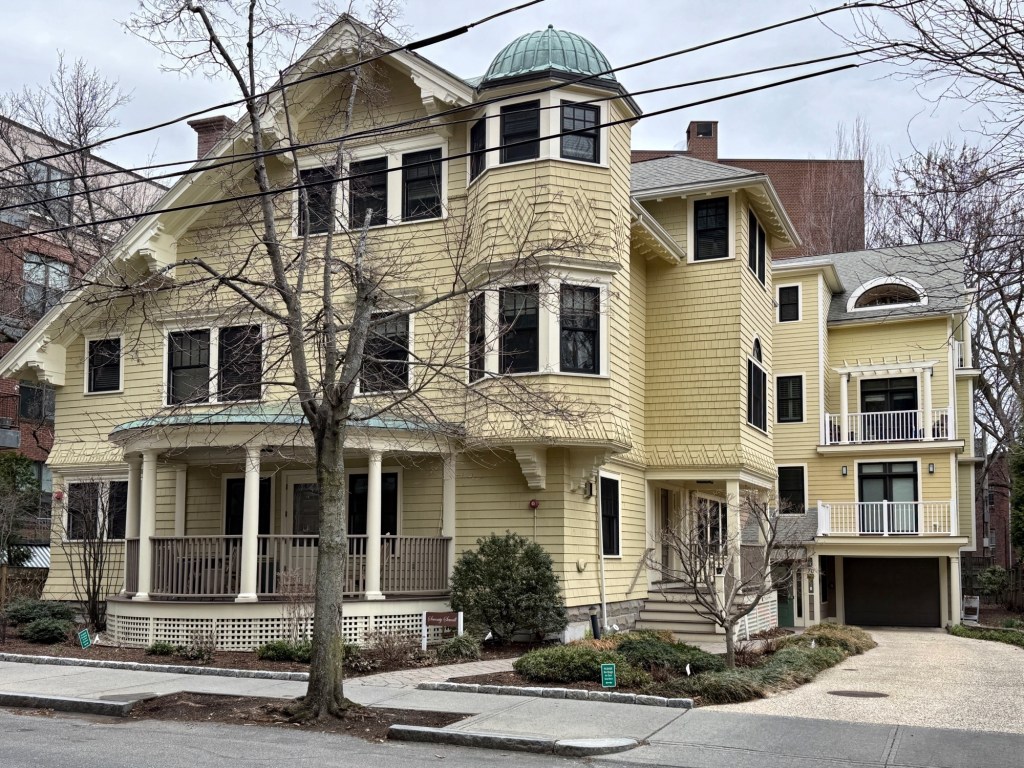
Located on Sewall Avenue in Brookline, Massachusetts, the Charles P. Flagg House exemplifies upper-class single-family housing built in the late 19th century that has been added onto and converted into multi-family housing to serve a growing city. Charles Partridge Flagg (1851-1911) was a real estate developer and head of the D. F. Flagg & Co., a wholesale liquor company his father started in Boston. He purchased the former Dexter property, subdivided the estate, and hired architect Julius A. Schweinfurth to design a home for his family. “Jule” Schweinfurth was long-associated with the firm of Peabody & Stearns of Boston, which in the late 19th century, was one of the premier architectural offices in the United States, but when he was not offered a partnership offer by his bosses, he established a new firm under his name. For the Flagg House, Schweinfurth blended the Shingle, Queen Anne, and Arts and Crafts architectural styles with a unique asymmetrical roofline, wide overhanging eaves with cross brackets and exposed rafter tails, consistent shingle siding, and a two-story polygonal oriel with domed roof at the corner. The Flagg House was moved forward on the lot to facilitate a rear addition and completely renovated in 2011, transforming it into a seven-unit condominium building with garage and elevator. This example of “gentle density” is exactly what communities should allow for, to preserve the character at the streetscape but provide additional housing.
An expression of the Shingle style in all her beauty, the George B. Dexter House on Sewall Avenue in Brookline was built in 1885 both as a residence and a billboard advertising the owner’s business, really. The residence was built for George B. Dexter (1854-1935) a partner in the Dexter Brothers Company a paint and stain manufacturer that was a favorite of architects in the late 19th and early 20th centuries. For his Brookline residence, George Dexter hired architect S. Edwin Tobey to design this Shingled masterpiece with continuous shingle siding with rounded bays and a shingled piazza to showcase the stain products of his company. According to articles, Dexter also stained and painted the interior a variety of colors to showcase the wide range of options his company had. George Dexter would move to Pill Hill neighborhood in a new home just a decade after having this residence built, likely caused by the development of apartments and commercialization in the Coolidge Corner area by the turn of the century. The Dexter House was converted to a two-family in the 1920s and today has three condominium units, with owners clearly taking great pride in this significant residence.
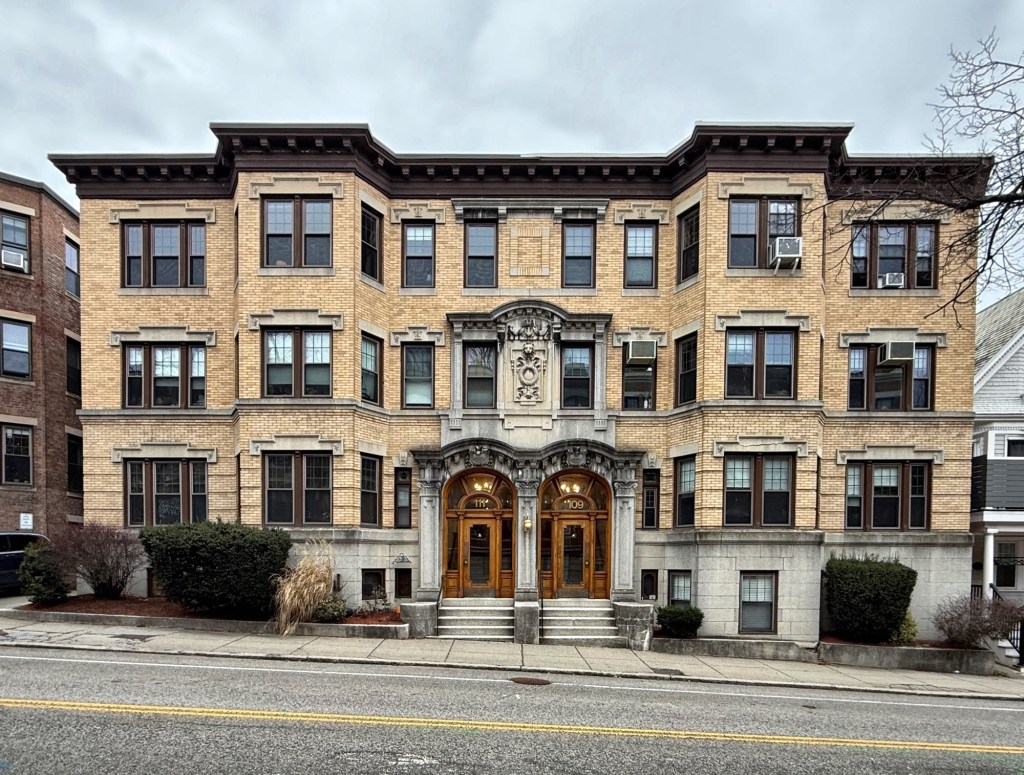
In the early 20th century Brookline, Massachusetts, saw an immense increase to its population, spurred by the streetcar system and a suburbanization of greater Boston. As land is finite, developers eyed the large estates near commuter lines and built apartment buildings to supply housing to middle-income residents. Not all residents welcomed the change as density and the destruction of old estates caused concerns for many wealthy and older residents in Brookline who enjoyed the bucolic suburbs to dense city life. As a result, many Brookline developers hired known architects to design apartment buildings with high-quality materials and finishes to contribute to the rich architectural streetscapes and established neighborhoods. This apartment building, one of two at the corner of Longwood Avenue and St. Paul Street, was built in 1913 from plans by Gay & Proctor, an established local architectural firm. The developer, Bernard Steuer (1859-1921), was an Austrian-Jew that emigrated to the United States and worked in real estate and building in Brookline and Boston. The building features a heavy cornice with modillons, three-story polygonal bays that break up the massing, and cast stone detailing with Beaux Arts style entries.
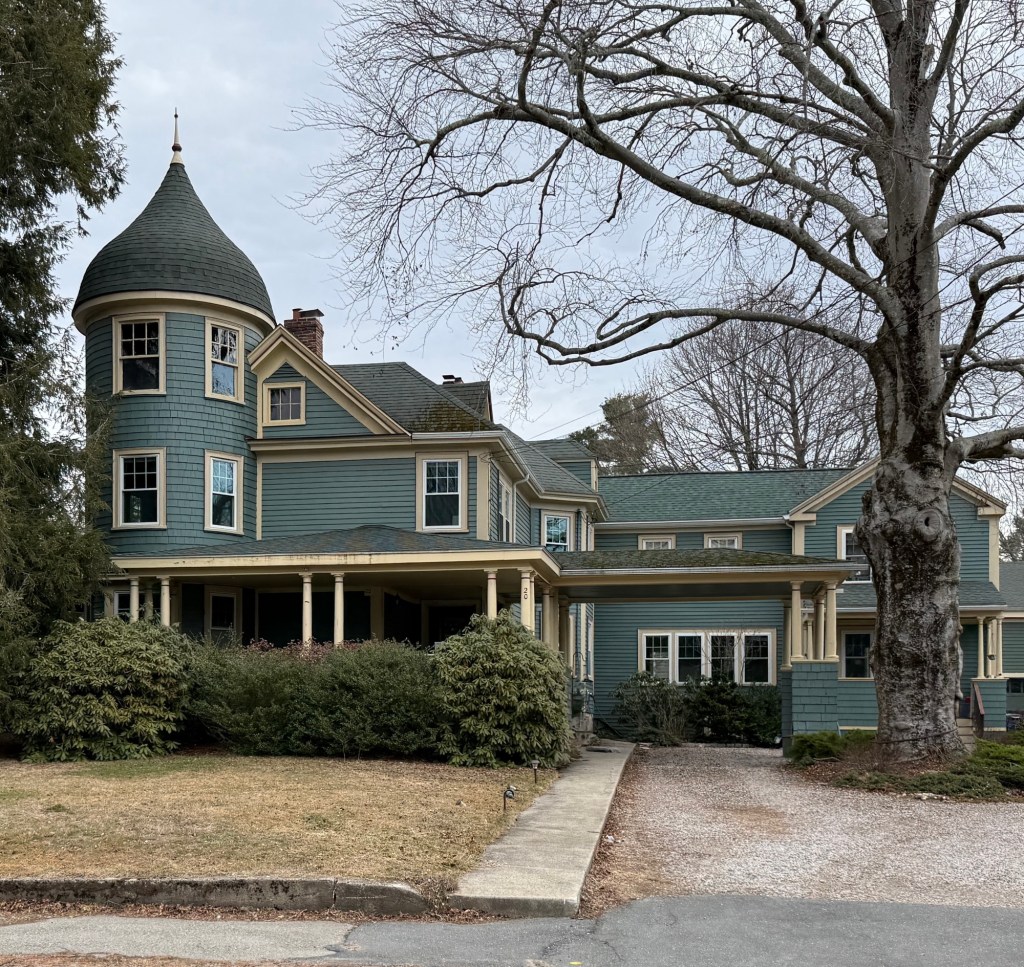
A fine example of the Queen Anne style of architecture, this late 19th century residence in Sharon, Massachusetts, is equally significant for one of its owners, Dr. Caroline Hastings. Caroline Eliza Hastings (1841-1922) was born in Barre, Massachusetts, and after attending public schools there, would enroll at the New England Female Medical College (later absorbed into the Boston University Medical School), graduating with an MD degree in 1868. She conducted a private practice and additionally worked as an instructor at her alma mater. She was affiliated with the Talitha Cumi Home in Jamaica Plain, Boston, a medical facility run by women to treat and house unmarried mothers and their young children. Doctor Hastings was an amazing woman who also established and was president of Boston’s first women’s medical society, and while on the Boston School Committee, implemented the first free school lunch program for poor children in the country. In the early 20th century, Dr. Hastings and her husband, Charles Printer, purchased this house built in 1890 and moved here together, where they likely enjoyed retirement. Dr. Caroline E. Hastings died in 1922, and her Sharon home has been preserved by later owners and resembles the property when she resided here.
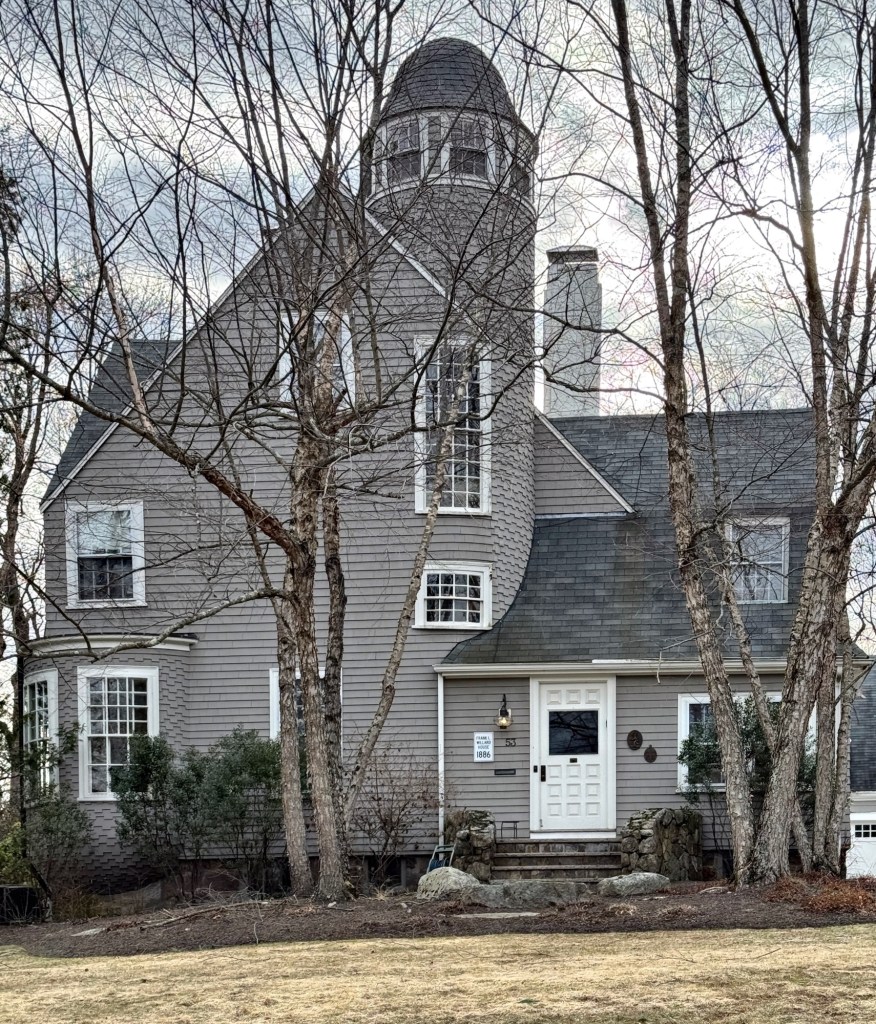
Built in 1886 as a summer house, this handsome Shingle style residence on Pleasant Street in Sharon, Massachusetts, is one of the finest examples of the Shingle style in the area. The house was built as a summer residence for Francis Lyman Willard (1845-1913), who was President and Treasurer of the Riverside Boiler Works in Cambridge, and maintained a primary residence in Jamaica Plain. He and his wife, Mary Smith Willard, had this home built as their country retreat, spending summers here to escape the hustle-and-bustle of city life. The architect could not be discovered at this time, but it appears to have been a Boston-area architect that specialized in the Shingle style due to its unique and high-quality detailing. The feature that stands out is the four-story wood shingled tower on the facade capped by a bell roof that includes a large 20-over-20 double-hung curved wood sash stair window.
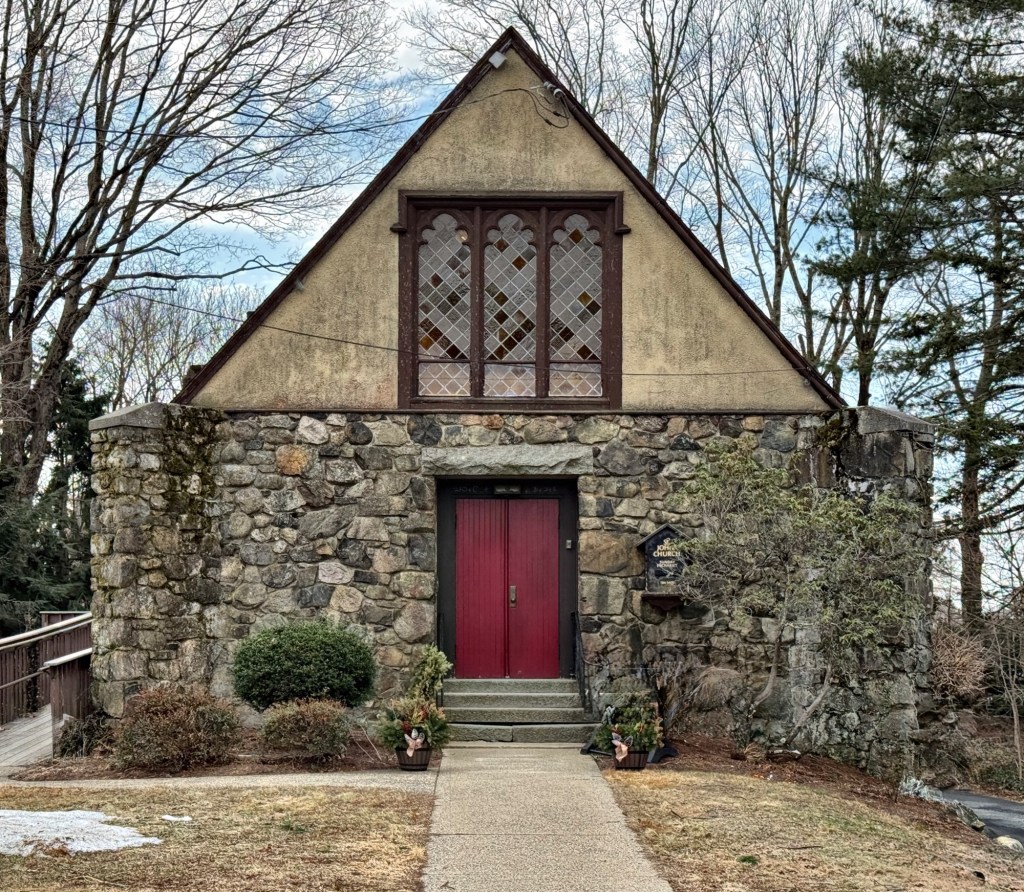
The small yet architecturally significant St. John’s Episcopal Church in Sharon, Massachusetts, was built in 1902 from plans by one of the premier ecclesiastical architects of the early 20th century. Episcopalians in Sharon began demanding their own house of worship in the late 19th century, and by the turn of the century, had funding to erect their own chapel. Boston-based architect, Ralph Adams Cram, of the firm Cram, Goodhue & Ferguson, designed the building, which fits within the scale of the residential neighborhood it is located within. St. John’s is an example of Neo-Gothic Revival architecture, a style which Cram became known for, with a fieldstone base, three feet thick, and stucco gabled facade above with tripartite windows with diamond-cut colored glass. The chapel was expanded at the rear, but maintains its rustic charm at the street.
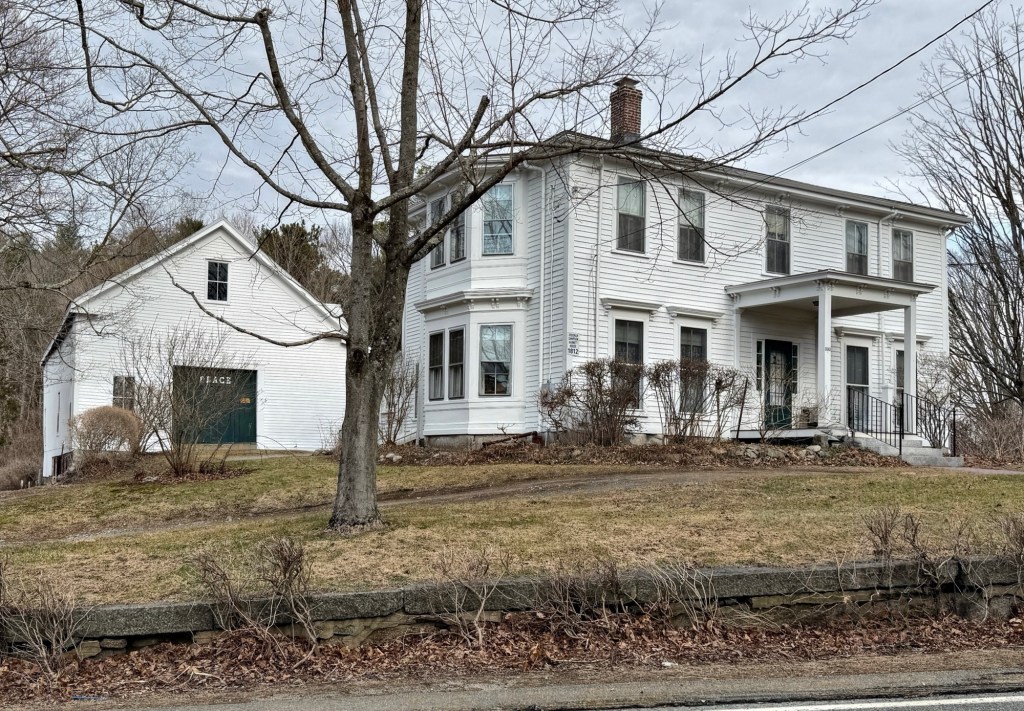
Deborah Sampson (1760-1827) was born in Plympton, Massachusetts, and after a troubled childhood, she worked as an indentured servant until the age of 18. She subsequently worked as a teacher during the summer, though she had little in the way of formal education. In the early 1780s, Deborah tried to disguise herself in men’s clothing and enlist in the military to fight against the British forces. She was rebuffed but tried again under the name Robert Shirtliff (sometimes spelled Shurtleff) and this time was successful. Deborah was described as being exceptionally tall, plain looking, and masculine in appearance and mannerisms. She spent at least 17 months as a combat soldier and participated in several skirmishes and sustained multiple injuries. She was reportedly hit by musket fire in the summer of 1782 but refused medical treatment for a leg injury due to fears that her true identity would be discovered. Sampson is said to have extracted one piece of shrapnel from her leg by herself; another remained in her body for the rest of her life. Sampson’s time as a Revolutionary fighter came to a halt a few months before the end of the war, after she fell ill in Philadelphia and a doctor realized that Shurtleff was, in fact, a woman. Sampson received an honorable discharge and went back to Massachusetts. She married Benjamin Gannett (1757–1837), a farmer, on April 7, 1785, and the couple moved to this farmhouse in Sharon, Massachusetts, where she lived the remainder of her life as a farmer’s wife. After Deborah Sampson died at the age of 66, her husband petitioned Congress to receive a pension as the widower of a Revolutionary veteran. A committee ultimately decided to award him the money, concluding that the war had “furnished no other similar example of female heroism, fidelity and courage.” She was the only woman to earn a full military pension for participation in the Revolutionary army. The Deborah Sampson Gannett Farmhouse is a private residence.
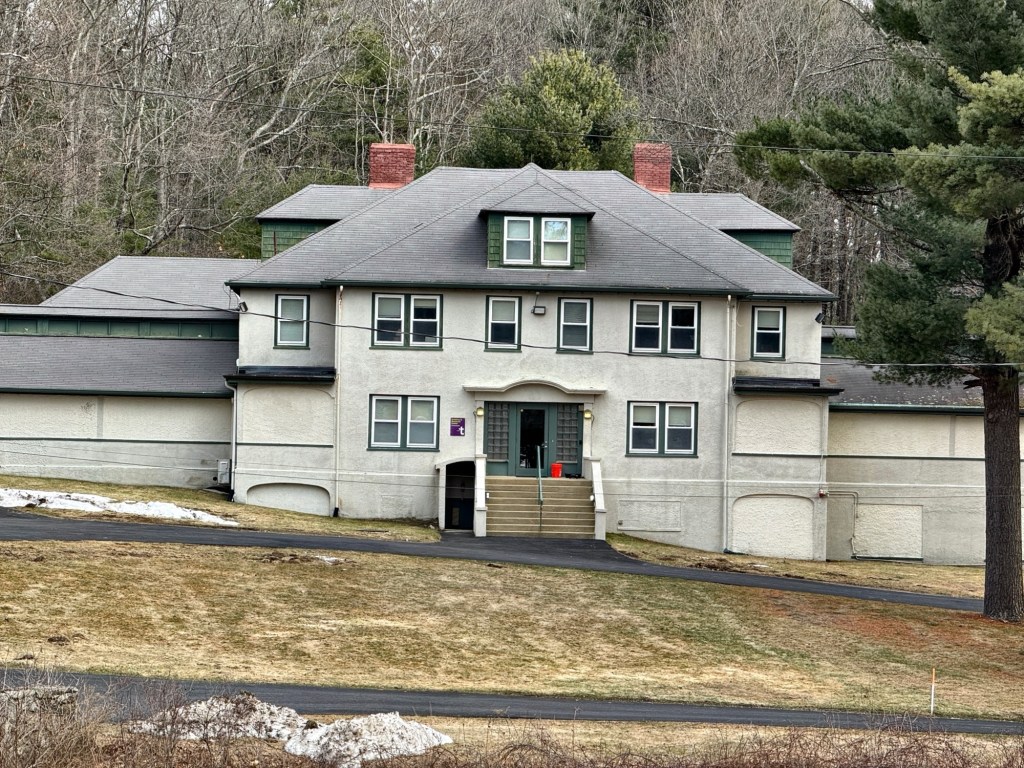
The old Sharon Sanatorium was built on former farmland in Sharon, Massachusetts, as a medical facility for the cure of pulmonary infectious diseases. The rural medical institution was designed in 1890 by the architectural firm of Longfellow, Alden and Harlow and completed a year later. The Sharon Sanatorium for Pulmonary Diseases opened formally in February 1891 with the purpose to provide affordable care for patients suffering from Tuberculosis and other pulmonary diseases. At the time, tuberculosis was a major health concern and treatment often included fresh air, so facilities such as this were designed with access to open air sleeping porches and forested surroundings. The Sharon Sanatorium was sited to catch the prevailing breezes on the side of Moose Hill, the second highest ascent between Boston and Providence. In 1916, the Sanatorium opened a Children’s Pavilion, which was reserved for children less than fourteen years of age suffering from tuberculosis. By 1938, the threat of tuberculosis was under control, and the Sanatorium began admitting patients suffering from arthritis and rheumatic fever until the facility closed in 1947. The Sanatorium integrated with the Boston Children’s Hospital in 1949 and soon after, the property was bought by Henry Plimpton Kendall (1878-1959), a wealthy entrepreneur and industrialist, for use as the Kendall Whaling Museum, showcasing his personal collection of paintings, prints, and tools of the whaling industry in New England. In 2001, the museum merged with the New Bedford Whaling Museum and today, the property is managed by the Trustees of Reservations as their Archives and Research Center.
 Buildings of New England