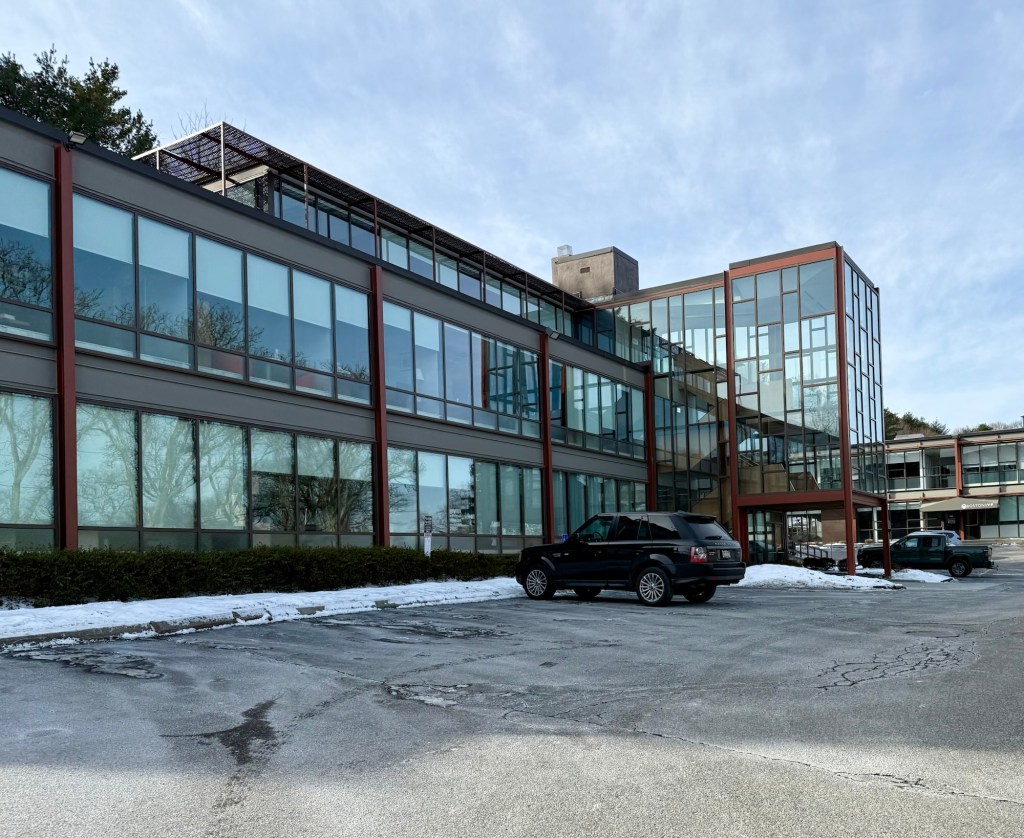
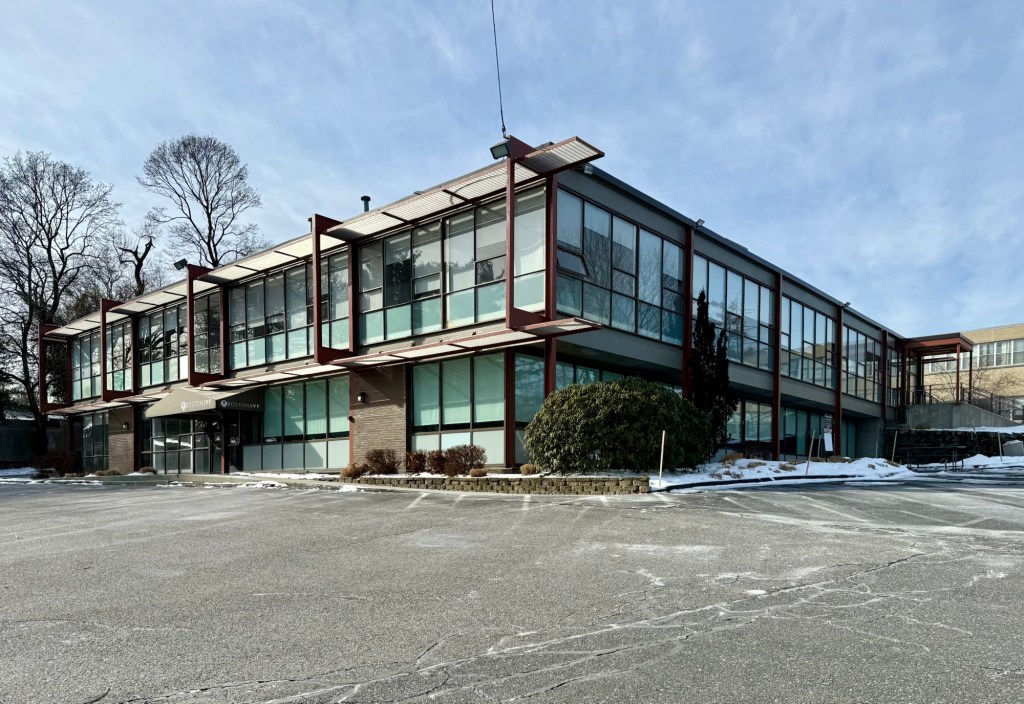
Mid-Century Modern commercial architecture is often maligned for its car-centric and unadorned designs, but the Lyman Park Offices on Boylston Street in Brookline, Massachusetts, are some of the finest office buildings constructed in Brookline in the 20th century. The two office buildings were built on the site of the Theodore Lyman estate and were built at a time Brookline saw rapid commercialization along the Boylston Street corridor. Designed by the firm of Salsberg & LeBlanc, the Lyman Park Offices are landmark examples of the International style in the commercial form in Brookline. Built of steel and glass, the buildings exhibit spandrels above each floor level, enhancing the strong horizontal emphasis of the design.
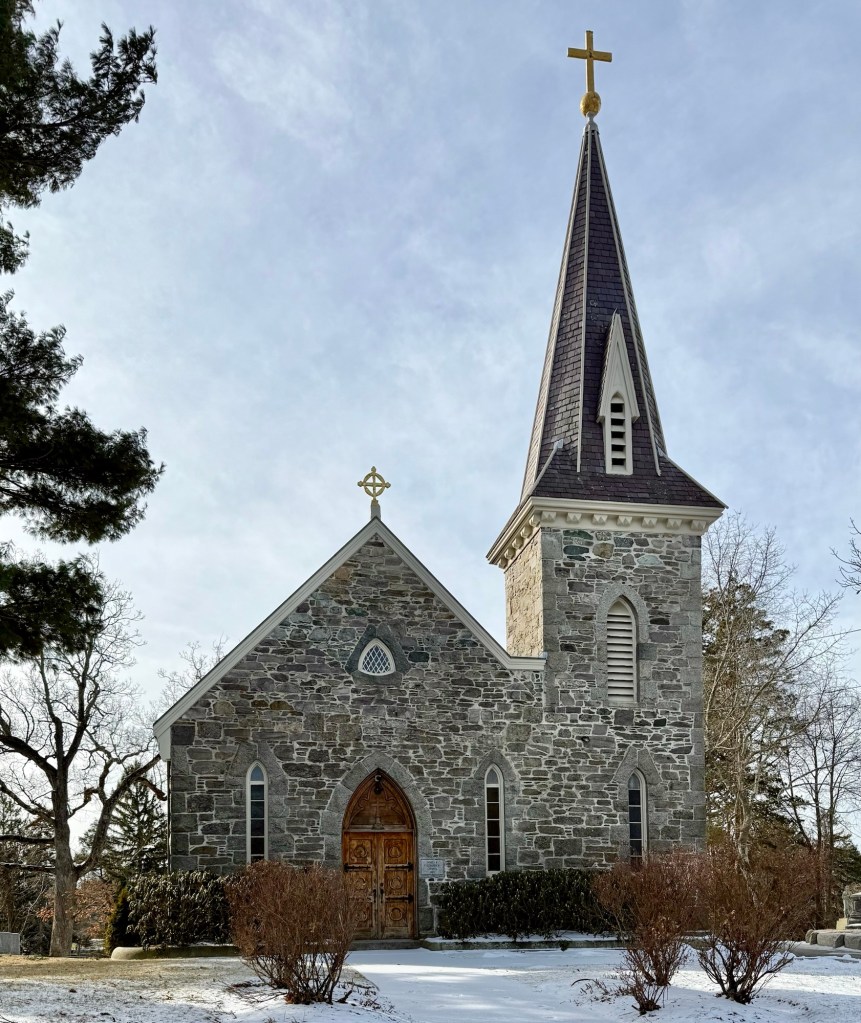
Holyhood Cemetery in Brookline, Massachusetts, was laid out in 1857 under the direction of Father Joseph M. Finotti, pastor of Assumption Parish , which included Brookline and Brighton. The cemetery reflects the mid-19th century influence of the Rural Cemetery movement and the romantic landscape cemetery planning begun at Cambridge’s Mount Auburn Cemetery in the 1830’s. A plan of the cemetery was drawn up by Shedd & Edson and published in August 1857. It shows curvilinear avenues and paths named after former bishops of Boston and Biblical figures. All were welcome to be buried except those who “died in a state of Drunkenness, Duel, or by self-destruction, unbaptized, non-Catholic, or otherwise opposed to the Catholic Church.” In the 1857 Shedd & Edson plan for Holyhood Catholic Cemetery, a chapel was located at the center on the hill shown in a small drawing on the edge of the plan. Known as St. Joseph’s Chapel, the stone building was designed by Patrick Keely, the successful and influential New York architect of many mid-19th century Catholic churches. The chapel would be dedicated in 1862. Decades later, a cemetery office was planned and built across Heath Street from the cemetery gates, but was demolished sometime in the 20th century. The cemetery grew and it along with the mid-19th century chapel, has been lovingly maintained to this day.
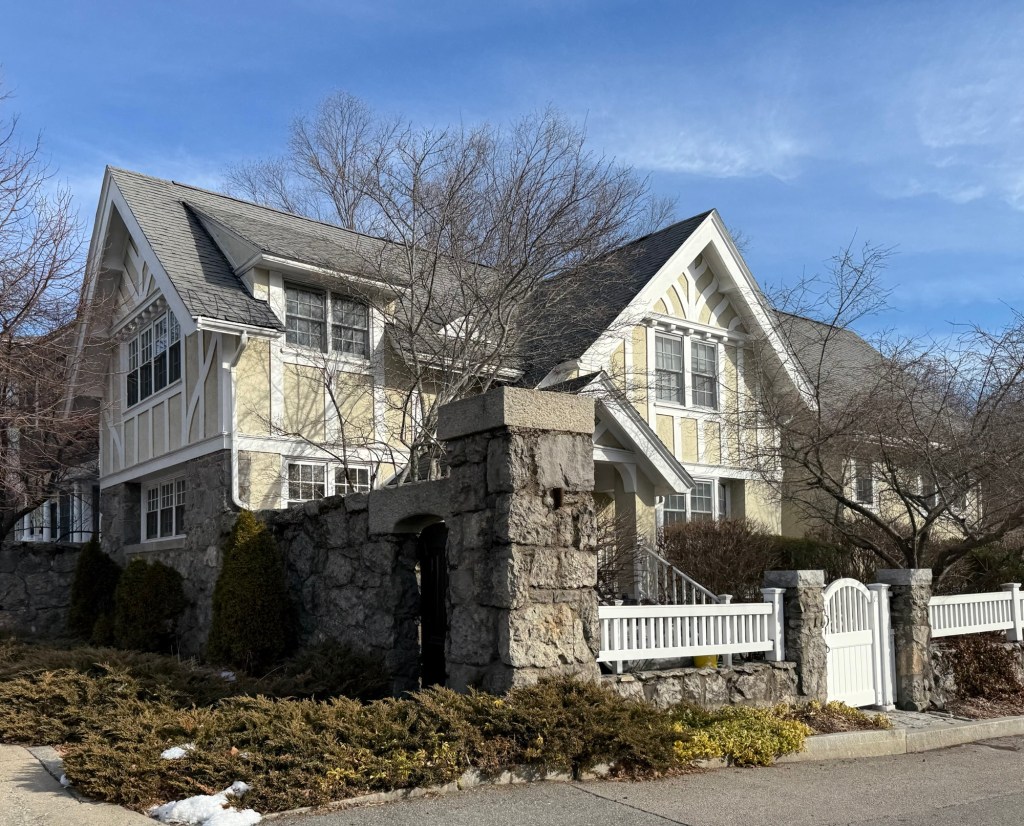
Besides the former Wright Carriage House (now the Soule Recreation Center), the only other extant building that was built on the grounds of the former John G. Wright Estate in Brookline, Massachusetts, is this structure, the historic gatehouse to the property. Built in 1907 at the same time as the manor house, the gatehouse was also designed by architects Chapman & Frazer and served as the entry to the expansive grounds with a room for the gatekeeper to sleep in overnight. The Tudor Revival style building is less ornate than the stone mansion, the half timbering and stucco work well to compliment the other buildings. While the formerly dark half timbering has since been painted a white, the building still maintains its character. While the remainder of the Wright Estate was subdivided and sold off by the heirs of next owner, wool merchant, Andrew Adie, the gatehouse remained and survived the destruction that befell the main manor. The old gatehouse was converted to a full-time residence and remains to this day.
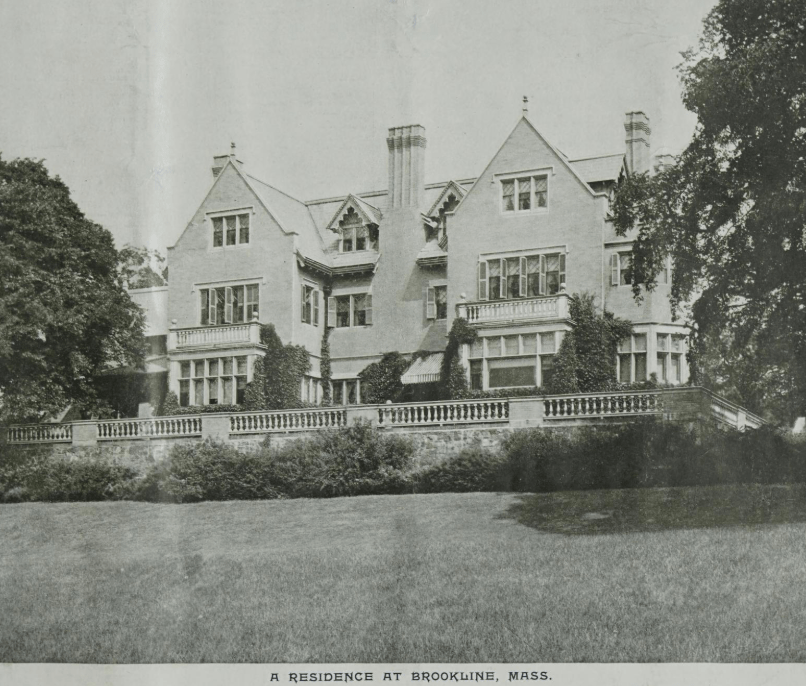
John Gordon Wright (1843-1912), was a Boston wool merchant who purchased farmland on this site in the 1890s and hired architects Chapman & Frazer, to design this stone mansion as an estate house. He previously moved into an earlier wood-frame home on the site and a decade earlier, had the architects design his carriage house and stable, which survive today as the Soule Recreation Center. The stone Tudor Revival style mansion house was massive and featured in national periodicals when completed. The estate was beautified by landscaping designed and laid-out by the Olmsted firm. In 1942, the property was purchased by the Rivers School (now located in Weston) and converted into classrooms and administrative offices for the private school. When the school moved to Weston, the Town of Brookline in 1961 bought property for recreational purposes. Sadly, in 1967, the mansion house burned down, but the carriage house and gate lodge remain as lasting remnants of a once great Brookline estate.
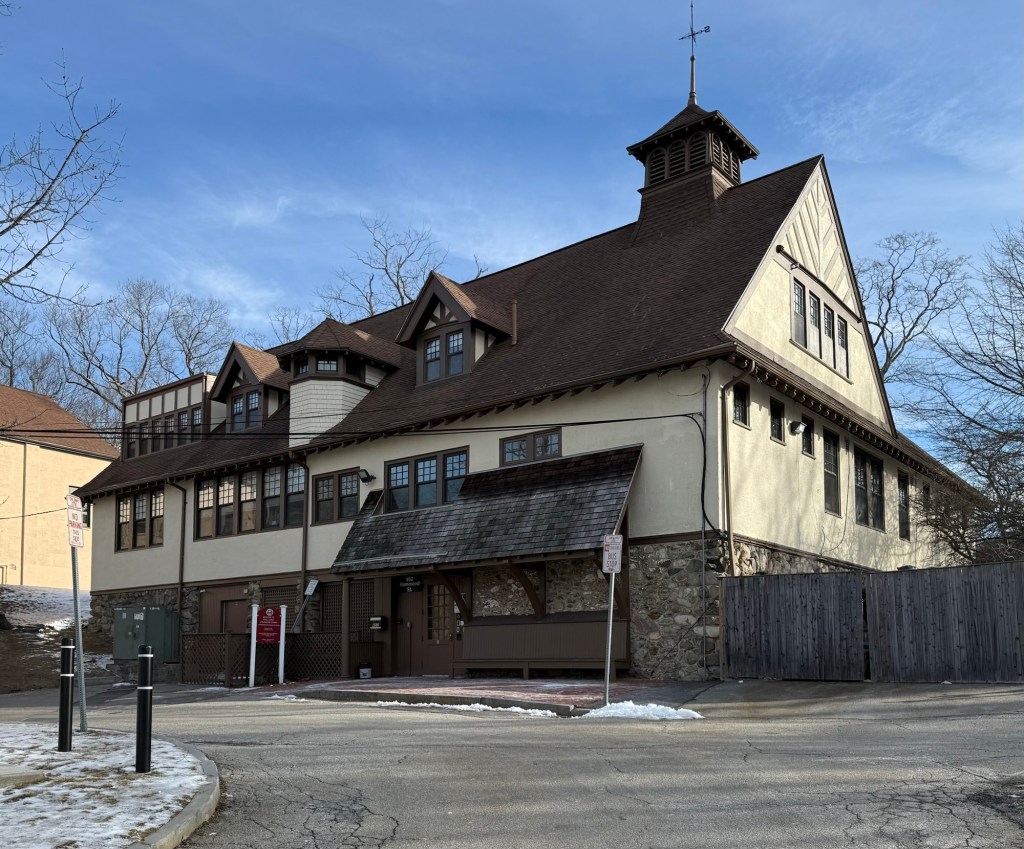
The Soule Recreation Center in Brookline, Massachusetts, was originally the stable and carriage house on the John G. Wright estate. John Gordon Wright (1843-1912), was a Boston wool merchant who purchased farmland on this site in the 1890s and hired architects Chapman & Frazer , to design an estate house (since demolished), and this building to serve as a carriage house and stable for horses. The stone Tudor Revival style mansion house was complemented by the earlier wood-frame Tudor carriage house, resembling an English manor with grounds designed and laid-out by the Olmsted firm. In 1942, the property was purchased by the Rivers School (now located in Weston) and converted into classrooms and administrative offices for the private school. When the school moved to Weston, the Town of Brookline in 1961 bought property for recreational purposes. Sadly, in 1967, the mansion house burned down, but the carriage house and gate lodge remain as lasting remnants of a once great Brookline estate.
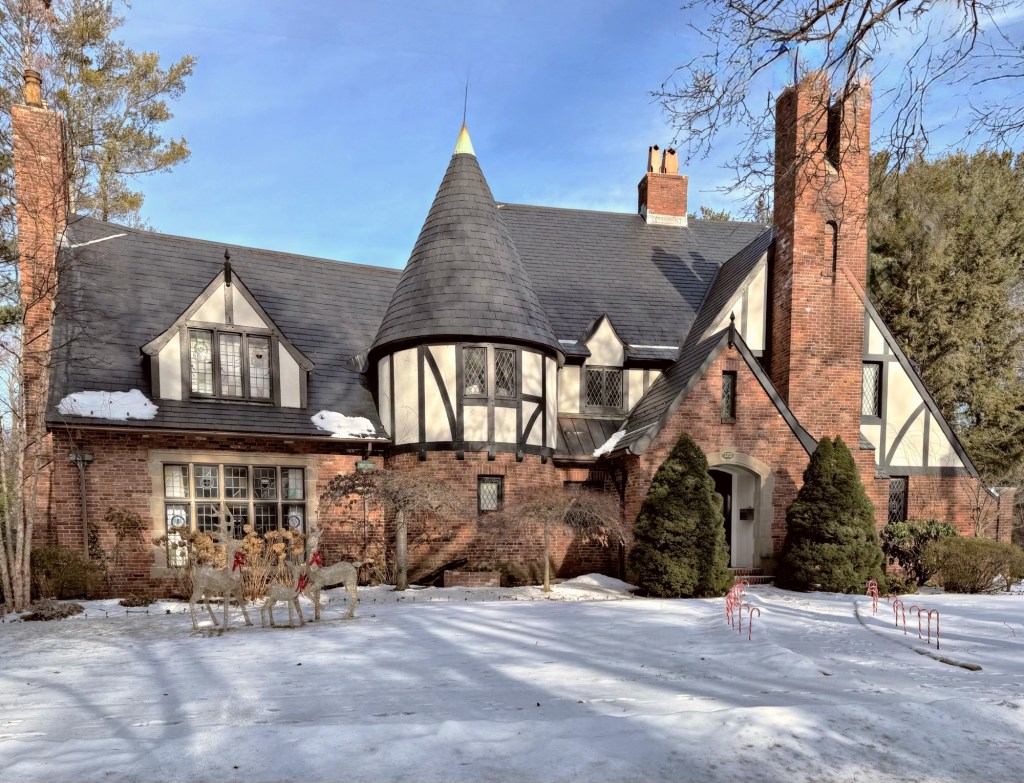
Found on Woodland Road in Southern Brookline, Massachusetts, this brick dwelling is one of a dozen-or-so whimsical Tudor cottages built there in the1920s and 1930s. The Barnard Gordon House, built around 1928, utilizes brick and stucco cladding with ornamental half-timbering, diamond pane leaded glass casement windows on the second story, and decorative half-timbering. The main attraction is the round tower with conical roof also serving as the entrance, resembling more of Rapunzel’s tower than a normal suburban home. We need more unique houses today like they built 100 years ago. Everything today feels so sterile and unwelcoming, maximizing interior layout at the loss to street presence.
A playful interpretation of a medieval English cottage, with its stucco cladding, half-timbering, weatherboards in the gable ends and ornamental well enclosure in the front yard, can be found on Woodland Road in Brookline. The whimsical cottage was built in 1928 for Arthur B. Bernard, the son of the president of the New England Leather Company in Boston’s Leather District. Arthur would follow his father’s footsteps and join the business himself. Architect and builder, Fred S. Wells of Newton designed and constructed the house (and others in the area in the same style). What’s your favorite part of this house?
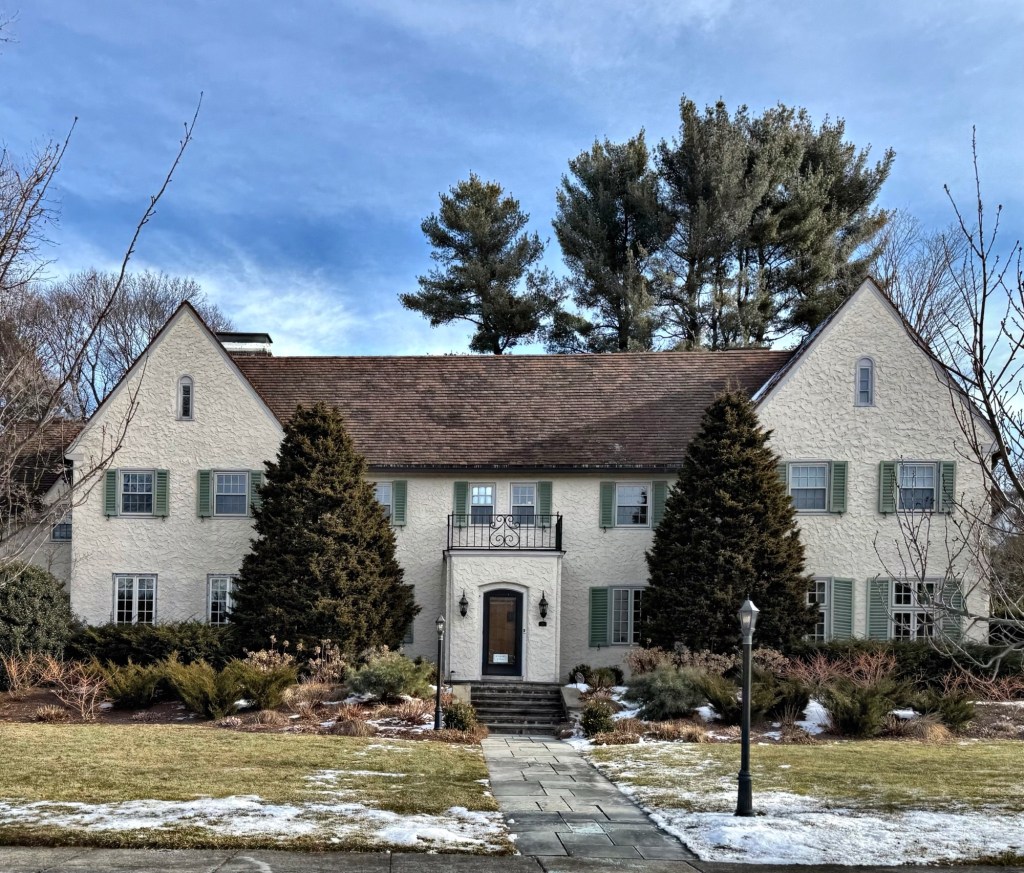
The early decades of the 20th century were the golden years for suburban development in the Boston area. With personal automobiles better-connecting the city to lesser developed areas like Milton, Newton and Brookline, middle-upper class residents were able to relocate to the suburbs and build stately homes, typically in one of three architectural styles: Colonial Revival (most common), Tudor Revival, or Arts and Crafts (least common). This large house is located on Randolph Road in the Woodland/Heath area of Southern Brookline, and dates to 1928. The residence was constructed for Dr. Walter C. Miner, an orthopedic dentist, and his wife, Ethel and designed by the firm of Strickland, Blodgett & Law. The large house sits on a double-lot, and is notable for its symmetry, slate tile roof, and rough-faced stucco walls.
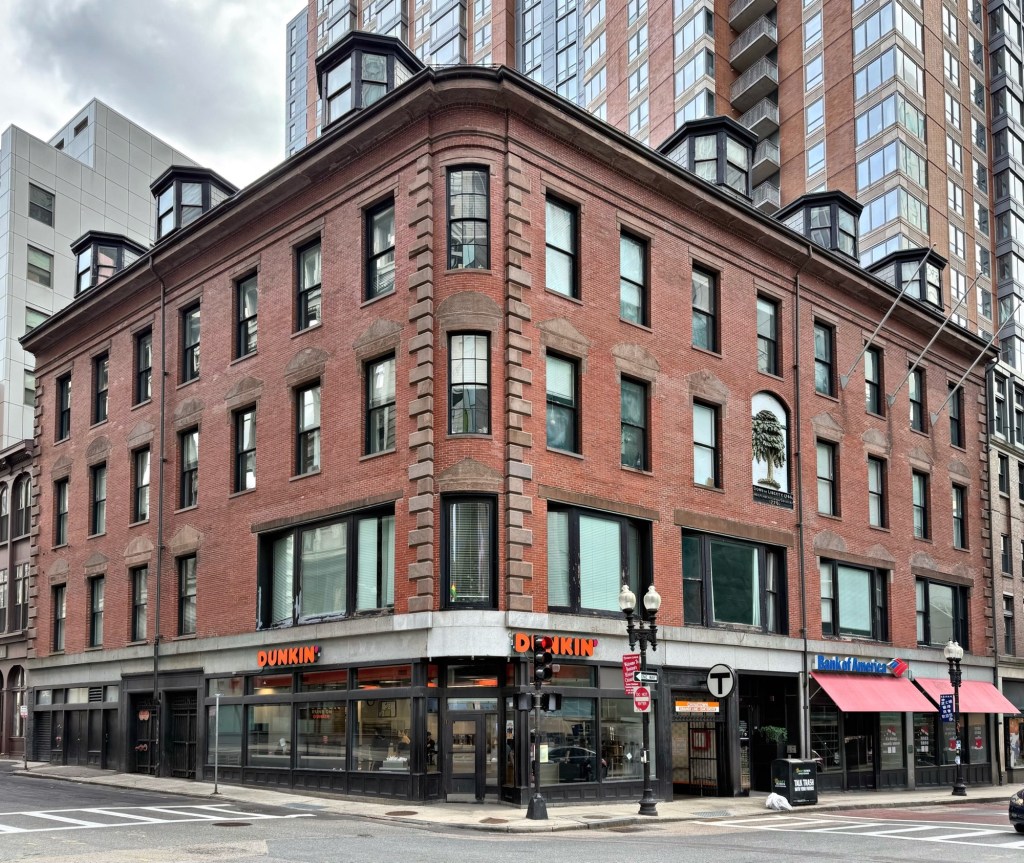
The Liberty Tree Block is located at one of Boston’s oldest and most important intersections, Boylston and Essex streets. It is said that near this site, the Liberty Tree stood, and where in 1765, Patriots in Boston staged the first act of defiance against the British government under its branches, The Stamp Act protests. The tree became a rallying point for the growing resistance to the rule of Britain over the American colonies. The Liberty Tree was cut down by British Loyalists in 1775, but the tree’s symbolism lives on in the building constructed on the site 75 years later. Nineteenth-century real estate developer David Sears had this commercial block built in 1850, which housed stores at the street with ballrooms on the upper floors. The Liberty Tree Block is best-known and named so due to the wooden relief plaque of the Liberty Tree on the Washington Street elevation. The motif stands 8′ high and 5′ wide and was carved by ship carvers. The bas relief is inscribed with “Liberty–1765” across the top, “Law and Order” at its roots, and at the bottom, “Sons of Liberty, 1765. Independence of their Country, 1776.” The building (and its carving) are protected Landmarks in Boston.
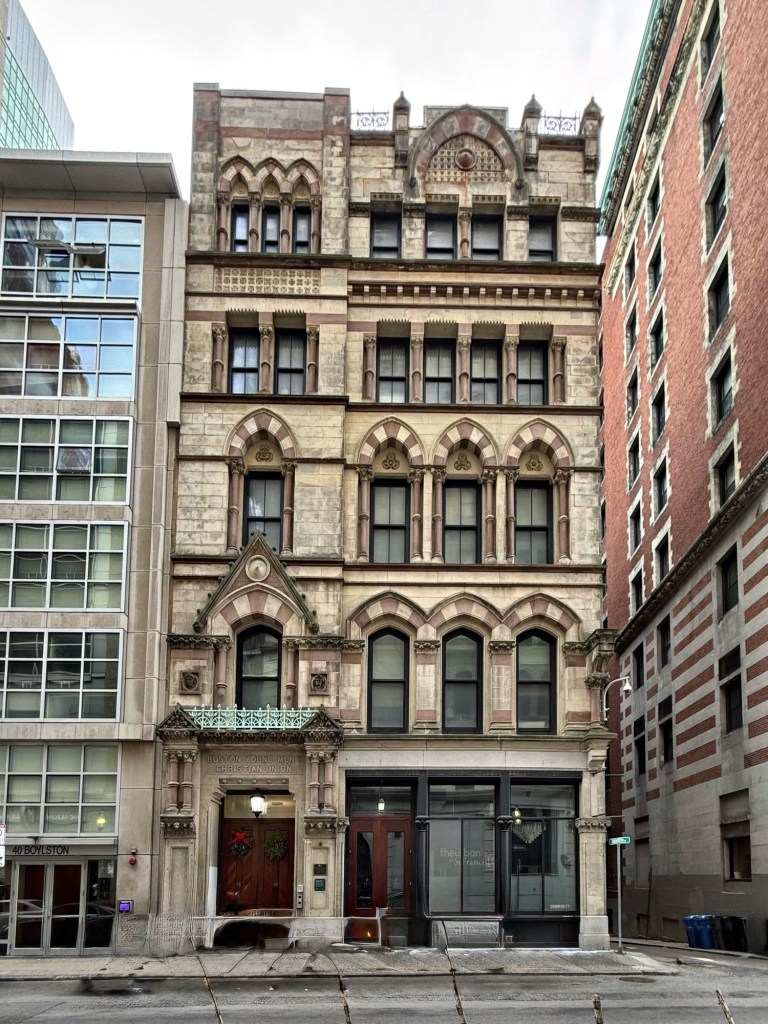
The Boston Young Men’s Christian Union was founded in 1851 by a group of Harvard students as a biblical and christian literature discussion group, which incorporated the following year. First located on School Street, the organization’s activities were to provide a focal point for the intellectual, religious, and social life of primarily middle-class, well-educated Christians. The organization grew to the point that a new building was needed, and in 1873, a site on Boylston Street was acquired as a perfect central location for the group. Architect Nathaniel J. Bradlee of Bradlee and Winslow was hired to design the structure, principally because Mr. Bradlee by then a prominent architect and public figure, was also a life member of the Union and the brother of one of its founders. The building was completed in 1875 and included ground floor retail with an auditorium, gymnasium, library, social and game rooms, and offices for the Union above and behind. Designed in the High Victorian/Ruskinian Gothic style, derived from a mixture of English, Italian, French, and some German Gothic precedents, the style emphasized complicated, asymmetrical massing, polychromy, ornate details, and lancet or Gothic arched openings, in this building a sandstone facade was used. The building became a City of Boston Landmark in 1977. In 2016, the building was converted to an affordable housing development by The Architectural Team Inc., and called “The Union”. The development provides 46 units of affordable housing, including 25 targeted to those who have experienced homelessness. What a great rebirth of the building. Historic Preservation and Affordable Housing can work together and create great projects.



 Buildings of New England