Leet Store // 1909

The handsome rubblestone commercial block at the corner of Main and Water streets in Chester, Connecticut, was built in 1909 by Italian stone masons for Joseph H. Leet and contained a grain and feed store, with other spaces in the building rented out. Decades later, the old Leet Store became a auto repair shop and the upstairs space was used as a meeting hall and theater for the community. The building was restored in 1979 and expanded at the rear with a two-story wood-frame addition for additional commercial space.

Chester Flatiron Building // 1913

At the junction of West Main and Main Streets in Chester Village, Connecticut, this unique flatiron commercial building stands overlooking the Pattaconk Brook that cuts through the center of town. In 1913, this two-story block was built with ground floor retail and a second floor residence for owner, Elmer Pierce, who ran his pharmacy downstairs. By 1920, the building was owned by Jacob Feinstein, who raised his family on the second floor and had his clothing business, “Feinsteins” in the store below. Later, the retail space was occupied by Child Design, a wooden toy store, and after that, a lighting fixture store. Historic main street buildings are often incubators for small and local businesses, keep the chain stores near the highways!

Randall House // 1927

This handsome stone mansion in Derby, Connecticut, was built by industrialist Walter Randall (1868-1949) and his bride, Olive Vouletti Whitlock Randall (1870-1938), in 1927 on a tract of about 200 acres of farmland. Olive was a granddaughter of Isaac Merritt Singer, the inventor of the first practical sewing machine for home use, which made him one of the wealthiest men in the world. It is unclear as to who the architect was, but the stone residence was built in an English Tudor/Arts and Crafts style, possibly from stones taken from the 200-acre estate. The property was sold in 1950 to Harold and Ida Yudkin, who developed much of the land into a shopping center and housing development, but maintained this stone house and a smaller parcel surrounding it. That smaller parcel was purchased in the 2010s by a developer who restored the old house, and developed a small cul-de-sac of “green” homes on the aptly named, Singer Village Drive.

Upland Farmhouse // 1929

The Nashoba Valley Winery in Bolton, Massachusetts, is one of Bolton’s most successful examples of the adaptation of an old agricultural property in the state. The land here was first developed as a farm in the early 19th century by Captain Martin Houghton (1779-1833). The farmland here, which has always had a scenic view, was called “Valley View Farm” later owner, William N. Felton (1835-1920). Sadly, the old farmhouse burned down in 1928, and the property was sold that year to Roy Clemens, an osteopathic doctor, who had this charming shingled cottage built in 1929. Roy and his wife, Laura, planted an apple orchard on the hills and named the property “Upland Farm”. Roy died in 1969 and Laura followed in 1981. With suburban development likely, the property was ultimately saved when it was purchased by Jack Partridge as the new home of the Nashoba Valley Winery, which was founded in Somerville in 1978. The winery specializes in fruit wines, and grows most of the fruits and berries for them on the property. The business expanded, adding a distillery, brewery and restaurant, and the beautiful grounds are often host to weddings and events.

Mary S. Johnson Mansion // 1910

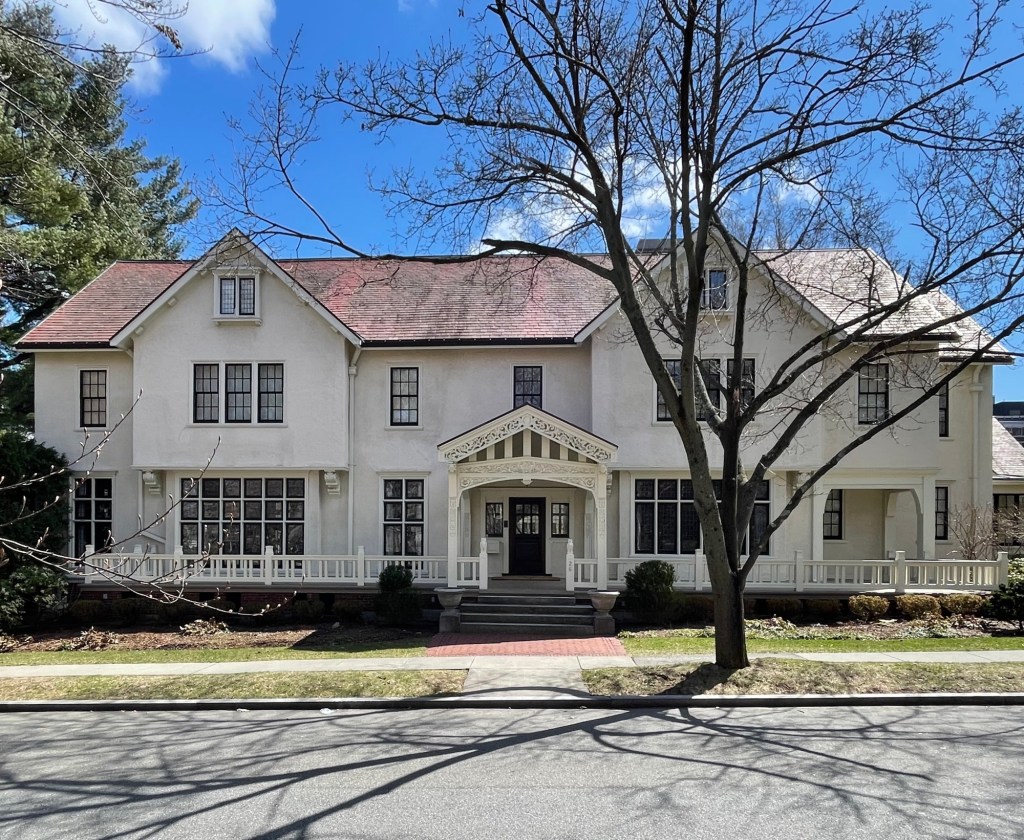
Mary Elizabeth Spiers (1847-1915) married Iver Johnson (1841-1895) in 1868 and raised their children until Iver’s death in 1895. The couple lived in Worcester before moving to Fitchburg where Iver Johnson was head of the Iver Johnson’s Arms & Cycle Works in Fitchburg, and had sporting goods stores in Worcester, Fitchburg, and Boston. After his death in 1895, his widow Mary, became president of the stores and trustee and operator of the Iver Johnson Sporting Goods Co. in Fitchburg. Ms. Mary S. Johnson sought retirement and purchased land on Main Street in the bucolic town of Lancaster and built this large mansion in 1910. The estate sat on 75-acres of land and comprised of an older farmhouse, the 20th century mansion, two caretaker’s cottages, and a large stable. Ms. Johnson died suddenly in 1915 and the estate of over $4 Million dollars was distributed amongst the couple’s children. In 1934, the estate became the Dr. Franklin Perkins School, a K-12 school for students with special needs.

Highways Cottage // 1902

One of the more unique and enchanting historic summer “cottages” I have seen in my travels is this early 20th century rustic example in the Onteora Park colony. Built in 1902 for John S. Stanton Sr. (1837-1933), this residence was later the summer home of Dr. Edward Ahrens and his wife, Gertrude, who founded the Mountaintop Arboretum nearby. The house stands 3 1/2-stories tall and features horizontal log siding on the ground floor and cedar shingle siding above. The facade is dominated by the broad gable end roof that extends downwards to the first floor at flared eaves on the sides and over the windows.

Beauford Lodge Cottage // 1902

This handsome cottage on Thurber Road in the Onteora Park colony in the Catskills of New York, was built by 1902 for Col. James P. Kimball (1840-1902), and his wife, Maria (Brace) Kimball, as their summer home. James Peleg Kimball was one of the most renowned U.S. Army surgeons of the late nineteenth century. The home was meant to be the couple’s place of respite, but Col. Kimball died here in 1902, not long after the family moved into the home to enjoy the fresh air of the Catskills. Maria Kimball retained the cottage for years until it was sold in 1919, and owned later by Clayton McMichael of Pennsylvania, and a director of the Onteora Summer Theatre. The rustic Shingle/Arts and Crafts style cottage was originally named Beauford Lodge, and was later named Stone Acres by McMichael.

Onteora Park Library // 1906

Built in 1906, the Library at the Onteora Park summer colony in Hunter, New York, is one of the many architectural treasures in the development. Designed by George A. Reid, the Canadian artist, architect, and summer resident of Onteora Park, the Tudor-style Arts and Crafts building was constructed in 1906 and opened to a collection of over 1,500 books and a full-time librarian during the summer season. Built of wood-frame construction with stucco exterior finish and adorned by half-timbering, the building has been lovingly maintained and preserved by members of the community for over 120 years.

Former Bear and Fox Inn // 1888

Once the heart of the Onteora Park colony in the Catskills Mountains, this large building was known as the Bear and Fox Inn. The inn was built in 1888 from plans by young architect Dunham Wheeler (1861–1938), the son of the founder of the colony, Ms. Candace Wheeler, along with three cottages, while Ms. Wheeler’s Associated Artists interior design company provided the upholstered furnishings. Candace’s daughter, Dora (Wheeler) Keith, painted an inn sign depicting a bear and fox dancing by the light of the moon. In the early development of Onteora Park, there was no sewer or water system, and the original cottages had no kitchens built within the homes. As a result, the Bear and Fox Inn provided a space where cottagers would meet daily for meals. By the 20th century, cottagers would add kitchens inside their homes, and some dinners and events were moved to the Field House. The Bear and Fox Inn was altered with the removal of the large dining room, and converted to a private residence, which remains to this day. The structure is an excellent example of the Arts and Crafts style in a rustic finishes, typical for Upstate New York summer cottages.

Memorial Church of All Angels, Twilight Park // 1896

The Memorial Church of All Angels is located in the center of the summer colony of Twilight Park, found in the town of Hunter in the Catskill Mountains. The founding of the church began shortly after the colony was established in 1888, when two years later, the Rev. H. M. Baum from Evanston, Pa., an early visitor to the Park, realized the need for an Episcopal Church, and funds were raised to build a small chapel, known as the St. Paul’s Church. The church was foreclosed upon in a matter of years. In 1895, church services were again reinvigorated when the Rev. Henry Yates Satterlee, the first bishop of Washington, then the Rector of Calvary Church, New York, had taken the cottage of his cousin, the artist Walter Satterlee, for his summer home. He set out to establish a summer chapel for Episcopalians in Twilight Park, and he hired architect Alexander Mackintosh, to furnish plans for the church. The church opened in 1896, and it would be expanded in 1909 with an addition and porch and again in 1915 with the belltower. The church opens every summer for services and is one of the finest Episcopal chapels in the Northeast.