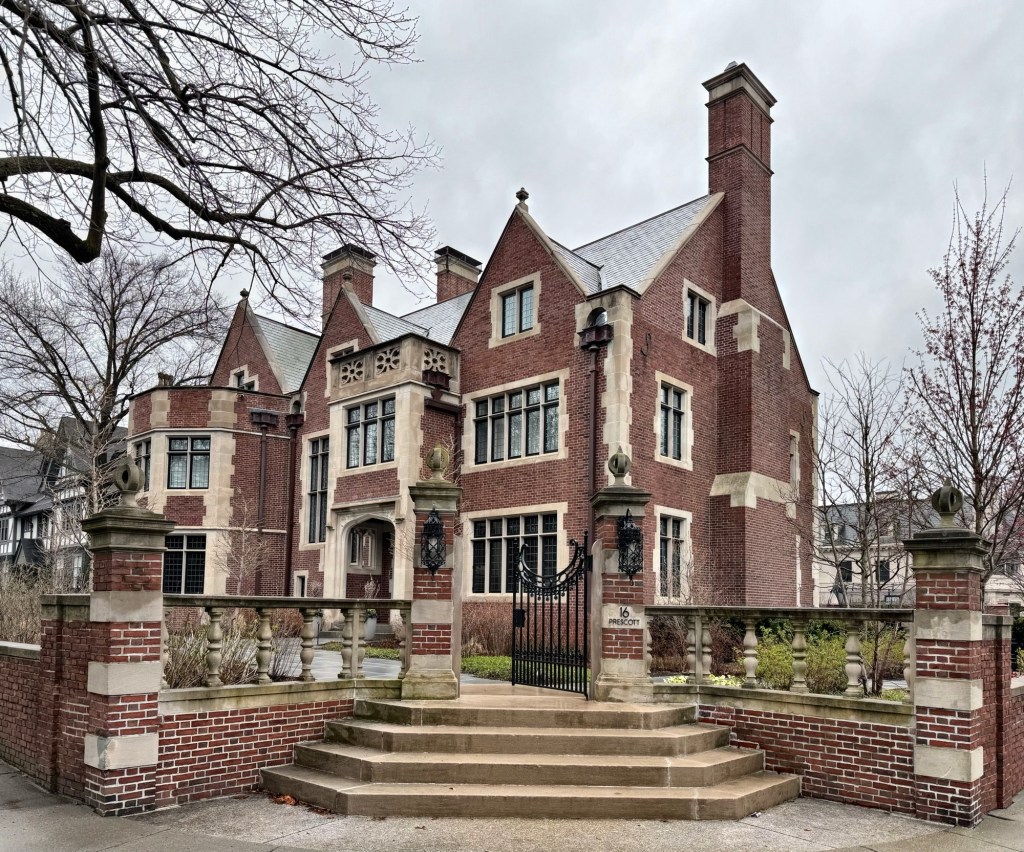
Irving-Strauss Mansion // 1906

This unique Tudor Revival style house in the Cottage Farm neighborhood of Brookline was built in 1906 for Irving J. Sturgis (1873-1924), a banker and broker originally from Michigan. Architect Joseph Everett Chandler, specialized in the Colonial Revival style and historic restorations, but was clearly adept at other styles as evidenced in this stately manor for Mr. Sturgis. After WWI, the property sold to Mr. Leon Strauss, who worked in dry goods. The Irving-Strauss mansion is constructed of brick with cast stone trim and features classic ornamentation seen in the Tudor Revival style. Steeply pitched gable roofs have stone
coping, metal windows are casement or fixed with small pained lights and are framed in cast stone trim. Framing the entranceway is a brick and stone gateway, of which, a garden wall extends around the property, with a stately garden gate surmounted by stone finials displaying the flair of the style.

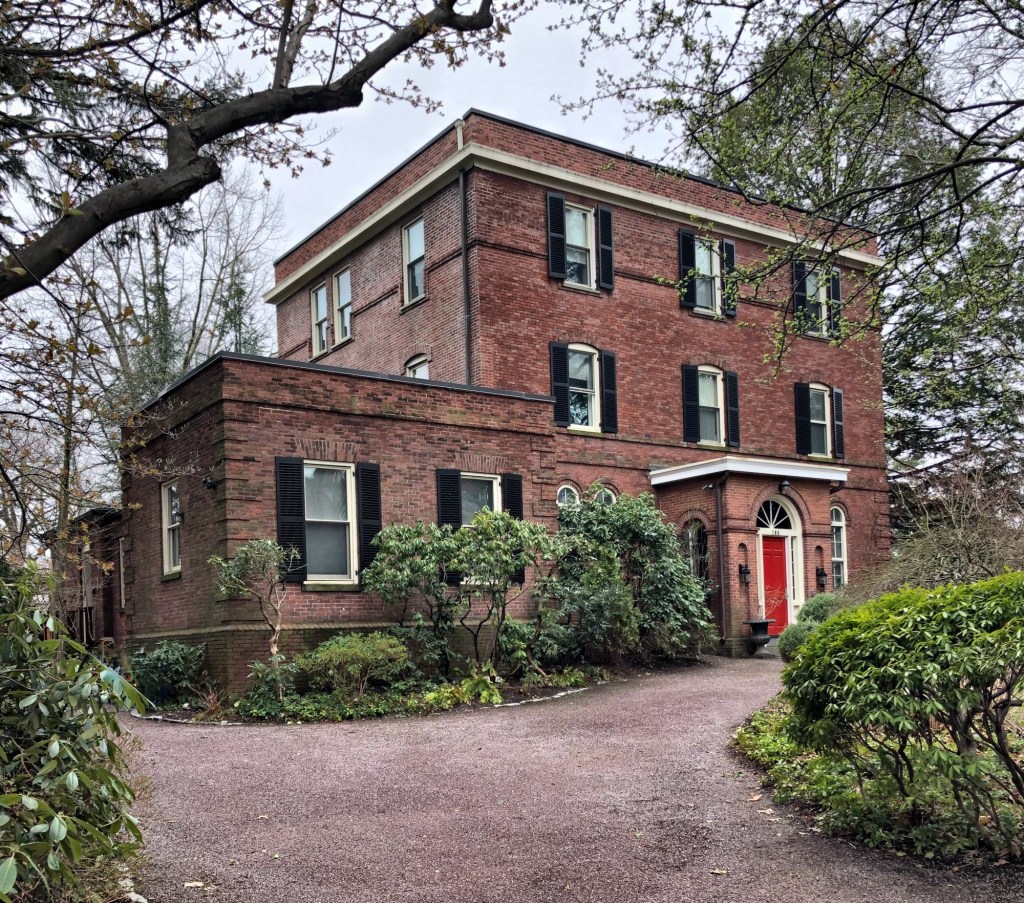
Almy-Palfrey House // c.1858

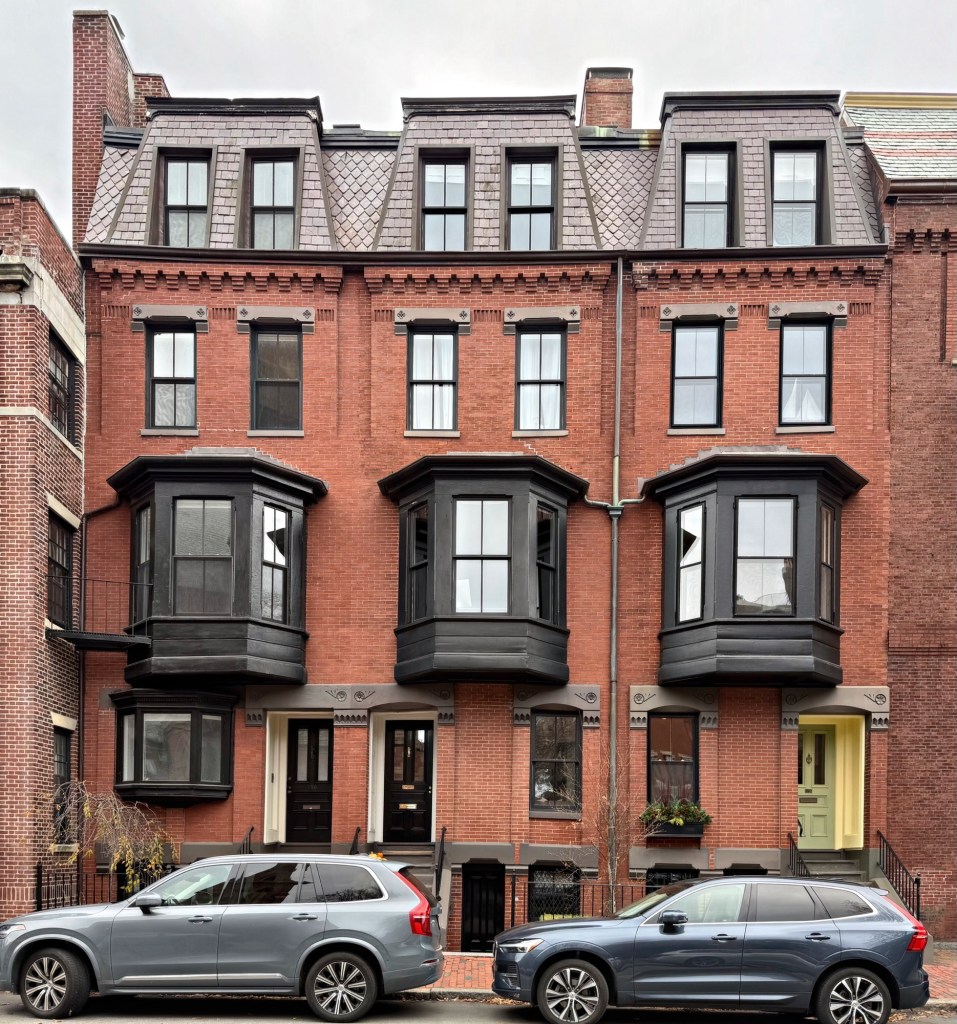
The area was developed thanks to Amos A. Lawrence (1814-1886), a wealthy second-generation Bostonian, who provided much of the capital and enthusiasm for the growth of the cotton industry in New England prior to the Civil War. Lawrence’s involvement in the industry aided the development of the Massachusetts mill towns of Lowell and Lawrence, whom the city was named after. In 1851, Amos Lawrence purchased 200 acres of land from David Sears, who himself developed the equally beautiful Longwood neighborhood of Brookline on the other side of Beacon Street. Amos began to subdivide the land, working with the architect George Minot Dexter and landscape architect and surveyor, Alexander Wadsworth, who designed Mount Auburn Cemetery in Cambridge, to create an early picturesque residential suburb. With houses designed in the newly popular Gothic Revival and Mansard styles and several small parks, the area became known as Cottage Farm. This house was built for Amos Lawrence as an early, brick Mansard home, and rented out to Frederick Almy, a wealthy Boston attorney. The property was sold out of the Lawrence Family and later purchased by John Gorham Palfrey (1875-1945) a lawyer, who modified the house by removing the mansard roof and replacing it with a full third story with a brick veneer to match the walls below to give it a more Colonial Revival design.

Abercrombie Fine Arts Wing // 1974

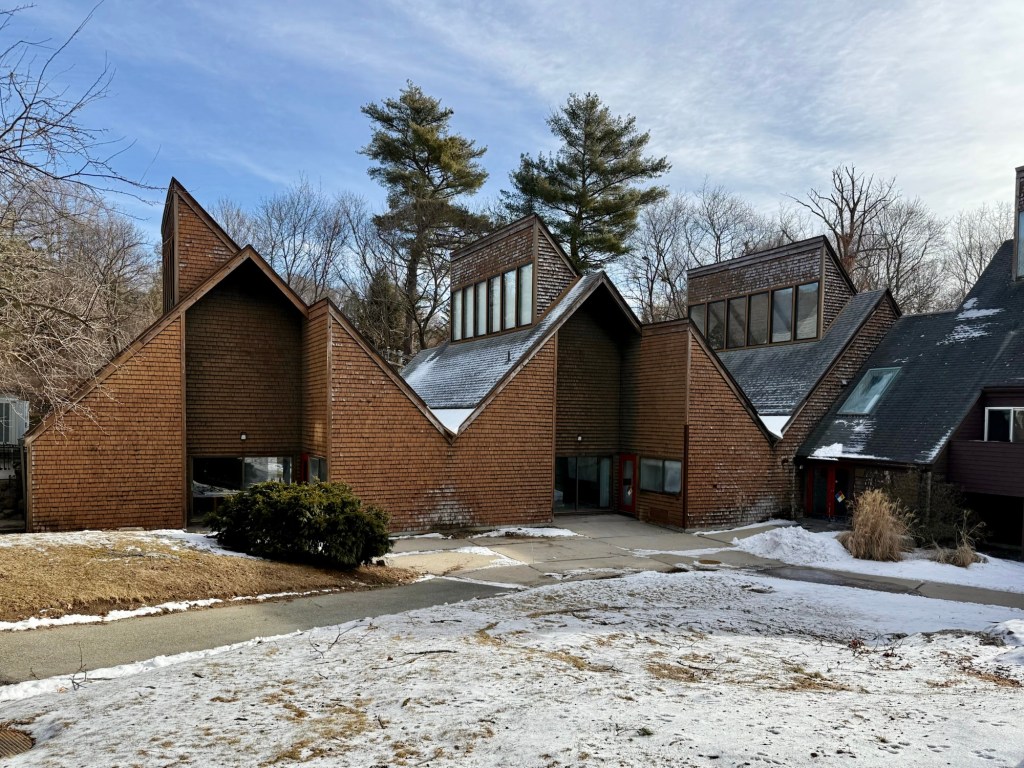
Completed in 1974 for the now defunct Pine Manor College in Brookline, Massachusetts, this interesting Contemporary/Shed style building is modern, yet employs materials and a general form that fits into its surrounding context. When Pine Manor College received a grant by the Abercrombie Foundation, planning began immediately to design and build the Abercrombie Fine Arts Wing of the school. The building was designed by Paul J. Carroll & Associates, and features a bold roofline with clerestory windows, used to provide ample natural light for the classroom and art studio spaces inside. The building remains a part of the newly established Messina College, a Boston College campus enrolling first-generation high-financial need students, giving all an opportunity for education, no matter their circumstances.

Little Building // 1917

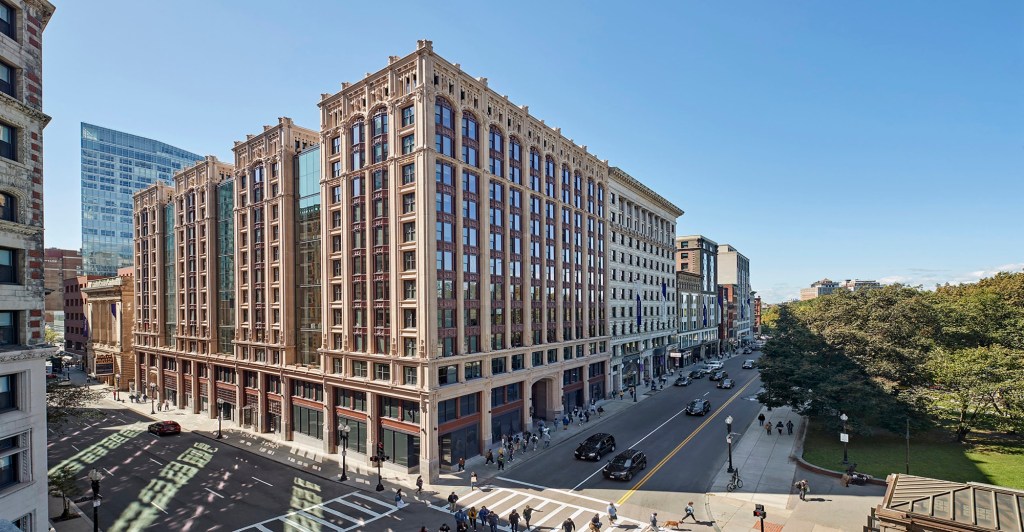
The Little Building sits prominently at the busy corner of Boylston and Tremont streets overlooking the Boston Common. Like the Colonial Theater next door, the Little Building was designed by architect Clarence Blackall and named after its developer and owner, John Mason Little. Blackall designed the Little Building in the Neo-Gothic style with a steel frame and a two-story Tudor-arched entrance on Boylston Street. The original facade was granite and cast stone, and the floors were made from reinforced concrete. The building replaced the Hotel Pelham which occupied the site since the 1850s. After being completed in 1917, the Little Building was considered significant enough that it was featured in American Architect and Building News, highlighting many architectural details inside and out. The Little Building was advertised as a “City Under One Roof” with 600 offices, dozens of shops, a post office, restaurants, and connections to the nearby subway and theaters. Emerson College purchased the Little Building in March 1994 for $5 million and converted the building to dormitories. After years of deteriorating masonry, Emerson College hired Elkus Manfredi Architects to oversee a full renovation of the building, including a sweeping facade restoration and the insertion of three glazed elevations between street-facing light wells. The “new” Little Building is a splendid re-imagining of a historic building, showing how old buildings can be renovated to meet contemporary uses through well intentioned design and care.

Colonial Theater Building // 1899

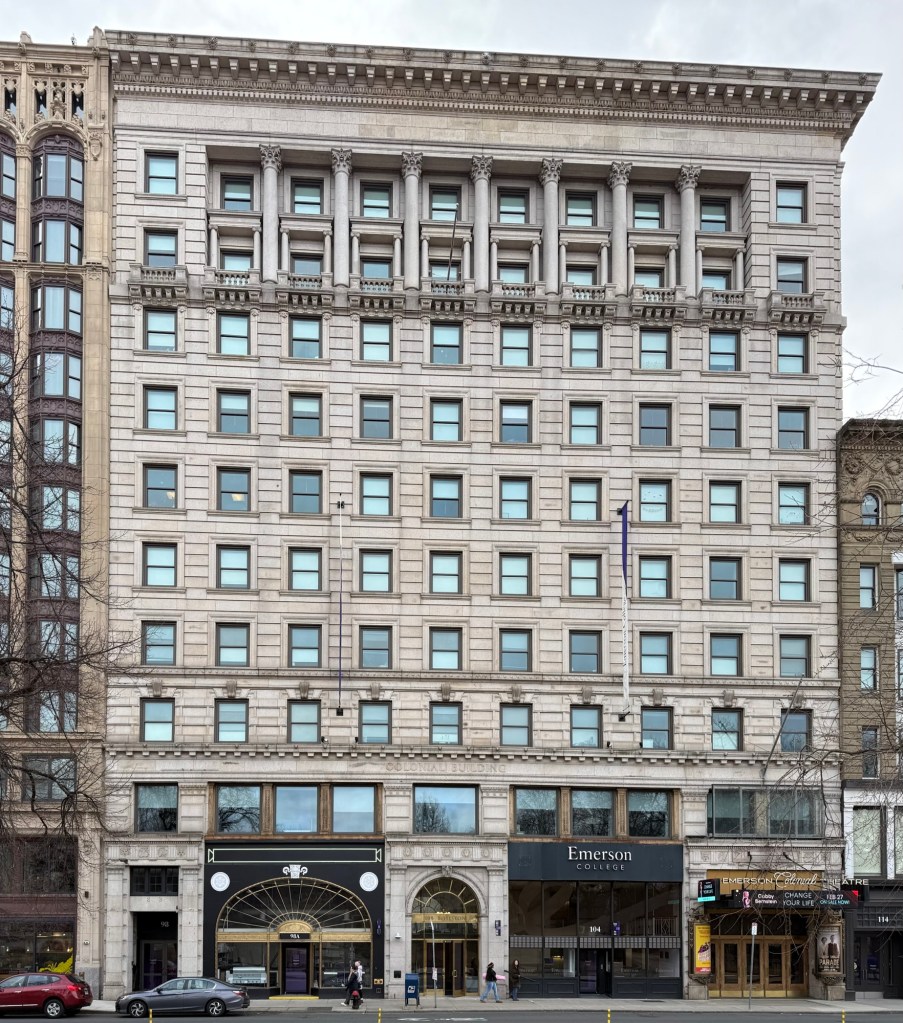
One of my favorite buildings on Boylston Street in Boston is the ten-story Colonial Theater Building, a landmark Classical Revival style structure of stone. Built in 1899, the Colonial Theater replaced the original Boston Public Library building (1855) which was demolished by 1898, and relocated to Copley Square. The Colonial Theater was designed by famed theater architect, Clarence Blackall and is said to be the oldest, intact theater in Boston. The theatre first opened its doors for a performance of Ben-Hur on December 20, 1900 with a sold out show. Ben-Hur operated with a cast and crew of 350 people and featured eight live horses on stage in full gallop during the chariot race scene, with the play being so mechanically and technically extraordinary it was featured on the cover of Scientific American. While cheekily named the Colonial Theater, the interior theater spaces were anything but. The spaces originally contained murals and Baroque style finishes, many of which remain today. Beyond the 1,700-seat theater, the building contained between 250-300 professional offices. The building is owned by Emerson College, who underwent a massive restoration project of the building with Elkus Manfredi architects. Allowing the oldest Boston theater to shine again!

Old Boston Public Library // 1855-1898

Courtesy of BPL collections.

Established in 1848, the Boston Public Library was the first large, free municipal library in the United States. The Boston Public Library’s first building of its own was a converted former schoolhouse located on Mason Street that opened to the public in 1854. As soon as the library occupied the building, it was apparent that the amount of visitors and collections could not effectively be held in the cramped quarters. Planning began almost immediately for it’s first purpose-built library. Less than a year later, in December 1854, library commissioners were authorized to purchase a lot and fund the construction of the new library. A desirable building lot on Boylston Street, opposite the Boston Common, was purchased and a public invitation for proposals from architects was held. The requirements for the building included: a library hall with alcoves capable of containing on fixed shelves at least 200,000 volumes, a general reading room with ample accommodations at tables for at least 150 readers, a ladies reading room, an adjacent library room for the arrangement of 20,000 books “most constantly demanded for circulation,” and quarters for the Trustees and Librarian. The facade was to be of brick, with stone dressing”. The selected design by architect, Charles Kirk Kirby, was for this handsome Italianate style building which took nearly three years to build, opening in September 1858. Twenty years later, as the library outgrew that space, the Trustees asked the state legislature for a plot in the newly filled Back Bay, and planning began on the McKim Building, built in 1895 down Boylston Street. This building, the first purpose-built Boston Public Library building, was demolished in 1898, and replaced by the ten-story Colonial Theater Building. It stood just 40 years.

Steinert Building // 1894

The Steinert Building on Boylston Street in Boston is one of the city’s most iconic and mysterious buildings. The Beaux Arts style building was constructed in 1894 from plans by architects Winslow & Wetherell and contained three floors of display rooms, three floors of teaching studios and practice rooms. The building is arguably best-known for the 650-seat Steinert Hall, a basement concert hall constructed 35′ under ground and considered by some to be one of the most perfect concert halls, acoustically, in the U.S. The building was constructed as the national headquarters for the prestigious firm of M. Steinert & Sons, one of the largest and finest music stores in New England. Established in 1860 by Morris Steinert, a Bavarian musician, musical instrument collector and founder of the New Haven Symphony (originally Steinert’s Family Orchestra). The company was expanded under his second son, Alexander Steinert, who had the Steinert Building in Boston built, requiring a music hall to showcase musicians and their products. The subterranean concert hall closed in the 1940s, following the 1942 Cocoanut Grove fire, the third-deadliest building fire in American history, which resulted in deaths of 492 people. This tragedy inspired an entirely new set of building and fire codes throughout the city; which ultimately would close Steinert Hall, as it had only one means of egress, making it too cost-prohibitive to bring the theatre into compliance. The building was long-operated as a piano showroom, but closed in 2017 and has been vacant ever-since. The basement music hall remains frozen in time, awaiting a new life.

Lincoln Street Garage // 1956

Few buildings in Boston showcase the evolution of its neighborhood (or bring out the architectural critics) quite as well as the Lincoln Street Garage in the Leather District of Boston. This Post-WWII mixed use building was originally constructed in 1956, on the former site of the United States Hotel (1839), one of the first major hotels in the nation, which was razed in 1930. The original building was designed by architect Archie Riskin, and stood three stories high with parking on half of the second floor and on the 3rd floor and roof. A fifth floor of office space was designed and constructed by 1959 also by Riskin. Due to its site at the edge of a historic commercial/industrial district and adjacent to the Central Artery, a raised highway that snaked its way through Downtown Boston, the building was minimally visible and faded away to obscurity until the late 1990s when the highway was buried under the city as part of the “Big Dig”. The open scar and subsequent re-greening of much of the former highway spaces necessitated the owners to re-work the building, due to its newfound gateway presence into the neighborhood. Brian Healey Architects renovated the building, adding an additional floor of offices and reworked facades. The result is a Post-war mixed-use hodgepodge of a building that expresses its use visually on each floor in a no-nonsense way, making it a unique urban building. Additionally the building has long been rented to small businesses, almost all Asian-owned with direct ties to the Chinatown and Leather District neighborhoods. Recent plans have been approved for a new office tower on the site and supported by preservation groups stating that “the existing garage is historically significant or beneficial to the neighborhood”, but to me, the further erasure of quirky buildings for more out-of-context developments is not the way to go.

Albany Building // 1899

One of the last major 19th century buildings erected in Boston’s Leather District is also one of the finest examples of Beaux Arts architecture in the city. This is the Albany Building, built in 1899, and fills an entire city block. The Albany Building was designed by Peabody and Stearns and built by Norcross Brothers as the offices for the United Shoe Machinery Corporation. Its two-story base is adorned with swags and cartouches and its fifth floor is topped with a complex cornice. The use of beveled corners and ornate detailing break up the massing of the building which otherwise, would read like a box. The building today serves as an important visual gateway into the Leather District and its context of late 19th century commercial blocks centered around the leather and shoe manufacturing businesses.

South Station // 1899

When the railroads serving Boston were first laid out and built, each line stopped at its own terminal which created a dysfunctional and cumbersome travel experience for those entering or leaving the city. The Boston Terminal Company, established in 1897, was charged with the task of consolidating service from the four terminals at a single terminal, a union station (similar to North Station), for routes south of the city. South Station was designed by architects were Shepley, Rutan and Coolidge of Boston and quickly became New England’s busiest transportation center. The five-story Classical Revival style station built of stone is an architectural landmark with three-story Ionic colonnade crowned by a clock surmounted by an eagle, stands above the triple-arched brick masonry lower level corner entrance. While the station handled 125,000 passengers each day during World War II, post-war passenger rail traffic declined in the US. South Station was sold to the Boston Redevelopment Authority in 1965 and (surprise!) they demolished portions of the building and later developed plans to demolish the rest of the station and replace it with a multi-use development including a new train and bus station with large parking garage. Luckily for everyone, the BRA failed in this endeavor and the building remained to the point where public transportation is again invested in and beloved and the building has since been restored. Recently, a glass “crown”, known as South Station Tower, a 51-story designed by Pelli, Clarke & Partners, with new office space, luxury residences, and a redesigned, arched interior concourse (which in my opinion, is the best part). The redevelopment is a push towards transit-oriented development and blends new and old in an innovative way.

What do you think of it?