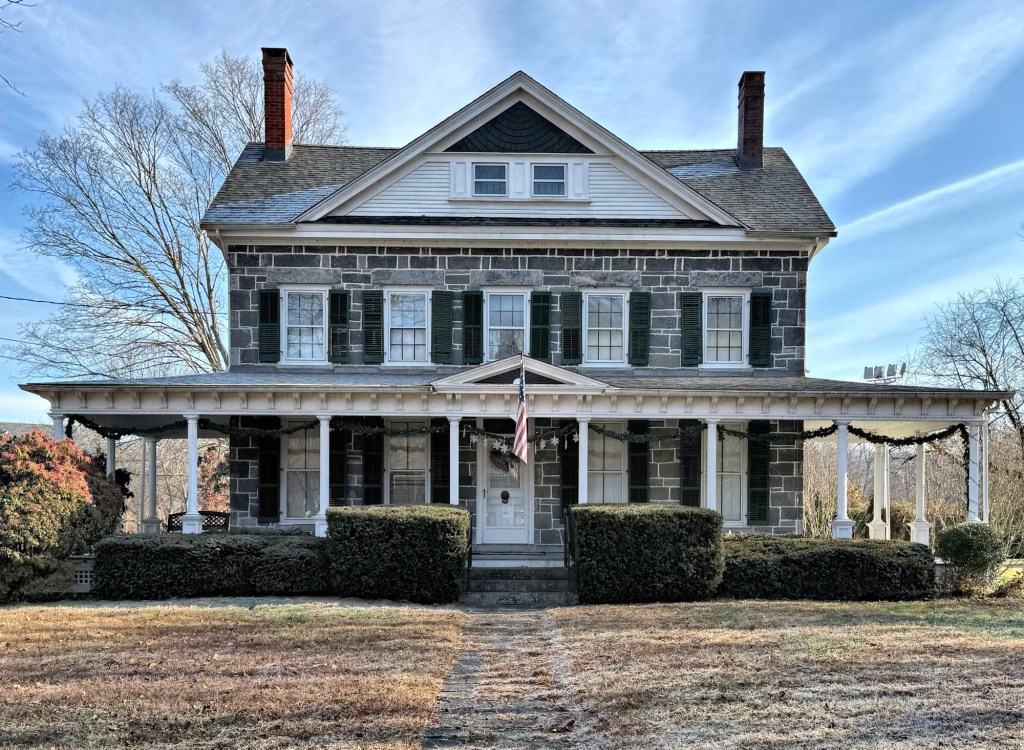
Southworth House – Deep River Historical Society // 1842

The Southworth House, also known as the Old Stone House, in Deep River, Connecticut, is a significant example of a stone, Greek Revival style house built for an important local family. The Southworth House was constructed in 1842 for Deacon Ezra Southworth (1803-1859) from stone harvested from one of the Southworth family’s quarries. Ezra was the son of local shipbuilder, Job Southworth who began building ships at the Deep River landing in the 1790s. Ezra Southworth branched off into manufacturing, becoming a partner and patent holder producing ink wells. His son, Ezra Job Birney Southworth (1844-1919), went into business with his father-in-law in shipping and served as a member of the State Legislature twice. In 1882, Ezra Jr. added the wooden ell onto the rear of the Stone House along with the wrap-around veranda and likely the rear barn as well. Ada Gilbert Southworth Munson was Ezra J. B. Southworth’s only child to live to adulthood and inherited the family home. She was a founding member of the Deep River Historical Society and bequeathed her family home to the Society in 1946, who have maintained the significant home here ever since. 

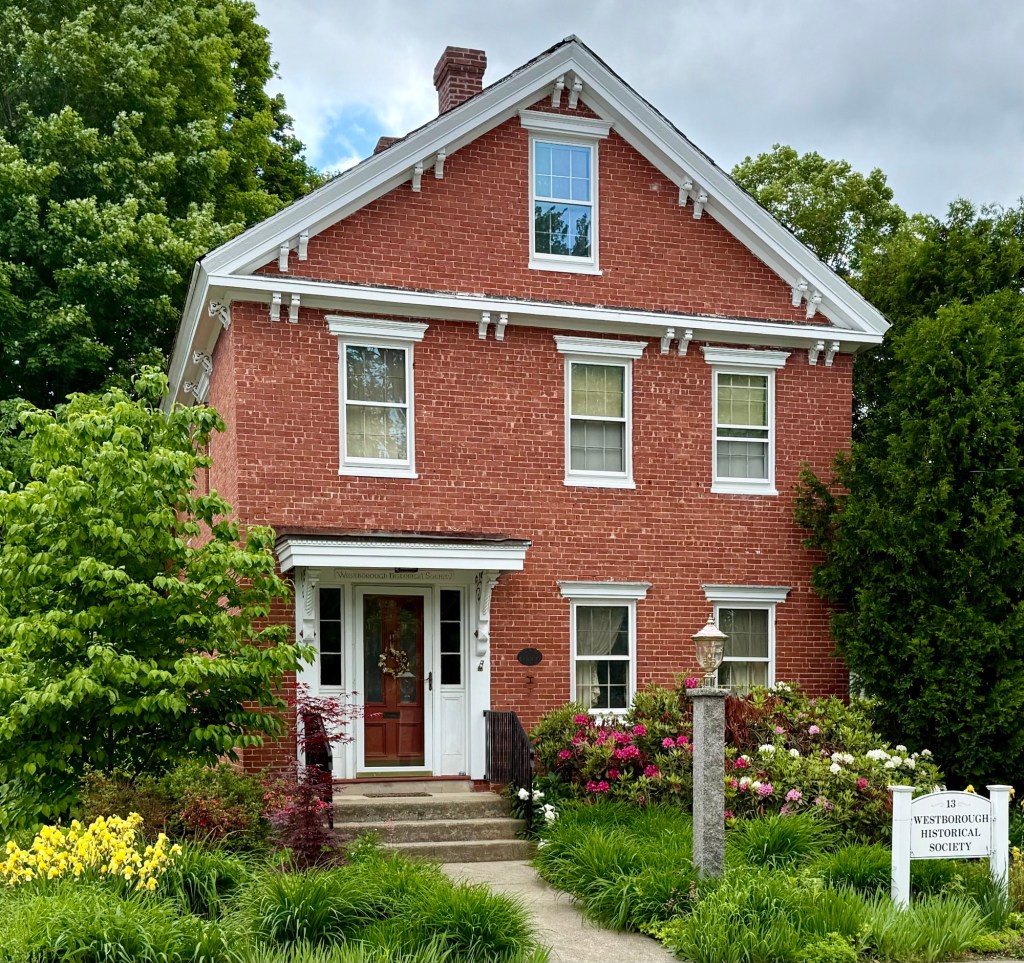
Sibley House – Westborough Historical Society Building // 1844

The Sibley House is a historic house museum as well as the headquarters of the Westborough Historical Society. Located on Parkman Street in the center of Westborough, Massachusetts, the transitional Greek Revival/Italianate style house was built in 1844, by William Sibley, who was a blacksmith and wheelwright. Soon after the house was built, William married Jane Caroline Gibson, and the couple raised five children here. William joined Westborough’s Company K, 13th Massachusetts Regiment during the Civil War and was wounded at Antietam. After the war, William returned home and he and his brother Frank began to manufacture sleighs.  At one point, they produced as many as 300 a year! The Sibley House was purchased by the Westborough Historical Society in 1990, nearly 100 years after the society was established in 1889. The house is open to visitors and provides a glimpse into daily life for Westborough citizens at the time. 

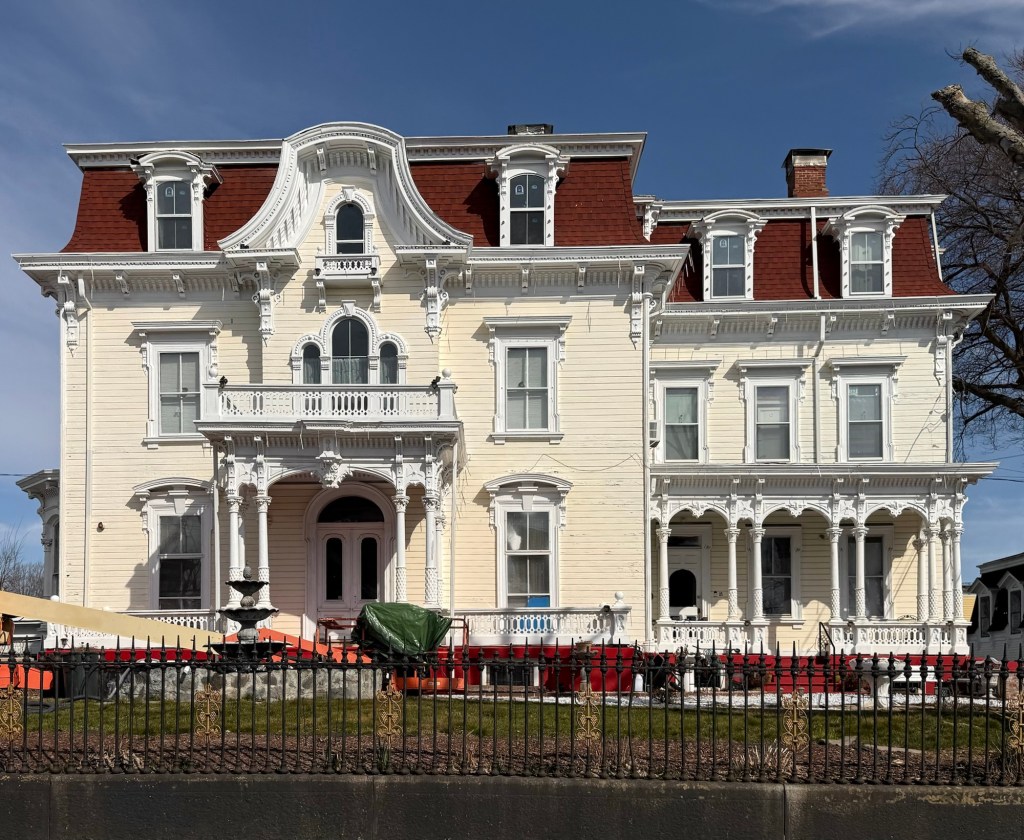
Benjamin F. Greene House // 1868

Built for Benjamin Franklin Greene, a second-generation mill owner of the Greene and Daniels Thread Company in Central Falls, Rhode Island, this large, Second Empire style house is one of the finest of its style in the entire state. The house is one of only a few high-style residences left from the mid-nineteenth century in Central Falls, when industrialization’s full expansion provided manufacturers such as Greene with fortunes to be expended on their houses. Designed by Providence architect Clifton A. Hall, the ornamentation of the Greene House is extraordinary for its elaboration, relieving the severity of the simple, block-like shape of the house. The central door is set under a flat-roofed porch which is supported by trios of Corinthian columns. Above the porch a trio of round-head windows is set under a “sunbonnet” gabled dormer which caps the central pavilion, is supported by brackets, and encloses a round-head window with a small balcony. What a spectacular home!

Nathaniel C. Allen House // 1793

The Nathaniel C. Allen House is a two-story Federal style residence located in New Gloucester, Maine. The house was built in 1793 by Shubael Marsh, a local builder (and father of Shubael Jr. (1797–1867), who moved to Texas with Stephen F. Austin) and sold to Nathaniel Coit Allen, an early settler in New Gloucester, who served as a General during the American Revolution. The property was purchased by Col. James Madison Thompson, then owner of the Glen House, an early White Mountains hotel in New Hampshire, who renovated the home by replacing the central chimney with two narrow ones and raised the ceilings and introduced Victorian interior woodwork. A subsequent owner added large Colonial Revival porches on the front and side entrances along with a new entry. The house showcases the changing tastes from Federal style to Victorian back to traditional tastes.

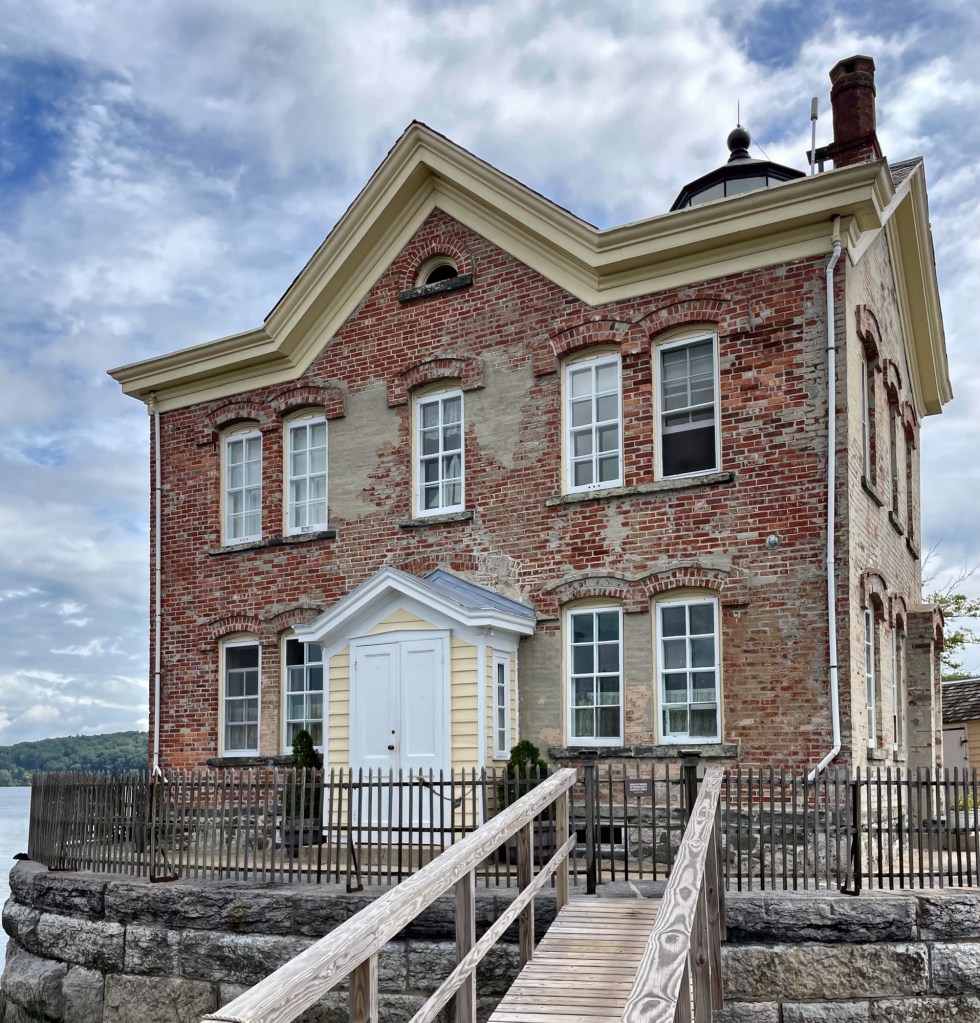
Saugerties Lighthouse // 1869

A landmark beacon on the Hudson River in New York, the Saugerties Lighthouse is a venerable aid to navigation and historically significant structure in the town of Saugerties. The first lighthouse here was built in 1835 and replaced in 1869 by the present structure, being the oldest lighthouse on the upper Hudson. The structure was important to the industry and later growth and development of the area as it provided aid to boatmen in trouble as well as providing a light and fog bell to warn ships of river hazards. The Saugerties Lighthouse was automated in 1954, making the light keepers obsolete. The building was closed up. Due to neglect, it fell into disrepair and decay and the Coast Guard proposed to demolish the structure in 1964. Local residents began to actively preserve and protect the lighthouse and funding was acquired to restore and recommission the structure, which occured in 1990. The Saugerties Lighthouse Conservancy today maintains and preserves this important historical asset and the lighthouse is even available for a short-term stay as a bed & breakfast, allowing visitors to serve as a lighthouse keeper for a weekend (without having to keep the lantern running.)

Edgar Hall House // 1889

Another of Acton’s amazing old Queen Anne homes is the Edgar Hall House, an 1889 gem on Windsor Avenue. The house was built for Edgar Henry Hall and his wife Angelina who raised their daughter, Alice, in the home. Edgar and his brother inherited the family business from their father, Enoch Hall, and they produced wooden pails, tubs, clothing racks, and other wooden goods. The company employed over 30 workers in the early 20th century until it closed during the Great Depression. Edgar retired and relaxed from this stunning Victorian home until his death in 1954.

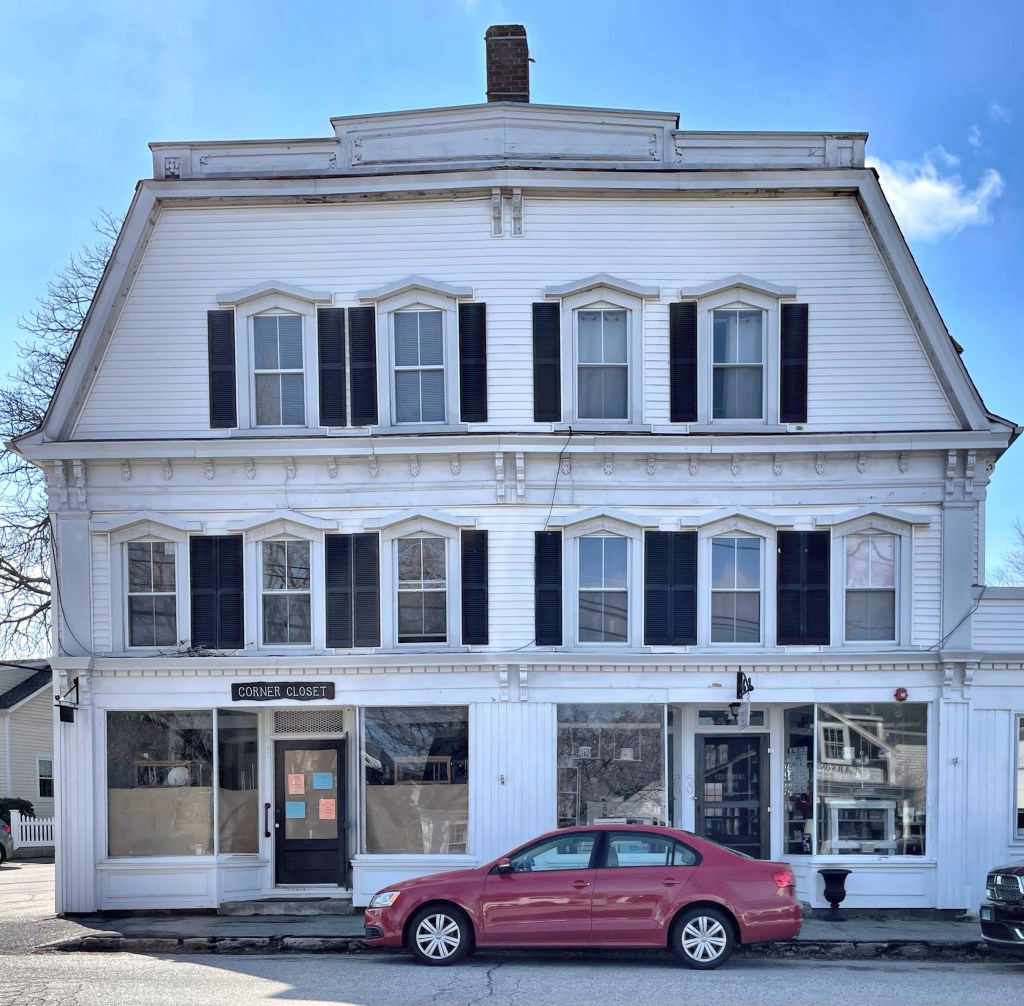
Roswell B. Fitch Store // 1851

Roswell Burrows Fitch (1833-1908) was born in the seaside village of Noank to parents Elisha and Mary P. Fitch. At twelve years of age he commenced to be self-supporting, and from then until he was fourteen, occupied a clerkship in a general store in town. In his teens, summers were spent aboard ships fishing for a livelihood, and his winters attending school. Upon completing his education, he became clerk in a store, and was afterwards engaged to assume the management of a union store which was erected for the special purpose of being placed under his charge. This building was constructed as the union store in 1851 with eighteen-year-old Roswell becoming an active partner in the business. In his twenties, he slowly bought out, one-by-one, the twelve other owners, until he possessed absolute control. The eclectic Greek Revival and Italianate style building features classical detailing, but with a bracketed cornice and gambrel roof which is capped by a parapet. Mr. Fitch retired from business in 1890 and got to work “Victorianizing” his nearby home. Stay tuned for the next post which features his home in Noank.