Founder’s Hall // 1884

Completed in 1884, Founder’s Hall is the oldest building on the campus of Atlantic Union College, a now defunct college in Lancaster, Massachusetts. The handsome Queen Anne style building was constructed for the school, originally known as South Lancaster Academy by Stephen N. Haskell, an elder of the Seventh-day Adventist (SDA) church. The building was designed by Worcester-based architects Barker & Nourse, and is the oldest educational SDA facility standing. The institution changed names, first to Lancaster Junior College, and then to Atlantic Union College, before the institution closed in 2018. The building and nearby campus buildings were sold in 2021, but the future is uncertain at this time.

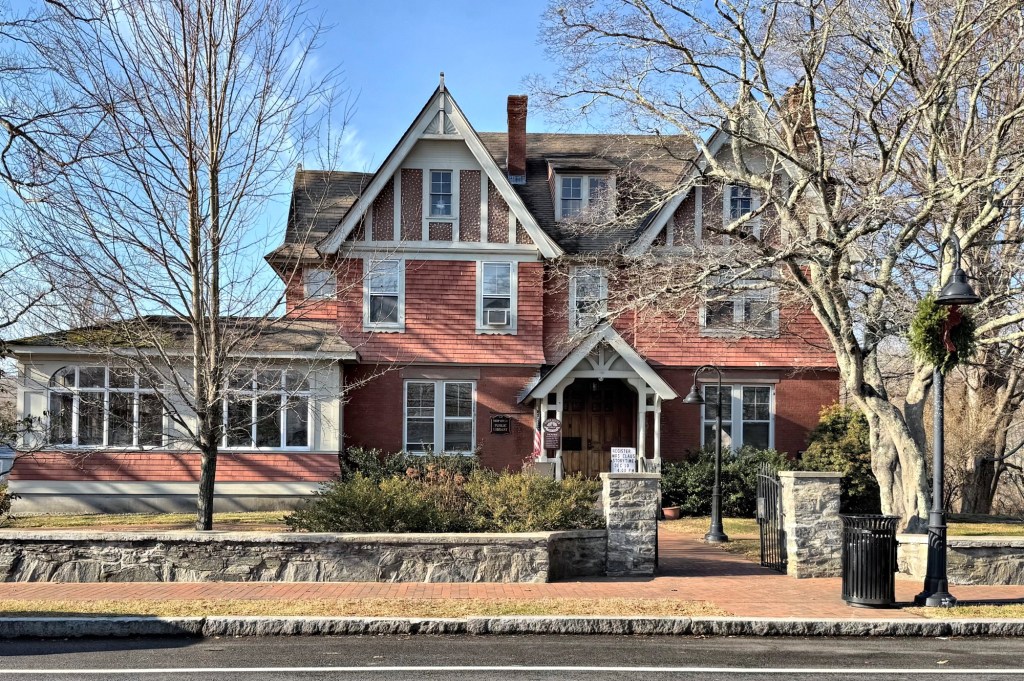
Swedenborgian Church of Lancaster // 1881

Built in 1881, the Swedenborgian Church of the New Jerusalem in Lancaster, Massachusetts, is a handsome Victorian-era chapel that has been well-preserved for nearly 150 years. The Queen Anne/Shingle style church was designed by architect Francis Ward Chandler of the firm, Cabot & Chandler, for the local Swedenborgians in Lancaster, some of which likely spent summers in Lancaster from Boston. The membership of the church dwindled in the early 20th century, and the congregation sold the church to a local women’s social group, the Current Topics Club in 1923. The women’s club met in the old church and maintained the building for nearly a century until the building sold to private owners in about 2007, who converted it to a residence, preserving the unique architecture we still see today.

Solon Wilder House // 1883

On Main Street in the central village of Lancaster, Massachusetts, the Solon Wilder House stands as one of the town’s finest Victorian-era residences. The house dates to 1883 and was built for Solon Wilder (1828-1889) and his wife, Olive. Mr. Wilder ran a store and served as town treasurer, doing well enough financially to build this handsome, and modern house and rear stable for the time. The Stick style house features a porch with cut woodwork, decorative trusses in gables, and wooden wall cladding interrupted by “stickwork” patterns raised from the wall surface that is meant to symbolize the structural skeleton of the home.

Robbins House // c.1850

Originally built in the 1840s or 1850s, this stunning house on Main Street in Chester, Vermont, was “Victorianized” in the late 19th century through applied ornament, a tower, and porches. Historic maps show that this house was owned by Cyrus Robbins and his wife, who likely had the residence built in a vernacular example of the Greek Revival style, with a 2 1/2-story form with gable roof oriented towards the street. The corner pilasters remain as do the original facade windows with five on the first floor, three on the second, and a single window in the upper floor. By the late 1800s, the house was modernized with the addition of the wrap-around porch with decorative spindles and ornament and the octagonal turret with wood shingle conical roof. Today, the house is painted colors to highlight the Queen Anne appearance and details.

Whiting Library // 1891

The Whiting Library in Chester, Vermont, was designed by architect George H. Guernsey, and is said to be the only building in the village designed by a regionally significant architect. For the design, Guernsey created an eclectic library blending Romanesque and Queen Anne influences that strikingly enhance the library’s relatively modest physical stature. The building was named to honor Chester physician, Laurin G. Whiting and his wife, Abigail, who donated funds for the land and building. The polychromatic brick and granite building features unique gables, corner tower, and arched openings, which were carried over to a lesser scale into an addition a few decades ago.

William Pollard House // 1899

This high-style and ornamental house in Chester, Vermont, ranks among the state’s best examples of the Queen Anne style. The residence was constructed in 1899 for William Pollard (1854-1941), a local businessman who owned a shirtwaist manufactory in town with his brother, who lived next door. The painted-lady Victorian house features an asymmetrical plan highlighted by a three-story octagonal corner tower that is surrounded by a wrap-around porch with a delicate spindled frieze. The use of accent colors in the paint scheme further highlight the millwork details on the residence, which have all been preserved for well over a century. 

Marie Hill Farmhouse // c.1810

Located in the charming rural town of Andover, Vermont, the Marie Hill Farmhouse is one of the most interesting and charming residences in the area. Built around 1810, the brick farmhouse was designed in the Federal style, with a symmetrical five-bay facade, brick end chimneys, and a fanlight over the front door. The property was purchased by New Yorkers, Laurence Pfluger and his wife Mary “Marie” Pfluger, who operated the farm, raising dairy cows. Laurence would ship eggs, dairy and meat to his market in New York from this farm, which did quite well financially. The farmhouse was “modernized” by the turn of the 20th century with the addition of the two-story octagonal towers on the facade, front and side porches, along with the decorative slate spelling out “Marie Hill Farm” after his Marie Pflueger. The residence was later converted into a guesthouse, a use that remains to this day, still retaining the iconic name and branding in the southern gable.

Edward Stanwood House // 1880

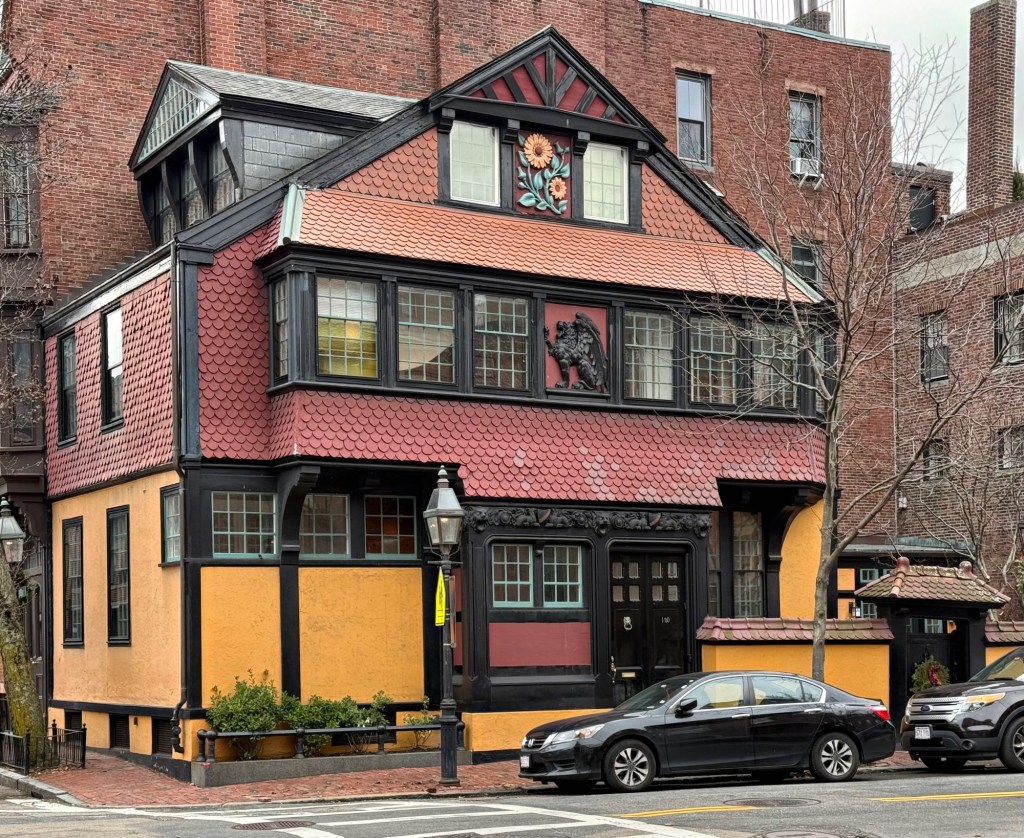
The Edward Stanwood House at 76 High Street in Brookline, Massachusetts, is one of the finest and exuberant examples of the English Victorian Queen Anne style, notable for its varied wall textures and materials, unique form, and applied ornament. The house was built in 1879-1880 for Edward Stanwood, who was for many years the editor of the Boston Daily Advertiser, and a children’s magazine, The Youth’s Companion. The ornate residence was designed by Clarence Sumner Luce, with interiors by Thomas Dewing. The Stanwood House features a well-preserved exterior and period-appropriate paint scheme, highlighting the bas-relief sunflower ornament and gargoyles. Of particular note is the use of hung tile siding, overlaid to give the appearance of fish scales and the roof cresting.

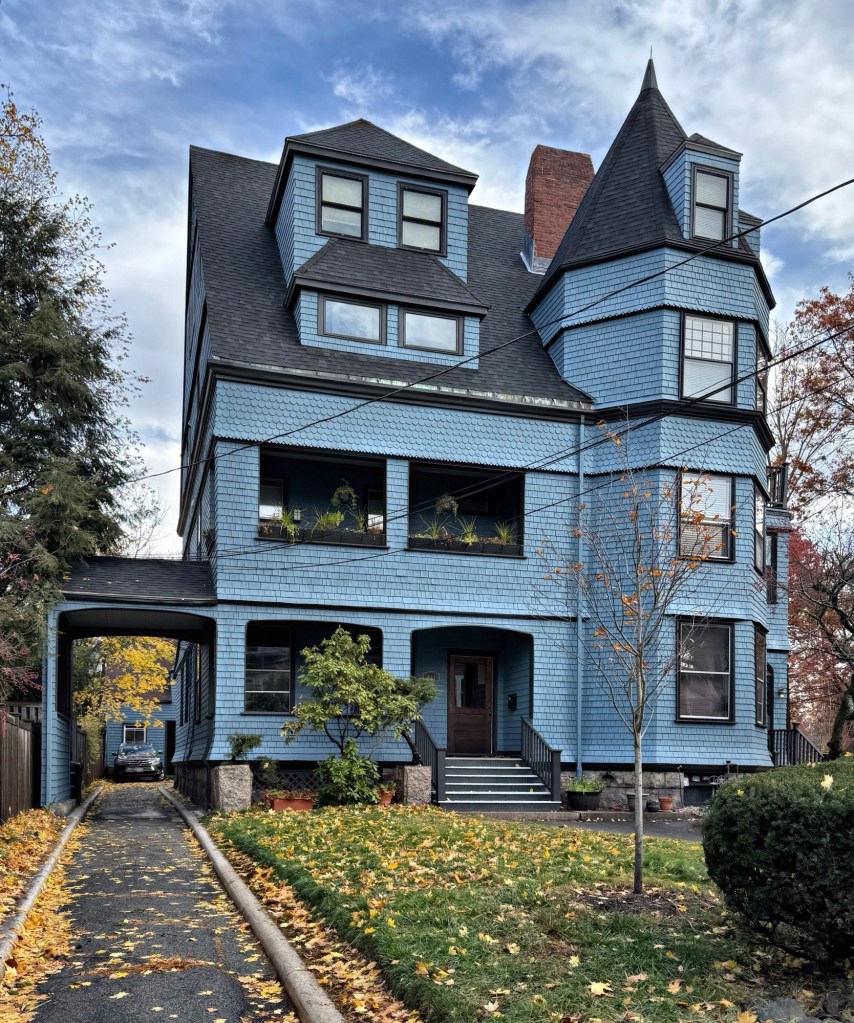
Charles Storrow Rental House // c.1884

This charming and quirky Queen Anne style house on Edgehill Road in Brookline was built as a rental property on the estate of Charles Storrow (1841-1927), a wealthy businessman who lived in his home next door (see last post). Like his own home, the residence was designed by Edward Clarke Cabot, his wife, Martha’s father, who utilized varied materials, forms, and roof shapes to create a unique composition unlike anything else in the neighborhood. The bulbous central tower and eyebrow and wall dormers also add intrigue to the design.

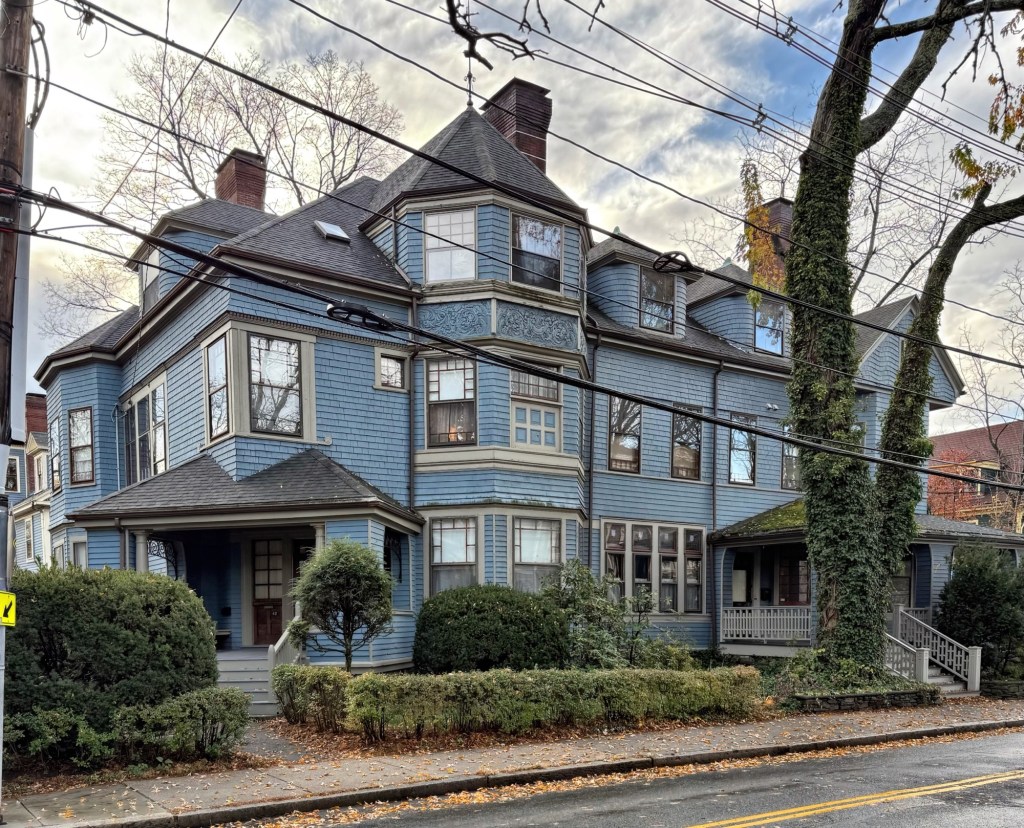
Charles Storrow House // 1884

Facade

This shingle and brick Queen Anne style house at 112 High Street in Brookline, Massachusetts, was built in 1884 for Charles Storrow and his wife, Martha Cabot Storrow from plans by architect, Edward C. Cabot, Martha’s father. The lot here is said to have been gifted to Charles from his father, Charles Storer Storrow, a prominent civil engineer and industrialist, who is known for designing and building the dam and textile mill complex in Lawrence, Massachusetts. Besides the Victorian main house, the property included a historic stable and a detached house on an adjacent lot, which appears to have been rented by Mr. and Mrs. Storrow. The property was designed by Frederick Law Olmsted’s firm, with rustic rock walls, natural topography, and large, mature plantings. The Storrow House originally had stained glass windows designed by John LaFarge, which were sold in the 1970s. 

Side elevation.