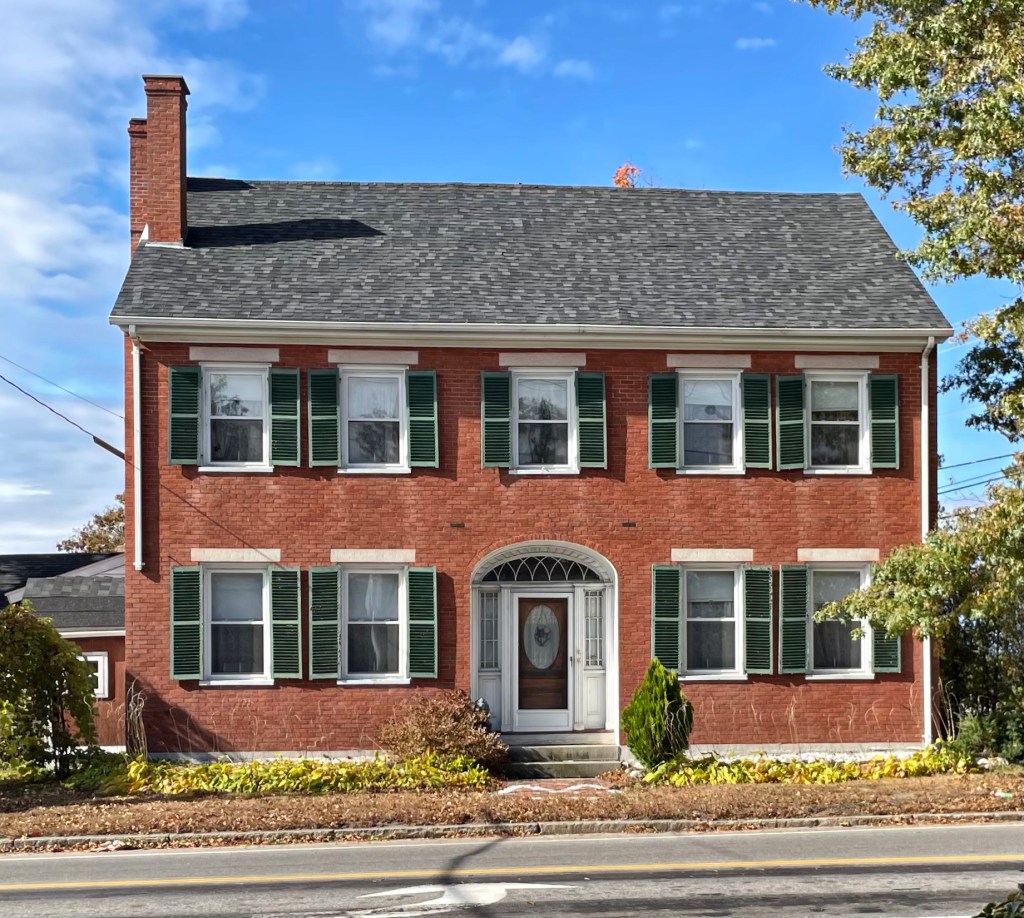
This stunning brick Federal style home sits in the center of Gray Village in Maine. The house dates to the early 19th century and was long-owned by members of the Morrill Family, seemingly first by William C. Morrill and remaining in the family for generations. The residence is a high-style example of the Federal style with recessed elliptical entrance with fanlight transom and sidelights with a Victorian-era front door. The house was likely built by a local mason or housewright who employed the designs of a Federal style plan book for the architectural detailing at the entry.
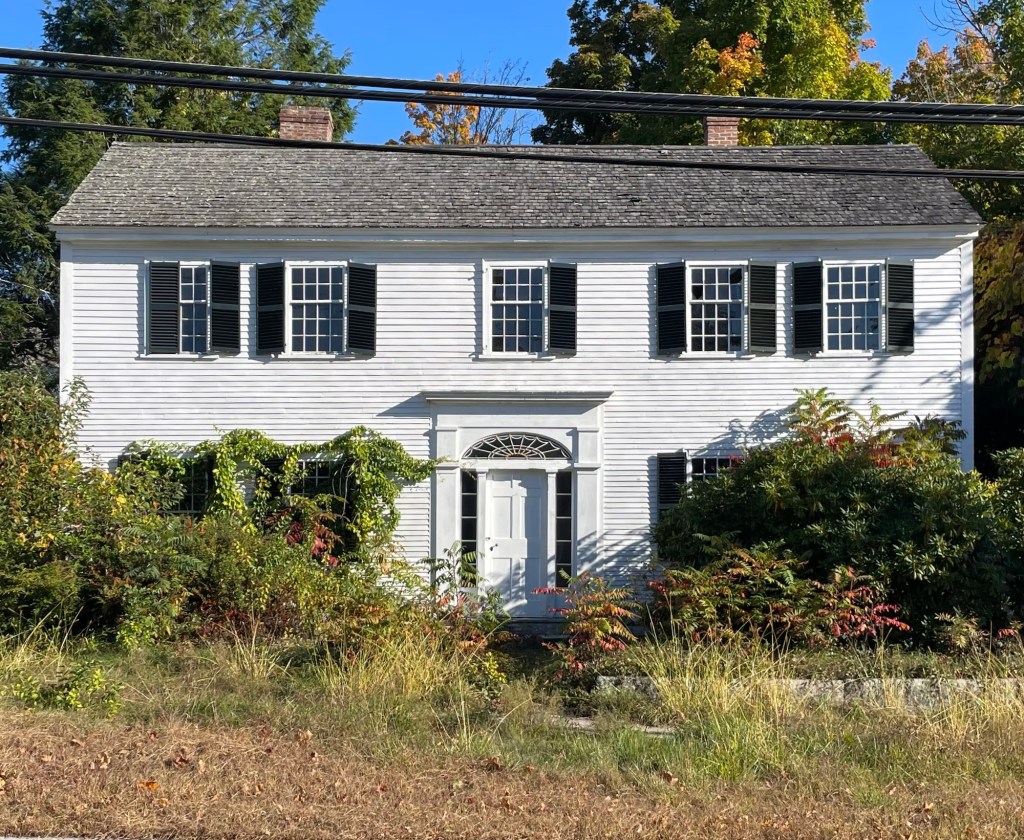
Built around 1784 for Reverend Samuel Perley, this Federal style home is one of the finest in the town of Gray, Maine. Samuel Perley (1742-1830) was educated at Harvard College and while there, met and befriended John Adams, who would later become the second President of the United States. The two maintained a lifelong friendship. Perley came to Gray in 1784 as a pastor of Gray’s first church. He likely had this house built at the time or purchased an existing house and updated it and the house is said to have Moses Eaton stencilling inside. At one point, Rev. Perley and his wife lived on one side of the house while his son Isaac, his wife, and their twelve children lived on the other.
One of the many Federal period houses in Ashby Center is this lovely c.1810 residence on Main Street. The house is known as the Wellington House, and was possibly built by Darius Wellington, a carpenter who assisted with building the town’s First Parish Church in 1809. The house exhibited a symmetrical facade with stunning fanlight transom over the main entrance and eight-over-twelve sash windows. In the latter half of the 19th century, the property was owned by Cyrus Sears, a prominent sea captain, who sought a life inland with his family. He would serve in the Civil War, but had the half-decade house “modernized” with new bay windows and an entry porch. He would later move to Baltimore and serve as a port captain and consul to Cuba. In the past few years, the owners have restored the home to its original Federal design, re-emphasizing the stunning fanlight transom and sidelight details.
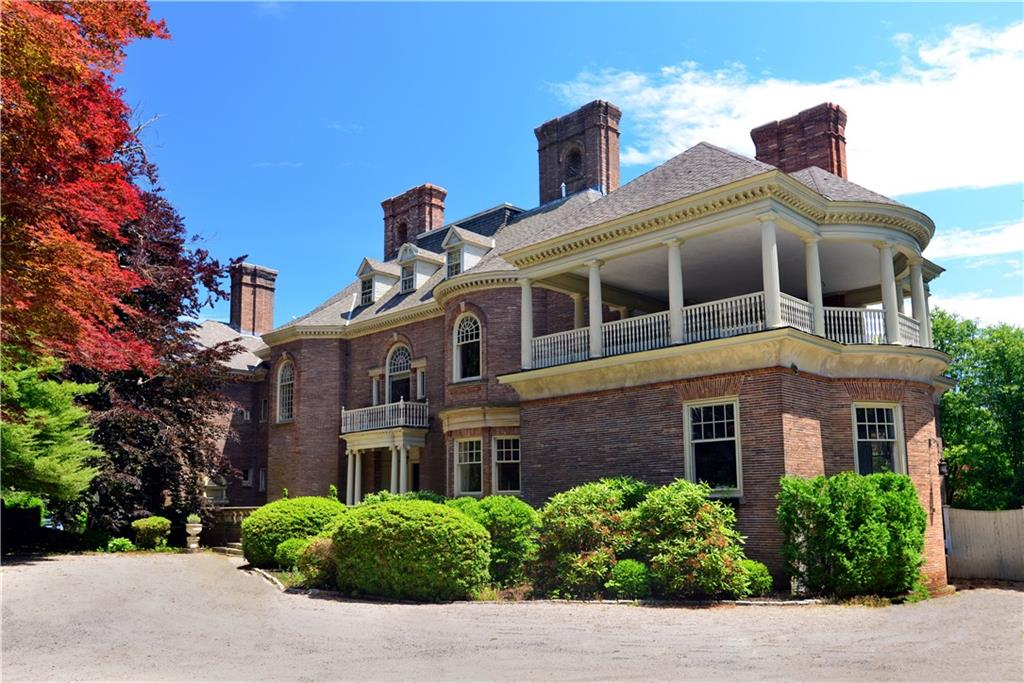
During the height of the Shingle and Queen Anne styles’ popularity, architect Stanford White of McKim, Mead & White completed plans for one of the earliest Colonial Revival style residences, “Sunnyside” in Newport, Rhode Island. The residence was built in 1886 for “Commodore” William Edgar (1810-1887) and his wife, Eliza Lucille Rhinelander (1832-1916). William was a co-founder of the New York Yacht Club in 1844 and heir to a New York fortune. Eliza was an aunt of Edith Wharton and a grand-daughter of William Rhinelander, co-founder of the Rhinelander Sugar Refinery. The property remained in the Edgar Family as Lucille Rhinelander Edgar (1858-1948), an unmarried daughter of the couple, would live here year-round with servants. The house is built of buff-Roman-brick with a large central block flanked by L-plan wings under a hipped roof punctuated by massive chimneys. Of special note on the facade are the rounded bays, entry portico with Palladian window above, and side porch.
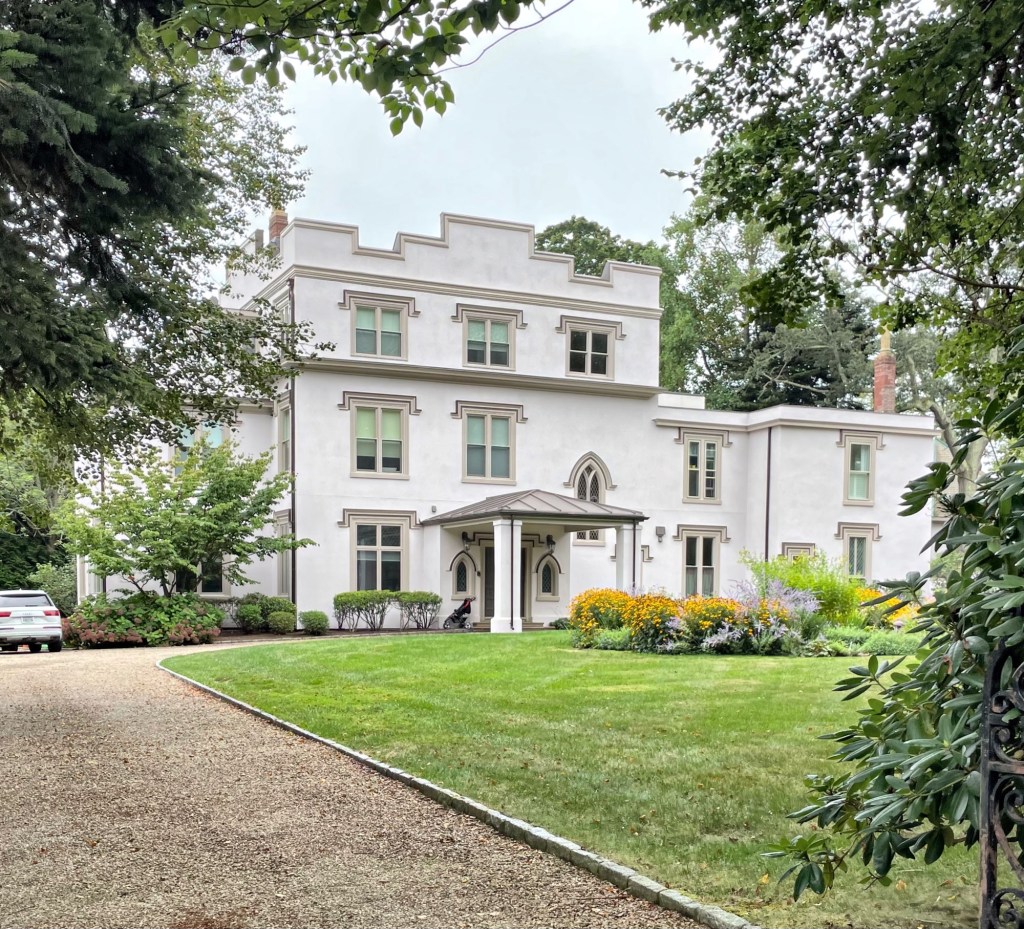
A rambling Gothic Revival style house in the mode of the picturesque Gothic estates in England, can be found tucked away in Newport, Rhode Island. This is Tudor Lodge, a stuccoed summer “cottage” notable for its stucco siding, moulding over all the windows, broad crenellated parapets, and a hip-roof porte-cochère in front of the principal entrance. The house was supposedly originally built as a summer residence for Nicholas Redwood Easton around 1850. After his death, the property was purchased by members of the Gibbs (Gibbes) Family, who owned much of the land in this part of town, giving nearby Gibbs Avenue its name. The property was purchased around 1900 by William Rogers Morgan, a New York City banker, who greatly remodeled and named the estate, Tudor Lodge, giving the house its present appearance. The estate was converted to four condominium units in 1980.
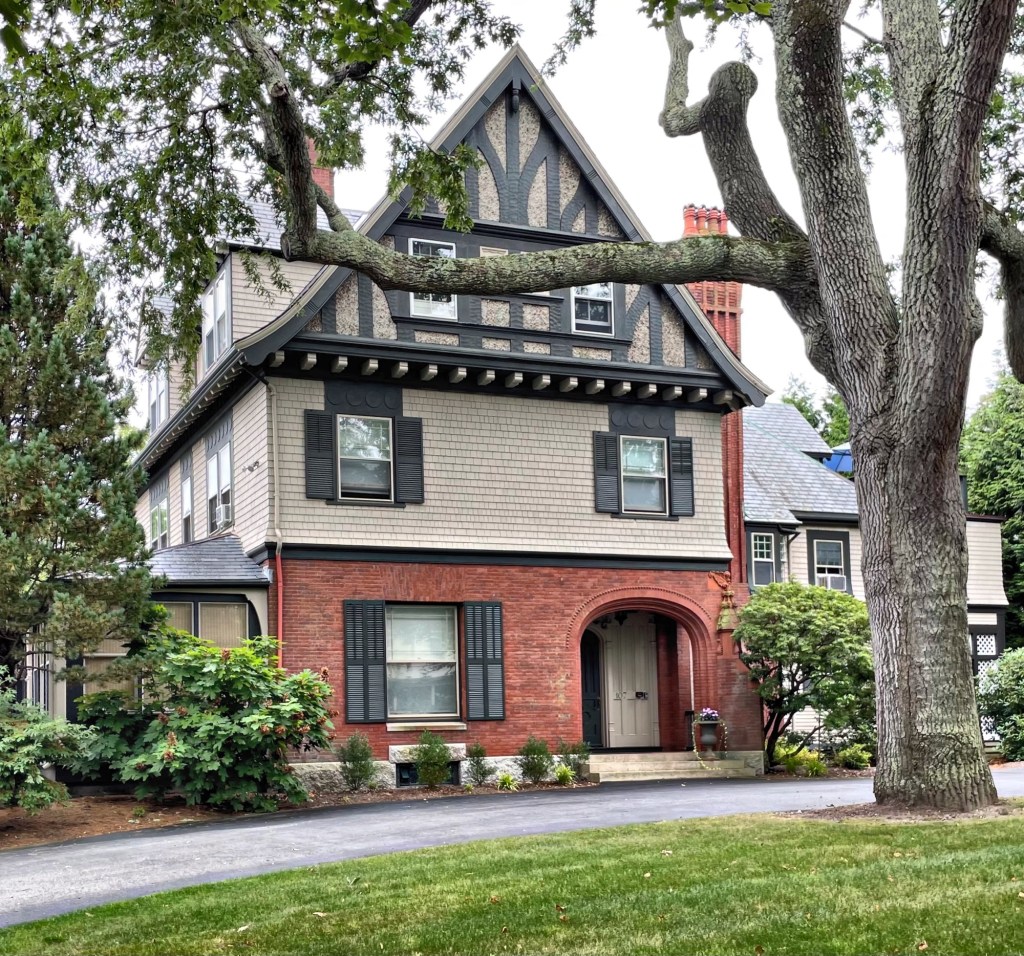
Oakwold, a stunning Queen Anne residence on Old Beach Road in Newport, Rhode Island was supposedly built on speculation and purchased by Augustus Jay (1850-1919). Mr. Jay was born in Washington, D. C., the son of Peter Augustus Jay and Josephine Pearson Jay. Augustus Jay graduated from Harvard College in 1871 and from the Columbia Law School in 1876, and worked as a diplomat. His wife was Emily Astor Kane (1854–1932), a daughter of DeLancey Kane and Louisa Dorothea (née Langdon) Kane. Emily was a descendant of John Jacob Astor. The “cottage” was named Oakwold, and was designed by architect Clarence Sumner Luce, who designed many summer residences in Newport, and specialized in the Queen Anne style. Particularly noteworthy in the design of Oakwold are the brick first floor with entrance within a recessed arched opening and pebble-dashed and half-timbered gable ends.
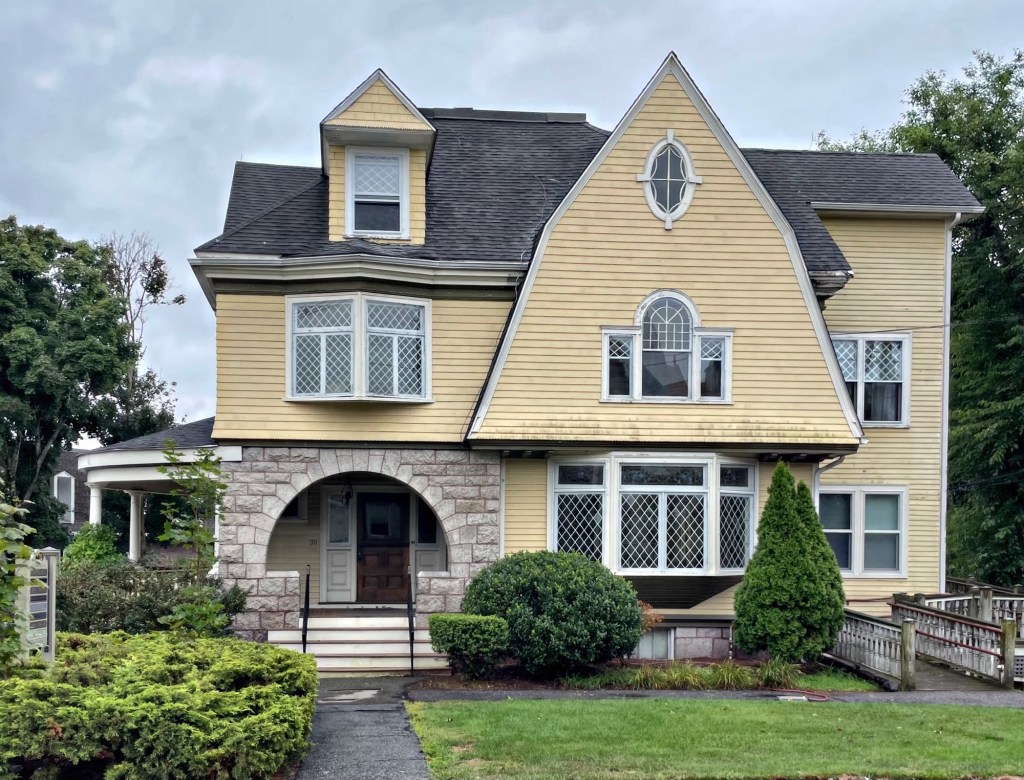
Built in 1893, this house in Norwood, Massachusetts, was built for Dr. Ralph Fogg, a leading dentist in the Boston area with offices in Boston, Norwood, and Quincy. Dr. Fogg was dissatisfied with nitrous oxide gas as an anesthetic, as it failed to protect the patient against pain; and, in trying to find some harmless compound to accomplish the desired results, he produced the “Boston Vegetable Vapor,” an anesthetic to compete with nitrous oxide in markets. In 1885, the Boston Vegetable Anesthetic Company was formed for the purpose of placing the vapor in the market, and it was used by leading dentists across the country. With his dental practice growth and success of his new invention, Dr. Fogg and his new wife, Anna Saville, hired architect, Herbert Mosely, to design a stately home for their family. The Queen Anne/Shingle style house features a sophisticated use of stone, clapboard and wood shingle materials. It’s main facade is dominated by a broad gambrel gable with the main entrance set within a rusticated stone arch which is edged with large voussoir blocks.
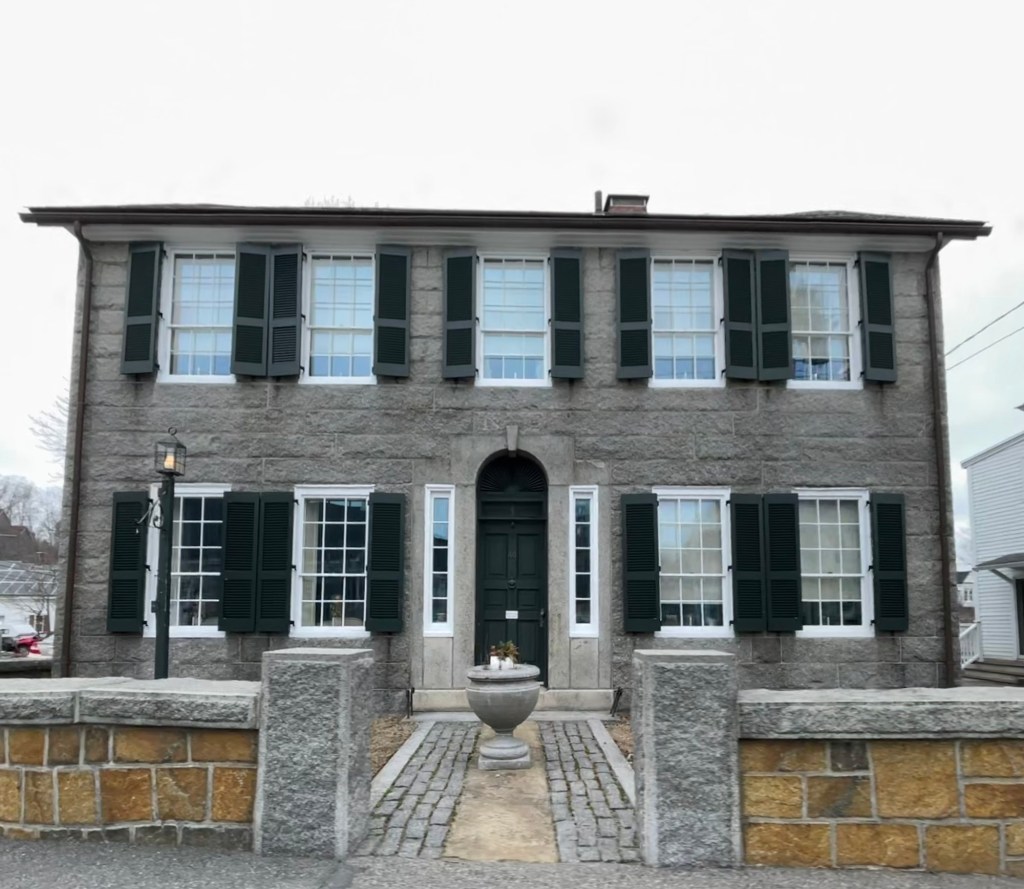
Levi Sewall (1805-1880), a native of Maine, built this stunning granite Federal style house in Rockport, Massachusetts in 1832 in preparation for his marriage to Mary Ann Robards. The granite blocks used to build the house were hauled by oxen from Sewall’s own quarry in Pigeon Cove, which is said to have produced stone of excellent quality. Sewall was one of the towns earliest entrepreneurs in the granite business and did quite well, supplying the building material to many of the region’s buildings in the mid 19th century. The property was inherited by Levi and Mary’s son-in-law, Frank Scripture, who took over the family business. Levi Sewall’s descendants occupied the Sewall-Scripture House until 1957, and ever since, it has been home to the Sandy Bay Historical Society and Museum.
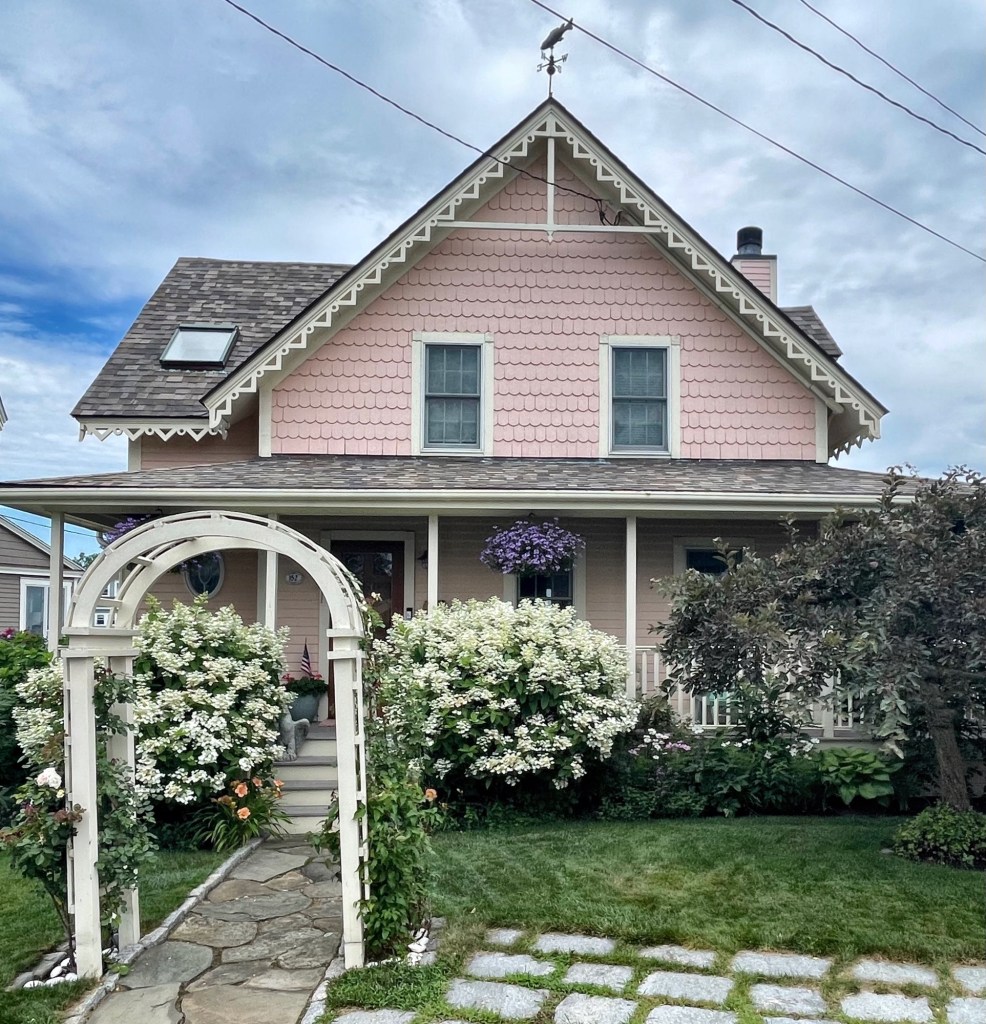
One of the most picturesque and charming summer cottages (now year-round residences) in the Salem Willows neighborhood in Salem, Massachusetts is this Victorian on Bay View Avenue. The cottage was built around 1877 for Joseph Pray Allen (1822-1897) who was a police officer who likely climbed the ranks in the force to afford a second home in the city. The 1 1/2-story cottage has decorative bargeboards at the eaves and stick bracket at the gable. Perfection!
By the end of the 19th century, various coastal developments on the elongated coastal town of Hull, Massachusetts, developed into established neighborhoods of cottages. As a result, new stores, schools, and post offices were built to accommodate the increase in population. William Henry Sylvester (1840-1923) a local resident, built this structure to serve as a store, professional offices, and post office. Like other buildings in the area constructed in the 1890s, the structure blends Queen Anne and Craftsman elements in a great composition. Sadly, the building has not been maintained and the windows are now boarded up, with the entire waterfront parcel selling in 2018. Plans to demolish the buildings on the site, including this charming structure were proposed to erect new townhomes, but they have not materialized. I’d love to see the site redeveloped with much-needed housing, but this structure should be incorporated in the development.
This large Federal style home in Rockport is a rare extant example of a spite house in Maine. The story goes… James McCobb, an Irish immigrant, arrived in what is now Phippsburg in 1731. Living in a log cabin with his Irish-born wife, Beatrice, he raised a large family of 10 children, among whom was Thomas McCobb (1778-1815), who became a sea captain. In 1774, James built a handsome Federal period house for his second wife, Hannah Nichols, with whom he had three children (twin daughters, and a second son, also named Thomas). He married a third time in 1782 to Mary Langdon Storer Hill, who had a son, Mark Langdon Hill, from a previous marriage, who ended up marrying one of McCobb’s daughters, one of the twins, who was a half-sister to Thomas. While Captain Thomas McCobb was away at sea, the Hills, which included Thomas’ half-sister/wife of Mark Langdon Hill, broke his father’s will and took the homestead for themselves. When Captain Thomas McCobb returned from his voyage and discovered what had happened, he vowed to build the most beautiful house in Maine and one that would dwarf the one he had been deprived of. The house was promptly dubbed “The Spite House”.
This house was built in 1806. Ironically, Captain Thomas apparently never married and left no descendants, as a result, when he died in 1815 in Boston, the house was given over to the Hill family. The house had fallen into disrepair and was purchased in 1925 by Donald Dodge of Philadelphia, who moved the house, to save it from demolition, over 85 miles by boat from Phippsburg to Rockport. He also transported a 1796 house from South Harpswell to be used in the construction of the wings that were subsequently added onto the Spite House. The property now sits on Beauchamp Point, not visible from the street, in a desirable enclave of summer residences, with sweeping views of the Atlantic Ocean.
This homestead is one of the earliest homes in the Camden–Rockport area of Maine. Originally built inland from the harbors, the house was a one room cabin with an open sleeping loft above. Allegedly built in 1769 by Robert Thorndike (1734-1834) one of the earliest settlers of Rockport the house has served as a significant piece of the town’s history ever since. There were two additions to the house in 1806 and 1826. The first addition in 1806 consisted of the front door entry and the front parlor, a birthing room and a chamber and loft above. The 1826 addition in the back of the home provided a kitchen area that was later divided to provide a small parlor. In 1826, Frederic Conway bought the property from Robert Thorndike Jr., which remained in the family until 1916. The property is now owned by the Camden-Rockport Historical Society as a house museum and the organization is further documenting the history of this house and the two towns.
Before the turn of the 20th century, William L. and Elizabeth G. Phinney purchased a narrow house lot at the corner of Hawes and Chatham streets in the desirable Longwood neighborhood of Brookline. They then retained the young architectThomas Marriott James, to design this massive Federal Revival style mansion. After William died in 1911, Elizabeth remained in the house until 1920, when it sold to C. Willard Bigelow a wool dealer and his wife, Ruth. The Phinney-Bigelow House is an exemplary Federal Revival style house on a narrow lot which takes full advantage of its boxy form. The slightly asymmetrical facade with Palladian window, limestone trimmings, and bold entrance are all great additions to the design.
Another of the early homes of the affluent Longwood subdivision of Brookline, Massachusetts is this painted brick house which dates to the 1850s. The house was developed by Amos A. Lawrence, who developed much of the neighborhood, renting out suburban houses to wealthy Boston-area residents. In 1866, Lawrence sold the property to Samuel S. Allen of Roxbury and it would change ownership a half-dozen times in the next century. The property was added onto and modernized a few times, notably during the ownership of Henry A. Christian, MD, the first Chief-of-Medicine at Peter Bent Brigham Hospital over the Muddy River in Boston. The streamlined late-Colonial Revival look with vestibule side entry, windows, and shallow hipped roof are all likely later alterations from the 1850s house.