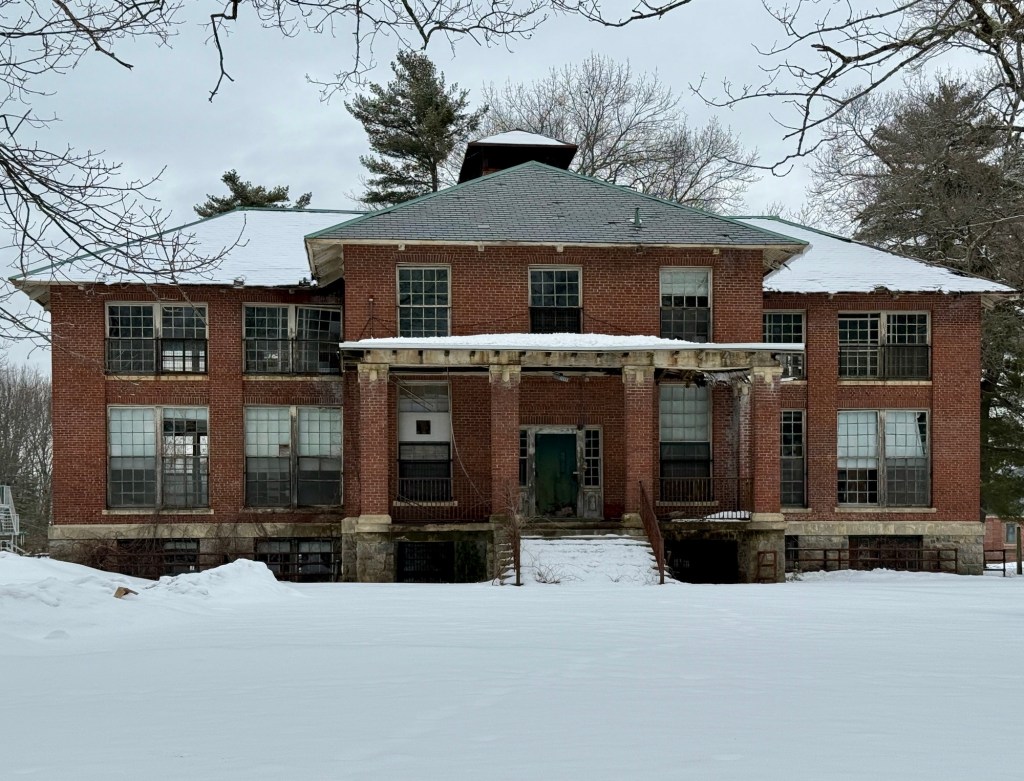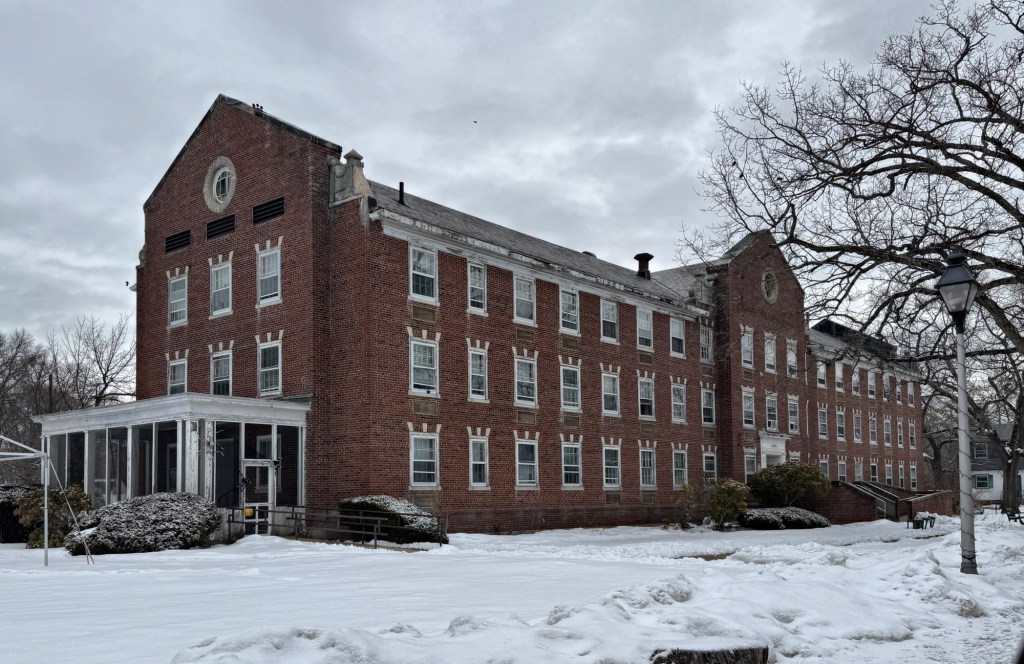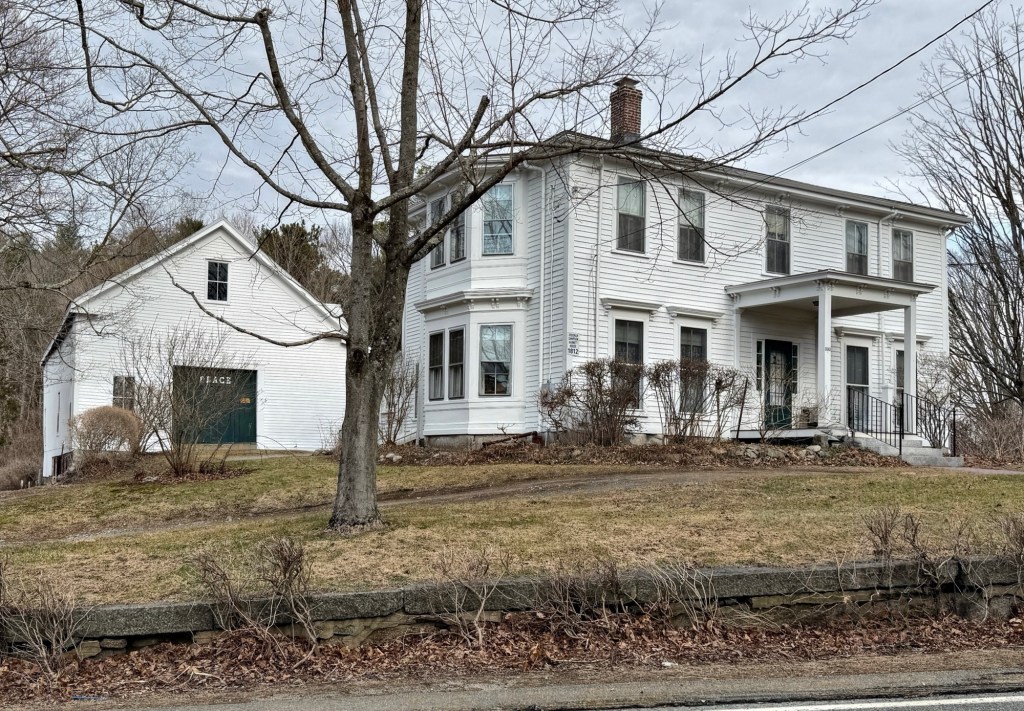
Warren W. Dutcher House // c.1860

The finest example of the Second Empire style in the industrial village town of Hopedale, Massachusetts, is this stately residence at the beginning of Adin Street, which has been colloquially known as ‘Millionaire’s Row’ as it is lined with many large mansions owned by factory owners and managers. This is the Warren W. Dutcher House, built around 1860 for its namesake, a wealthy and well-connected manufacturer. Square in form, the house is capped by a concave mansard roof in slate, and features a cornice with paired brackets, round-headed dormer windows, and a central entry with door hood supported by oversized brackets all under the full-length porch. Warren Whitney Dutcher (1812-1880) was originally from North Bennington, Vermont, and in the 1850s, he invented a temple that worked better than one used by the Draper Corporation. are adjustable stretchers used on a loom to maintain the width and improve the edges of the woven fabric. George Draper bought an interest in it, and encouraged Mr. Dutcher to move to Hopedale to expand his operations. He moved to Hopedale in 1856, and built this home after a few years of managing the Dutcher Temple Company. After Warren Dutcher died in 1880, the home was inherited by his son, Frank Dutcher, until he built his own house on a lot behind his childhood home.

General Draper High School // 1927

The General Draper Memorial High School is one of the many civic and institutional buildings in Hopedale Village that were donated to the small industrial community by members of the wealthy Draper Family, who operated the Draper Corporation Factory in town. The school was built in 1927 on land donated to the Town by Princess Margaret Bonocompagni, the youngest child of the late William F. Draper, who married Prince Andrea Boncompagni of Italy in 1916. The marriage ended in divorce by 1924 and years later, she had no need for the family home in Hopedale, and bequeathed the site to the community for a new high school in memory of her late father. General William Franklin Draper (1842-1910) was a Civil War veteran who became a politician and managed the Draper company in Hopedale, where he built a massive mansion for his family. The mansion was demolished and replaced by this Colonial Revival style High School, designed by New Hampshire-based architect, Chase R. Whitcher, the handsome structure has since been expanded at the rear to service the growing student population in town.

Urncrest // c.1875

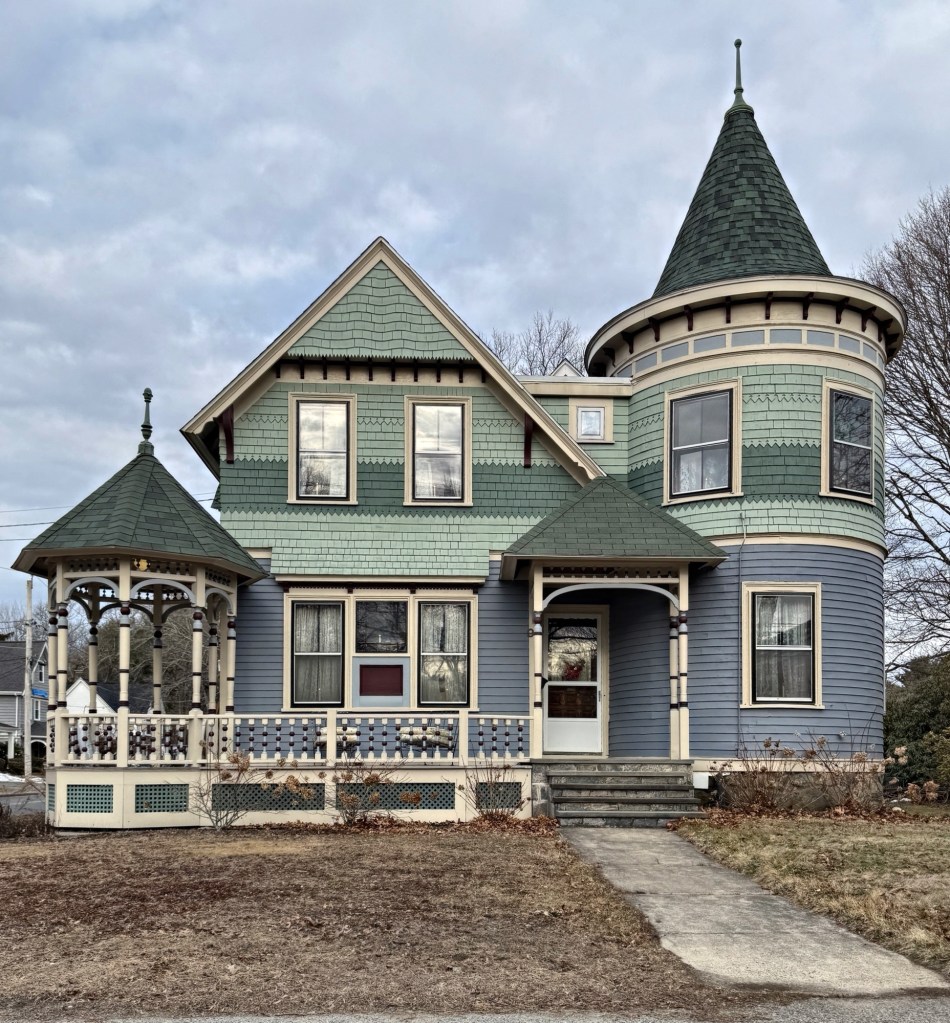
Located on Adin Street, a street of homes formerly owned by factory owners and managers in Hopedale, Massachusetts, you will find “Urncrest”, a stunning Queen Anne Victorian mansion. This home was originally built around 1875 for William Lapworth (1844-1937) an English-born weaving expert, who worked at Hopedale Elastics Co. and patented certain weaving processes for suspenders, boot webbing, and garters. Hopedale Elastics was absorbed by the Draper Corporation in 1890, and Lapworth “modernized” his home with profits from this sale. His formerly modest home was updated with a corner tower, large additions, wrap-around porch with porte cochere, and applied ornament. The detached carriage house was also expanded, where he added a coachman’s apartment.

Hopedale Community House // 1923

Hopedale in the 1920s saw a civic building campaign led by George A. Draper (1855-1923), then treasurer of the Draper Corporation. Draper often talked about the need for a community center in Hopedale for his workers, and in 1919 decided to build one at his own expense. He commissioned architect Edwin J. Lewis, Jr. of Boston to design the Hopedale Community House which was intended to serve as a social and civic center for all Hopedale residents, as well as Draper Corporation employees residing in other towns. The building was opened in 1923, but sadly George Draper died before he could see it used. Colonial Revival in style, the building’s facade is dominated by a portico along the entire elevation with double-height Ionic columns. The slate hipped roof is capped by a square clock tower at the crest. The Community House included an assembly hall, a banquet hall that doubled as a gymnasium, a kitchen, rooms for smoking and cards and billiards, a ladies’ social room, the Knights of Pythias club room, and candlepin bowling lanes in the basement, all of which exist to this day.

Hopedale Central Fire Station // 1915

Hopedale’s Renaissance Revival Central Fire Station on Dutcher Street was designed by Milford architect, Robert Allen Cook, a favorite of the Draper Corporation, who had oversaw the design of the Draper Company Offices just five years earlier. Very similar in style and detailing to the Draper Offices, Cook created a fire station of brick and terra cotta with a monumental hose tower at the corner, all in the Renaissance Revival style. The building was largely funded by the company, who was by far the largest employer in town and had funded many municipal and institutional buildings in the community as part of the company town. As fire prevention was important for the Draper Corporation, they even funded some of the first fire trucks in Massachusetts, even for such a small community. The town has done a great job preserving this architectural landmark for over 100 years. 

Little Red Shop // c. 1843

The area that is now the town of Hopedale, Massachusetts, was originally known simply as the “Dale,” a small, secluded agricultural area between Mendon and Milford, that beginning in 1842, was home to a communal Christian society called “Hopedale Community.” The communal agricultural and manufacturing society that eventually acquired over 600 acres  and numbered more than 300 members at its peak before ultimately failing in 1856 due to socioeconomic inequalities and bankruptcy resulting from conflicts between its ideology and business organization.  In that same year, the assets of Hopedale Community were purchased by the E.D. and G. Draper Company, led by Ebenezer and George Draper, who were the operators of Hopedale Community’s most successful manufacturing enterprise, textile machinery manufacturing. The Drapers had previously shared space in this old machine shop, which dates to around 1843, alongside fellow community workers who made hat and shoe boxes, sawed lumber, and ran an iron forge. As the Drapers founded the Draper Corporation, which became the largest maker of power looms for the textile industry in the United States, they never lost sight of their beginnings and preserved this building, which became known as the Little Red Shop. To preserve the building, it was moved four times in its life, to allow for the growth of the company factories, eventually being placed in its current location on town parkland, where it now houses a collection of Draper textile machinery as the Little Red Shop Museum. The Little Red Stop is just one story with nine bays and is vernacular in style, with its notable decorative feature being the metal weathervane mounted at the roof over an elaborate saw-cut wooden base. 

Hopedale Town Hall // 1886

In 1886, when the Town of Hopedale was incorporated, George Draper, the head of the Draper Corporation, bankrolled $40,000 for the design and construction of a new town hall building for his new hometown. Designed to house municipal offices, a meeting hall, the town’s library, with ground floor commercial spaces, the building is the work of architect, Frederick Swasey. The Richardsonian Romanesque style town hall is constructed of Milford granite with contrasting trim in Longmeadow sandstone with a lot of great detailing and a prominent entry arch with engaged colonettes. Before the building opened, its donor, George Draper died, and the building was officially donated to the town by his heirs. After over 100 years as the town hall, in 2025, the town voted to sell the building as its restoration and updates to make the building fully accessible would be too expensive. As of the time of posting, the building’s future is uncertain, but the building really needs to be preserved!

Draper Corporation Company Offices // 1910

After decades of growth of the Draper Corporation in Hopedale, Massachusetts, in the late 19th century, the company began a massive building campaign of larger, architecturally significant (and most importantly, fireproof) buildings for company use. The original company office building, constructed in 1880, was outgrown and it was decided a new, larger company office was needed. Designed by Milford-based architect, Robert Allen Cook in 1910, the former office building was located across Hopedale Street from the main plant. This massive two-story brick building on a raised basement is an example of the Renaissance Revival style built of brick and terra cotta. The building closed along with the company in the mid-20th century, but as opposed to the main complex, was adaptively reused through a renovation as a senior living facility.

Draper Corporation Factory Complex // 1892-2021

2021 aerial photo

Hopedale, Massachusetts separated from Milford and incorporated in 1886. The “downtown” of the community encompasses industrial, institutional, and residential buildings in Hopedale Village, also known as Draper Village after the long-driver of the local economy, Draper Corporation. Hopedale was largely developed as a planned company town, and its architectural significance and ultimate preservation was largely due to the success of the Draper Corporation as majority owner until the 1950s. The Draper Corporation was originally a small operation in Hopedale in 1841 managed by George Draper (1817-1887), but grew exponentially thanks to his son, George Albert Draper (1855-1926), who had a passion for finding innovative technology to make the production of cloth more efficient. He led the company’s charge to become the nation’s leading producer of machines for the cloth-making industry. In the ensuing decades the factory village of Hopedale became a “model” company town under his leadership, with the business controlling every aspect of the town and worker life in a paternalistic program that extended beyond social structure to include architecture and urban planning of the village. The company developed hundreds of homes for workers, a town hall, library, churches, schools, a fire station, and recreational facilities, along with its factory complex at the center. In1892, with the advent of the Northrop Loom, Draper became the largest producer of textile machinery in the country. Due to their success at the end of the 19th century, much of the complex was built and rebuilt in fire-proof brick factory buildings with large windows to allow light and air into the facilities. Draper’s dominant position within the textile machine manufacturing industry began to erode shortly after World War II, and the company began to sell its company houses to their occupants as private homes in 1956. During the 1960s American textile machinery makers such as Draper lost their technological leadership to foreign manufacturers due to cheap labor, and the general American textile industry collapsed. The plant eventually closed in 1980, and sat vacant until it was decided by the local officials to raze the once great complex, as adaptive reuse was not feasible in the market for such large structures. The mill was demolished in the summer of 2021 and the lot at the center of town remains a brownfield site.

Brookline Village Fire Station // 1908

Built in 1908 from plans by the architectural firm of Freeman, Funk and Wilcox, the Brookline Village Fire Station is a massive, red brick structure with white sandstone trim and a copper cornice. Located on Washington Street in Brookline Village, the station stands out for its high-style Italian Renaissance style, notable for the use of brackets and off-center hose-drying tower with arched openings. The station replaced an earlier hose house, and was built before the fire department shifted to fire trucks, but was adapted later for larger fire apparatus. The station is one of the finest in the Boston area, and the Town of Brookline have done a great job preserving this significant structure.