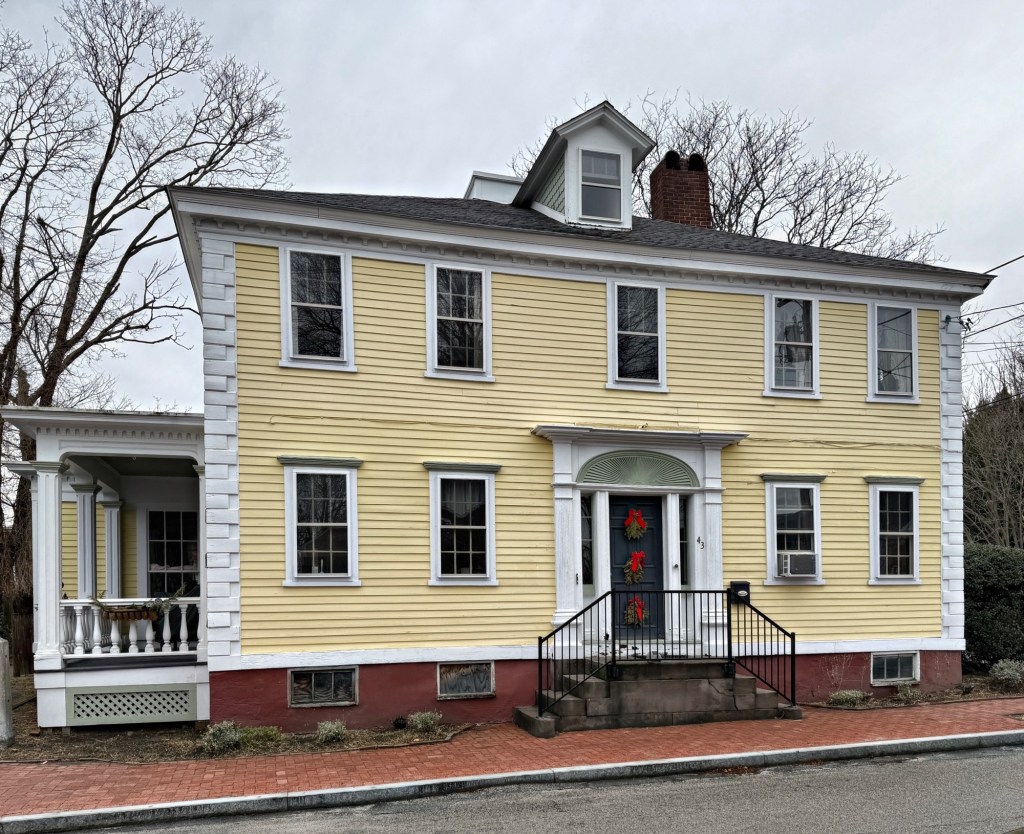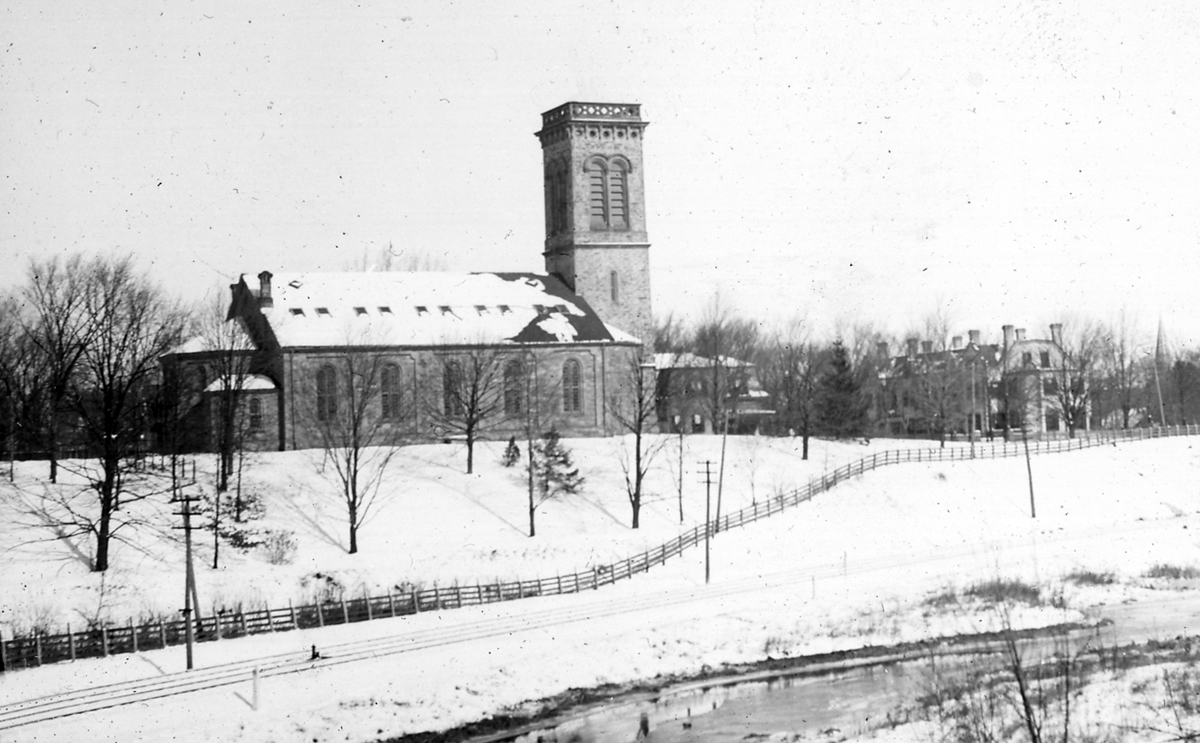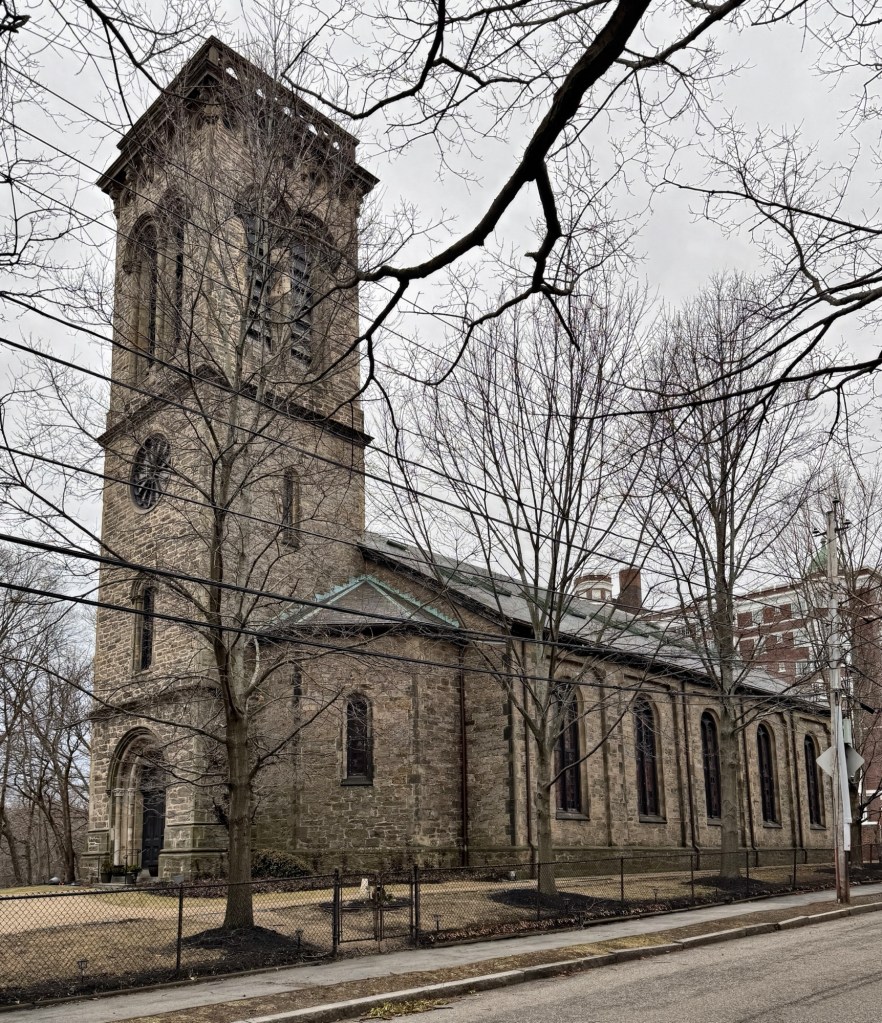
Southworth House – Deep River Historical Society // 1842

The Southworth House, also known as the Old Stone House, in Deep River, Connecticut, is a significant example of a stone, Greek Revival style house built for an important local family. The Southworth House was constructed in 1842 for Deacon Ezra Southworth (1803-1859) from stone harvested from one of the Southworth family’s quarries. Ezra was the son of local shipbuilder, Job Southworth who began building ships at the Deep River landing in the 1790s. Ezra Southworth branched off into manufacturing, becoming a partner and patent holder producing ink wells. His son, Ezra Job Birney Southworth (1844-1919), went into business with his father-in-law in shipping and served as a member of the State Legislature twice. In 1882, Ezra Jr. added the wooden ell onto the rear of the Stone House along with the wrap-around veranda and likely the rear barn as well. Ada Gilbert Southworth Munson was Ezra J. B. Southworth’s only child to live to adulthood and inherited the family home. She was a founding member of the Deep River Historical Society and bequeathed her family home to the Society in 1946, who have maintained the significant home here ever since. 

Griffin-Malloy House // 1720

This First Period Home on in Wayland, Massachusetts, can be found at 184 Glezen Lane and is one of the community’s oldest residences. The Griffin-Malloy Homestead dates to about 1720 and is a large, single-family farmhouse that is just over 300 years old! Records state that the house was built by early settler, Samuel Griffin and possibly expanded later by his son, Deacon Jonathan Griffin. After generations of Griffin Family ownership, the old farmhouse was purchased in 1877 by Timothy Malloy (1839-1909) an Irish immigrant who settled in Wayland and operated a farm here. The house as of the 20th century, retained much of its original wood paneled walls and fireplaces, and has been lovingly preserved by generations of great stewards. 

Hopestill Bent Tavern // 1710

The Hopestill Bent Tavern is a historic First Period tavern, now a private residence, in Wayland, Massachusetts, on the Old Connecticut Path, a Colonial postal road. The tavern was owned and occupied by Hopestill Bent (1672–1725), a veteran from the King William’s War (one of the French and Indian Wars). Hopestill Bent was the great-great-grandfather of Charles Bent, a fur trader and first territorial Governor of New Mexico during the Mexican-American War, who was later scalped and killed by Pueblo warriors, during the Taos Revolt. The Bent Tavern served as a tavern until about 1780, was moved to the present site farther back from the street in 1800, and enlarged to the current size.

Old Wayland High School // 1855

In 1854, at the annual Town Meeting at Wayland, residents voted to build the community’s first High School, this structure, which was completed in 1855. The roughly square building is Italianate in style with the round arched windows and bracketed cornice, but with some holdover features common in Greek Revival architecture, including the tall pilasters dividing the bays, and projecting portico supported by square paneled columns. A few years after opening, the new High School was so underused, the local grammar school held some classes here. By the 1880s, high school students were sent to school outside of town. As the town population began to increase and the size of the student body necessitated a new high school. The town considered repair of this building, which had suffered from neglect, or construction of a new building. In the end, money was appropriated to build a new High and Grammar School in 1896. The town had the first school moved slightly on the town lot to allow space for the new, second school, and sold the 1850s schoolhouse to the local chapter of the Independent Order of Odd Fellows, known as Pequod Lodge. The second high school was demolished in 1978, over a decade after the present High School was built by The Architect’s Collaborative (TAC). In 1978, the Old Wayland High School was sold to the neighboring Trinitarian Church and has been used for administrative purposes and church meetings.

Upland Farmhouse // 1929

The Nashoba Valley Winery in Bolton, Massachusetts, is one of Bolton’s most successful examples of the adaptation of an old agricultural property in the state. The land here was first developed as a farm in the early 19th century by Captain Martin Houghton (1779-1833). The farmland here, which has always had a scenic view, was called “Valley View Farm” later owner, William N. Felton (1835-1920). Sadly, the old farmhouse burned down in 1928, and the property was sold that year to Roy Clemens, an osteopathic doctor, who had this charming shingled cottage built in 1929. Roy and his wife, Laura, planted an apple orchard on the hills and named the property “Upland Farm”. Roy died in 1969 and Laura followed in 1981. With suburban development likely, the property was ultimately saved when it was purchased by Jack Partridge as the new home of the Nashoba Valley Winery, which was founded in Somerville in 1978. The winery specializes in fruit wines, and grows most of the fruits and berries for them on the property. The business expanded, adding a distillery, brewery and restaurant, and the beautiful grounds are often host to weddings and events.

Simonsville Schoolhouse // 1856

One-room schoolhouses like this example in the Simonsville area of Andover, Vermont, have been commonplace throughout rural portions of New England where children of most ages would share the classroom and be taught everything from basic spelling to math. The Simonsville schoolhouse was built in 1856 and is a typical example of a vernacular one-room schoolhouse in rural New England, with no frills or ornament, just a house of learning. The Simonsville Schoolhouse was converted to a residence sometime in the latter half of the 20th century and has been renovated, keeping the basic form and interior floorboards from the 1850s. The school-turned-home is currently (2025) listed for sale.

Providence County Courthouse // 1926

S. Main Street Elevation

The Providence County Courthouse complex occupies an entire city block running between Benefit Street and South Main Street and while of immense scale, is broken up into more human-scaled wings and masses that make the building one of the finest and contextual designs in a city full of amazing architecture. The courthouse here replaced the first courthouse, a stunning palace of justice designed by Stone & Carpenter in the High Victorian Gothic style, that was completed in 1877. The old courthouse was soon outgrown and a larger building was planned following WWI. The present courthouse was built between 1926 and 1930 following a design by Jackson, Robertson & Adams in the Georgian Revival style, fitting of its context amongst some of the finest Colonial-era houses and buildings in New England. The building today contains the Rhode Island Supreme Court, Providence County Superior Court, and the local trial court. The South Main Street facade is my favorite with the Guastavino tile roof entry and stunning colonnade at the street level. A multi-stage clocktower emerges from the center of the building, at a height of 216-feet, making the courthouse the 11th tallest building in Providence.

Benefit Street Elevation

Major John Bradford Homestead // 1674

The Major John Bradford Homestead (also known as the Bradford House) is a stellar and well-preserved example of a First Period house in Kingston, Massachusetts. The house was reportedly built by Major William Bradford (1624-1704), the son of Governor William Bradford  who arrived to Plymouth via the Mayflower in 1620 and served as Governor of the Plymouth Colony between 1621 and 1657, purportedly built the west (left) half of the house in 1674 for his eldest son John Bradford and his bride, Mercy Warren. John Bradford (1653-1736) served as selectman, a deputy from Plymouth, and as a representative in the Boston General Court, who in 1717, led in the establishment of Kingston as a new town by donating land for the meeting house, school house, burial ground, training green, and minister’s house. In around 1715, John Bradford expanded this house which was not sufficient to house his wife and seven children. After centuries, the house began to show its age, and in 1921, coinciding with the tercentenary of the Pilgrims arriving to Plymouth, the Bradford House was thoroughly documented and restored by Frank Chouteau Brown and George Francis Dow. Since 1921, the property (including a historic barn moved here from a nearby site) has been owned and preserved by the Jones River Village Historical Society, who operate the property as house museum.

Kingston Almshouse // c.1772

Built on the banks of the Jones River in Kingston, Massachusetts, this large residence is said to date to 1772 and was the home to a prominent ship-building family as well as to hundreds of destitute residents of the community who lived and worked here as the town’s poor house. Land (and possibly an earlier house) was acquired in 1772 by Zenas Drew (1735-1822), the son of Cornelius Drew, a wealthy shipbuilder who employed his many sons to work in the same industry, and the existing house was constructed for his family. From the house, numerous shipyards would be seen with large brigs travelling down the Jones River into Plymouth Bay and the Atlantic. After Zenas Drew’s death in 1822, the Town of Kingston acquired the property for use as the town’s almshouse or poorhouse, and likely expanded the property to its current Federal style configuration. Throughout the 19th and early 20th centuries, almshouses were a reality for society’s most vulnerable people, where these locally run institutions provided living and working conditions in a time before Social Security, Medicaid and Section 8 housing became a reality. These facilities were designed to punish people for their poverty and, hypothetically, make being poor so horrible that people would continue to work at all costs. Being poor began to carry an intense social stigma, and increasingly, poorhouses were placed outside of public view, as was the case here in Kingston outside of the town center at the banks of the river. By the 1920s and 1930s, these institutions began to close, with Kingston’s closing in 1923. The property was sold to a private owner, and has remained as a single-family residence ever since. 

William Sever House // 1755

The William Sever House is an architecturally and historically significant residence in the town center of Kingston, Massachusetts. A prosperous merchant, owner of ships involved in coastal and international trade and member of the colony’s House of Representatives, William Sever (1729-1809) was prepared to erect a home of appropriate status when he married his cousin, Sarah Warren, in 1755. Sever joined his father Nicholas Sever’s commercial shipping business after graduating from Harvard College in 1745 and in 1754, was elected to the Massachusetts Bay Colony’s House of Representatives. In 1769, Squire Sever was elected to the Governor’s Council, a position he held until 1774 when he joined the Provincial Congress. Due to his experience and seniority, Sever was appointed to head the Congress and was declared “President of Massachusetts” and endowed with the governor’s executive powers. After his death in 1809, the house remained in the Sever family for generations, including as a summer residence for James W. Sever, the namesake of Sever Hall at Harvard University. The residence is well-preserved and showcases the telescoping nature of some of these early Colonial-era properties, with the main house adjoined by a barn and carriage house and diminutive ells and was thoroughly documented in the 1930s through the Historic American Buildings Survey, with detailed drawings, plans, and photographs of the exterior and interior spaces.