John Carter House // c.1765

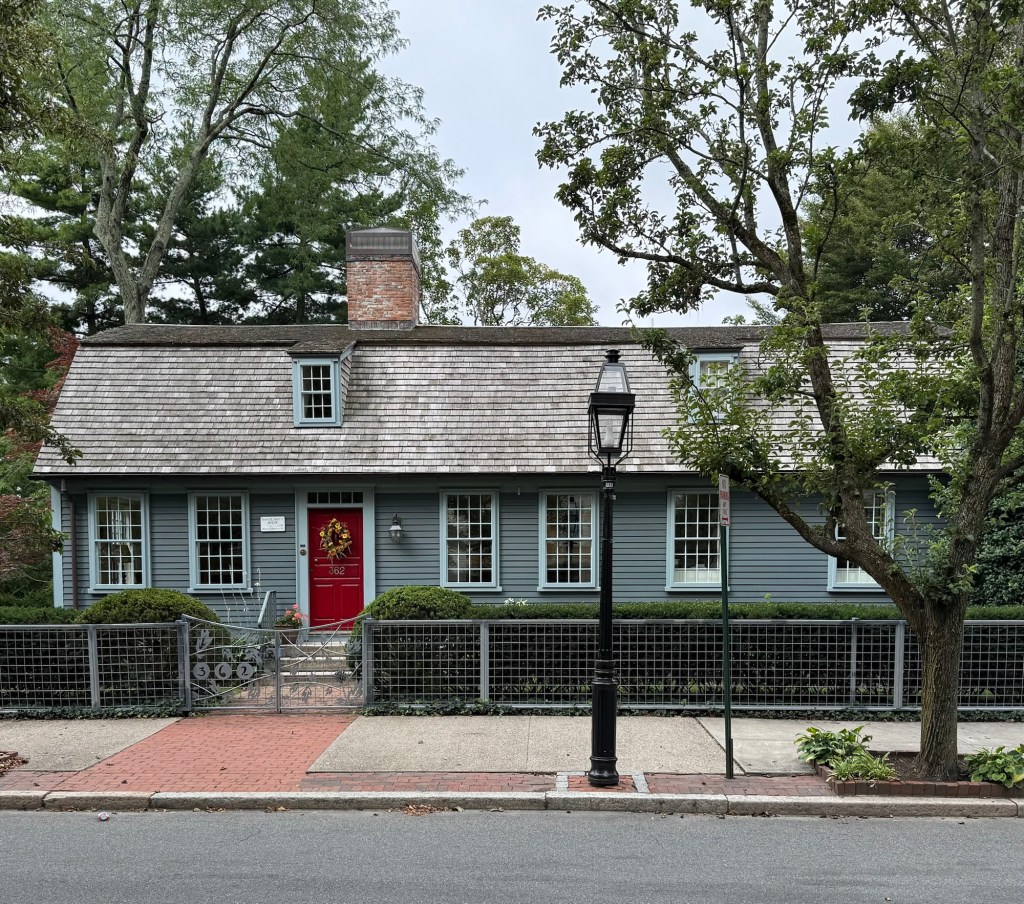
One of the many stunning and well-preserved Colonial homes in Canterbury, Connecticut is this residence, the John Carter House on S. Canterbury Road. Records show that the house was built around 1765 for John Carter and his wife, Mary Smith. This house is a good example of the domestic architecture of 18th-century Connecticut and while there have been some changes over time, it continues to exhibit all the major hallmarks of the colonial type, such as a center-chimney plan, clapboard exterior, and five-bay facade. The house originally had a saltbox roof sloping to the rear, but was removed sometime in the 19th or 20th centuries, likely when the projecting Colonial Revival-era porch was added at the entrance. What a spectacular home!

Jacob Bacon House // 1794

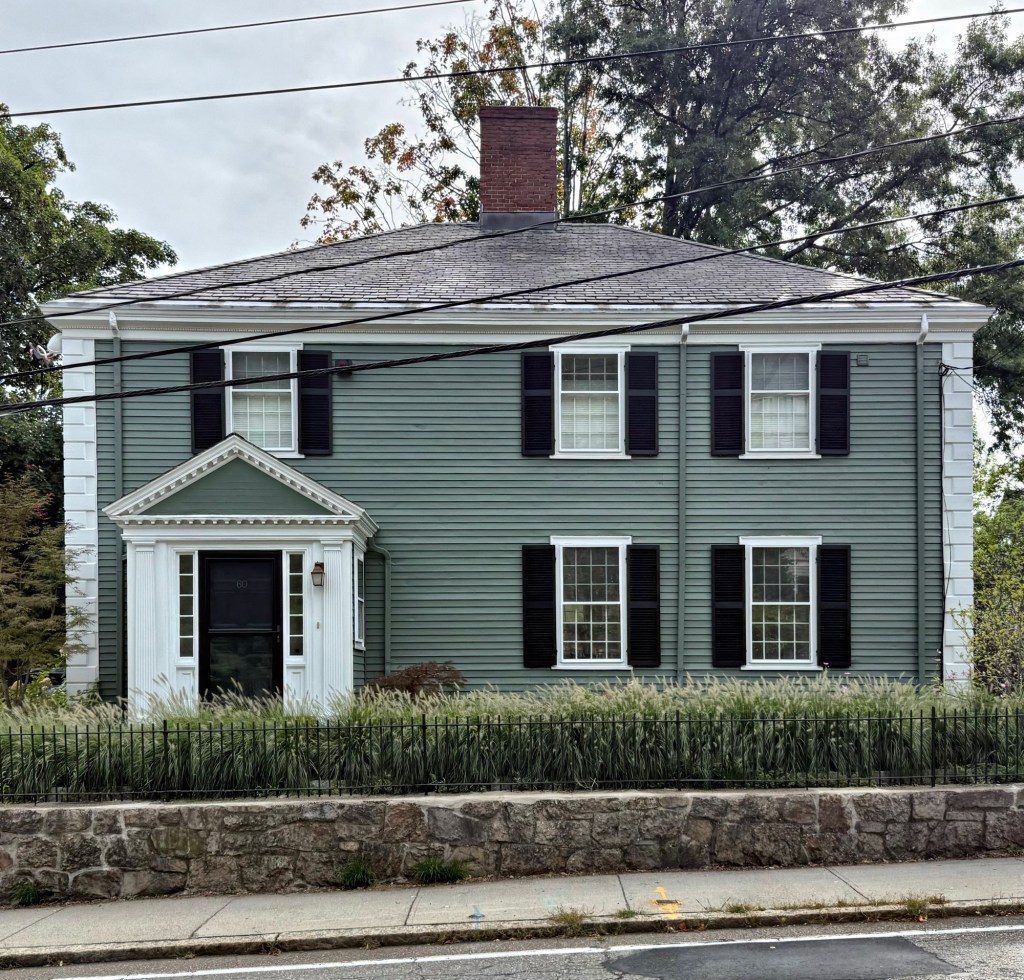
In 1794, Revolutionary War veteran, Jacob Bacon (1754-1844), built this house on S. Canterbury Road outside the main village of Canterbury, Connecticut. The late Georgian/Federal style house features a large central chimney, symmetrical five-bay facade with center entrance, and a bold blue paint color. The house was seemingly built following Jacob’s 1793 marriage to a Martha Clark. Do you like the color of this house, or would you paint it something different?

First Congregational Church of Canterbury // 1964

The Canterbury Green has been home to four congregational churches in its history. Originally established in 1711, a modest frame church was built here and in 1736, a new meetinghouse was constructed as a more permanent building. The rustic structure was deemed insufficient for a wealthy rural community, so in 1805, a stately, Federal style edifice was built. Designed by Thomas Gibbs, a local architect/builder who also designed other nearby high-style Federal homes, the building was destroyed by fire in December, 1963. Within a year, this church was constructed on the ground of its 1805 building. While designed and constructed during the mid-20th century, the town clearly wanted its new church to contribute to the village’s Colonial character, having this Colonial Revival style church serve as the new anchor to the green.

William Moore House // 1803-2019

Formerly located at the intersection of two historic turnpikes in Canterbury, Connecticut, the William Moore House was a historic and architecturally significant residence that stood over 200 years until its demolition in 2019. The large, Federal style house was built in 1803 for William Moore, a merchant who operated a store and also served as the town postmaster. The upper floor of this house at one time accommodated a ballroom where the local Masonic organization met. Later in the 19th century, the house became the home of prominent merchant, banker, and politician Marvin H. Sanger, Connecticut Secretary of State from 1873 to 1876. In 1921, it was the home of Lillian Frink when she became one of the first women ever elected to the Connecticut General Assembly, along with four other women elected that same year. The house with its projecting center pedimented bay, elaborate corner pilasters on pedestals, and elegant Palladian window represented the height of country Federal-period architecture until destroyed by a fire in 2018, leading the town to raze the building a year later in 2019. The lot remains vacant as of 2025.

Prudence Crandall’s School for Young Ladies and Little Misses of Color // c.1805

Built c.1805 for Elisha Payne, this architecturally distinguished Federal style mansion in Canturbury, Connecticut is one of the most significant buildings in the state, not only for its architecture but historical significance. In 1831, a young white woman, Prudence Crandall, was asked to open a boarding school for girls in Canterbury. She purchased this mansion and began operations for the school, which was attended by many wealthy girls in town. In 1832, Ms. Crandall was approached by a young Black girl who worked as a servant in town, named Sarah Harris, asking to attend the school. Encouraged by conversations with both Harris and Maria Davis, a Black woman who worked for Crandall and shared copies of the abolitionist newspaper The Liberator with her, Crandall agreed to admit Harris. Almost immediately, residents protested the school’s admission of a Black girl and parents threatened to withdraw their students, Crandall undeterred, closed her school and reopened in 1833, solely for Black and Brown students. Young girls traveled from several states to attend the school. The legislature of Connecticut responded by passing the “Black Law,” which prevented out-of-state Black and Brown people from attending school in Connecticut towns without local town approval. Crandall was arrested, spent one night in jail, and faced three court trials before the case was dismissed. In September 1834, a nighttime mob of men attacked the house, smashing the windows, leading Crandall to close the school out of fear for her students as no protections were afforded to them. These events made national and international news in the 1830s and galvanized the burgeoning abolitionist movement. Crandall would later marry and left Connecticut, never to return. For her vision and brave actions at this school, Prudence Crandall is Connecticut’s official state heroine and the house was designated a National Historic Landmark in 1991.

George Washington Smith House // c.1886

This house on Westminster Road in Canterbury, Connecticut, is architecturally distinguished by its extensive and imaginative detailing, which reflects the widespread availability of manufactured architectural ornament in the Victorian period. The porch columns, archways, bay window, and round-arched windows all reflect an Italianate influence and the work of its original owner, Mr. George Washington Smith (1857-1937). The house dates to about 1886 when George W. Smith, built it from his workshop formerly located across the street. Smith manufactured mast-hoops, the wooden fixtures for attaching sails to the masts of sailing ships, and utilized his woodworking skills to build and decorate the exterior of his family home.


Asa Bacon Farmhouse // 1783

Located in northern Canterbury, Connecticut, this rural farmhouse was built following the American Revolution, showcasing the emergence of the Federal style from the Colonial Georgian type farmhouses before. The house dates to 1783 and was built by Captain Asa Bacon (1735-1819), a wealthy farmer and captain in the Revolutionary War. The home was also occupied by his son, Asa Bacon Jr. (1771-1857) a Yale educated lawyer who practiced law in town before moving to Litchfield. Asa Jr. was a turnpike promoter, advocating for turnpikes through the formerly sleepy agricultural town, opening it up to trade and commerce. The early Federal-period home features a five-bay facade and central entry with triangular pediment and fluted pilasters. The house appears much like it would have when originally built besides the Victorian-era two-over-two window sashes installed in the late 19th century. The farm even retains a few 19th century barns, likely built when the windows were replaced by later owners.

Edward Waldo House // c.1715

The Edward Waldo House in Scotland, Connecticut, is a vernacular Georgian house with saltbox roof and wings which from its erection about 1715 until 1971 was owned by members of the Waldo family. Edward Waldo (1684-1767) purchased land here along the Shetucket River in 1702 and by 1715, erected this house. The saltbox house which Edward Waldo built was one of the first houses in the town of Scotland and would remain in successive generations of the family for centuries. The house was the birthplace of Samuel Lovett Waldo (1783-1861), a portraitist who was a founder of the National Academy of Design as well as Daniel Waldo, chaplain of Congress, 1856-1858, and was one of seven Revolutionary War veterans who, having survived into the age of photography, were featured in the 1864 book The Last Men of the Revolution. The last Waldo owner, Miss Ruth Waldo died in1975. She insured the preservation of her family homestead by bequeathing the house, its contents, and about 15 acres of land to the Antiquarian & Landmarks Society of Connecticut Inc. and the surrounding acreage to the Connecticut Forest and Park Association, creating an enduring legacy for centuries to come. The house, set amongst a quiet country road, is evocative of early days in Scotland, Connecticut, and is one of the finest-preserved Colonial homes in this part of the state. 

Scotland Congregational Church // 1842

The main visual anchor of the charming town green of Scotland, Connecticut, is this building, the Scotland Congregational Church. Built in 1842 as the congregation’s third building, this Greek Revival style edifice features stately proportions, temple-front with four large Doric columns supporting the portico, and a two-stage belfry. The chapel (some say it was converted from the original town hall) was acquired by the congregation in 1867, and has remained in its new location ever since. Later alterations include the stained glass windows and clock in the pediment, which dates to the early 20th century.

Huntington Homestead // c.1715

The Huntington Homestead in Scotland, Connecticut, was the birthplace and boyhood home of Samuel Huntington (1731–1796), a Founding Father, a signer of the Declaration of Independence and a distinguished statesman during the Revolutionary War and early Republic. The remarkably well-preserved site includes an eighteenth century house on its original foundation surrounded by acres of farmland and is now protected as a museum. The house was built sometime between the transfer of land in 1715 from Deacon Joseph Huntington to his son Nathaniel, and Nathaniel’s marriage in 1723 to Mehetabel Thurston. As originally constructed, the house consisted of a two-story structure with an end chimney on the west end and one large room on each floor. By the time of Nathanielís death in 1767, the house had been doubled in size with the addition of two rooms west of the chimney, giving the house its current five-bay form. The Georgian style Colonial-era home features a symmetrical facade, twelve-over-twelve windows, and a saltbox roof and is one of the finest Colonial-era homes in this part of the state.

Scotland Town Hall // 1896

The town of Scotland, Connecticut, is a rural community centered around agriculture and is the smallest municipality in Windham County’s ‘Quiet Corner‘. European settlement began in earnest following the purchase of 1,950 acres of land from then Windham, by Isaac Magoon, a Scotsman, who named the new village after his ancestral home. The present-day town hall and offices of Scotland, was originally built in the 1840s as a one-room schoolhouse. In 1894, the town voted to consolidate all the school districts in a single building, and to expand the one-room village school to accommodate them. The present two-story structure was completed in 1896 and was added to the front of the old building. It is unclear if anything remains of the original schoolhouse. The vernacular, Stick style building served as the town’s consolidated school until a modern school building was constructed in the 1960s. This building became the town hall/offices and remains a significant visual anchor to the town’s common.

Pawtucket Hair Cloth Mill //1864

Despite its name, this handsome mill structure, known as the Pawtucket Hair Cloth Mill, is actually located in Central Falls, Rhode Island. The building, located on Roosevelt Avenue on the banks of the Blackstone River, is a great example of a Civil War-era mill, built for one of the many wool and cloth companies in New England. Begun in a small factory across the street in 1856, this business became successful after the acquisition of patents for weaving haircloth (most of the raw material for which originally came from Russian horse markets) for upholstery, crinolines, and inner linings. The company is said to have once been the largest producer of haircloth in the world. The Italianate style mill stands pretty much as built, besides the tower that has lost its low pyramidal cap. The building was one of the first commissions by great Rhode Island architect, William Walker, who was just 34 at the time of designing this large, and complicated structure.

Kennedy-Stafford Mill // 1825

One of the oldest mills in Central Falls, Rhode Island, is this four-story brick building constructed in 1825 is important as one of the earliest extant brick mills in Rhode Island, at a time when such buildings were shifting from wood construction to fire-proof brick or stone construction. Built on one of the first industrial sites in the city, along the Blackstone River, the mill was originally constructed for a John Kennedy as a cotton manufactory. The complex was purchased and expanded in the 1860s by the Stafford Manufacturing Company, who built a new dam on the river and extension to the 1825 building. The structure features a five-story square end tower with freight doors, and a monitor roof which runs the span of the original 1825 building, terminating where the Stafford Company addition begins. Originally, canals flowed directly under the building, powering the building and three mills downstream, but they were filled in by 1965. Elizabeth Webbing started in the Kennedy/Stafford mill buildings in 1933. After over 70 years of making cloth straps used for seat belts, dog collars, luggage straps and more, it ceased operations in March of 2001. The complex, which included 19 nearby mill buildings, was split up and sold off. In 2007 work began on converting the former mill to residential use with the first phase of the project opening to tenants in 2009. It’s another great example of adaptive reuse into housing, the best type of project!

George M. Thornton House // c.1870

One of the finest homes in Central Falls, Rhode Island, is this eclectic Victorian residence on Clay Street. The home was seemingly built around 1870 and modified by the end of the 19th century by later owner, George Mumford Thornton (1850-1916). Mr. Thornton was an industrialist who was elected as one of the first aldermen when Central Falls incorporated in 1895. The well-preserved house features varied siding, a rounded corner tower with spiral-columned porch and conical roof, and original multi-light sash windows. What a spectacular home.

Pawtucket-Central Falls Station // 1916

The Pawtucket-Central Falls Railroad Station is a crumbling relic of a time once dominated by rail travel. This architectural landmark spans the border of the cities of Pawtucket and Central Falls, along with the tracks of the former New York, New Haven and Hartford Railroad and is one of the more unique buildings in Rhode Island. The station opened in 1916 to replace separate stations in the two cities from plans by F.W. Mellor, architect for the New Haven Railroad with Norcross Brothers of Worcester facilitating the construction over a structural steel base spanning the tracks. As many as 140 trains per day once passed under this station, but in 1959, it closed. The building was purchased by a private owner and plans failed to materialize for decades, leaving us with a crumbling masterpiece in architecture and engineering. In 2007, the lot was partially developed with the addition of a suburban, soulless CVS store and parking lot, which today, directly abuts the station. In 2023, a new Pawtucket/Central Falls station opened nearby, which has brought new calls to demolish this building, with people actively seeking grants to fund the estimated $10 Million dollar demolition.