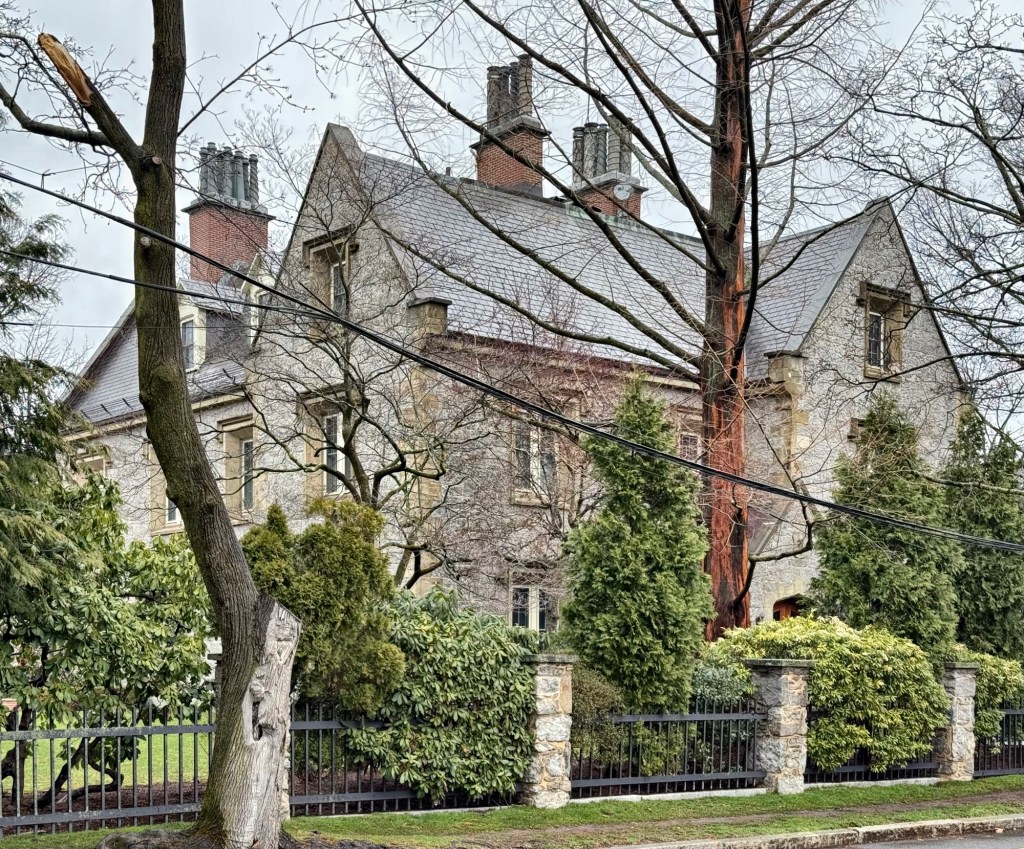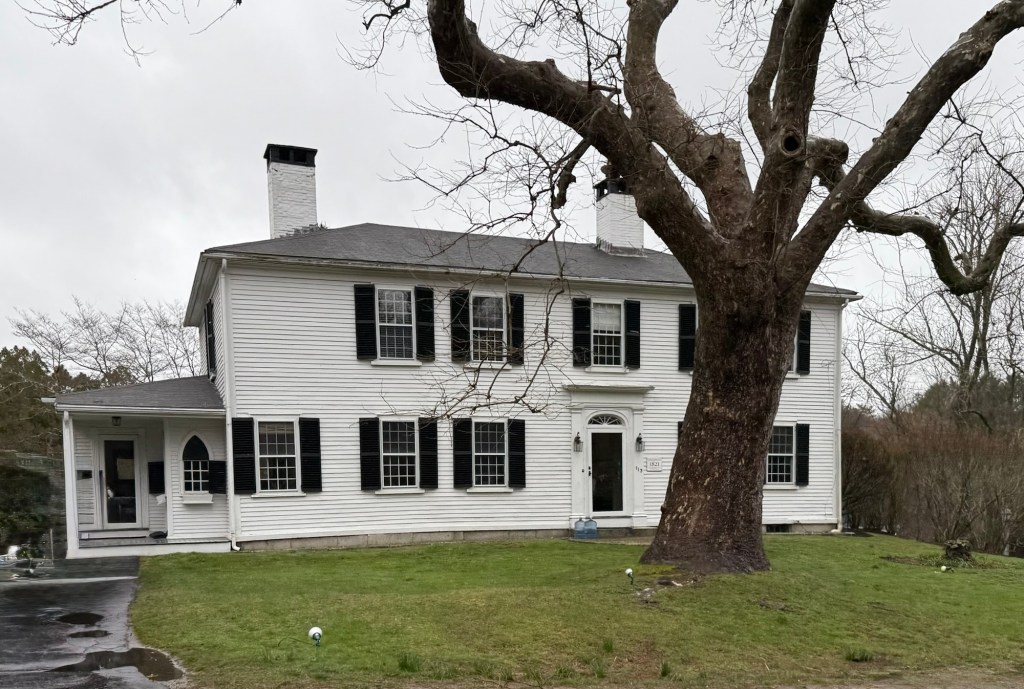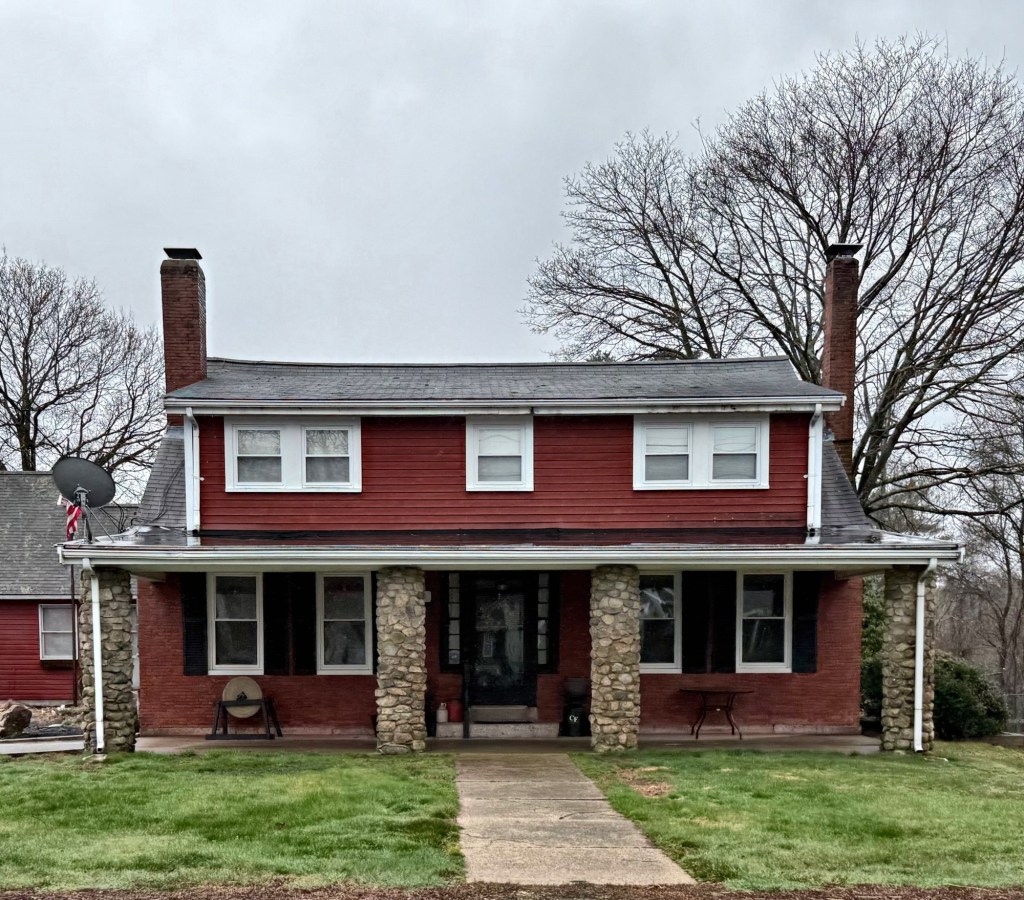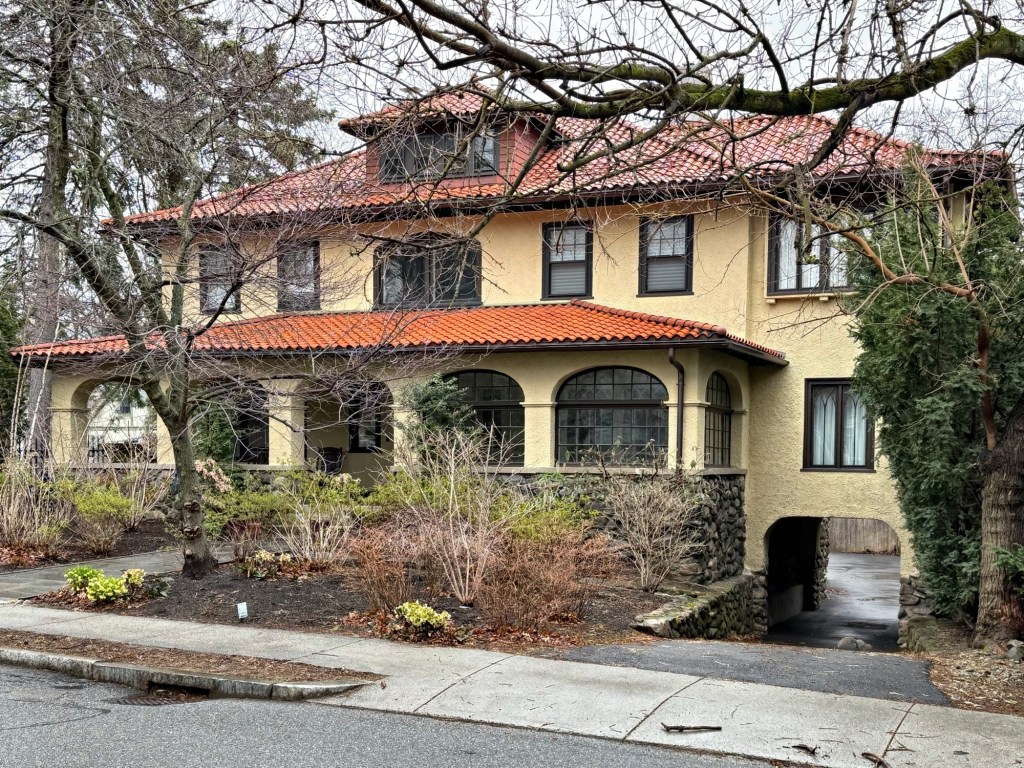
Hidden Valley Castle // 1921

Photo from listing.

A castle can be found in the small town of Cornwall, Connecticut! Set amongst 275 acres of woodland and streams, with several outbuildings on the property, this whimsical castle looks like it was dropped here from Cornwall, England, but it actually dates to the 1920s. Hidden Valley Castle, had its beginnings when socialite Charlotte Bronson Hunnewell Martin envisioned building a unique country retreat for herself and her husband, Dr. Walton Martin, in the Litchfield Hills of Connecticut as a summer retreat. Just before this, Charlotte had bought a group of 20 brownstones in Manhattan on 48th and 49th Streets, between Second and Third Avenues, and converted them into charming townhouses around a central Italian-inspired garden. Called Turtle Bay Gardens, the houses were highly acclaimed and almost immediately attracted prominent and celebrated residents. The Cornwall Castle was designed by architect, Edward Clarence Dean, who also redesigned the Turtle Bay Gardens for the couple. Dr. Martin imported many of the materials as well as the 100 workmen required to build the castle, a project that lasted five years. Charlotte would also have a cottage built on the estate and hired young Italian artist, Vincenzo Rondinone, to be her resident artist on the estate to create unique vases, bowls, and pots to be used at the house and to be given as gifts to visitors and friends. The property was restored in recent years and put up for sale, with the cottage sold as a separate dwelling.

Foster-Beck House // c.1845

This attractive Greek Revival style residence with later porch was likely built in the 1840s and is one of the finest homes in the village of West Cornwall, Connecticut. The house was likely built for Stephen Foster (c.1816-1863), a merchant and railroad contractor who had constructed a portion of the Housatonic Line railroad near West Cornwall, further opening the village up to trade. Stephen and his wife, Helen, lived here for some time until around 1860 when they relocated to a larger, Italianate style mansion nearby. In 1867, this property was purchased by George Beck, a German immigrant and partner of the Vollmiller Shear Shop, who manufactured metal shears and scissors in West Cornwall. It is likely that Beck was owner of the house at the time the wrap-around porch with scroll-sawn columns.

Brattle-Thurston House // c.1749

This early Colonial house with unique, rusticated wood coursing carved, treated, and painted to resemble ashlar stone, can be found on Prospect Hill Street in Newport, Rhode Island. This is the Brattle-Thurston House, a circa 1749 Georgian residence of an appropriate gray color, yet when I stopped by in early 2024, had peeling paint. The house was originally part of the Latham Thurston estate, and was later rented or purchased by Robert Brattle (Brattell), who lived here with his wife, children, and an enslaved person according to the 1790 census. The home would later be owned by William Thurston, a hatter and dyer, who likely inherited the residence from his ancestor. Beyond the unique rusticated wood siding, the design features splayed lintels, the main entrance on the side elevation and a later entrance facing the street with segmental pediment above.

Birdsey Hall // c.1804

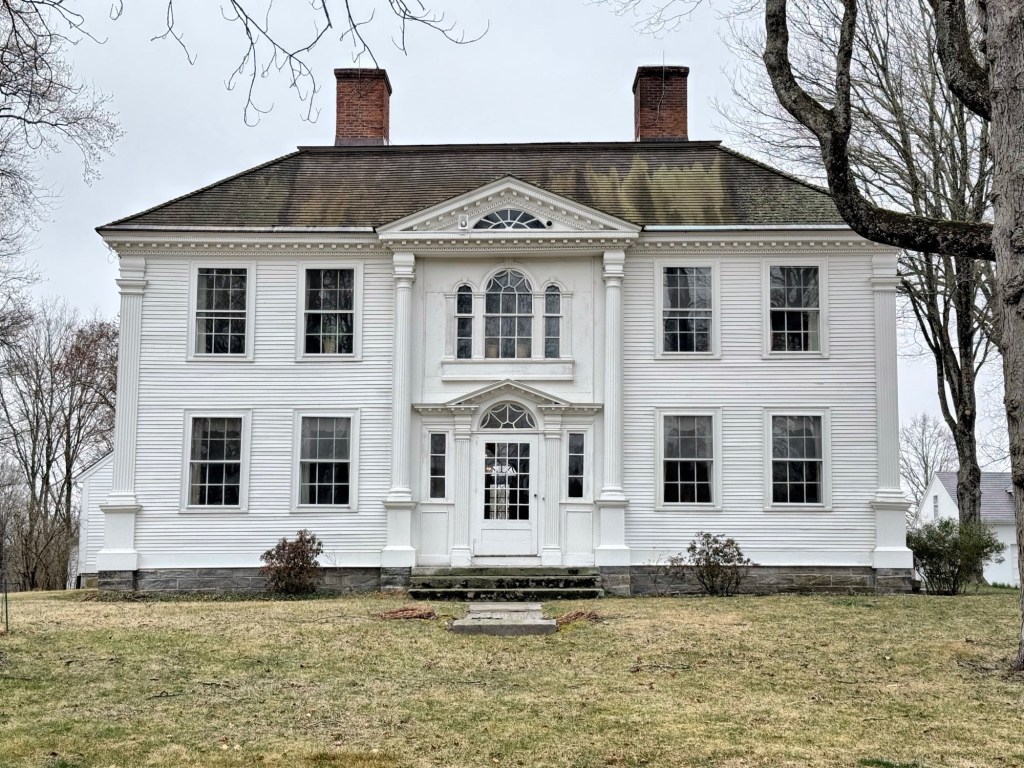
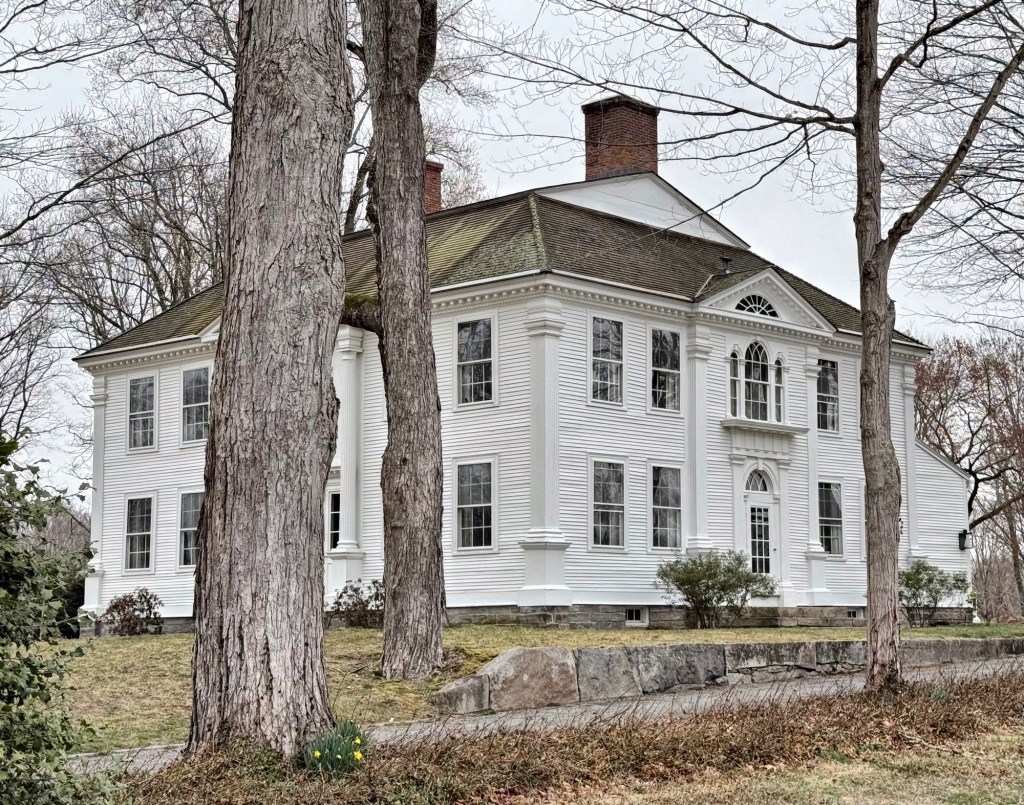
Built circa 1804 in the form of an English country estate house, Birdsey Hall stands as the finest property in the town of Goshen, Connecticut. The residence was built for Birdsey Norton (1763-1812), a wealthy cheese merchant who was said to have been inspired to build a country estate after travelling the American south on business. The high-style Federal/Adamesque mansion features expansive grounds bounded by brick walls and Victorian gardens. The property was later owned by Fred Favorite and Robert Devoe, friends of Liberace, who operated an antique store. Birdsey Hall remains one of the finest Federal estates in Connecticut.

Myron Norton House // 1840

The Myron Norton House, built in 1840, is located in the central village in Goshen, Connecticut. Built of stone, the house is unique as the only example of a stone house in the village, and the only Greek Revival house that departs from the usual gable-roofed form, having a square plan and hipped roof with monitor. The home was built for Myron Norton (1788-1853) and his wife, Caroline (Marsh) Norton, who outlived her husband by 23 years, living here until her death in 1876. Myron Norton made his fortune patenting and selling pineapple cheese molds, where he pressed the curds from local cows in wooden pineapple-shaped molds to give them the desired shape. It is the house that cheese built!

Thompson-Sperry House // 1803

In 1803, General David Thompson (1766-1827) and his wife, Sybil (Norton) Thompson, moved into this recently completed Federal style residence on North Street, the main road through Goshen Village, Connecticut. David Thompson was a merchant and partner in the firm Wadhams & Thompson, occupying a store nearby the Congregational Church. Business partners David Thompson and David Wadhams built near-identical houses across the street from each other, though the Wadhams house has since been gut renovated and lost much of its original fabric. The Thompson House stands out for its Palladian second-story window, glazed with interlacing arcs. The property was owned at the end of the 19th century by Albert Sperry, a Civil War veteran.

Henry A. Waldron House // 1893

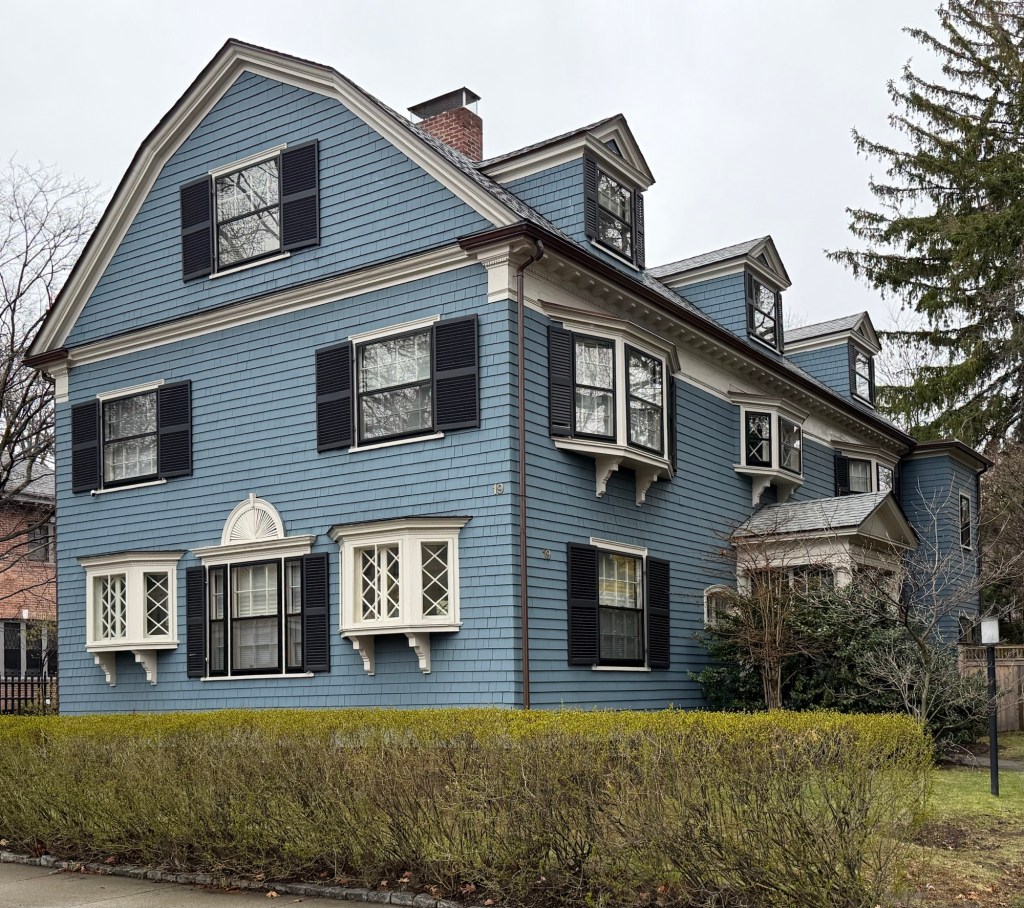
The period of the late 19th through early 20th centuries provided architects the opportunity of blending the two prominent styles, Queen Anne and Colonial Revival into a single composition, and as a result, this period has provided some of the most whimsical yet stately homes in New England. This modestly sized residence sits on Stimson Avenue, one of the finest streets in Providence, and despite its unassuming size, packs an architectural punch with its materials and detailing. The Henry Waldron House was built in 1893 for Henry A. Waldron, a clerk in Providence. From deed research, it appears a member of his family, Nathan Waldron, a wealthy grocer, purchased the site in 1891 and likely funded some or all of the construction of the residence there. The architectural firm of Hoppin, Read & Hoppin is credited with the design of the residence, which employs a Colonial Revival form with the gambrel roof and Columned and ornate entrance porch with fan motif, while the use of varied siding materials and octagonal tower with pyramidal roof veers into the Queen Anne style.

William and Kathleen Fuller House // 1905

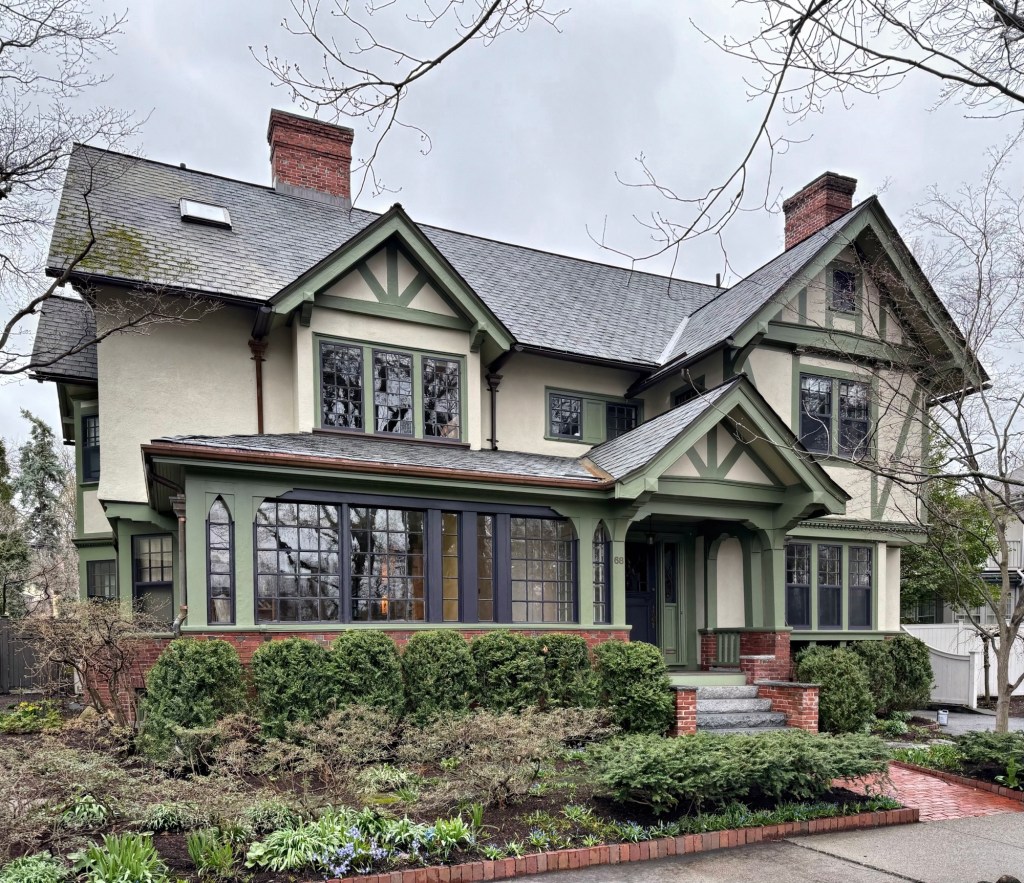
This handsome Tudor residence was built around 1905 for William Oliver Fuller (1856-1941) and his wife, Kathleen Stephens Fuller (1869-1948), and can be found at the corner of Beech and Lincoln streets in the finest neighborhood in Rockland, Maine. Although an architect could not be established at this time, the high-style residence features half-timbered gables, an inset front porch framed by stone pillars, and an absolutely perfect color palette. William Fuller was a newspaper publisher, who created his first newspaper, the Rockland Enterprise when he was 18 years old and in high school. He would go on to become the editor and publisher of the Courier-Gazette, the region’s main newspaper. Kathleen Fuller frequented the newspaper herself through her published poetry and columns and would later become an associate editor and co-owner of the paper.

Israel Putnam House // c.1648

The General Israel Putnam House in Danvers, Massachusetts, was built circa 1648 by Lieutenant Thomas Putnam on farmland that then consisted of 100 acres. In 1692, his youngest son, Joseph Putnam, lived here, inheriting the property over his half-brother, Thomas Putnam, Jr. (1652-1699), causing friction within the family. During the infamous witch trials and hysteria in Salem Village, Joseph Putnam was one of two people who took notes during the examinations of the first three to be accused of witchcraft in 1692 – Sarah Good, Sarah Osborne, and Tituba. From that point forward, he was one of the most outspoken opponents of the proceedings, which put him in direct conflict with most of the Putnam family, especially that of his half-brother Thomas. Fearing accusations against him by his half-brother, Joseph was said to have kept horses saddled at all times, ready to escape at a moment’s notice. He was never accused, though Thomas Putnam was responsible for the accusations of 43 people, and his daughter was responsible for 62. In 1718, Israel Putnam, the son of Joseph Putnam, and later Commander of the colonial troops at the Battle of Bunker Hill, was born in this house. It is the only extant structure with direct ties to Commander Putnam. During the Battle of Bunker Hill, Putnam is thought to have ordered William Prescott to tell his troops, “Don’t fire until you see the whites of their eyes.” This command has since become one of the American Revolution’s notable quotations. It was given to make the best use of the low ammunition stocks that the troops had. The Putnam House remained in the family into the 20th century, and due to highway and commercial expansion, the property now sits in the middle of a cloverleaf intersection of two highways. The house was given by the Putnam family to the Danvers Historical Society in 1991, but as of 2020, the Putnam family once again owns the property. The house is not holding up well and I could not locate plans for restoration or preservation of it online. This house deserves to be preserved.

Joshua Silvester House // 1857

This large house sits on Peabody Avenue in Danvers, Massachusetts, and is thought to be the oldest house built of cement in the United States! Joshua Sylvester Silvester (1803-1888), the house’s original owner, was born in Wiscasset, Maine, and began working in the shoemaking business, expanding his products in England, taking many business trips there. While in England, he is said to have particularly admired Charles Dickens’s estate, Gad’s Hill, and modeled his Danvers home after it. Joshua Silvester not only designed this house, but directly supervised its construction which is of hand-poured cement/stucco by two masons imported to town to work on the house. The fifteen-room residence with octagon-shaped barn was complete by 1858. In 1880, the property was purchased by Isaac B. Howe of Clinton, Iowa. Howe was a civil engineer who had helped to lay out the Transcontinental Railroad and had been superintendent of the Iowa division of the Chicago and Northwestern Railroad. Howe died within a year of moving to Danvers,
but his family continued to live in the house for many years.


Jeremiah Page House // 1754

In 1754, a 32-year-old brickmaker Jeremiah Page built this large, gambrel-roofed Georgian house in Danvers, Massachusetts, for his young family. Jeremiah and his first wife, Sarah, raised nine children here and dreamed of liberty from England. Following the Tea Act, passed by British Parliament in 1773 that granted the British East India Company Tea a monopoly on tea sales in the American colonies, Page was said to have demanded that “none shall drink tea in my house.” One evening when her husband was out, Sarah Page is said to have invited several women from the neighborhood up to the porch atop the Page House’s gambrel roof to enjoy tea. Larcom quotes Page as telling her friends, “Upon a house is not within it,” thereby finding a loophole around her husband’s directive. This legend was enshrined in the poem “The Gambrel Roof” (1874) by Lucy Larcom, who knew Sarah Page’s granddaughter. Jeremiah Page would fight in the Revolution, serving as a Captain. The Page House remained in the family for two more generations, Sarah Page’s daughter in-law, Mary Page died in 1876 and her will put the property into a trust with the stipulation that once there were no longer any Page descendants to live there, the historic house was to be torn down. After Mary Page’s daughter Anne Lemist Page died in 1913, the trustee planned to demolish it according to her wishes. The Danvers Historical Society sprung into action and sued to oppose the will, fighting to preserve this significant home. They won, and relocated the home a block from Elm Street to its present site on Page Street, where it stands today. The Danvers Historical Society maintain the structure to this day, including the “porch” at the roof where the tea party once took place.

Brocklebank-Nelson-Beecher House // c.1661

The Brocklebank-Nelson-Beecher House is a First Period structure in Georgetown, Massachusetts, believed to have been built in the 1660s. The land on which the house stands was granted in 1661 to Samuel Brocklebank (1628-1676) , a surveyor who, with his widowed mother and brother, left England and were among the first settlers of Rowley in 1639. It was built by Lieut. Samuel Brocklebank who also owned a farm of 72 acres on the site. Lieut. Brocklebank was appointed captain in a militia and was killed with his entire company in Sudbury in 1676 during a raid by Native people during the period of the King Philip’s War. Samuel’s wife remarried and moved to Newbury, and his son, Samuel Jr., resided in the family home which remained in the Brocklebank family until 1754. The house became a tavern by owner Solomon Nelson, who purchased the property in 1765 and made substantial additions and renovations to the house in its current Georgian style. In 1858 the house was bought by Rev Charles Beecher, brother of Harriet Beecher Stowe and Henry Ward Beecher. An ardent abolitionist, he was the pastor of the town’s Old South Congregational Church. Today, the Brocklebank-Nelson-Beecher House is owned by the Georgetown Historical Society, who maintain and showcase the town’s rich history from this important early residence.  

Nelson House // 1797

This residence sits on the historic Elm Street in Georgetown, Massachusetts, and is one of the best late-Georgian style dwellings in the town. The house was built in 1797 for Nathaniel Nelson (1767-1853), a banker who worked in Newburyport, just years after his marriage to Sally Chaplin. Nathaniel descended from Thomas Nelson (1615-1648), who was among the twenty families who had come to the New World in the winter of 1638 with the Puritan cleric Ezekiel Rogers (1590-1660). With Rogers most of these families settled at Rowley, incorporated in 1639 with Georgetown later setting off from Rowley, creating their own town in 1838. Nathaniel and many of his family worked as tanners, preparing the skins of animals into leather, and had shops in the area. Mr. Nelson was such an esteemed member of society, that when the War of 1812 broke out, he was asked to store money and gold from Newburyport in his basement, away from the coast, hiding it from the British forces. After successive ownership, the residence was purchased in 1936 by Everett A. and Mary A. Spaulding. A Georgetown native, Everett Augustus Spaulding made colonial revival furniture under the corporate name Spaulding Colonial Reproductions. The residence remains in spectacular condition, with its large central chimney, symmetrical façade, portico, and hipped roof punctuated by pedimented dormers.

Dickinson–Pillsbury House // c.1700

The Dickinson-Pillsbury House is believed to be over 320 years old and is significant as a well-preserved example of a First Period house in good condition. Located on Jewett Street in Georgetown, Massachusetts, the house was seemingly built before 1700 by James Dickinson Sr. or James Dickinson Jr. and was inherited by Samuel Dickinson (1754-1841). The house is notable for being the home of War of 1812 veteran and inventor Paul Pillsbury, who purchased the property about 1801. His inventions included devices for pegging shoes, milling bark off tree sections, and stripping kernels from ears of corn. Paul Pillsbury and his wife Elisabeth Frink had a family of seven sons and one daughter. Paul Pillsbury was also the uncle of abolitionist Parker Pillsbury and the great-uncle of attorney Albert E. Pillsbury who drafted the bylaws of the NAACP. What an incredible family! The house is well-preserved and a great example of a First Period residence from the 17th century.

Adams Hall // c.1828

According to local histories, this significant Greek Revival style property on Elm Street in Georgetown, Massachusetts, was owned by Josiah Adams (1757-1852), a farmer, a Revolutionary War veteran, and a fourth-generation descendant of the immigrant Robert Adams, who arrived here from Devonshire, England by about 1629. In March 1849, the town’s Congregational Society purchased Adams Hall for eight hundred dollars to house the church vestry, which remained in the building for forty-one months until a new building was built for that purpose next door. Later, Adams Hall was owned by Moses Tenney (1808-1903), operator of a prosperous saw mill in Georgetown, and served at one time in the state senate. The structure retains its significant temple-front with four, two-story Doric columns supporting the portico. Also special on this residence is the use of flush-board siding and the oversized first floor windows.