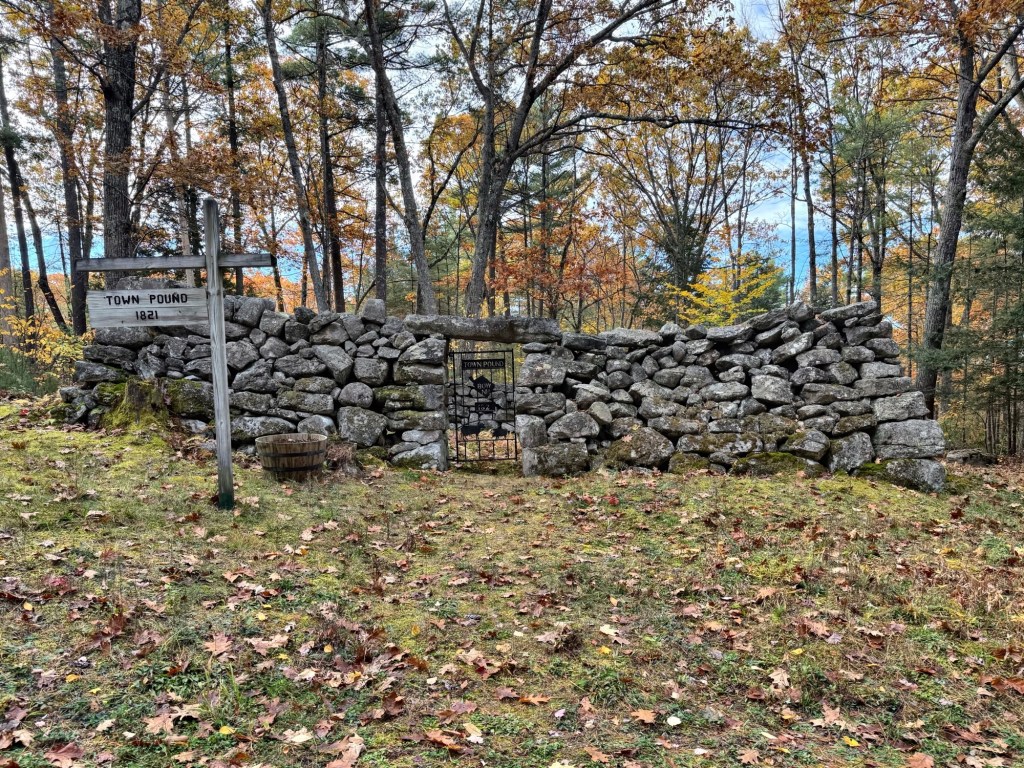
Bow Town Pound // 1821

In farming communities all across New England, disputes inevitably arose when one person’s livestock left their land and damaged another person’s crops. New England laws required farmers to fence their fields and keep farm animals from straying, but some inevitably got out. The solution was to build pounds where stray cattle, horses, sheep and swine were rounded up and kept by a town-appointed pound keeper who would round up the roaming animals and keep them there, charging by the day until an owner releases the animal and pays the fee of any damage done. The old town pound in Bow, New Hampshire, dates to 1821 and features tall stone walls, high enough to prevent taller livestock from jumping out. As towns like Bow shifted away from agrarian culture, these structures crumbled back into the earth. Luckily for us, some sommunities preserved their pounds and in Bow, the local community restored the town pound in 2011.

Pierce-Guild Lightning Splitter House // 1781

The Pierce-Guild House at 53 Transit Street in the Fox Point neighborhood of Providence, Rhode Island, is one of the most iconic and photographed residences in the state. Known as a “lightning splitter”, the unique name is taken from local folklore that the sharp angle of the gable roof will deflect or split lightning if struck. Whether or not this superstition is true, the unique house form numbers to less than a dozen in Rhode Island. This house, arguably the most well-known for its location off Benefit Street, was originally built in 1781 as a modest 1-1/2-story cottage with a gambrel roof for Daniel Pierce (Pearce), a tailor. In 1844, the property was sold to George Guild, a grocer, who modernized the house by creating the massive gable roof to provide a narrow third floor, which was illuminated by the end windows and a diminutive dormer at the roof. The house retains much of its character, after a restoration by owners in the mid-late 20th century.

Delano Warehouse and Wharf // 1803

In 1802, Kingston-based merchants and landowners Benjamin Delano and brother-in-law Peter Winsor built this stone wharf and warehouse at Rocky Nook, a small peninsula at the end of the Jones River where it meets Plymouth Bay. The Rocky Nook had several warehouses in the early 1800’s which were used to hold cargo for the busy Kingston vessels that carried passengers and goods all down the eastern seaboard for transit, with larger vessels sent to the West Indies for trade. Benjamin Delano and his son Joshua either owned or partly owned 37 vessels between 1803 and 1882 and were a wealthy family that built their fortune on shipbuilding and trade. The warehouse, built at the end of the wharf was used to store goods and also served as a ship chandlery, a store selling goods needed for newly outfitted ships that were berthed up the Jones River.  A combination of the coming of the railroad and the need for faster and bigger vessels caused the decline of the shipping business in Kingston in the late 19th century with the shipbuilding industry largely evaporating by the 20th century. The Delano warehouse at the end of the wharf has since been converted to a private residence yet retains its unique character and siting with arguably the best view in town. 

Cosy Cabin // 1887

Tucked away in the town of Hunter in the Catskill Mountains of New York, the summer colony of Twilight Park has stood as an exclusive and private resort community established in the late 19th century. Twilight Park was born out of the Twilight Club, a Manhattan social club in the late-19th century and brought to life by founder, Charles F. Wingate. Mr. Wingate traveled to the mountaintop in 1887, and became enamored by its natural beauty. He arranged for the purchase of a former sheep’s meadow and led the construction of the first cluster of cottages in what would become a large community of over 100 summer homes. Cottages were laid out on roughly parallel roads at different elevations and on old connecting paths that later became roads with all lots built on ledges overlooking the Catskills. The first six cottages were log cabins, with this example, likely in the first batch. From maps and a report on the area, this early cottage appears to have been named “Cosy Cabin” and was first occupied by Mr. Wingate, the founder of the Twilight Club and Twilight Park. The cottage is unique for its vertically laid logs still containing their bark, and the rustic porch balustrade and detailing.

Dr. Benjamin L. Noyes House and Vault // 1903

Benjamin Lake Noyes (1870-1945) was born in Lisbon Falls, Maine, but grew up on Grand Manan, New Brunswick, Canada. He worked at his father’s hardware store before entering Bowdoin Medical College. After graduating, he moved to Stonington, Maine, to work as a physician. Here, he met his wife, Linnie Howard, and they married in 1899. In 1903, the couple had a large Queen Anne style house built on a bluff, overlooking the Stonington Harbor. Dr. Noyes was a physician, surgeon, occultist, inventor, surveyor and antiquarian, who took interest in genealogy and local history in his spare time. By the time of his death Dr. Noyes had completed 100 volumes of material on island history and genealogies of its people. To house his massive collection, he constructed a fire-proof vault of local granite at the base of his home opened his record collection to the public known as the Penobscot Bay Archives. After his death in 1945, much of the collection was sent to the local historical society for preservation. A fire in 1981 destroyed much of the house except the first floor and the granite, fire-proof building, and the upper floors of the Noyes house were rebuilt.

Peerless-Capitol Theater // 1894

Located across from the North Abington Depot, this structure was constructed in 1894 as a leather harness and saddle shop by local businessman, Henry Crossley. The expensive building of cut granite and brick seemed to have overextended Mr. Crossley’s means, as he would soon-after file for bankruptcy. The building would remain as commercial use until 1915, when the property was purchased by the Peerless Amusement Company for use as a 300-seat theater. By the 1930s, the building became known as the Capitol Theater, and was listed to seat 230 customers on the main floor and 70 in the balcony. Due to the more rural nature of the cinema, it closed in the mid-20th century, and suffered from neglect for decades until it was restored and is currently housing apartments. 

Harry W. Cotton House // 1905

In 1905, George H. Cotton and his wife, Cora S. Cotton, purchased a house lot on Amory Street in Brookline and hired famed architect, William Gibbons Rantoul, to design this home for their son and daughter-in-law. George Cotton was a manufacturer of brass tubing and also the founder of the Belmont Springs Water Company and maintained homes in the Back Bay of Boston and in Belmont. His son, Harry W. Cotton, also worked for the American Tube Works and lived in this home with his family. The Cotton House is an architectural blending of Dutch Renaissance Revival and Arts & Crafts styles. The stucco siding and entry portico are in the Craftsman style, while the prominent Flemish gable on the central pavilion and round arched pediments for the dormers are in the Flemish mode.

Kennedy-Stafford Mill // 1825

One of the oldest mills in Central Falls, Rhode Island, is this four-story brick building constructed in 1825 is important as one of the earliest extant brick mills in Rhode Island, at a time when such buildings were shifting from wood construction to fire-proof brick or stone construction. Built on one of the first industrial sites in the city, along the Blackstone River, the mill was originally constructed for a John Kennedy as a cotton manufactory. The complex was purchased and expanded in the 1860s by the Stafford Manufacturing Company, who built a new dam on the river and extension to the 1825 building. The structure features a five-story square end tower with freight doors, and a monitor roof which runs the span of the original 1825 building, terminating where the Stafford Company addition begins. Originally, canals flowed directly under the building, powering the building and three mills downstream, but they were filled in by 1965. Elizabeth Webbing started in the Kennedy/Stafford mill buildings in 1933. After over 70 years of making cloth straps used for seat belts, dog collars, luggage straps and more, it ceased operations in March of 2001. The complex, which included 19 nearby mill buildings, was split up and sold off. In 2007 work began on converting the former mill to residential use with the first phase of the project opening to tenants in 2009. It’s another great example of adaptive reuse into housing, the best type of project!

Cogswell Tower // 1904

The crown jewel of the nearly one square mile city of Central Falls, Rhode Island, is Jenks Park, the only large park in one of the densest cities in America. The land was a gift of Alvin Jenks, a descendant of the family which had been among the town’s earliest settlers and one of its leading industrial families, and provided a much-needed recreational/open space for the dense industrial city. In 1890, planning began on the park with consists of hilly terrain cut through by paved paths, rocky outcroppings, and large metal gazebos which were fabricated at the nearby Fales and Jenks machinery works. At the crest of the park’s hill is Cogswell Tower, a clock and observation tower given by a former resident, Caroline E. Richards Cogswell. The stone tower was designed by architect Albert Humes, who ironically, was serving as mayor of Central Falls at the time, which may represent somewhat of a conflict of interest to gain the commission… The Cogswell Tower stands 70-feet-tall and is constructed of rough stone with a pyramidal roof that was once surmounted by an eagle. Its most remarkable aspect, a circular, iron structure which surrounds the base appearing from below as a sort of Hula-Hoop to the tower. Jenks Park and the iconic Cogswell Tower remain as a source of pride for the City of Central Falls.

Fales & Jenks Mill // 1863

One of the largest mills in Central Falls, Rhode Island, is this complex tucked away on Foundry Street. Constructed in phases beginning in 1863, the site was originally owned by the firm of Fales & Jenks, manufacturers, and it was the first major factory in the town to not be built on a river, but on the railroad, showcasing a shift in the transportation of goods along with the increasing availability of steam power, relieving mill owners from having to build on the rivers. Fales & Jenks manufactured textile machinery here for just a few years until they moved to Pawtucket, and the complex was purchased by A. & W. Sprague in 1865 and after slight enlargement, was used as a flax mill until the Spragues’ failure in 1873. In the late 19th century, the mill was occupied by the U.S. Cotton Company. The oldest buildings are brick with granite lintels under a monitor roof. Later additions include a massive brick factory with a tower with castellated parapet. The small, two-story gable-roofed building at the corner was the mill office. The complex is today owned and maintained by the Murdock Webbing Company.