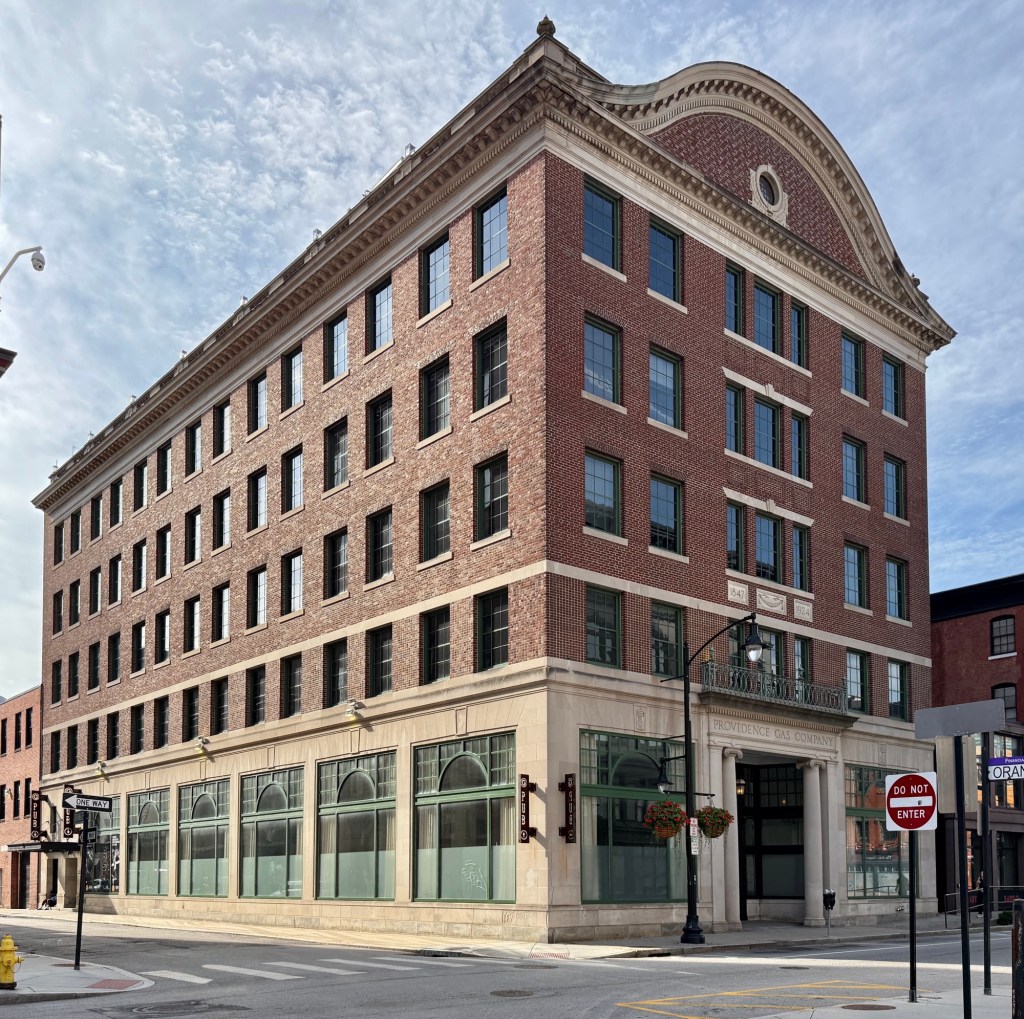
One of the unsung architectural landmarks in Downtown Providence, Rhode Island, can be found on Weybosset Street. The Providence Gas Company Building at 100 Weybosset Street was built in 1924 as the headquarters and offices for the Providence Gas Company, which provided services to a rapidly growing New England city. The architects, Clarke & Howe, used local precedence in their design, modeling the building as a commercial version of the 1774 Joseph Brown House on South Main Street, with its iconic ogee gable at the roof. Beyond its own ogee gable, the Gas Company building retains its columned entry and symmetrical facades. The building was converted into housing with a pub and rooftop restaurant.
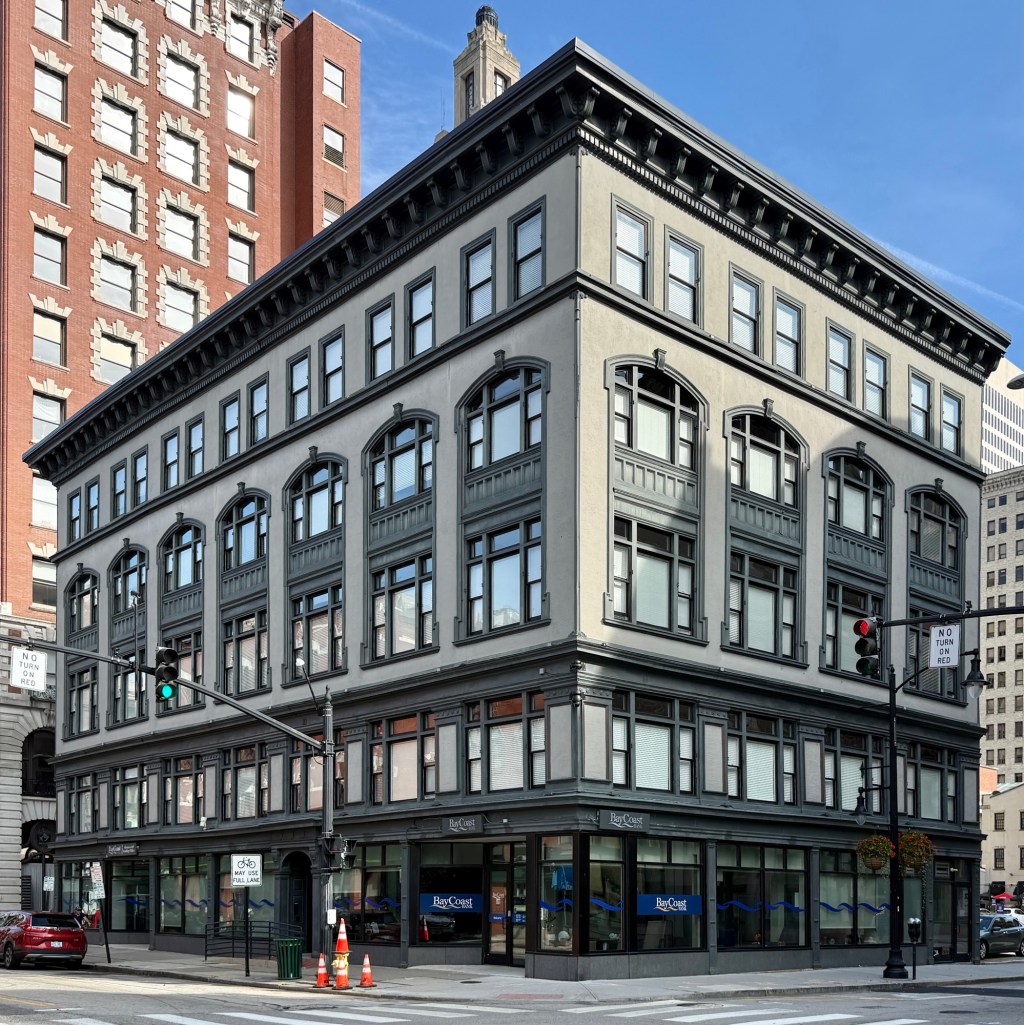
Originally built in 1859 as a four-story building, this commercial block on Dorrance Street in Downtown Providence was updated in the early 20th century in its present appearance. The Case-Mead Building is brick construction and was designed in the Italianate style, notable for its round arched windows. When built, the present third and fourth stories were a double-height Infantry Hall for Rhode Island’s First Light Infantry Regiment, and hosted dances and lectures until they moved to a larger building on South Main Street in the 1870s. The building was renovated in 1906 in the Renaissance Revival style, with a full floor created from the former two-story meeting hall and the primary facades clad with stucco and new trim added. The building recently housed offices, but was renovated in 2017 into housing, creating 44 apartments with funding from State Historic Tax Credits, Rebuild Rhode Island Tax Credits, and private funding.
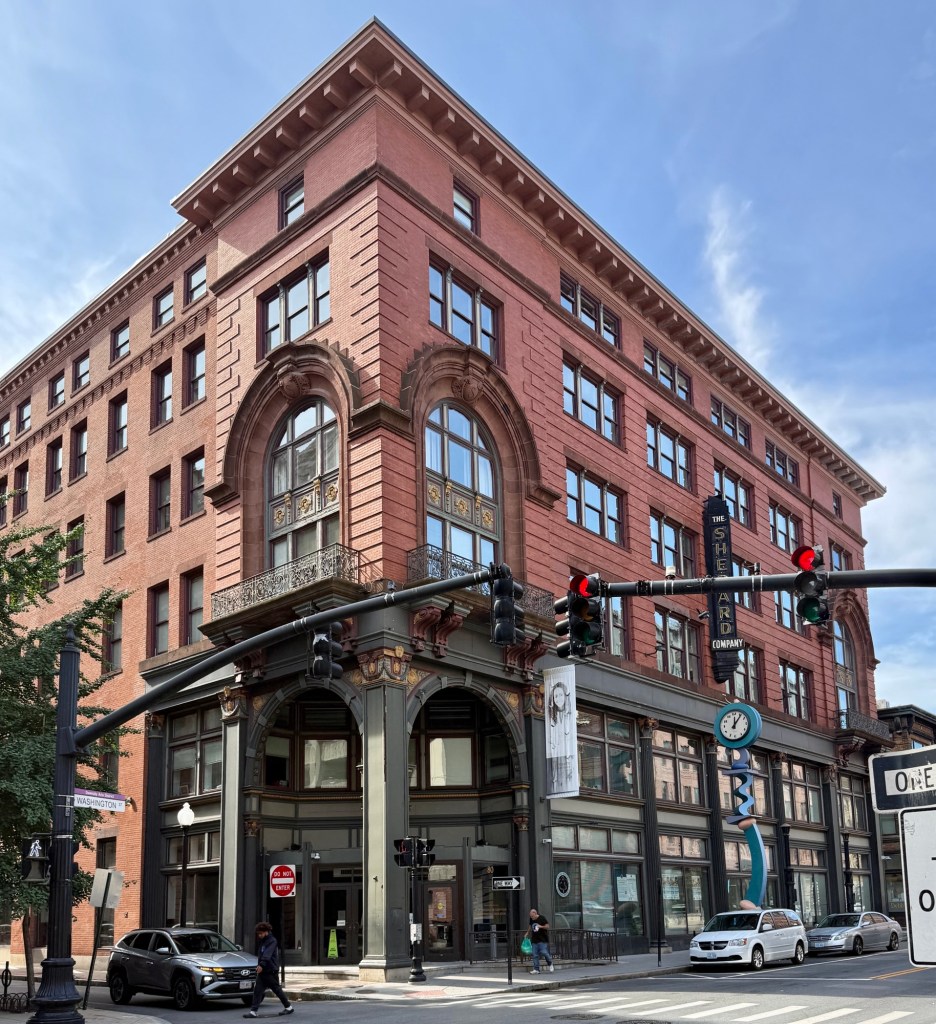
At the corner of Westminster and Union Streets in Downtown Providence stands the Shepard Company Building, a hulking reminder of the late 19th and early 20th century dominance of the department store and the American downtown as a retail destination. The company opened in 1880 in a modest 6,400-square-foot storefront, and saw immediate success, eventually occupying an entire city block. The company grew piecemeal into neighboring buildings between 1880-1903 when the entire 300,000+ square foot block was completed from plans by Martin & Hall, architects. Architecturally, the building tells its own history in layers: it started as a modest three-story Italianate structure, and later additions brought two-story arched entrances angled into the corners at Westminster and Union, and Washington and Union, that once lured shoppers inside to terrazzo floors with a sea of merchandise. Outside, a freestanding cast-iron clock became a beloved meeting point, with generations of Rhode Islanders arranging to gather “at the clock”. A massive fire in March 1923, caused over one million dollars’ worth of damage, but the structure was restored under Hall’s supervision. Shepard’s closed in 1974 and remained vacant for almost 20 years. After advocacy from preservationists, the building was bought by the State of Rhode Island and was rehabilitated by David Presbrey, the building is now the location of the Providence Campus of the University of Rhode Island, the Rhode Island Department of Education, and other state offices and education-related facilities.
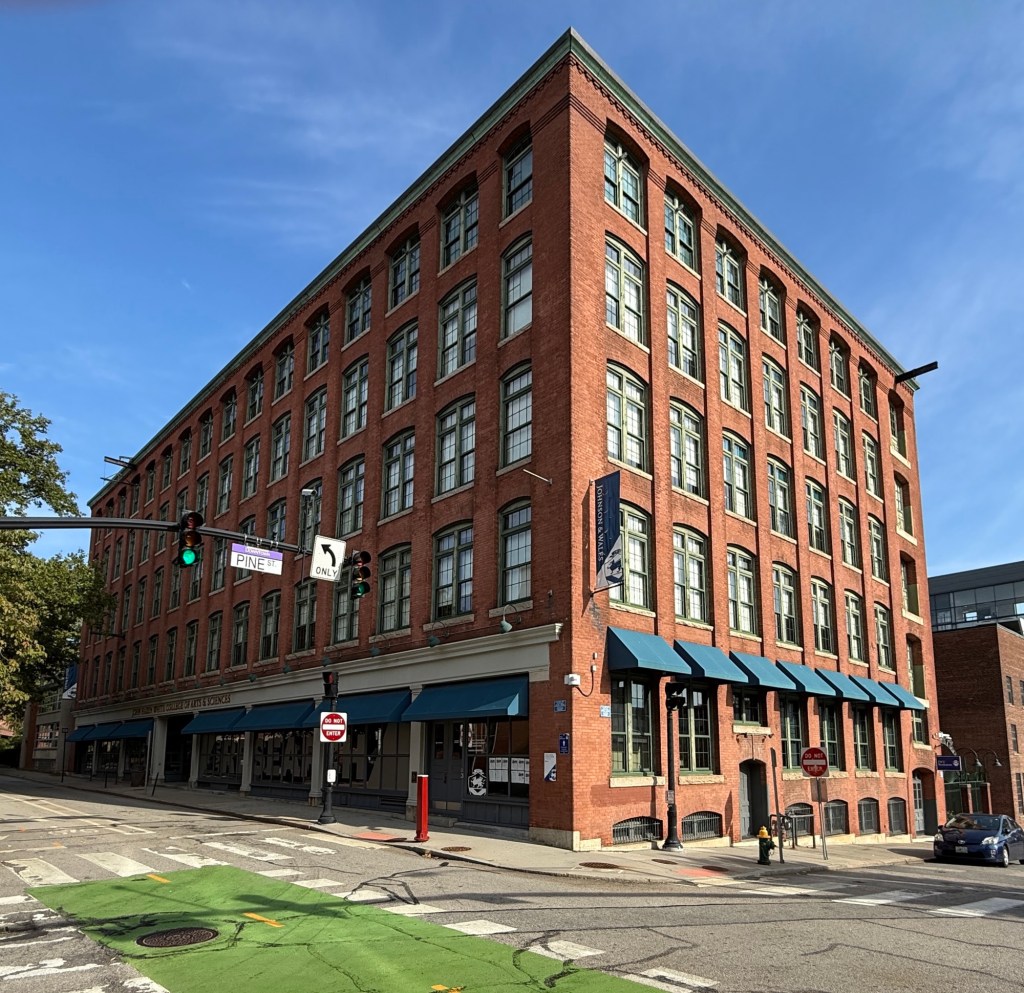
The Waite-Thresher Company Factory sits on Pine Street between the commercial Downtown and former industrial Jewelry District of Providence.The factory here was built in 1911 and is an excellent example of a light-industrial building of the early 20th century in Providence. The steel-frame building is sheathed with brick walls and retains its double-hung windows set within brick arches and classically designed storefronts. The Waite-Thresher Company was one of many jewelry manufacturing companies in Providence. Founded in 1885 from the merging of multiple companies, the Waite-Thresher Co. began primarily manufacturing thimbles and later became a leader in the American jewelry world as the kings of delicate, ornate filigree rings, pins, and accessories. The company eventually closed in the 1930s and after later uses, the building was acquired by Johnson & Wales University who in the 1980s, restored the building and opened it as the centerpiece of the John Hazen White College of Arts & Sciences on campus.
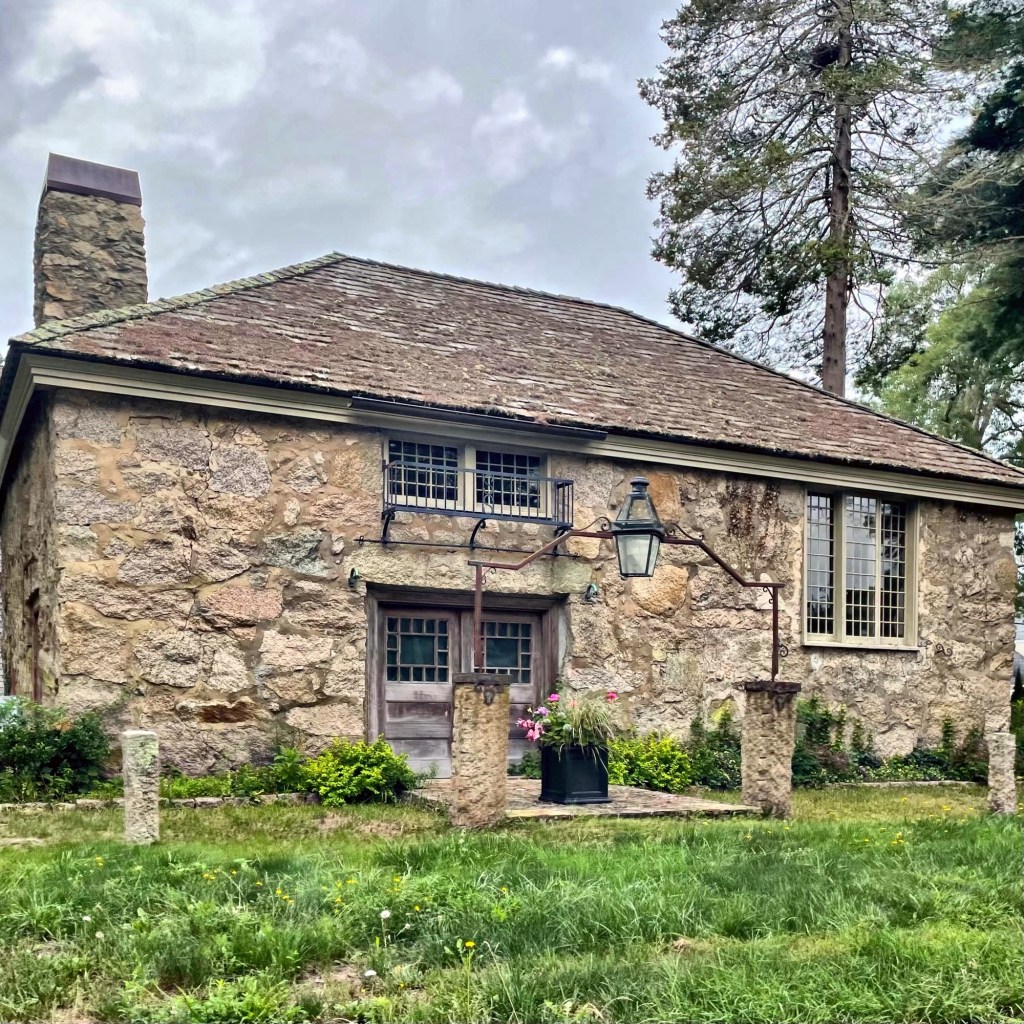
One of the most significant buildings in the coastal town of Marion, Massachusetts, is this stone structure, which is said to have had its beginnings as a storage warehouse. Located on Spring Street north of the main village, this building was constructed as early as 1820 as a salt works storage facility, and is an extremely rare surviving storage facility associated with the early 19th century salt industry in town. While many storage facilities we know today are void of architecture and soul, this building looks like it was plucked from the French countryside, thanks to a late 19th century renovation by one of the most prestigious architects in the United States. The salt industry in Massachusetts began on Cape Cod during the Revolution. Salt was a vital necessity for the preservation and curing of fish and meat for sale in this country and overseas. According to local lore, the Old Stone Studio was originally “a place for the conversion of sea water into salt.” Around the Civil War, the building was being used for petroleum processing facility, where kerosene, which had supplanted whale oil as a fuel for home and street lamps, was made and stored. The old stone structure had fallen into disrepair by the 1880s, that was until New York magazine editor, Richard Watson Gilder bought and restored it as a studio for his wife, artist Helena de Kay Gilder. At this point, Marion had become a premier summer colony with large waterfront estates and recreational facilities built for the wealthy in Boston and New York to spend the warmer months. Gilder hired his friend, Stanford White of McKim, Mead & White, to update the warehouse into a studio, adding the multi-light windows, decorative ironwork, and interior details, including the massive stone fireplace with a nine-foot mantle. The fireplace provided a stunning backdrop for guests, including President Grover Cleveland and First Lady Frances Folsom Cleveland, who summered in town. Ms. Gilder even painted the First Lady in the studio, and hosted her on occasions. The Old Stone Studio is now a private residence with addition off the rear.
At the tip of Converse Point, a peninsula in Marion, Massachusetts, jutting into Buzzards Bay, a once great estate was built at the turn of the 20th century as the community saw many wealthy summer cottages built. One of these owners was Harry Elisha Converse (1863-1920), who purchased land here in 1898 and razed earlier cottages to build The Moorings Estate. Harry E. Converse was President of the Converse Rubber Company, which produced winterized rubber-soled shoes and boots and later shifted to make footwear for the military, and is today known simply as Converse, the internationally known footwear and apparel company. In 1902, Converse hired architect, Tristam Griffin to design his new summer “cottage”, the Moorings, which was said to be the largest residence in Buzzards Bay at the time and rivaled the size of many area hotels. Part of the estate included a carriage house, cottages for family and friends, and this building, which was constructed as a bell tower and observatory near the entrance of the property that provided sweeping views of the grounds and surrounding coast. The 40-foot tower was designed in the Shingle style like the main house and featured a one-ton bell at the top. It was eventually connected to electricity and later provided a fire alarm for the entire estate. After the death of Harry E. Converse in 1920, the property was conveyed to three of his children, who subdivided the property which became too much to maintain as a summer home. The former observatory was acquired by Parker Converse and later converted into a residence, by him or his son, Courtland Converse. The unique structure is a lasting remnant of what was once the largest estate in this part of Massachusetts.
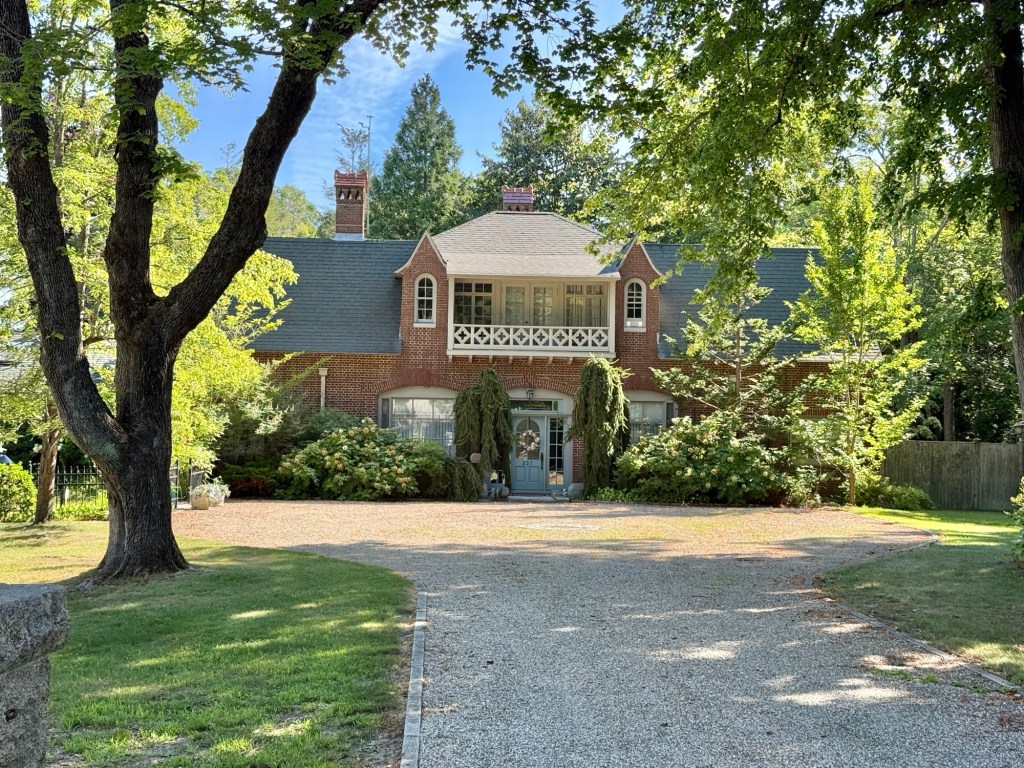
In the late 19th and early 20th century, Marion, Massachusetts, became an exclusive summer colony where wealthy families from cities would flock to soak up the sun and breathe fresh coastal air away from the heat and pollution of industrial centers at the time. One of these families was headed by Stanley Robert McCormick (1874-1947) of Chicago, the son of Cyrus McCormick, inventor and founder of the McCormick Harvesting Machine Company which would later become the International Harvester Corporation. Stanley McCormick was married in 1904 to Katharine Dexter McCormick (1875-1967), also a member of a wealthy family, who would devote her life to advancing women’s causes, serving as the vice-president of the National American Women Suffrage Association and in 1920, co-founded the League of Women Voters. Katharine remained active in later life, funding new birth-control research and the building of an all-women’s dormitory at the Massachusetts Institute of Technology, named McCormick Hall. Soon after Stanley and Katharine married, they purchased waterfront property in Marion, where Stanley spent summers as a child, to build a summer residence for his own family. In 1906, Stanley purchased land on Lewis Street and hired the Boston architectural firm of Page & Frothingham, to design and oversee construction of a large brick “cottage” and this brick garage structure down the street with a residence for the driver. While their summer residence was being built, Stanley McCormick, like his sister Mary, was diagnosed with schizophrenia. In 1909 he was declared incompetent by the California Supreme Court and would live for the rest of his life at the McCormick estate, “Riven Rock,” in Santa Barbara, California. In 1929, his wife Katharine and Stanley’s brother Harold were named conservators of his estate, which exceeded $30 million. The McCormick estate in Marion was occupied by Katharine’s mother for a number of years with Katharine visiting many summers. The cottage property was eventually sold and demolished in 1953, and the old garage was converted to a home with additions to make the property a year-round residence.
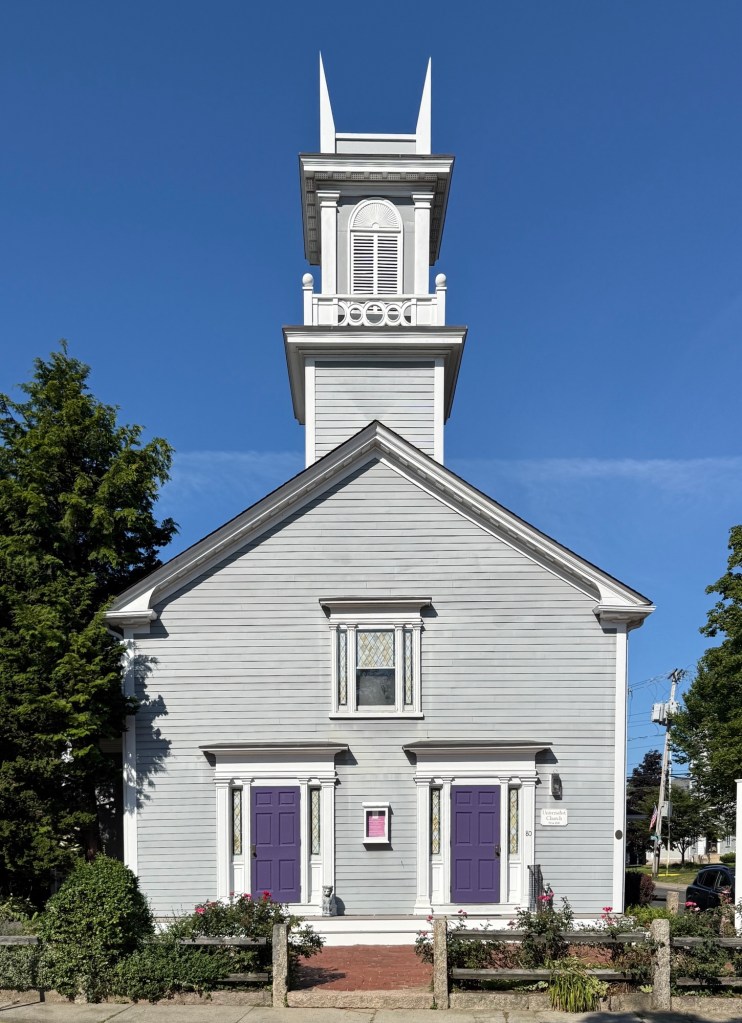
I do love a good adaptive reuse story! This historic church building on Main and Pleasant streets in the Wharf Village of Marion, Massachusetts, was constructed in 1833 for the town’s growing and new Universalist congregation. Architect Seth Eaton was hired and furnished plans, likely relying on neighbor, Warren Blankinship, a carpenter and congregant, to construct the building. It blends together the Greek and Gothic Revival styles well, but in a less sophisticated form than some larger churches. By World War II, the church’s membership had dwindled to only a few old Marion families and eventually closed. With the building’s future uncertain, at a time where demolition for surface parking lots was the go-to solution, Marion residents Andrew and Dorothy Patterson, purchased the building and soon after worked with local artists in town to restore the building for use as an art space. The Marion Art Center was founded in 1957, and to this day, serves as a non-profit community cultural organization dedicated to promoting the visual and performing arts.
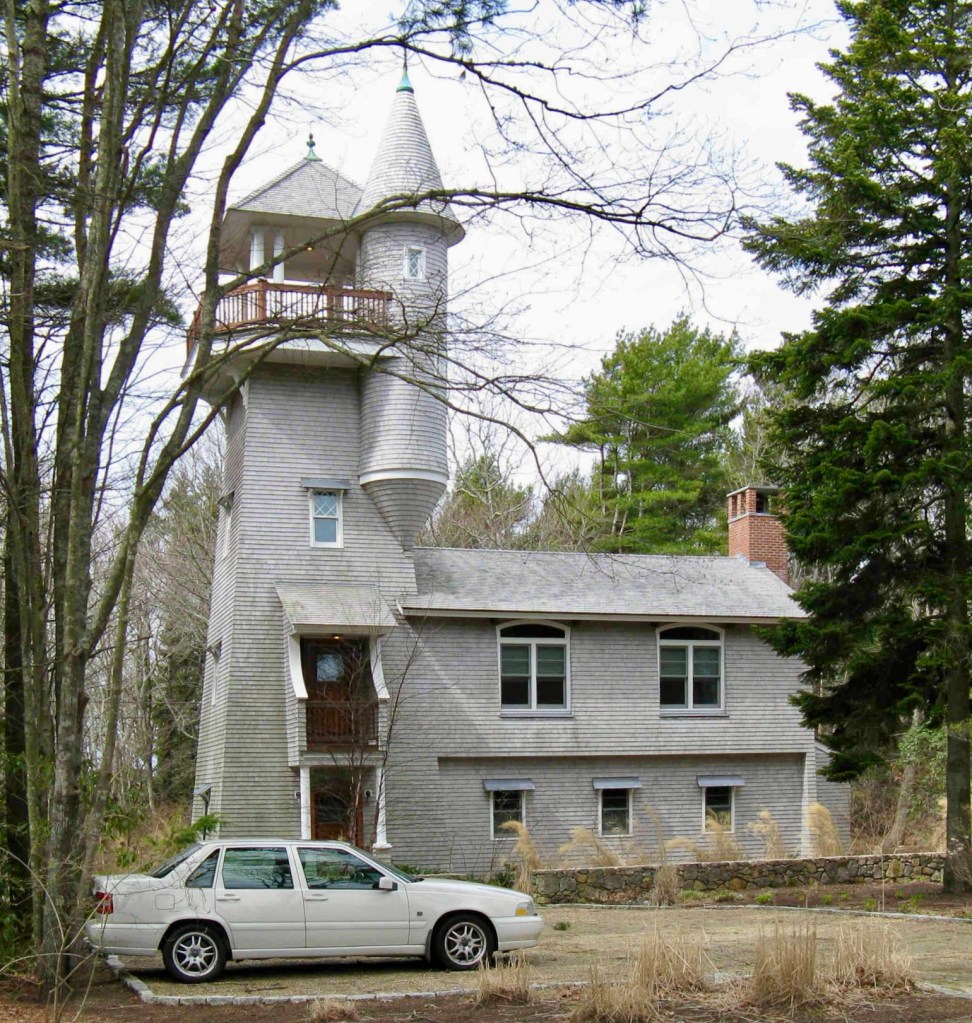
Preservation and New England ingenuity at its finest can be found at this quirky residence on Spring Street in the charming community of Marion, Massachusetts. The unique home seen here was originally built around 1899 as a water tower and windmill on the estate of William H. H. Ryder (1841-1921), which generated power from the wind to pump water from a well below ground, providing a continuous supply of water to his residence. The structure was in use until 1907 when municipally supplied water became available in town. When William Ryder, who never married or fathered children died in 1921, the property was inherited by his niece, Harriet C. Ryder (1869-1943), who lived with her uncle and kept house for him. Financial struggles forced Harriet to sell the main house and convert the windmill into a small cottage in 1926. The structure was originally used as a summer cottage but was later expanded and made a year-round residence, with later owners maintaining the unique charm and form of this iconic local landmark.
Tucked into the heart of Wharf Village, the main village in the charming coastal community of Marion, Massachusetts, this building which is known today as the Marion General Store, wears its history quietly beneath a deceptively simple Greek Revival facade. The structure was constructed in 1799 as Marion’s first Congregational Meeting House, where religious services of the congregational church were conducted before the separation of church and state. The construction of this wood-frame building did more than give the faithful a place to worship, it anchored Wharf Village as the commercial and civic center of town, setting in motion the currents that would eventually set Marion off from its mother-town, Rochester in 1852. By the 1830s, the old meeting house was in poor condition, and along with the push for a separation of church and state and tax dollars no longer going to the Congregational Church, a grander Greek Revival church was built across the street. The Old Meeting House was also renovated in the Greek Revival style and operated as Delano Hall, a store with dance hall and meeting space on the upper floor. The building lives on today as the Marion General Store, with its old clapboards and pilastes holding the layered history and architecture of the seaside community that grew up around it from working port town to wealthy coastal village.
The Gamewell Fire Alarm and Telegraph Company traces its roots to the pioneering work of William Francis Channing and Moses Farmer of Boston, whose 1850s telegraph-based fire alarm system was the first practical fire alarm box system that consisted of telegraph-based boxes placed on street corners, which, when activated, sent a coded signal to a central fire station notifying them of a fire or emergency. The duo applied for a patent for their “Electromagnetic Fire Alarm Telegraph for Cities” which was later acquired by John Gamewell of South Carolina. Following the Civil War, Gamewell partnered with Kennard and Company and built a factory in Newton Highlands in 1873. The company would adopt the trademark of a fist gripping lightningbolts, and by 1886, the Gamewell system was operating in over 250 cities in the United States and Canada. As the company grew operations, the business moved to this site in the Upper Falls village in 1889, which was desirable for its close proximity to the railroad and markets all over the region. The first factory was the two-story wooden factory building completed in 1889, with later wings to its east (1904) and west (1912) as the company continued to expand into the 20th century. The Gamewell company remained here until the 1970’s when Gamewell became a division of Gulf and Western. Luckily, the former factory was restored by owners Alexandria Properties and architects, Kraus Associates, as Telegraph, which now offer retail and office space for small local businesses
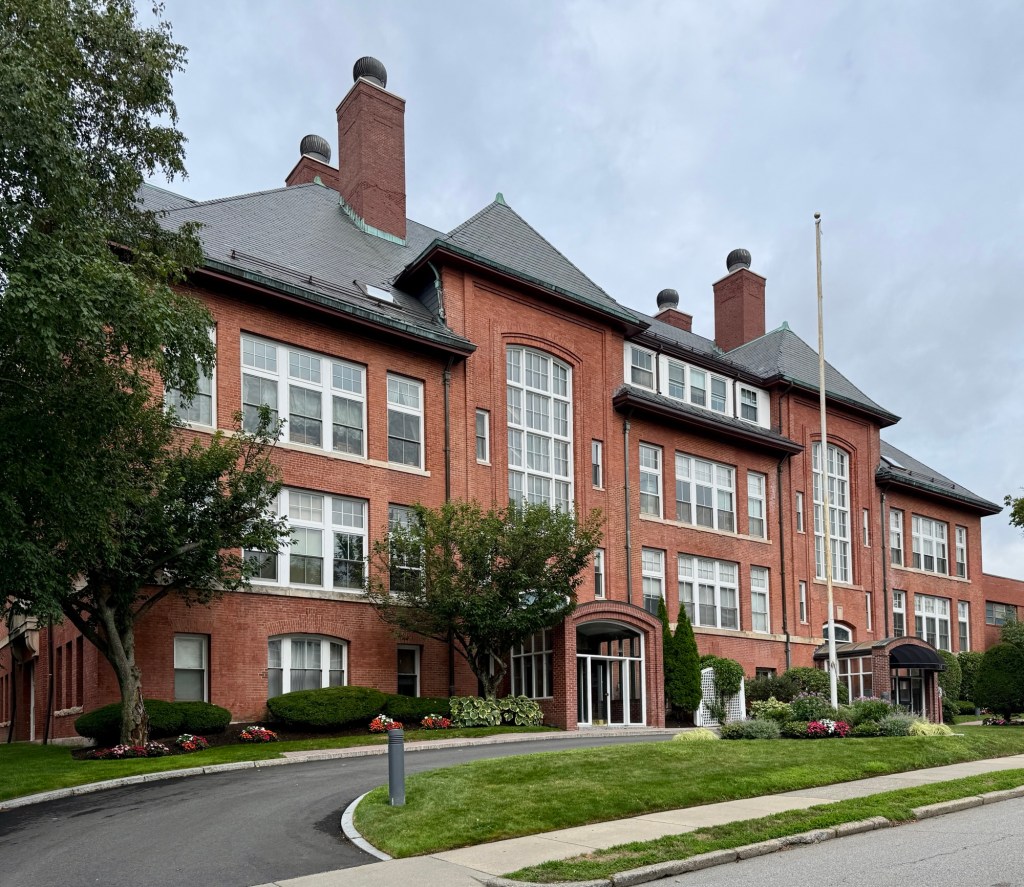
The Ralph Waldo Emerson School in Newton’s Upper Falls village was built in 1904 and dedicated a year later serving as the main school building in the industrial village. The brick school building was constructed adjacent to the Levi C. Wade School, a large Second Empire style wood-frame school constructed in 1869. The Wade School was razed for a 1950s addition to the Ralph Waldo Emerson School. The substantial school building was designed by the prominent architectural firm of Hartwell Richardson & Driver, at a time when the Upper Falls Village continued to expand due to the well-established cotton manufacturing mills and the Gamewell Fire Alarm Company. The large structure is hard to classify architecturally, as it blends elements of the Renaissance Revival, Arts & Crafts and Classical Revival styles, but with its massive chimneys, hipped roof with projecting eaves, and large arched windows, the building is an architectural statement for the relatively vernacular industrial village it is located in. By the end of the 20th century, school enrollments and consolidation of village schools saw the closing of the Emerson School, but luckily, the building lives on after it was converted to condominiums, with the 1955 addition now serving as a day care center, a senior citizen room and gymnasium-hall for the community.
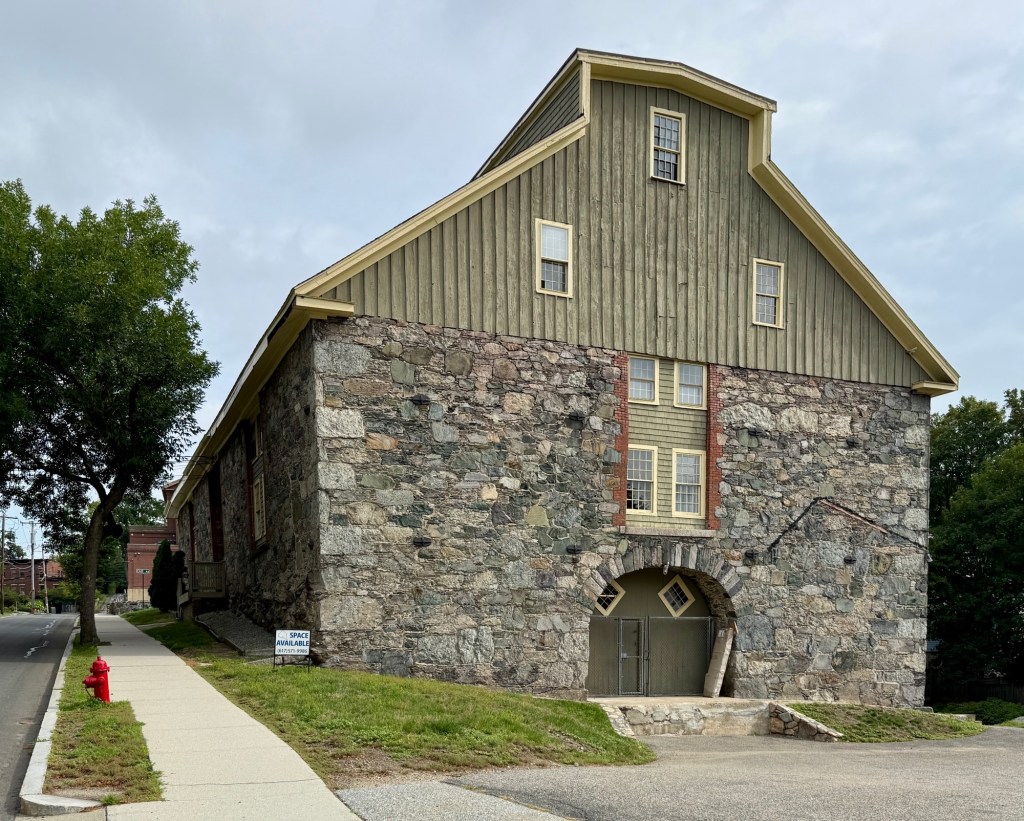
This historic stone barn in Newton’s Upper Falls village is representative of the ingenuity and resourcefulness of this once thriving nineteenth century mill village. Known as the Pettee Stone Barn, the structure dates to 1839 when Otis Pettee (1795-1853), who managed an iron foundry and machine-works for cotton machinery, built this structure as a warehouse. The barn was said to have been used additionally as a location for raising silkworms by Pettee’s company. After the business closed, the handsome barn was used later in the 19th and early 20th century as a carriage and horse barn for a shipping company and today, is rented to local businesses. Architecturally, the barn is significant for its use of fieldstone walls with door and window surrounds of cut stone and brick. A monitor roof runs the length of the gable ridge and illuminates the interior spaces. The Stone Barn remains remarkably preserved today and is a landmark in the community.
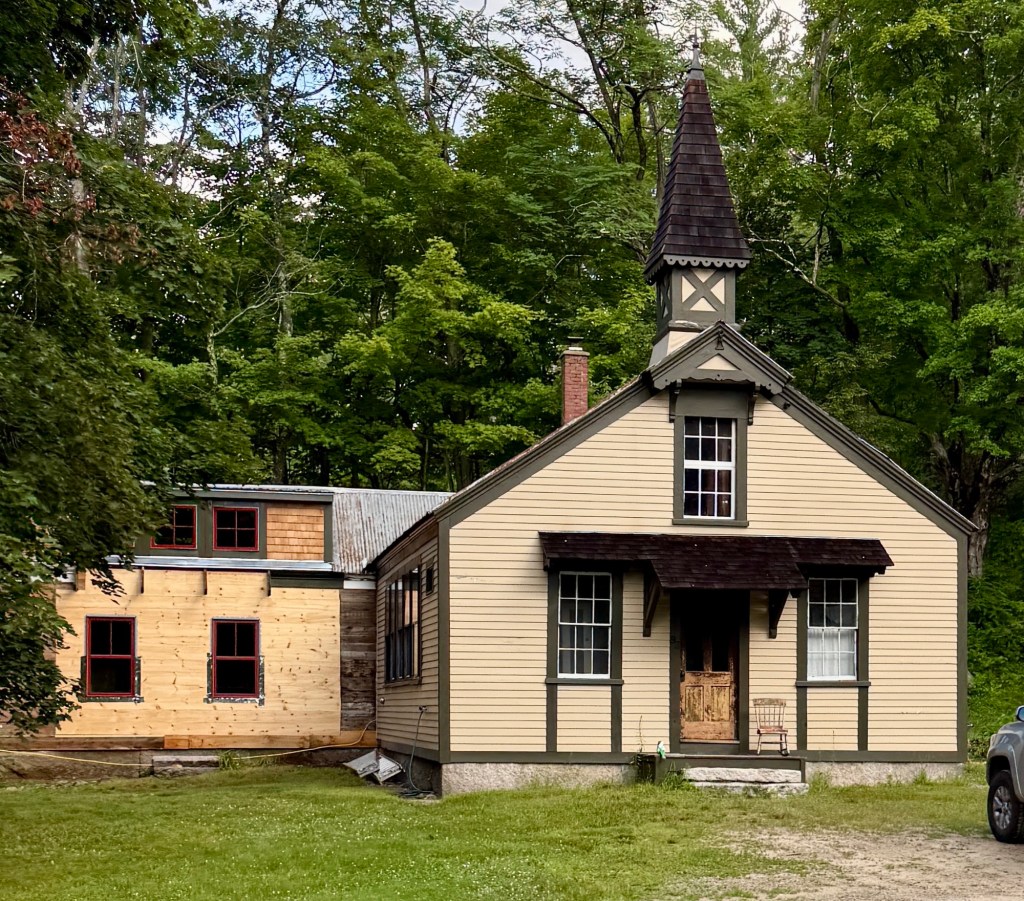
This historic one-room schoolhouse can be found in Chocorua Village in the town of Tamworth, New Hampshire, and is a rare Stick style example of its type. The one-room schoolhouse was built around 1880 for the village and was one about 19 district schoolhouses in the town of Tamworth, all servicing remote villages for area children. The school eventually closed when consolidated schools took over in the 20th century, and this charming Victorian schoolhouse has since been converted to a private residence with rear wings added.
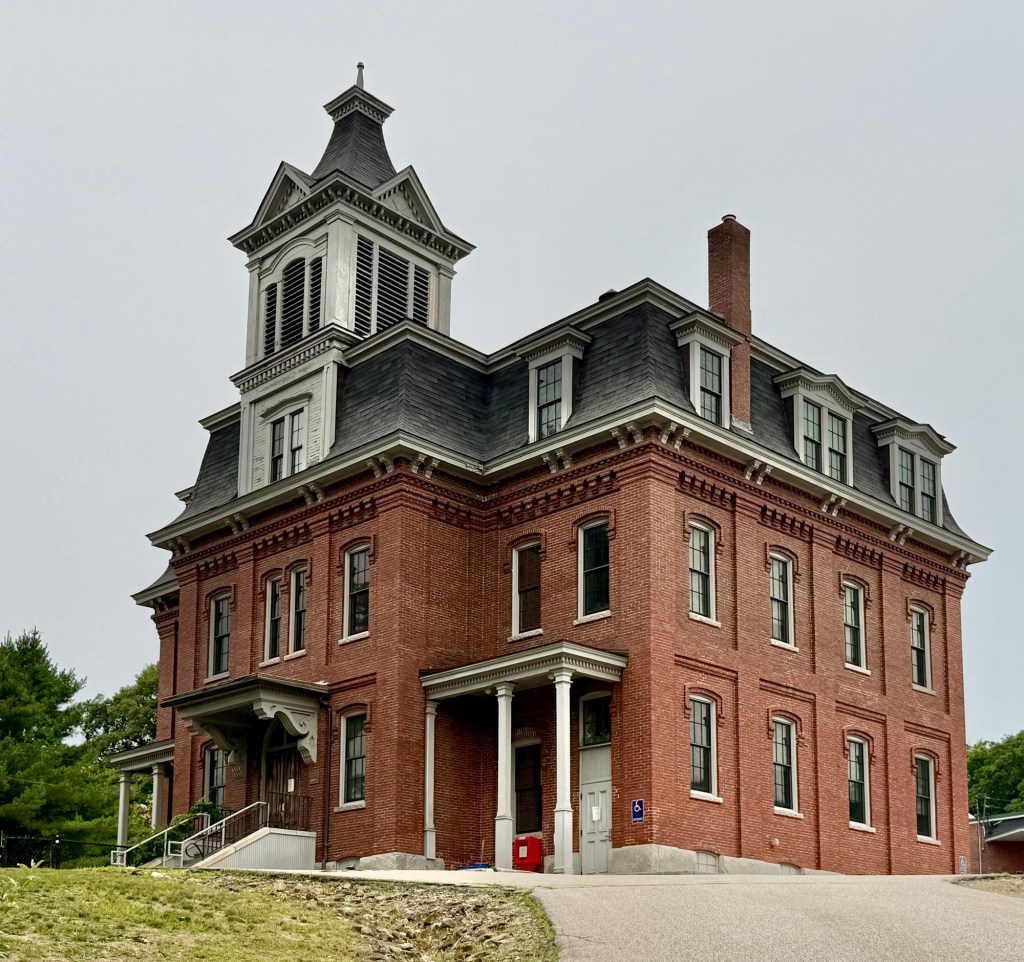
The former Ashland Junior High Schoolstands on a rise overlooking Ashland’s village center, on School Street just east of the entrance to the modern Ashland Elementary School. It is a three-story brick building designed in the Second Empire style and is topped by a mansard roof. The exterior is little changed from its original construction, although the interior has been subjected to period modernization after decades of vacancy and conversion to offices. The school was built in 1877 in response to the poor conditions of Ashland District Schools at the time. The school was closed in 1990, and the town voted to demolish it in 2000. The building was listed in the New Hampshire Preservation Alliance’s Seven to Save in 2007. A community effort rescued the building from that fate, thanks to the Ashland Historical Society which advocated for the sale of the building and subsequent restoration by the Tri-County Community Action Program, which occupies the building to this day. Preservation wins!