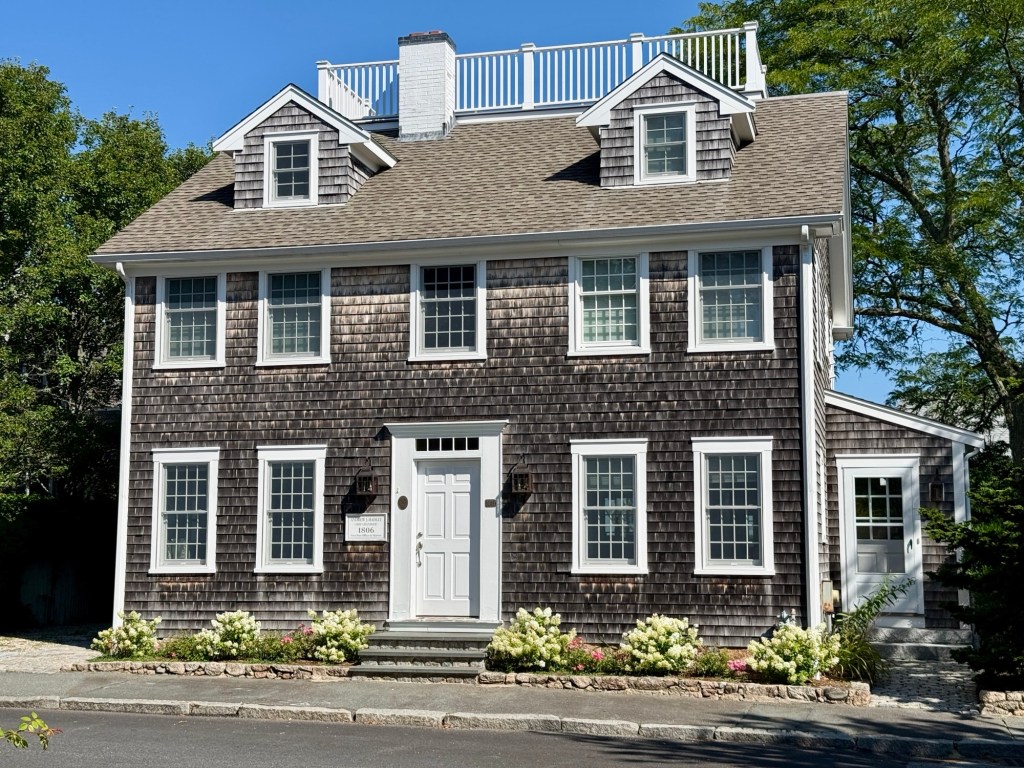
Hadley’s Store – Ryder-Harwood House // c.1806

This late-Georgian style residence on Main Street in Marion’s Wharf Village is a stone’s throw from the harbor and has been conveniently located near the town’s Long Wharf since it was constructed around 1806. The building was constructed as a store for A. J. Hadley, where ships were outfitted for voyages. While Hadley’s store occupied the eastern half of the first story, the left side of the ground floor was Marion’s first post office. The second floor served as a clothes-making factory with the top floor operating as a sailmaker’s loft. By 1855, the structure was converted to a residence and owned by Sumner Ryder, who served as the Town Clerk and later joined the ranks of the Union Army during the Civil War. During the early 20th century, the property, with its widow’s walk, was owned by members of the Harwood family, including Ms. Sarah W. Harwood, who lived here with Margaret French (1860-1935) who was listed in the Census for decades as her partner, housemate, and boarder. 

Marconi Wireless Telegraph Station Employee Hotel // 1914

Tucked into the woods in Marion, Massachusetts, the Marconi Wireless Transmitter Station stands as one of coastal New England’s most remarkable and now largely forgotten technological landmarks. Built in 1914 by the Marconi Wireless Telegraph Company, the Transmitting Station in Marion served as an important piece of the American half of a transatlantic relay system, sending powerful signals across the ocean to a receiving partner in Stavanger, Norway, through a sister station in Chatham. At the height of its operation, the site bristled with fourteen 400-foot tubular steel masts arranged in a rectangle stretching nearly a mile, a feat of engineering so audacious that contemporaries dubbed it a “wonder of the twentieth century.” The station in Marion included a cluster of buildings including: a powerhouse, an operating building, cottages, and an employee “hotel” pictured here that housed unmarried staff, were all built to service the towering steel structures, of which only one remains. The site was taken by the U.S. Military during WWI and WWII and later sold to a private owner and the property was subdivided and sold-off with the majority of the original 144 acres of land comprising the station donated to the Sippican Lands Trust in 1986. Scattered remnants of equipment remain on this mostly-wooded conservation land, including wires, concrete mast footings, and cables. The single remaining tower serves as a cell tower today. The old Employee Hotel is now used for offices.

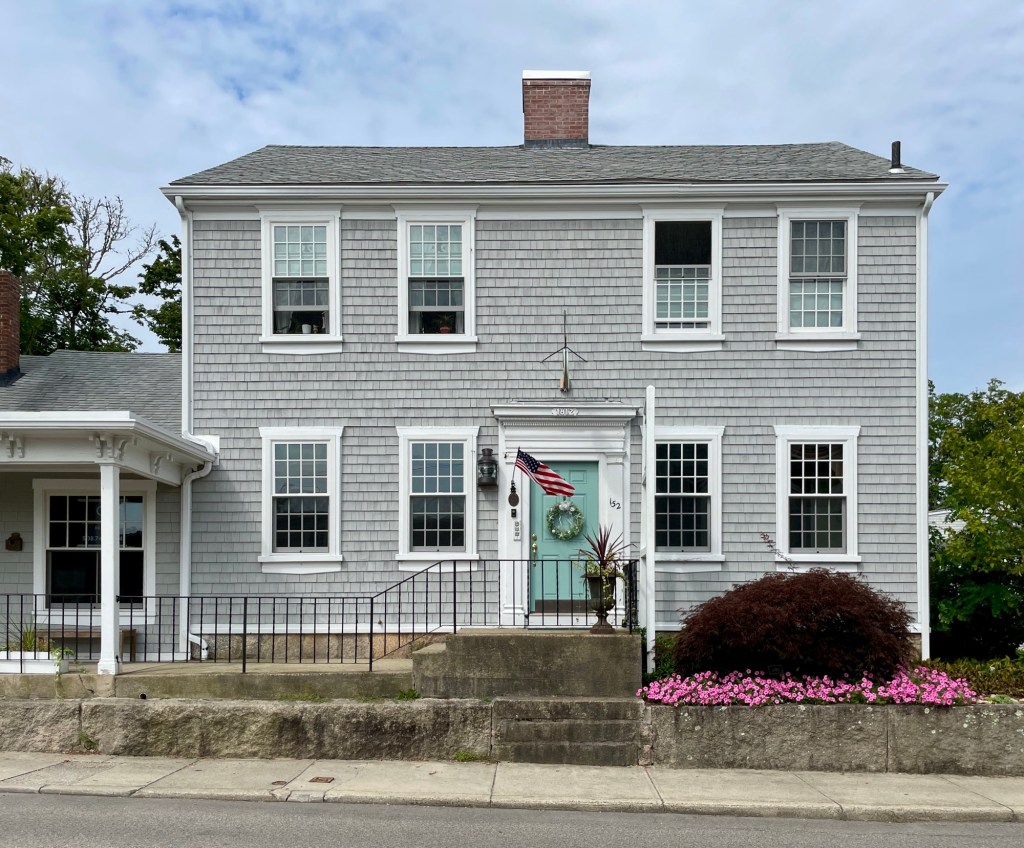
Handy’s Tavern – Sippican Woman’s Clubhouse // 1812

In 1812, a recently married Caleb Handy (1782-1855) built this house in the main village of Marion, Massachusetts, to serve as a residence and tavern to supplement additional income. The tavern provided lodging for travelers on the nearby stagecoach route and those who docked in the nearby harbor. Within a year of the couple moving into their new home, Caleb’s wife Sophia died unexpectedly. She was 22 years old. Within two years, Caleb married his late wife’s sister, Mary Dexter, and the couple had nine children together. The property was inherited by their son, Benjamin Bumpas Handy (1822-1897), a former sea captain who would later move west and help settle Mound City, California (now known as Loma Linda). In the 20th century, the property was purchased in 1923 by the Sippican Woman’s Club, who renovated and restored the building, holding events and meetings inside to this day.

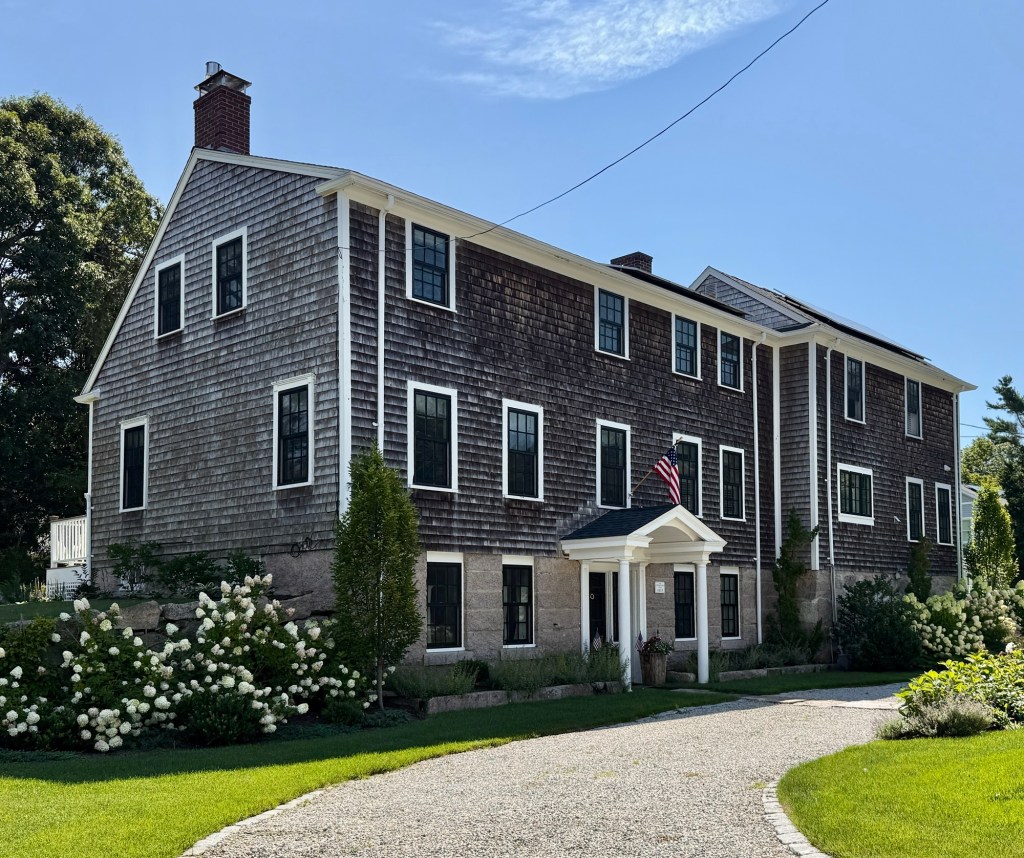
John Pitcher House – Old Parsonage, Marion // 1813

Known as the “Old Parsonage” this historic house in Marion, Massachusetts, was built in 1813 by Capt. John Pitcher (1788-1867) around the time of his marriage to Catharine Clark. John Pitcher was the brother of Elizabeth Pitcher Taber, a major benefactor of the town of Marion. The residence is unique in that the primary facade is actually facing away from the street, with the prominent three-story facade being the historic rear of the home. The Federal period house sits on a raised stone foundation with a central door and shingle siding above. Behind his home, a large pasture was grazed by sheep and cows until the land was sold off and subdivided for residential development later in the 19th century. When Capt. Pitcher died, he left his house to the Congregational Church, which used it as a parsonage for many years until 1966, when the church sold the property to Lawrence P. and Edith G. Pangaro, who co-founded the Marion Sentinel and the Sippican Publishing Company. The home was recently renovated.

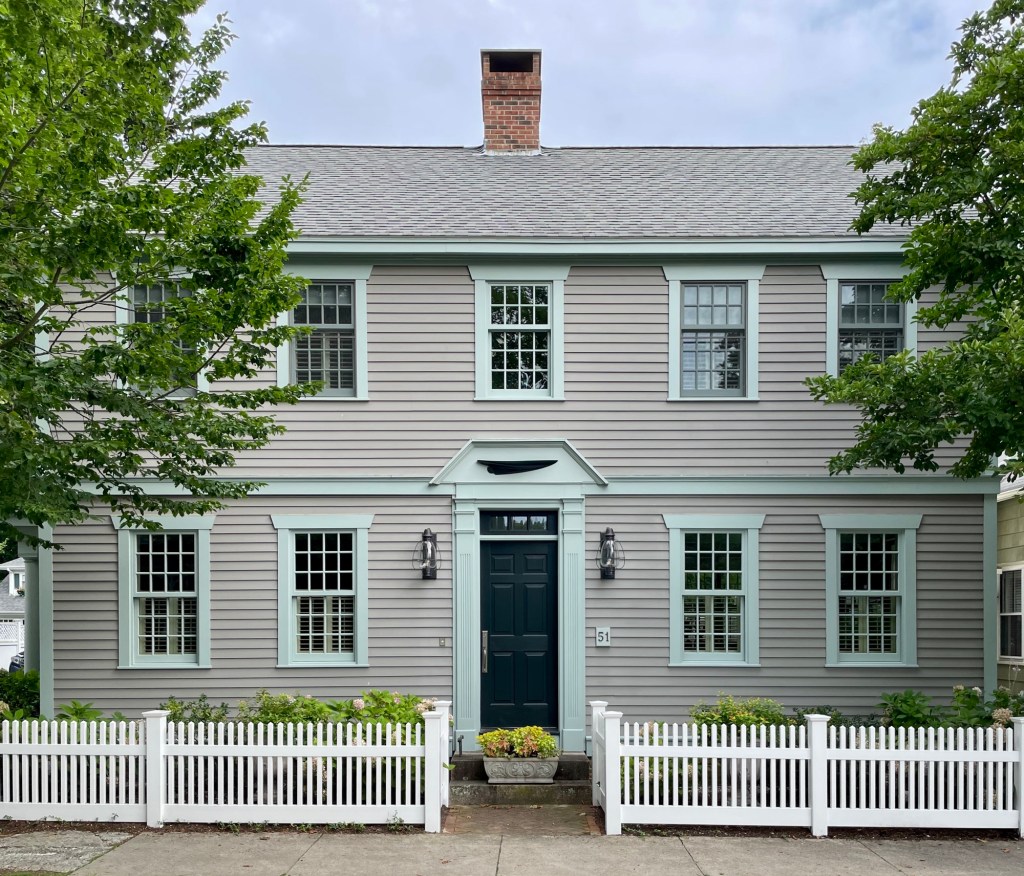
Look-Coggeshall House // 1828

Believe it or not, this beautiful home was once a one-story Cape house and given its present appearance in 2003! Built in 1828, the Look-Coggeshall House sits on the idyllic Main Street in Marion, Massachusetts, and was constructed for Captain Hiram Look (1803-1865), a sea captain, and his new wife Kezia within a year of their marriage. They had two daughters, one of which, Amanda, would inherit the family home with her husband, Bernard Coggeshall, who shows up in the census at varied times as a: tin peddler in 1870, huckster in 1880, a dealer in stoves in 1900, and as an owner of a hardware store by 1910. Old photos of the house show the original four-bay Cape form before the house was given its second story in 2003. The designer did an excellent job to preserve the door surround with transom, lintels and maintain the window spacing, with the addition of a band between the floors which visually depicts where the original roof began.

Cobb-Luce House // 1841

This beautiful side-hall Greek Revival style residence on South Street in Marion, Massachusetts, was built in 1841 as a parsonage for the Marion Congregational Church, built that same year. The first pastor to reside here was Rev. Leander Cobb, who assisted his father, Rev. Oliver Cobb, who had been preaching in Marion since the completion of the first meeting house in 1799. After Leander Cobb’s death in 1873, the church decided to sell this parsonage and it was purchased by Rev. Cobb’s second wife, Selina, who sold it to George Luce (1825-1893) a master mariner. In 1960, the property was sold to local historian and founder of the Sippican Historical Society, Olive Hiller Somers (1890-1967). The residence was renovated and retains much of its original architectural integrity.