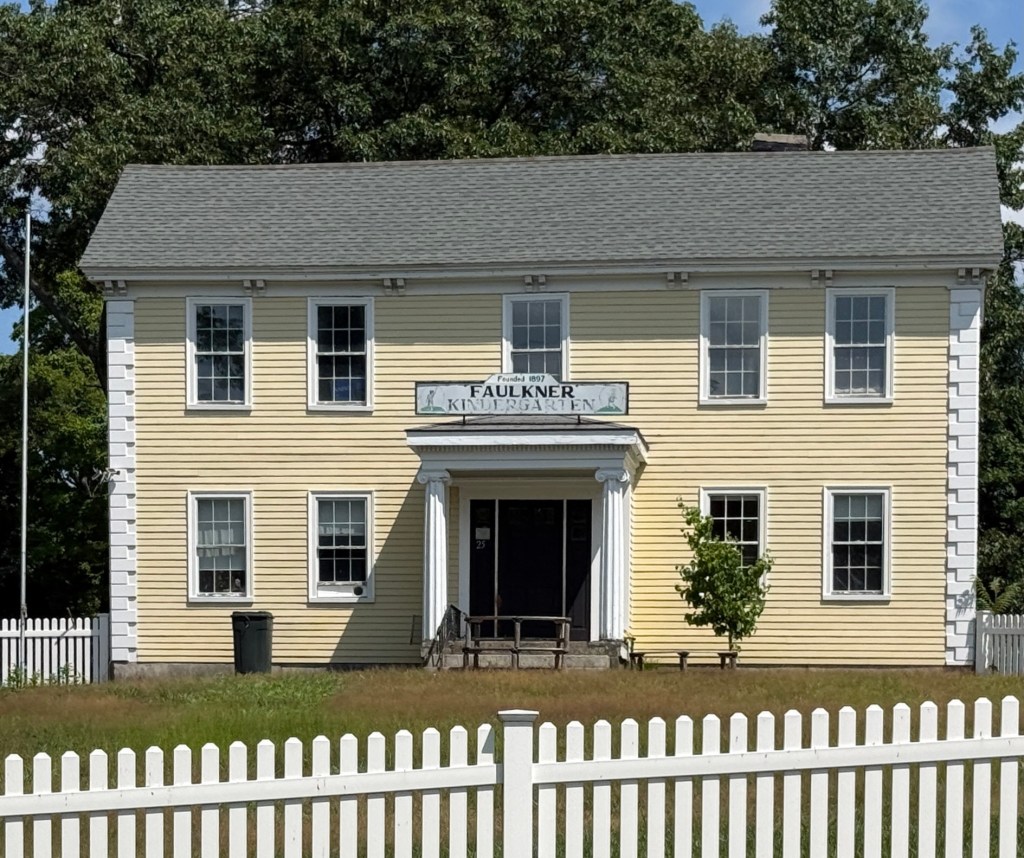
Adjacent to the Faulkner Mill, this early 19th century house in North Billerica was built by a member of the Faulkner family, who helped make the village an industrial center in this part of Massachusetts. This house is said to have been built around 1825 and was the residence of James Faulkner (1801-1877), who co-ran the adjacent Faulkner Mill with family, manufacturing cloth goods. A late Federal style house, the Faulkner residence features a five-bay facade with center entrance and corner quoins. After the death of James Faulkner, the property was inherited by his heirs, and in 1927, was given to the children of Billerica by Anne Faulkner, for use as a kindergarten, which remains to this day.
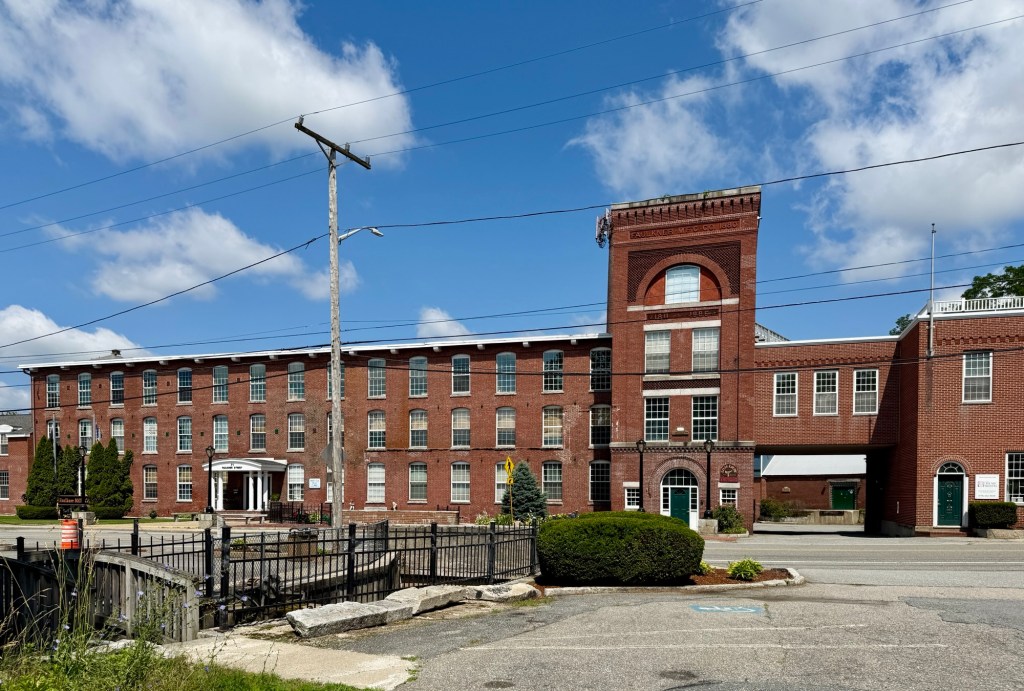
The manufacture of woolen goods was introduced in North Billerica by Francis Faulkner in 1811 on the bend of the Concord River. Francis Faulkner was the son of Colonel Francis Faulkner of Acton, one of the leading citizens of that town, who participated in the battles of Lexington and Concord and served throughout the Revolutionary War. When Francis Faulkner arrived in North Billerica, he began to manufacture woolen goods and expanded to coloring and dressing cloths. Mr. Faulkner would be joined by his sons, James and Luther, and was called the James R. Faulkner & Company. James Robbins Faulkner took over his father’s business, which expanded greatly after the Civil War. In 1880, the firm incorporated as the Faulkner Manufacturing Company, and they had the largest wing, this main block, added to the mill complex. The main building is an interpretation of the Romanesque Revival style and stands three stories tall and is notable for the four-story stair and water cistern tower with arched base. Sometime after 1914, the property was organized as the North Billerica Company and by 1935, a total of 135 employees were engaged in manufacturing wool blankets and cloth. Despite additions to the factory in the 1940s and again in the early 1960s, foreign competition forced the mill to close about 1987, leaving the buildings vacant with its future uncertain. Luckily, the Faulkner Mill is now home to a variety of small businesses and the Middlesex Canal Museum.
An excellent example of a Federal style country mansion, the Dr. Bowers House sits on the edge of the Town Common in Billerica, Massachusetts, retains its original form and architectural features which set it above many other residences of its period in town. The mansion was built in 1804 for Doctor William Bowers (1744-1820) and is square in plan with five bays on each side and brick end walls. The roof features a large monitor and massive chimneys extending from the rooms below. Formal entrances are located on both street-facing elevations, with the side door likely originally serving as an entrance to the doctor’s home office.
The Howe School, originally Howe Academy, in Billerica, Massachusetts, is a stellar example of a Greek Revival style school building that shows the emergence of the Italianate style in the 1850s. The school was founded following a generous bequest in the will of Dr. Zadok Howe, as a young men’s college-preparatory academy. When it was built in 1852, most Massachusetts towns divided themselves into smaller school districts, with each district erecting its own school building for pupils to get to the schools easier, improving attendance. The building committee hired Lowell architect, Daniel G. Bean, and it featured an innovative ventilation system for heating and bringing fresh air into the classrooms. The Howe School continued privately until 1897, when it became a public school. By the early 20th century, the small school building was deemed too small and ancient to remain the town’s high school, and a new building was constructed nearby. For years it operated as a grade school, and later as the school department offices. Following an extensive renovation that saw a rear addition, the Howe School building reopened as Billerica Access Television (the town’s public-access television station) as well as space for community events and meetings.
Dating to about 1723, the Danforth-Sexton House on Concord Road in Billerica, Massachusetts, is one of the town’s finest Colonial-era homes and excellently preserved as the home to the Billerica Historical Society. The original owner, Jacob Danforth (1698-1754), was a blacksmith and lived here with his wife, Rebeckah, until his death in 1754. The property was inherited by their son, David, who would sell the house to Rev. Henry Cummings, the fourth pastor of the First Church of Billerica. A series of doctors owned the house in the early 19th century, one of whom likely added the small addition to the side of the main house, which possibly housed a small doctor’s office. The final private owners were William Sexton and his wife, Clara Sexton, who would eventually bequeath the home to the Billerica Historical Society. The house and the now attached barn operate as a house museum with collections documenting the history of the community.
This beautiful Federal style house in Billerica, Massachusetts, was built in 1811 by Joseph Locke (1772-1853), a lawyer in Billerica until 1833, when he moved to Lowell residing there until his death. He was elected eight times to serve as a member of the state legislature from Billerica and once from Lowell and is best known for being the first justice to serve for the Lowell Police Court. The house was built on the site of the 1654 Jonathan Danforth homestead. In 1885, George E. Stearns bought the house and operated it as a hotel. After some time outside of the Stearns Family, the property was purchased by Dr. Albert Warren Stearns, psychiatrist and Dean of Tufts Medical School in 1915. The home has been preserved and maintains all the hallmarks of the Federal style.
The Rufus Underhill House in Billerica, Massachusetts, is an excellent example of the eclectic nature of residential architecture seen in the United States during the Victorian period following the conclusion of the Civil War. Without a clear distinguishing style, the house stands out for its unique form, architectural details, lancet windows and side four-story tower, all with paint colors to highlight and accentuate its distinctive features. The house and accompanying stable were built around 1870 for Rufus K. Underhill (1819-1894) and his wife, Deborah, as a place to spend their retirement. Rufus Underhill was born in Chester, NH and worked as a blacksmith, later establishing the Underhill Edged Tool Co. in Nashua later expanding to sales in Boston.
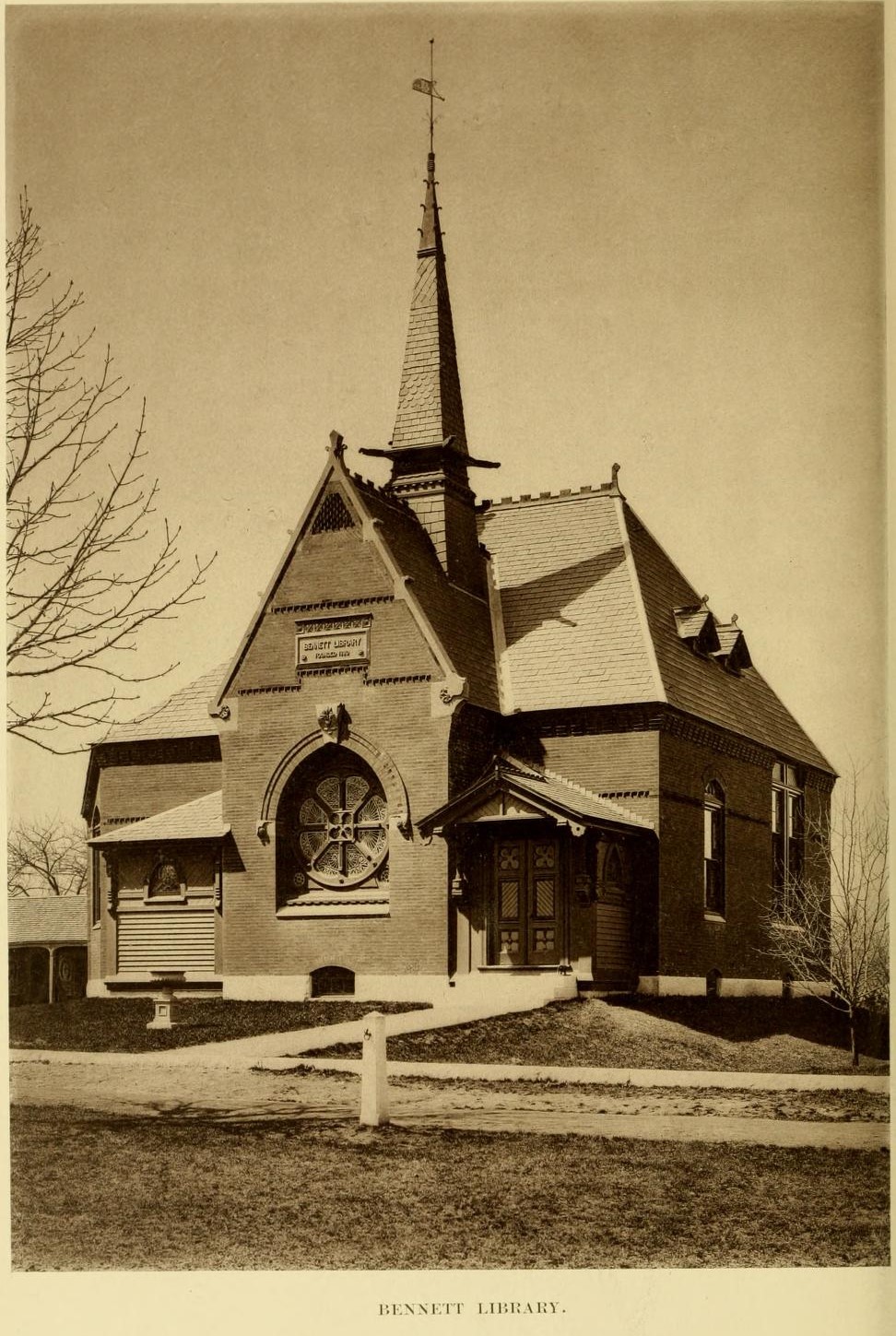
In the late 19th century, Eleanor Richardson Bennett (1794-1891), the widow of Joshua Bennett (1793-1865), bequeathed funds to erect the first purpose-built public library building in her hometown of Billerica, Massachusetts. A private members library known as the Social Library, was formed in Billerica in 1772, but Ms. Bennett wished to gift the town a public facility of learning in memory of her late husband, a prominent landowner in the West End of Boston and one of the richest men in Middlesex County. Eleanor Bennett hired the Boston firm of Rotch & Tilden, to design the new library building overlooking the Town Common. Completed in 1881, the Victorian Gothic library is built of brick with limestone trim, and features a large rose stained glass window, intricate terracotta and wooden detailing, and a slate hipped roof with a pointed spire. The library was eventually outgrown and the facility relocated to a new building, and again to the former Town Hall building in 2000. The former Bennett Library is still owned and maintained by the town as an event space available for rent. The building has been restored through Community Preservation Act funding.
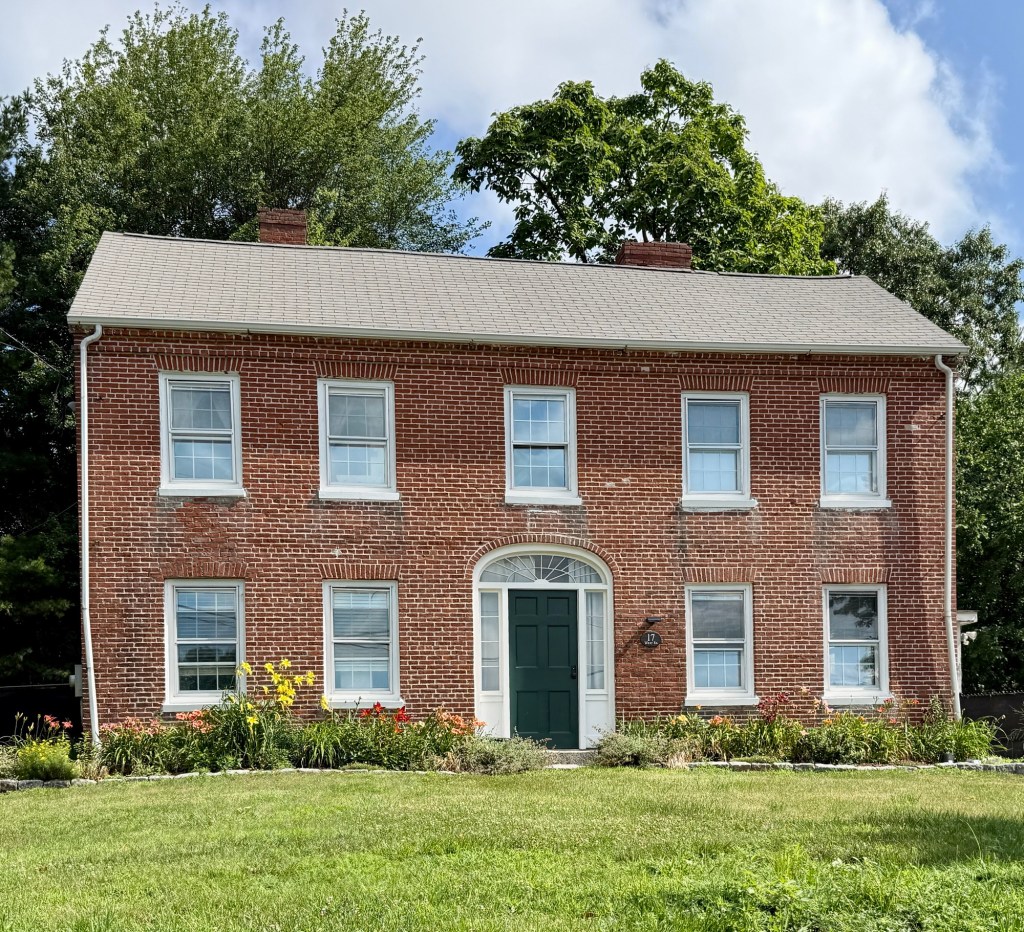
The Asa Hill Farmhouse in Billerica, Massachusetts, stands as a rare extant Federal style residence constructed of brick in the community. Asa Hill (1798-1874) was born in Billerica and in 1822, married Susan Lawrence of nearby Concord. The couple purchased land near his childhood home and had this two-story residence built to raise his family and farm the land. The couple raised four children here and operated a small farm until they moved away in their later years. The Asa Hill Farmhouse is constructed of brick laid in common bond and is notable for its center entrance with arched fanlight transom and sidelights.
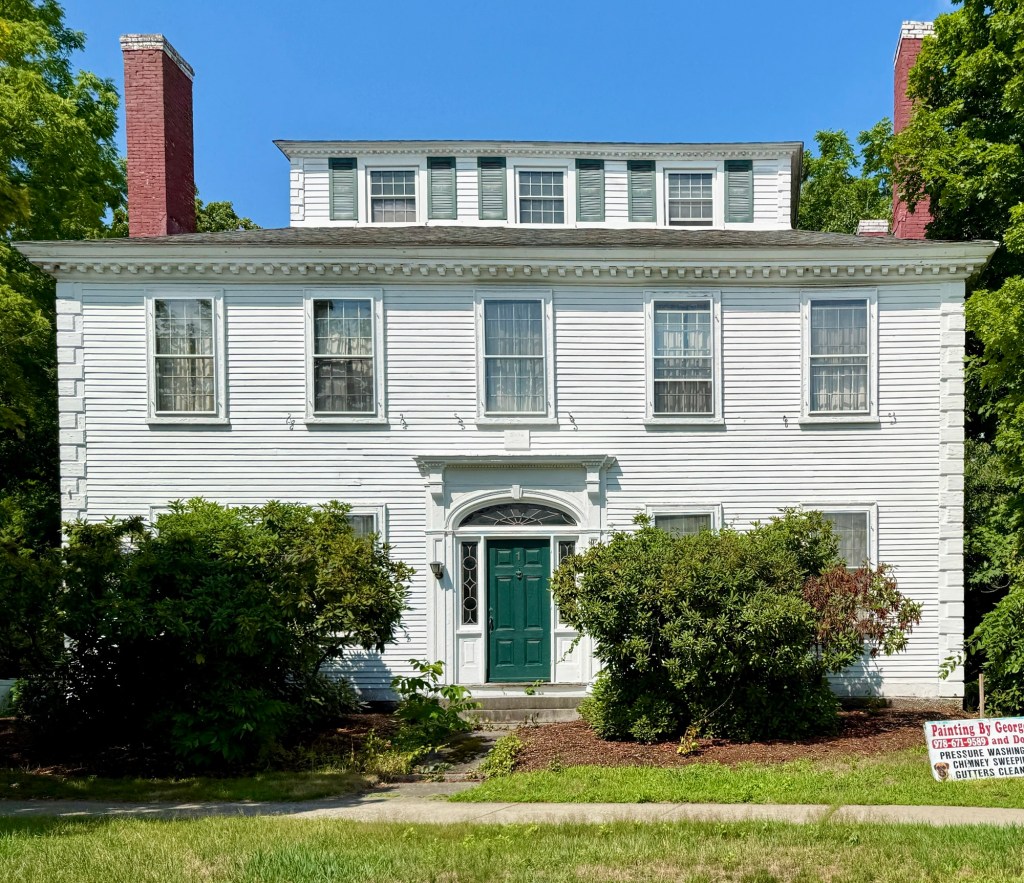
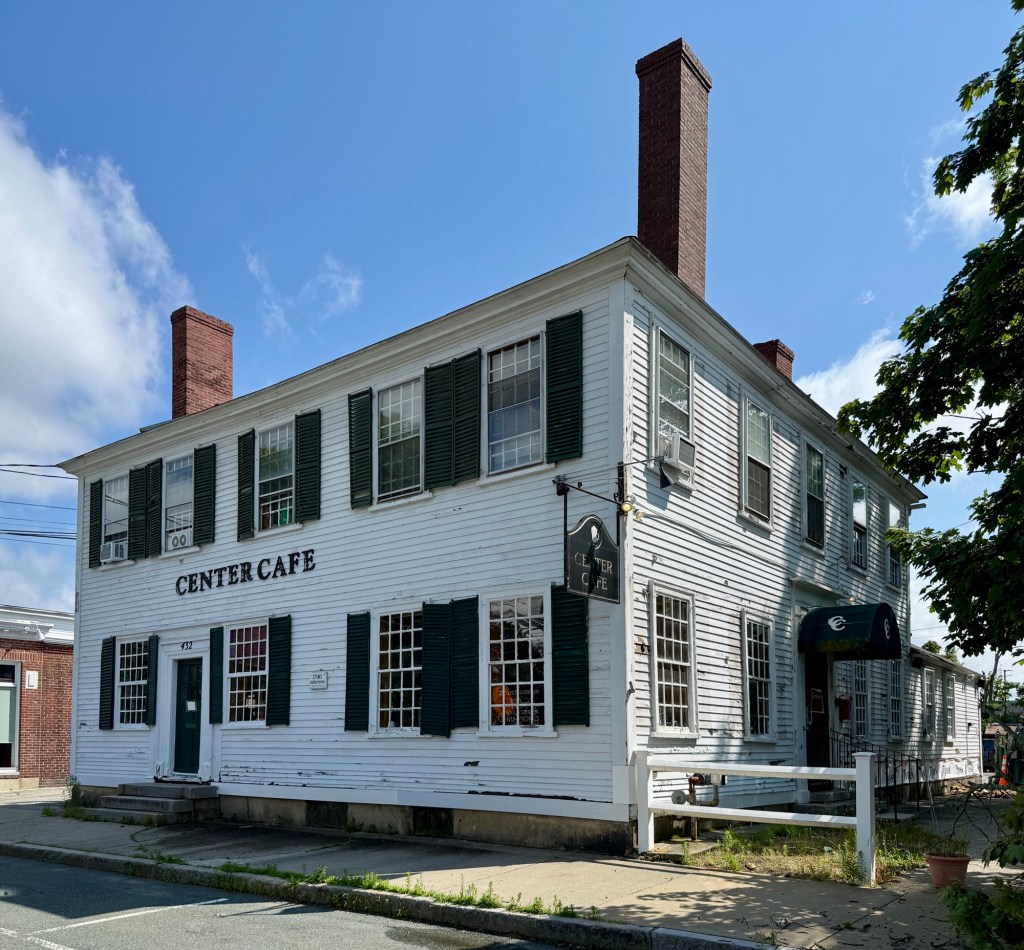
The Abbott-Bowers House at on Boston Road in Billerica Center was built in 1796 and stands as a significant Federal period residence in town, though suffers from deferred maintenance. The building was constructed for James Abbott, a merchant who likely operated a store from the street-side entrance. The property was owned later by Jonathan Bowers, the first Postmaster in Billerica and his home served as the Post office for over 100 years. Many other organizations and committees have also been run out of the building. The residence is five-bays wide on all elevations and has a hipped roof with tall end chimneys and what appear to be the original windows. The building recently sold and is planned for a new commercial use, hopefully with a restoration of the exterior.
Located on the edge of the Town Common in Billerica, Massachusetts, this handsome civic building stands as one of the community’s best examples of the Colonial Revival style. The building was constructed in 1895 to replace the mid-19th century Town Hall that was destroyed by fire in 1893. The community hosted a design competition, where prominent firms from the Boston area submitted designs, and ultimately selected the plans from the firm of Warren & Bacon, led by Herbert Langford Warren and Lewis H. Bacon, who had a short-lived business partnership lasting just one year. The symmetrical, two-story brick building is trimmed with limestone and capped with a gray slate roof. The facade is embellished with a Palladianesque arched loggia sheltering the entrances with a centrally placed Palladian window above on the second floor. Additionally, the roof is adorned by a Christopher Wren inspired cupola with a gold leaf dome capped with a weathervane. The building functioned as the Town Hall with offices and a grand hall on the second floor for city meetings until the town hall relocated in 1979 to a former school building. Since 2000, the former Town Hall of Billerica has housed the Billerica Public Library, which was formerly located in a smaller historic building nearby.
The town of Billerica was originally settled by colonists in 1640, but the area west of the Concord River was not settled until after 1690. This saltbox Colonial house built around 1696 is believed to be the oldest house in town west of the river. The residence was built by Samuel Manning (1644-1711) as his homestead. Between 1752 and 1800, the Manning family operated a tavern out of the rear portion of the house. In the later years of the 18th century by the family of William Manning, a veteran of the Revolutionary War, who after the war, began to believe that his military service meant little to the American ruling class. He wrote the anti-Federalist ‘The Key of Liberty” in 1798, arguing that the goal of the “Few” was to distress and force the “Many” into being financially dependent on them, creating a continued cycle of dependence to the elite class and government. In the late 19th century, this old saltbox Colonial house began to deteriorate, until the 1890s, when descendant of its original owner, and landscape architect, Warren H. Manning, spearheaded family efforts to restore the property. As a prominent landscape architect, Manning purchased not just the house, but the surrounding lands that formed the basis of Manning State Forest, protecting both. Manning conducted a carefully documented restoration of the house in 1899, and made it his summer home. A family association was eventually formed to take over the property, which leases the old home to a local pub and restaurant. The house faces south, away from the street and the kitchen ell off the side of the house does detract from the building, but it remains a significant early building from the settlement of Billerica.
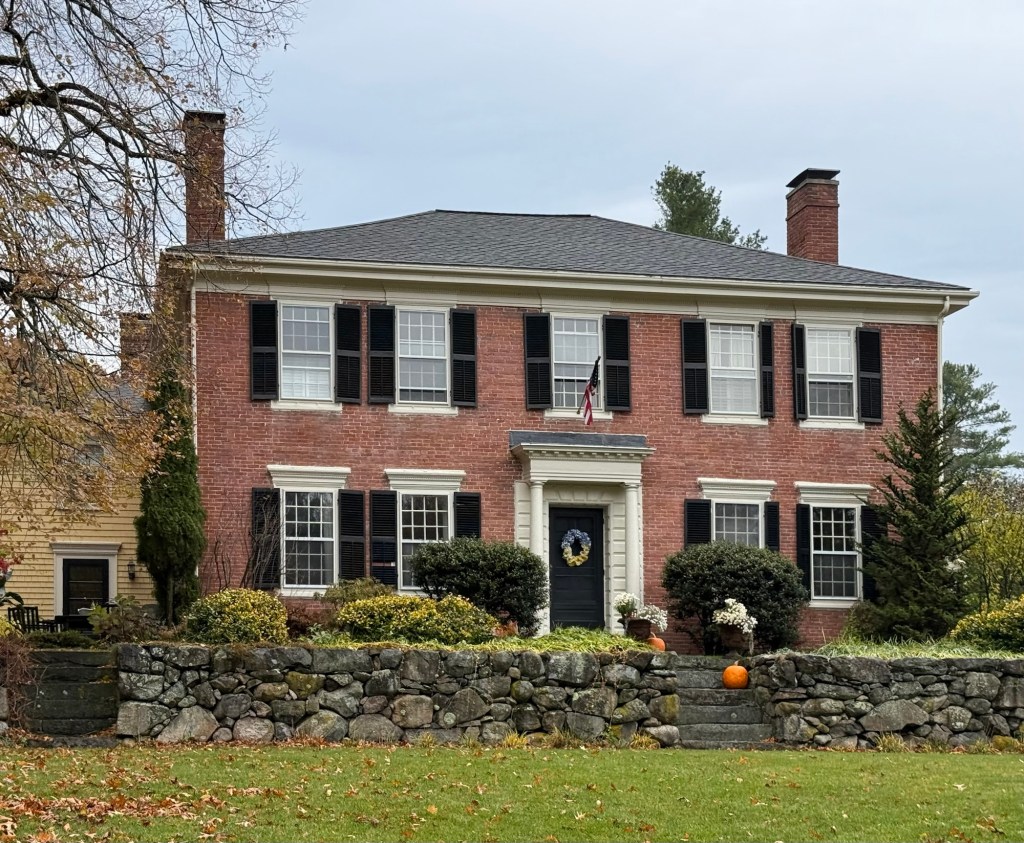
Another stately old home on Glezen Lane in Wayland is this brick, Federal style country mansion located across from the town Training Field. This residence is said to have been built by a Nathaniel Gleason (Glezen) and later inherited by a family member, Abel Glezen (1803-1890) who farmed the 55 acres of land and was a local politician. In 1900, as Wayland shifted from rural community to a desirable Boston suburb for summer residences, the Gleason House was purchased by Henry W. Patterson, who was in his late 20s when he bought this country house. Henry inherited his father’s estate and married Jane Harrington Adams from Massachusetts. The couple spent only a couple years here until Henry died in 1907 at just 35 years old. Jane, his widow, remained here until her death in 1950. The estate was subsequently subdivided and remains one of the finest homes in the community.
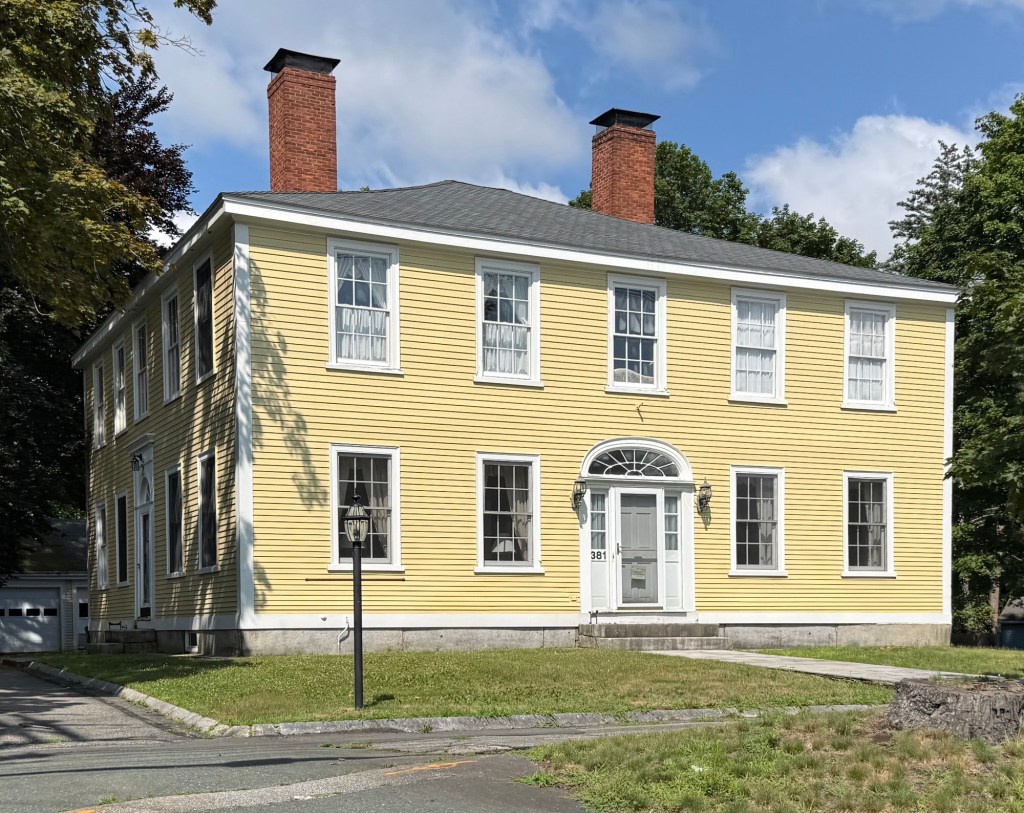
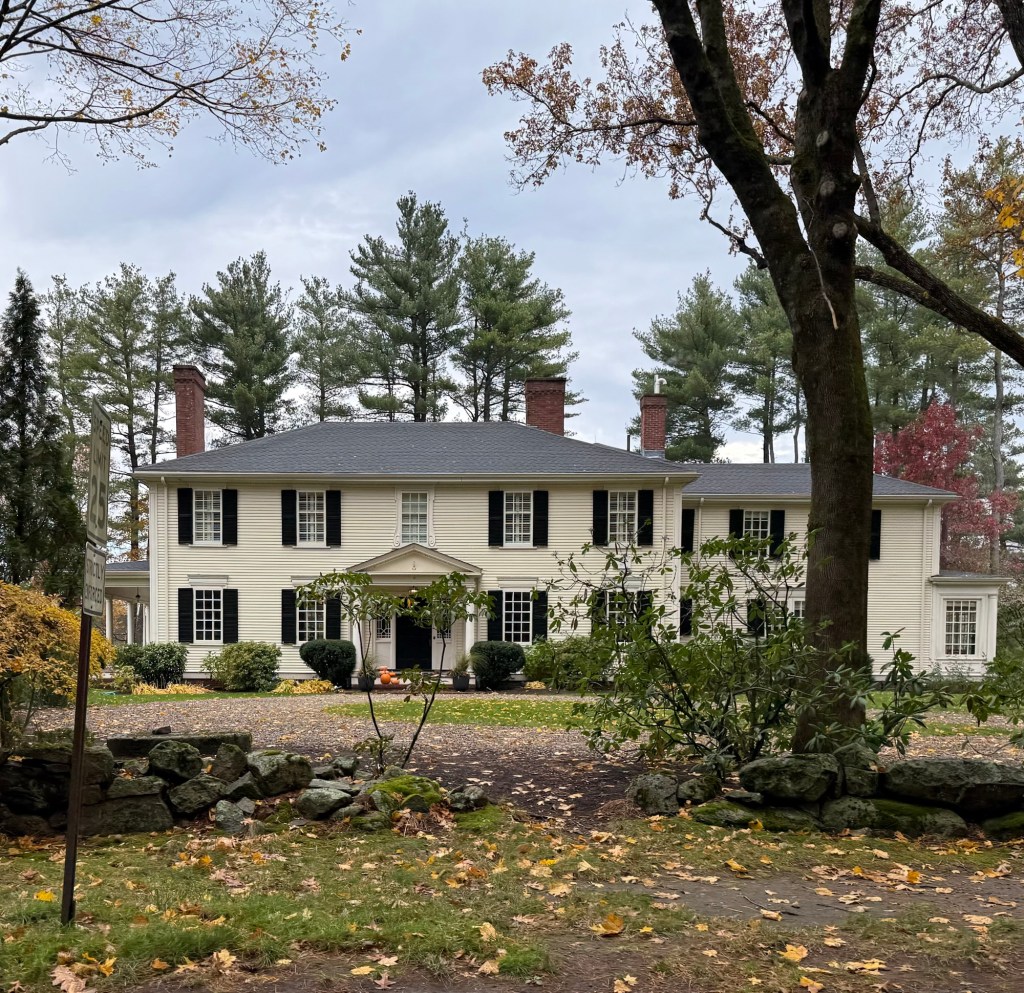
Built in 1805 by Isaac Gleason (Glezen), this Federal style mansion was later expanded in the early 20th century in the Colonial Revival style as Wayland became more of a wealthy Boston suburb. Located on the appropriately named Glezen Lane, this house was constructed for Isaac Glezen (1769-1843), who farmed the land here. Other family members built homes nearby. As Wayland shifted from rural community to a wealthy Boston suburb in the early 20th century, the property was purchased by Charles Ashley Hardy and his wife, Alice. The couple would sell the property in 1918, which comprised of 89-acres of land and a chauffeur’s residence, was purchased by Albert H. Beck, a New York banker. The property was later subdivided and consists of many other large, single-family homes.
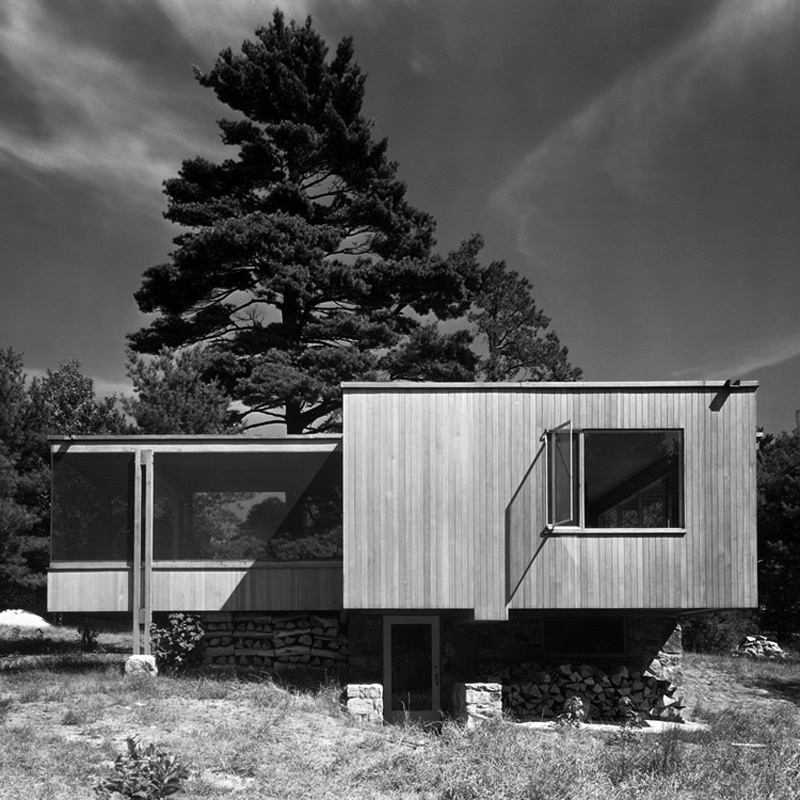
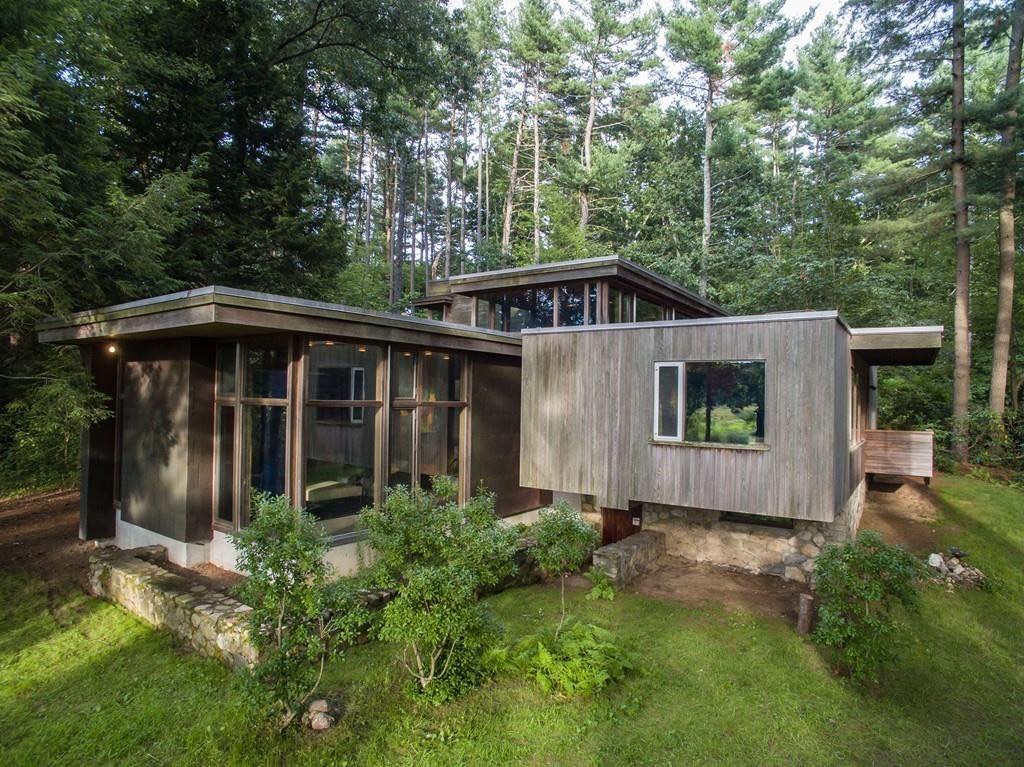
Nestled into the forests of Wayland, Massachusetts, one of the most significant examples of early Modernist architecture, the Chamberlain Cottage, represents the European Bauhaus style adapted to the American landscape and New England vernacular. Designed in 1940 and completed in 1941, the house was commissioned by Harvard Economics professor, Henry Chamberlain and his wife, Margareth, as a weekend retreat from Cambridge. Professor Chamberlain commissioned Marcel Breuer and his mentor, Walter Gropius, then Dean of the Harvard Graduate School of Design, to design a home with a specific request for a screened porch similar to Gropius’ residence in nearby Lincoln. For the Chamberlain Cottage, the design responds to the uneven terrain and the potential for river flooding by two distinct parts: a grounded stone base and a cantilevered wooden volume above. The lower stone level functioned as a foundation while providing storage for a canoe and housing a fireplace that extends vertically through the structure; with the upper wooden volume containing living spaces. Despite its compact size for weekend visits, the upper level is well planned and includes a living space, kitchen, a single bedroom, and the porch. Due to its small scale and siting, the one-bedroom cottage was not easily adaptable for modern living. After falling into disrepair in the 1980s and ’90s, the home was purchased by architects Sidney R. Bowen and Angela Watson, who expanded the structure over the course of a decade to its current size of 3,742 square feet. It has been occupied and lovingly maintained by later owners. It remains a private residence.