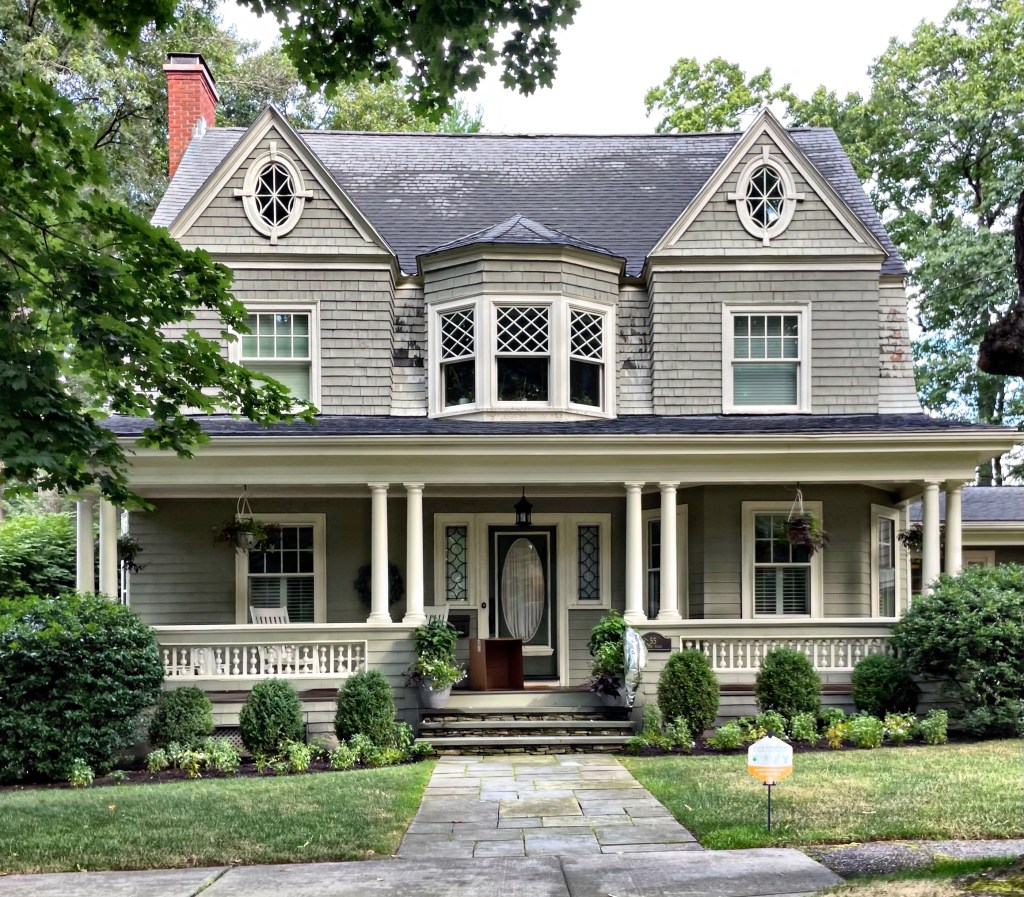
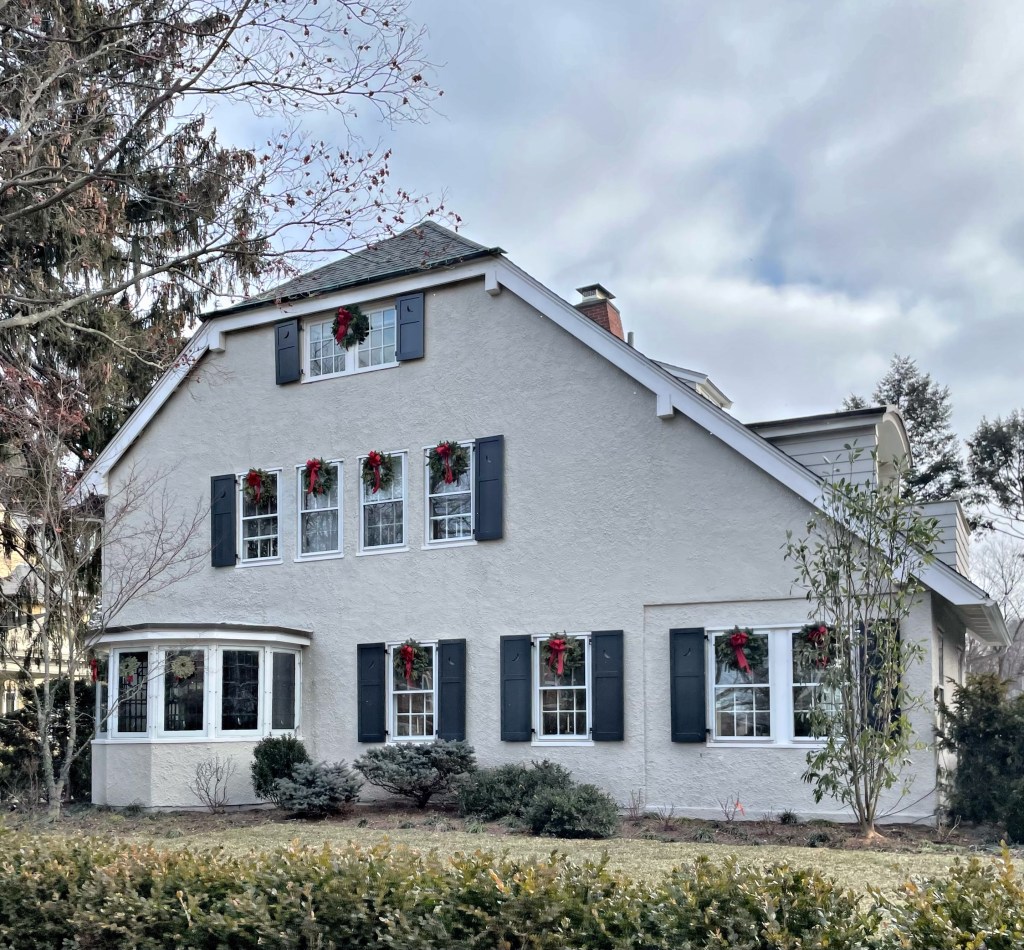
In 1907, William F. Lamont and his family moved into this beautiful turn-of-the-century home in the rapidly developing Waban Village in Newton, Massachusetts. The extension of the circuit railroad connected this part of Newton (which had previously been farmland) to Downtown Boston, opening up the area to development for middle-income families who sought land and fresh air in the suburbs. The first house on Alban Road in Waban was built for the Lamont Family, and it perfectly blends multiple architectural styles under a gambrel roof.
This tiny building next to the John Palmer House featured previously was built in 1854 by Thomas Snow as an income-producing property. According to the sign, Snow was a grocer in town and must have rented the small building, which was developed on a small sliver of land, formerly a side garden. I’d guess that the building was originally 1 1/2-stories with the brick first floor added underneath sometime later. The house is vernacular Greek Revival in style and the scale is exactly what makes Marblehead so charming to get lost walking in!
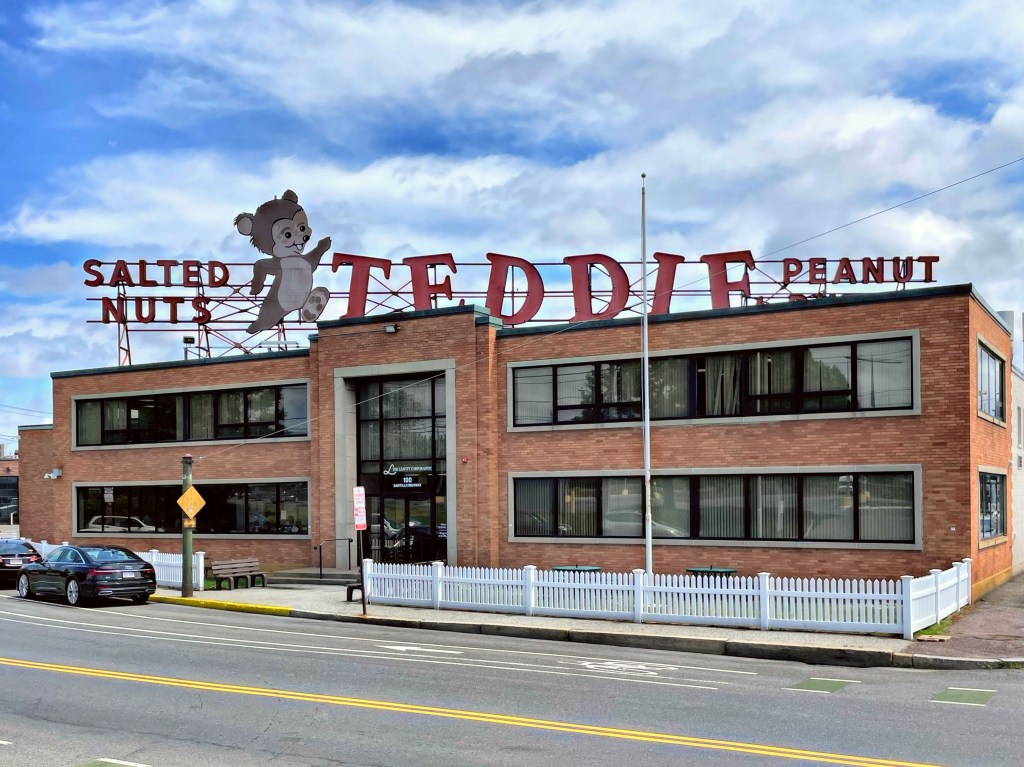
One of the most iconic buildings in Everett, Massachusetts is the “Teddie Peanut Butter” building, in the brewery/distillery district of the city (home to Night Shift Brewery, Bone Up Brewing Company, and Short Path Distillery). The building is best-defined for its massive Mid-Century rooftop sign with the cute teddy bear. The building was constructed by the Leavitt Peanut Butter Company in 1958, but the company had its beginnings nearly a half-century earlier. The Leavitt Corporation had its beginnings in 1897 when Sarkis Shaghalian, a European immigrant, started manufacturing candy and roasted nuts in Boston. In 1916, Michael Hintlian took over the company and in 1925, established a separate corporate entity specializing in peanut and nut products, the John W. Leavitt Company. The company did extremely well in its Boston location, eventually outgrowing their State Street buildings. In 1959, the company hired an industrial realtor, who found the Everett facility – a recently constructed building with Modern finishes and design. In 1959, Leavitt Corp. signed a lease and moved in by 1960, adding the rooftop sign at that time. The sign used to have neon strips, but was eventually removed.
Located next door to the First Congregational Church of Everett, you can find one of the finest eclectic commercial buildings in the region, and it is one that is often overlooked. The Everett Savings Bank was built in 1930 from plans by architect Thomas Marriott James for the Everett Savings Bank, which was established in 1889. This building was constructed just at the beginning of the Great Depression, at a time when banks and American citizens were penny pinching. The budget was likely set before the Stock Market Crash of 1929 as the relatively high-style bank building would have been a big expense at the time. The bank blends Art Deco and Spanish Renaissance Revival styles elegantly. The structure is constructed with sandstone walls that are decorated with figured panels and semi-circular multi-pane windows are outlined by rope molding. Crowning the building is a bold arcaded frieze with Moorish inspired cornice. Swoon!
While Everett’s population had remained small compared to nearby towns throughout much of the nineteenth century, its close proximity to Boston resulted in dramatic population growth between 1885 and 1915. During this late industrial period Everett’s population was one of the fastest growing in the state, doubling between 1870 and 1880, nearly tripling from 1880 to 1890 and doubling again between 1890-1900. The City of Everett immediately went about erecting a new schoolhouse to educate its youth. Architects Loring & Phipps were retained to prepare plans for the new high school. Ground was broken in August 1892 and the building was dedicated just over a year later in September 1893. The school was opened to 175 students on Monday, October 2, 1892 with a capacity of 550 students (as it was realized that the city would continue to grow). The building is high-style Queen Anne with red brick and mortar and light sandstone trimming. In 1905, the capacity of the high school was nearly doubled by the construction of an addition on the west end of the original building. Even doubling the size of the school did not prove adequate as the building was outgrown less than a decade later. From this, the Second Everett High School was built a block away. The First Everett High School is now known as the Whitney Lorenti House, a low income, elderly housing complex.
In the early 1780s, Leonard Proctor and Salmon Dutton and their families, moved from Massachusetts and settled in present-day Cavendish, Vermont and gave their names to the two major settlements on the Black River, Proctorsville and Duttonsville. Leonard Proctor was born in Westford, Massachusetts and fought in the Revolutionary War at a young age. He settled in Cavendish in 1782 and built a modest house/tavern, and underwent developing the village in his name, Proctorsville. By the early 1800s, Leonard was a highly esteemed member of town and had the funds to erect the finest Federal style manse in the village, to showcase the stability and wealth of his community. The home exhibits scalloped cornice moldings and the carved wood flowering vines springing from urns on the upper pilasters that have a folk/Federal quality that stands out as a very unique design detail. Carved Adamesque bell flowers that flank the door suggest Asher Benjamin’s Windsor influence. Elliptical sunbursts above the pilasters, elaborate guilloche friezes, and the broad semielliptical attic light have a later Federal character. It is possible that Leonard had this house built, and it was “modernized” by one of his heirs.
Portsmouth, New Hampshire is one of the most charming towns in New England to explore by foot, largely due to its walkable network of streets and tight blocks filled with preserved Revolution-era homes. Like many other cities all over the region (and nation), Portsmouth was hit by Urban Renewal, a planning tool used nationwide to provide Federal funds to address “urban blight” and revitalize downtown cores after decades of suburbanization and loss of tax revenue. An urban renewal district for Portsmouth was its North End neighborhood, which similar to Boston’s, was home to a vibrant Italian-American population.
In 1964, federal funds were allocated to the North End project area in Portsmouth, for urban renewal. Prior to redevelopment, the North End was a mix of residential and commercial buildings, with many older houses converted into storefronts with apartments above. In the mid-1960s, the area was considered overcrowded, run down, and a fire hazard. As a result, the Portsmouth Housing Authority proposed the destruction of approximately 200 buildings, a school, and a church and redevelopment for commercial, industrial, and public use, rather than for residences. The project would displace approximately 300 families as a result. In 1968, Portsmouth Preservation Inc., a preservation organization was formed to attempt to save some of the historic building stock in the area slated for redevelopment. After bitter fighting and preservation advocacy, just fourteen houses were saved and mostly moved to an area known today as “The Hill”. This building is one of them. It was constructed around 1725 for Rev. Jabez Fitch, the new minister of the North Church in town. Fitch graduated from Harvard College in 1694 first settling in Ipswich, MA, before becoming minister of the North Church in 1724, a position he held until his death in 1746. The house was one of the few in the urban renewal area to not have been moved.
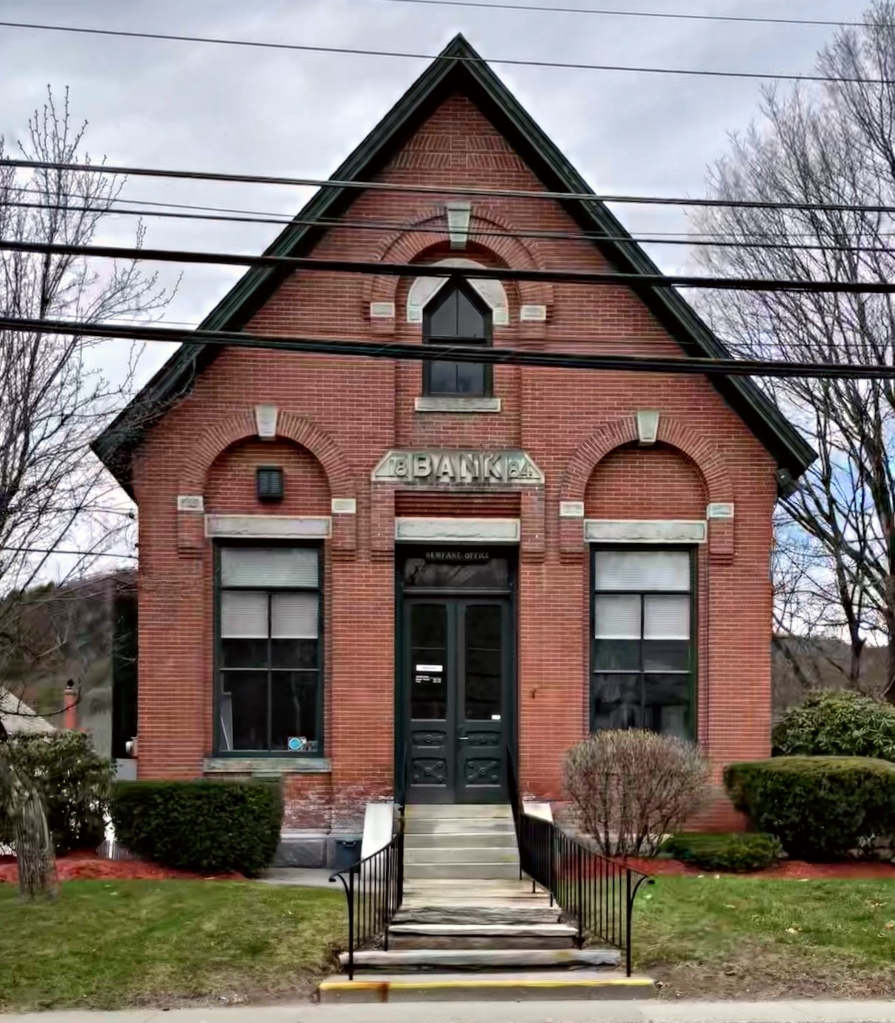
One of the few brick buildings in Newfane’s Village Center is this charming old bank, right on Main Street. The building was constructed in 1884 as the Vermont National Bank and is a vernacular example of the Romanesque Revival architectural style with the arched openings and brickwork. Vermont architect George A. Hines designed the modest building, which was built for $6,650. The bricks for the building were brought into town by ox cart. Those for the front facade cost 5 cents apiece; those for the sidewalls 3 cents; and those for the back wall 2 cents, showing how the best materials go on the highly visible facades.
Built in 1850, likely as a late-Greek Revival or Italianate style home, this property on Main Street in Ridgefield was completely “modernized” in the 1880s in the Queen Anne style popular at the time. The home was originally built for Francis Asbury Rockwell (1818-1881), a tin-smith, wine-maker and inventor who married Mary Lee Everest, who also had deep roots in the community and was a daughter of a local Revolutionary War captain. The couple built a home on Main Street and raised their children there until Francis and Mary died in 1881 and 1883 respectively. The family home was inherited by their eldest son, Charles Lee Rockwell, who became the director of the First National Bank in town. Charles updated the house to give it the Queen Anne Victorian flair we see today.
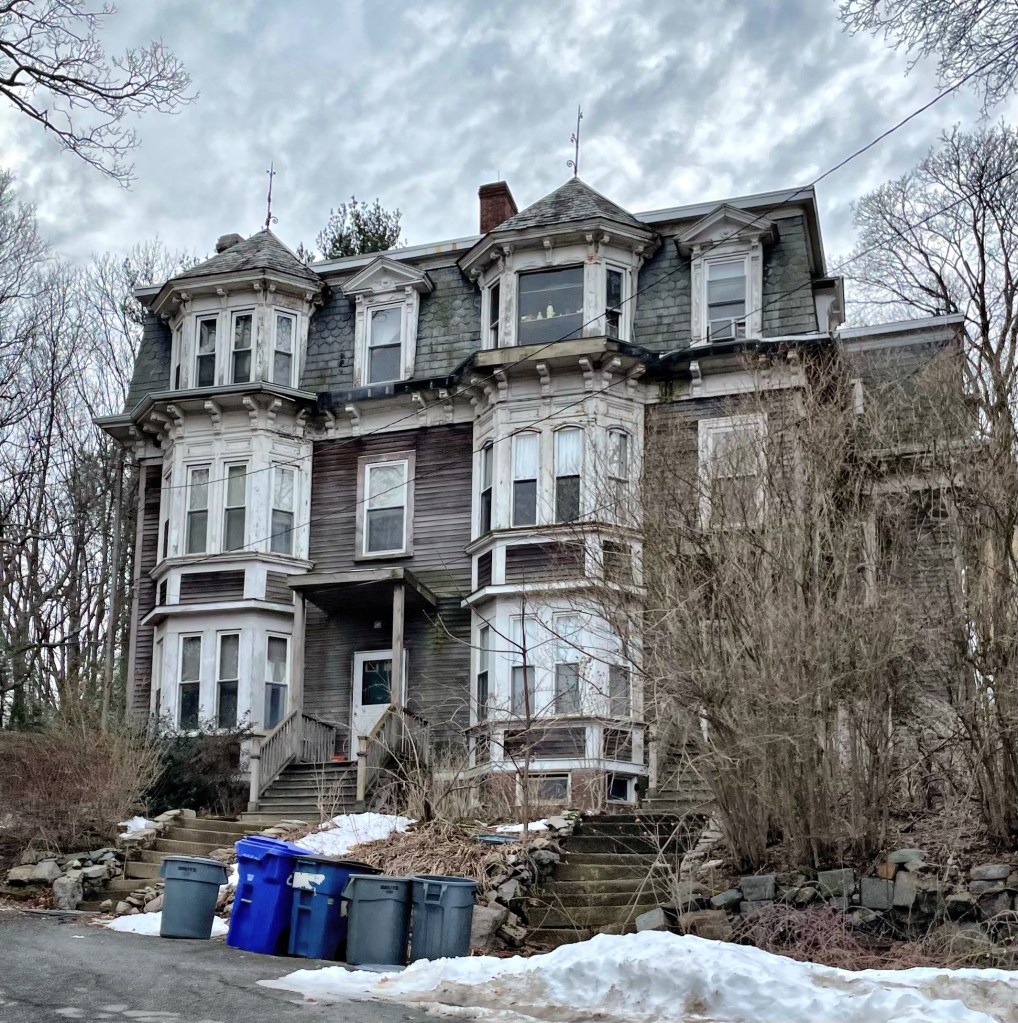
Isaac Harris Cary’s land holdings adjacent to Forest Hills Cemetery in Jamaica Plain, Boston, saw a surge in value when the cemetery and Forest Hills Station were constructed, opening up the area for development. After Isaac’s death in 1881, his unmarried daughter Susanna, built this large Second Empire style building contributes to the varied 19th century architecture of the street. This double-house was constructed around 1884, seemingly as a rental property which provided Susanna income while residing nearby. The two units suffer from some deferred maintenance, but are excellent examples of the Second Empire style in a double-house form.
In 1875, William C. Strong, a nurseryman from Brighton, MA, purchased the 93-acre Staples-Craft farm in Newton. He established a large nursery on the grounds and promoted construction of the Circuit Railroad, which connected the rural section of Newton to the Boston and Albany rail line in 1886, thus establishing the village of Waban. Due in great measure to the efforts of Strong and other developers, Newton’s youngest village grew rapidly as the once isolated farm area gave way to a vibrant suburban community. He built commercial structures and people began to flock to the village, for the new housing and easy-access into Boston by rail. Strong had a house built by architect Herbert Langford Warren in 1896 and lived there for years before having this house built in 1907, when William was 83 years old. The house was occupied by Strong for just a couple years until he moved away to Manhattan. The Arts and Crafts style home was purchased by Esther Saville Davis.
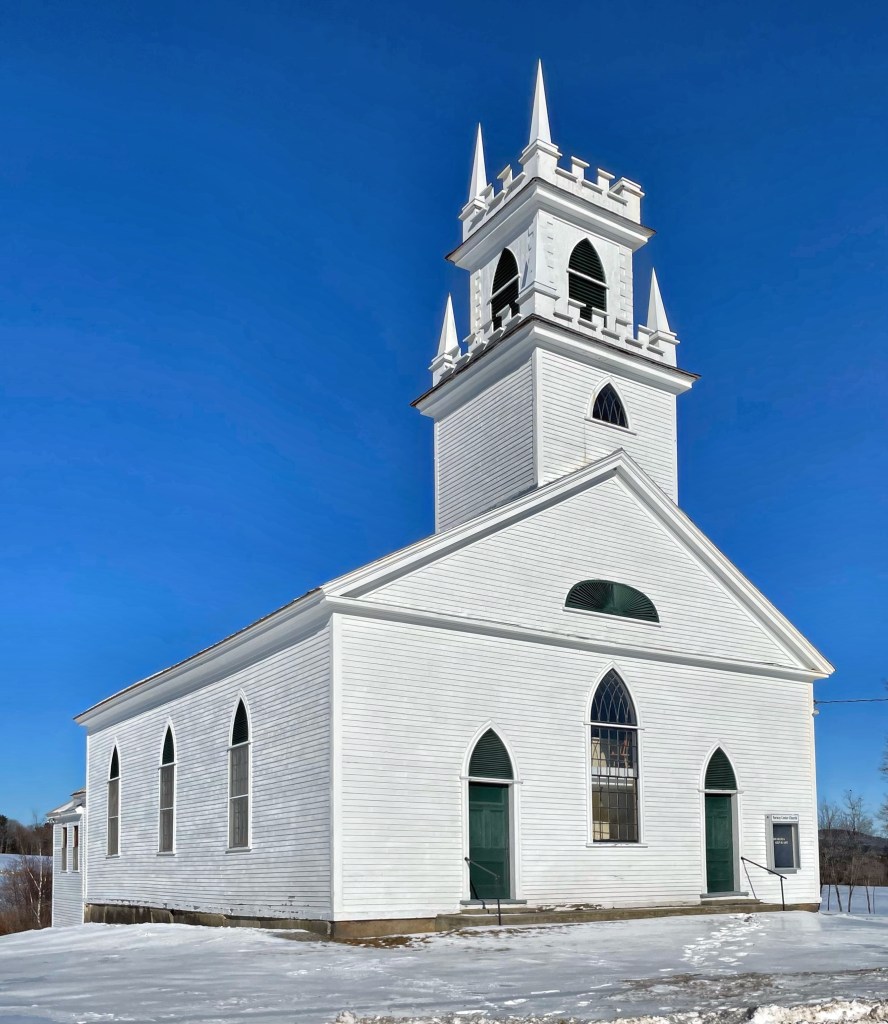
This beautiful, bucolic church in Norway Center was built in 1840 to replace an earlier meeting built in 1808-09 on the site. The present building is Gothic Revival in style with louvered panels making the windows appear lancet in shape and the amazing lancet window centered on the facade. The two-tiered tower is ornamented with crenellation and a wooden spire at each corner (besides one missing). The church features a louvered fan and strong pediment, which are nods to other prominent styles of the early-mid 19th century, Federal and Greek Revival respectively. This church quickly saw membership drop as Norway Village became the population center of town, with Norway Center becoming more agricultural and rural.
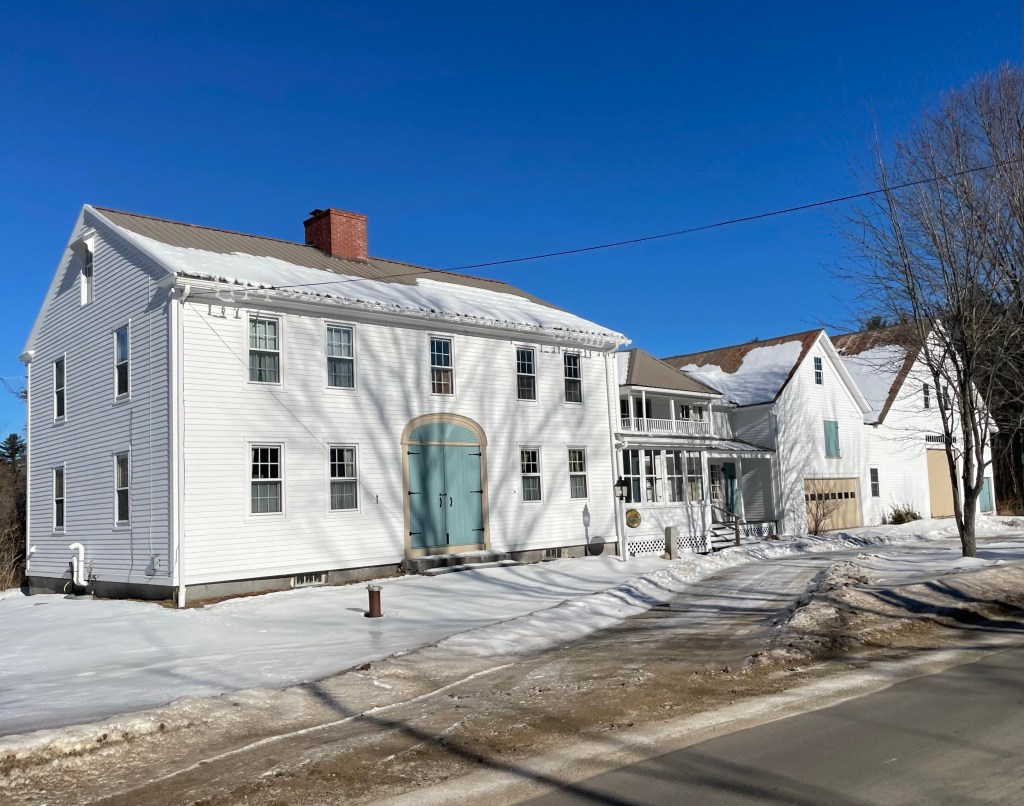
In 1820, just seven years after the incorporation of Sweden Maine, a homesteader, Amos Parker purchased fifty acres of land and began to erect a two-story, Federal house with a center chimney and a detached store beside it. Plagued by debt, Parker sold the unfinished house to Samuel Nevers circa 1833–1835, who purchased the property with the store for his recently married son, Benjamin. By 1860, Benjamin Nevers had a successful store and prospering farmstead. Benjamin died in 1883, and in the next two years, their daughter Charlotte, and her husband, Charles Bennett, dramatically remodeled and modernized the farmstead, adding a connected two-story ell building outward from the main house toward the old 1840 barn, connecting the entire property. I believe that the property remains in the Nevers-Bennett Family, as recently, Steve and Judy Bennett, recently negotiated an easement with the Maine Farmland Trust to protect their hay, beef, and maple sugaring acreage as farmland into the future.
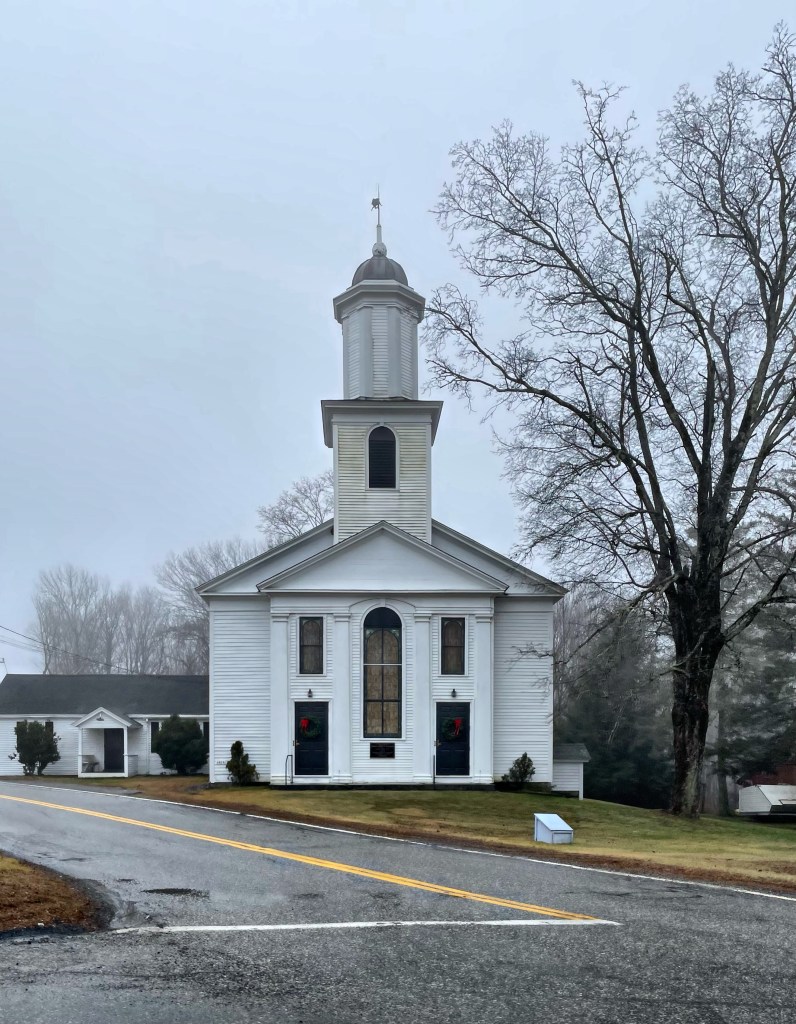
The Baptist Meetinghouse in Willington was built in 1829 by a local carpenter Albert Sharp, in a transitional Federal/Greek Revival style, common for the period. Its clapboarded facade has a projecting pavilion with two entrances flanking a two-story round-arched window. Four pilasters are surmounted by a wide entablature and the flushboarded pediment of the pavilion. Round-arched windows are repeated on the side elevations and the belfry, which is topped by an octagonal drum and a small dome. The Willington Baptist Church was organized in 1828, started by Rev. Hubbell Loomis, the fourth pastor of the Congregational Church across the common. Rev. Loomis was prominent both as a minister and an educator, and founder of Shurtleff College of Illinois. During his pastorate at the Willington Congregational Church, Mr. Loomis had strong tendencies toward Baptist sentiments. From this, membership of the congregational church split, some leaving for a new Baptist belief and others remained at the congregational church. The two congregations were split until 1911, when they again worshiped under the same roof, as the Federated Church of Willington, meeting in this building.
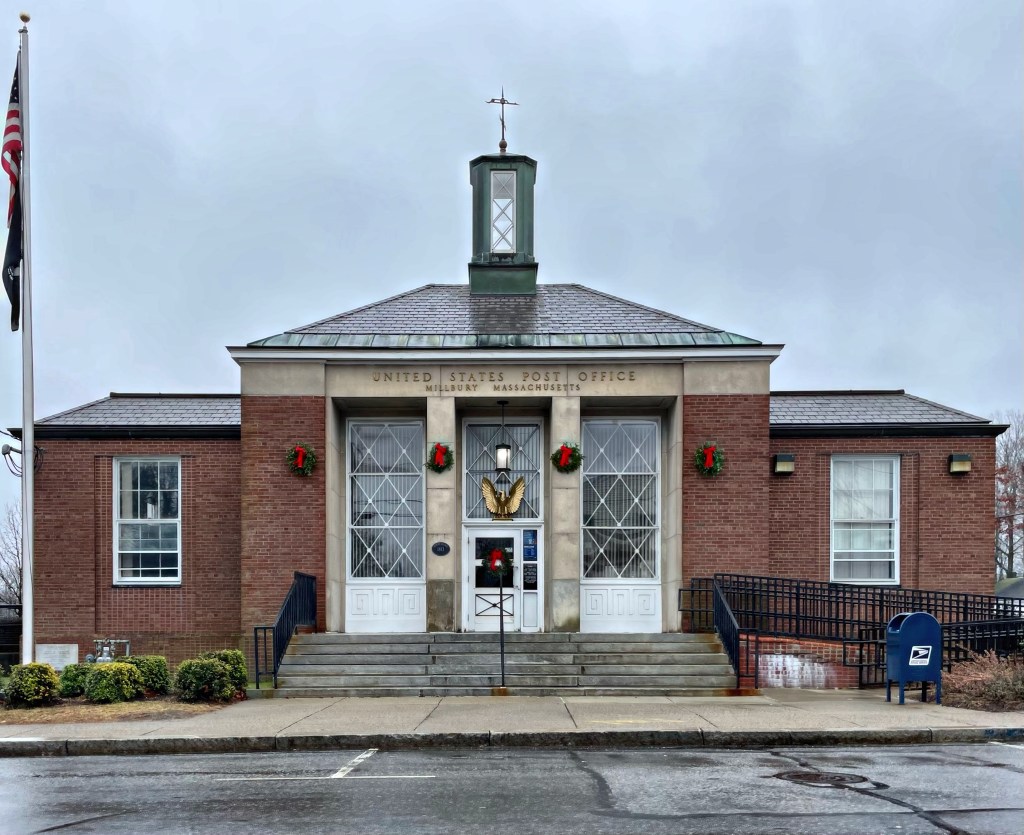
Located in downtown Millbury, MA, the town’s local post office stands as a great example of Art Deco and Colonial Revival architecture styles, showing how well different styles can be incorporated into a single, complimentary design. The Millbury Post Office building was constructed in 1940 from plans by Louis Adolph Simon, who served as Supervising Architect in the Office of the Supervising Architect for the U.S. Treasury from 1933 until 1939, when the office was moved to the Public Works Administration / Works Progress Administration. The post office was designed at the tail end of the New Deal programs to help stimulate local economies by building infrastructure and providing jobs to locals. Inside, a mural “An Incident in the King Philip’s War, 1670” was painted by Joe Lasker and installed in 1941 and was “revivified” in 1991.