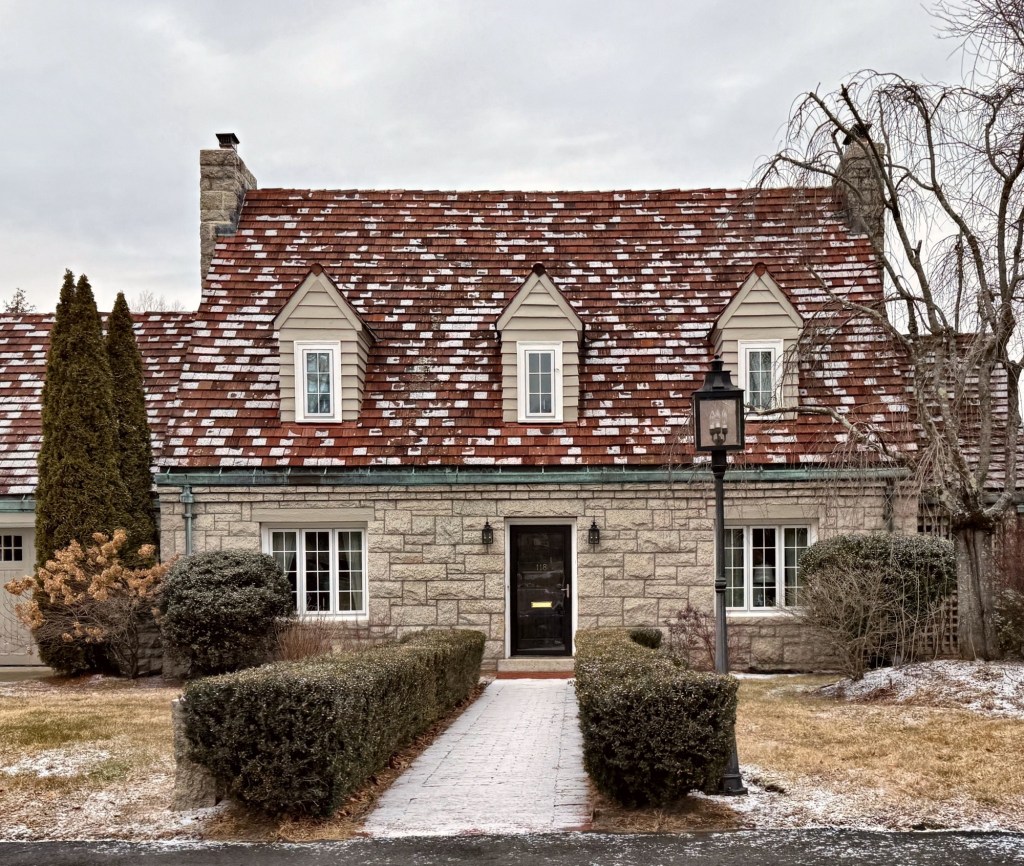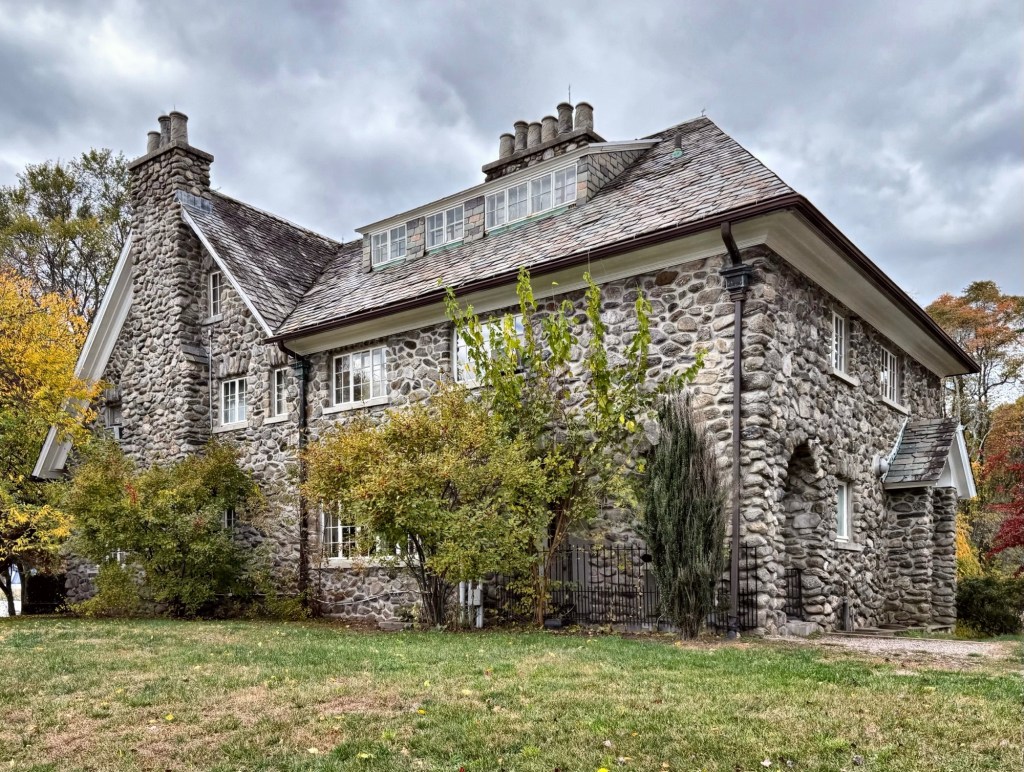
Dr. Byron Freeman Brown (1902-1962) was born in Maine and was educated at Bowdoin College before moving to Boston for medical school. After he graduated, he married and accepted a position as a doctor at Milford Hospital, not far from Hopedale, Massachusetts. Dr. Brown and his wife, Veronica, had this cottage on Adin Street built around 1930. Distinguished by its stone veneer walls and steeply pitched red clay tile roof punctuated by dormers and symmetrical facade, the Dr. Brown House is a great example of a Colonial Revival style house with Arts and Crafts flair built in the inter-war period.
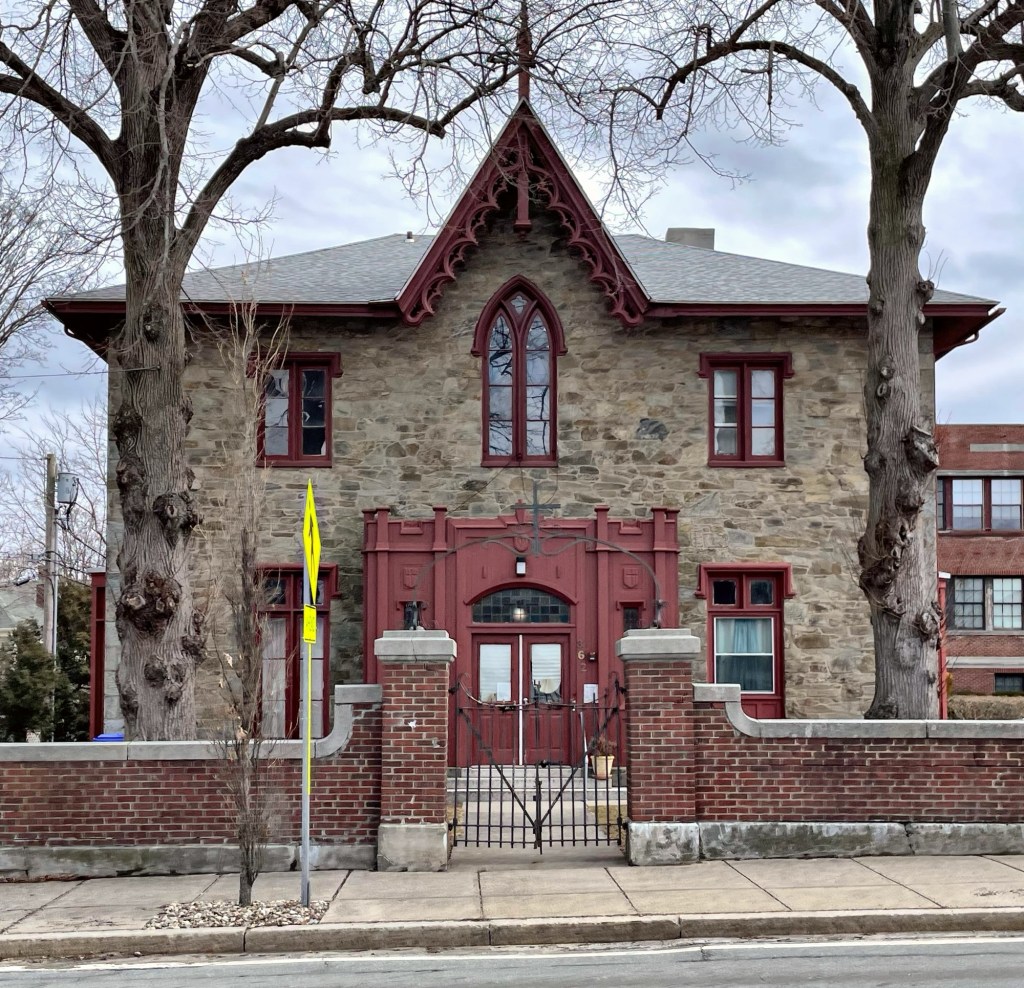
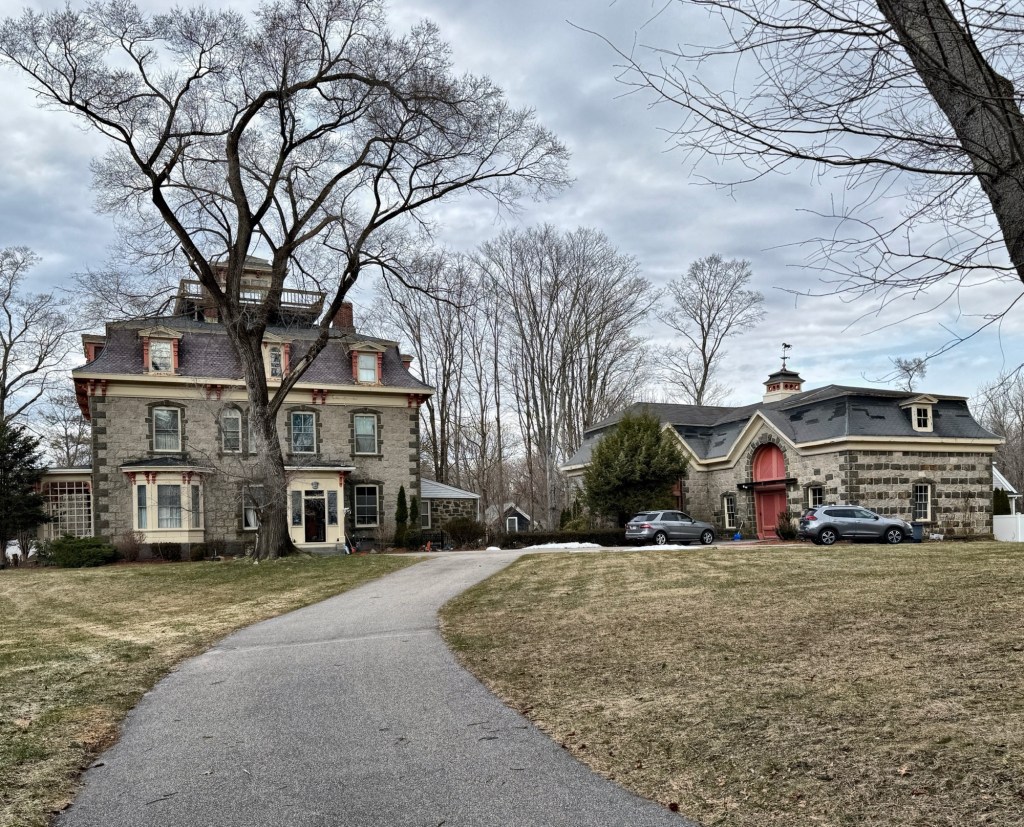
A big departure from the less ornate, yet classically proportioned Georgian and Federal style homes in Warren, Rhode Island, this Gothic Revival beauty on the town’s Main Street stands out for its detail and materiality. Built as a quintessential Gothic “cottage,” the facade of the Dow-Starr House in Warren has also been graced by a three-sectioned Gothic Revival porch as illustrated in Alexander Jackson Downing’s plan books from the 1840s. As completed, this house followed almost exactly Andrew Jackson Downing’s Design II as illustrated in Cottage Residences 1842 ; it differed only in its use of speckled fieldstone over coursed ashlar. The house was later acquired by and used as a convent for the St. Jean Baptiste Church in Warren, who also built a school building behind. The house has seen some alterations, but remains an important architectural landmark of the town.
The Southworth House, also known as the Old Stone House, in Deep River, Connecticut, is a significant example of a stone, Greek Revival style house built for an important local family. The Southworth House was constructed in 1842 for Deacon Ezra Southworth (1803-1859) from stone harvested from one of the Southworth family’s quarries. Ezra was the son of local shipbuilder, Job Southworth who began building ships at the Deep River landing in the 1790s. Ezra Southworth branched off into manufacturing, becoming a partner and patent holder producing ink wells. His son, Ezra Job Birney Southworth (1844-1919), went into business with his father-in-law in shipping and served as a member of the State Legislature twice. In 1882, Ezra Jr. added the wooden ell onto the rear of the Stone House along with the wrap-around veranda and likely the rear barn as well. Ada Gilbert Southworth Munson was Ezra J. B. Southworth’s only child to live to adulthood and inherited the family home. She was a founding member of the Deep River Historical Society and bequeathed her family home to the Society in 1946, who have maintained the significant home here ever since.
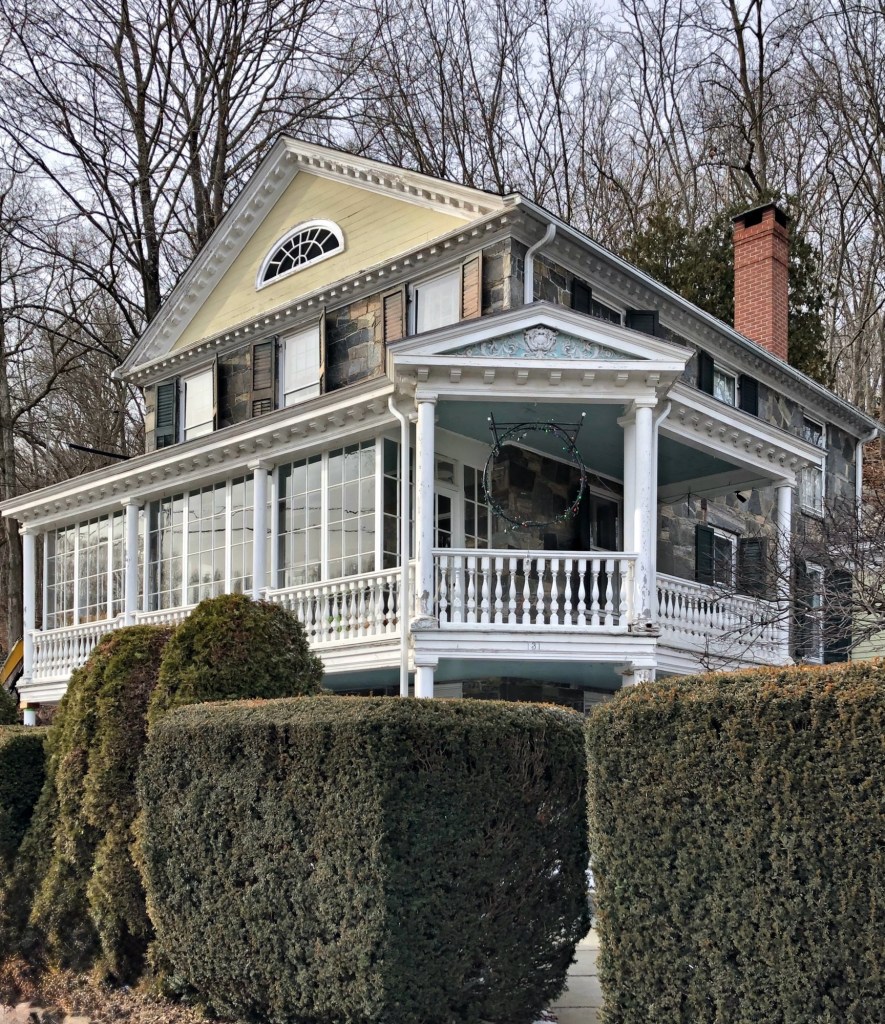
This Federal period stone house with a later Victorian-era porch, is located on Kirtland Street in Deep River, Connecticut, an area dominated by homes built for sea captains and ship builders in the 19th century. Calvin Williams (1785-1833) married Eunice Southworth of Deep River in 1809, and in 1820, built this stately home from granite from the Southworth family quarry. Captain Williams did not get to enjoy his home much as he was often out at sea commanding shipping vessels out of New York. Likely due to failing health, in 1832, Capt. Calvin Williams retired from the sea and returned to his home on Kirtland Street before he died in August of 1833. Federal style features of the house, like the elliptical fanlight and modillons in the gable and a fanlight over the main entry remain, while later alterations after his death include the spectacular enclosed porch from the late 19th or early 20th century.
This handsome stone mansion in Derby, Connecticut, was built by industrialist Walter Randall (1868-1949) and his bride, Olive Vouletti Whitlock Randall (1870-1938), in 1927 on a tract of about 200 acres of farmland. Olive was a granddaughter of Isaac Merritt Singer, the inventor of the first practical sewing machine for home use, which made him one of the wealthiest men in the world. It is unclear as to who the architect was, but the stone residence was built in an English Tudor/Arts and Crafts style, possibly from stones taken from the 200-acre estate. The property was sold in 1950 to Harold and Ida Yudkin, who developed much of the land into a shopping center and housing development, but maintained this stone house and a smaller parcel surrounding it. That smaller parcel was purchased in the 2010s by a developer who restored the old house, and developed a small cul-de-sac of “green” homes on the aptly named, Singer Village Drive.
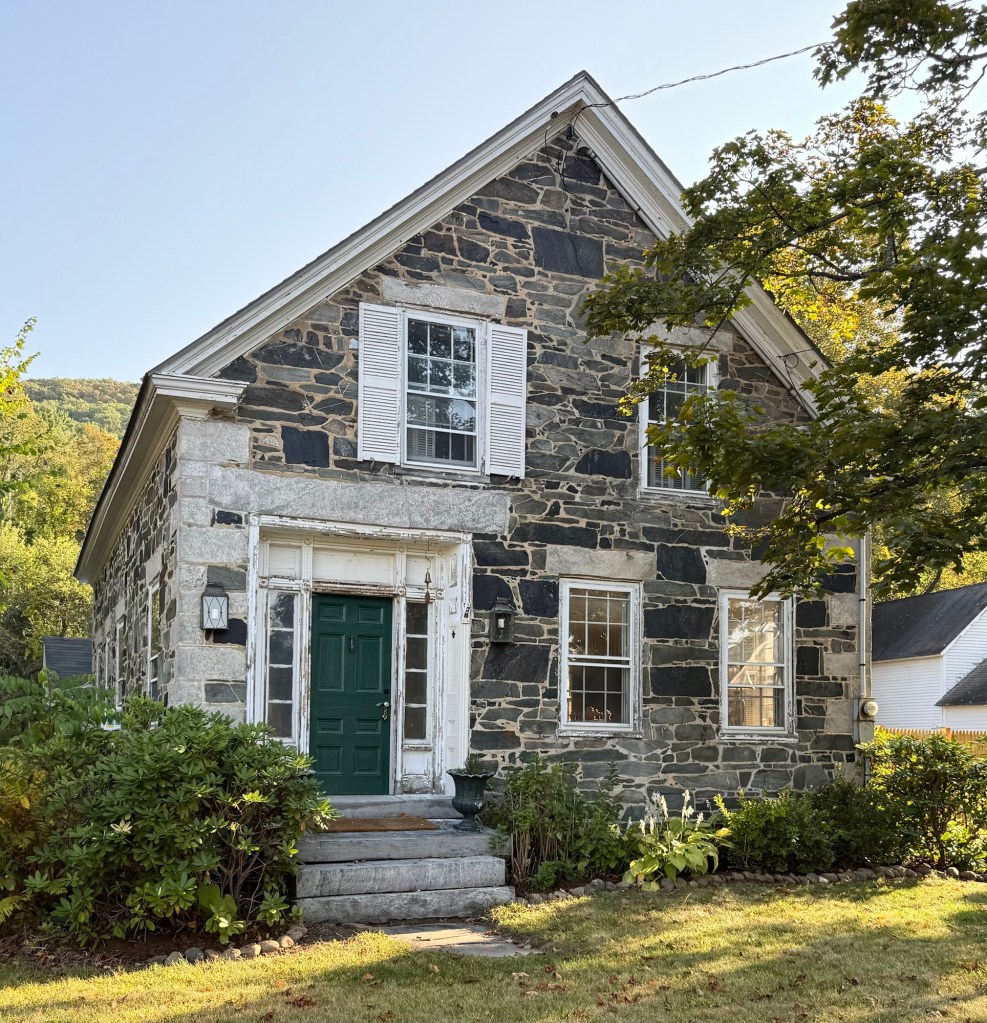
The Stone Village of Chester, Vermont, is said to be the largest collection of stone buildings in the state. Built around 1844, the Sherwin-Goldsmith House is one of a few dozen “snecked ashlar” buildings in the region, where rubblestone is laid up with mortar using long stones called “snecks” to tie an outer and an inner wall together. The construction method is said to have been brought to the area by masons from Scotland and Ireland which is known there as ‘Celtic Bond’. Oral tradition state that Scottish masons from Canada introduced the technique to local masons while erecting a mill in nearby Cavendish in 1832. Local Chester resident, Dr. Ptolemy Edson became such a fan of the building that in 1834, he had his home, the first stone building in Chester, built in this method. He then would influence the rest of the North Village of Chester, where many of his neighbors, as well as the church and schoolhouse, built their structures in snecked ashlar. The Sherwin House is one of three near-identical houses built around the same time that are colloquially known as the “Three Sisters” because they were built for members of the same family. The Greek Revival form is toned down in this smaller side-hall house, which playfully uses large blocks of schist and mica which read as quoins at the corners. Simeon Sherwin (1813-1874) was a farmer, postmaster, and justice of the peace in Chester. Later owner, Olivia Goldsmith, wrote her bestseller, First Wives Club when she lived here.
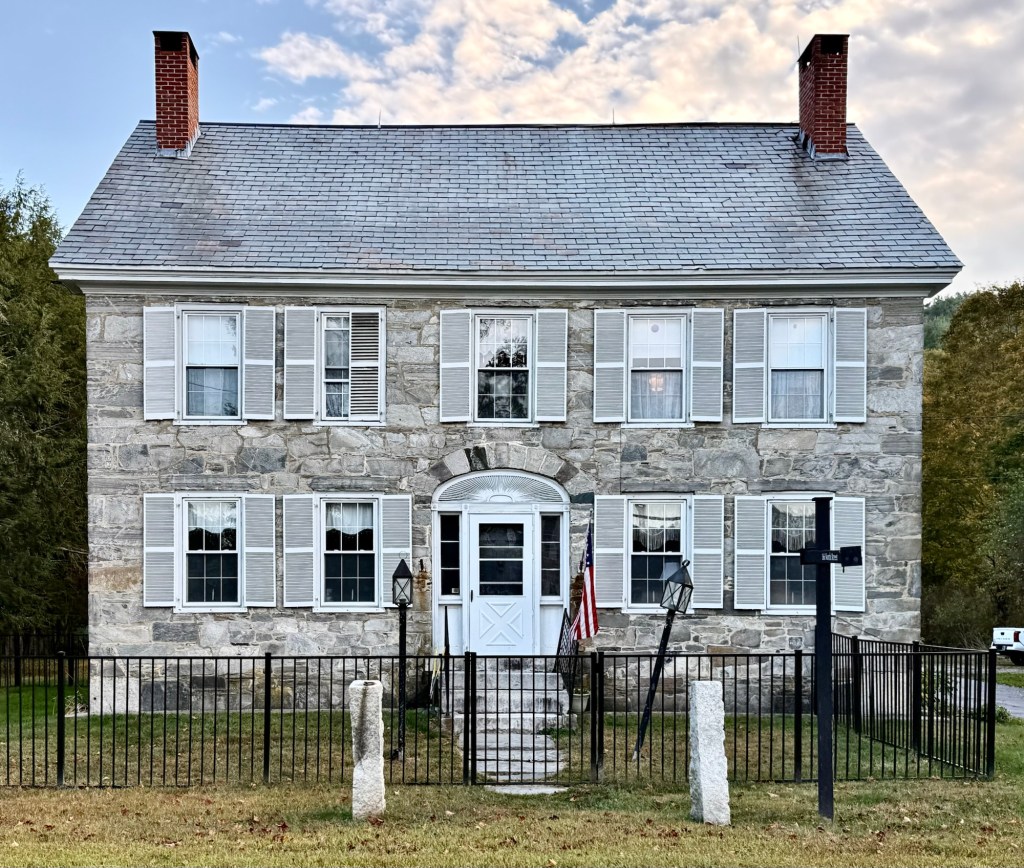
The Stone Village of Chester, Vermont, is said to be the largest collection of stone buildings in the state. Built around 1839, the Mason C. Richardson House is one of a few dozen “snecked ashlar” buildings in the region, where rubblestone is laid up with mortar using small long stones called “snecks” to tie an outer and an inner wall together. The construction method is said to have been brought to the area by masons from Scotland and Ireland which is known there as ‘Celtic Bond’. Oral tradition state that Scottish masons from Canada introduced the technique to local masons while erecting a mill in nearby Cavendish in 1832. Local Chester resident, Dr. Ptolemy Edson became such a fan of the building that in 1834, he had his home, the first stone building in Chester, built in this method. He then would influence the rest of the North Village of Chester, where many of his neighbors, as well as the church and schoolhouse, built their structures in snecked ashlar. Designed in the Federal style, the Richardson House is a vernacular, five-bay, two-story residence with central entrance and arched fanlight transom over the front door. Mason Richardson (1811-1881) was a merchant who lived here with his family while operating a store nearby.
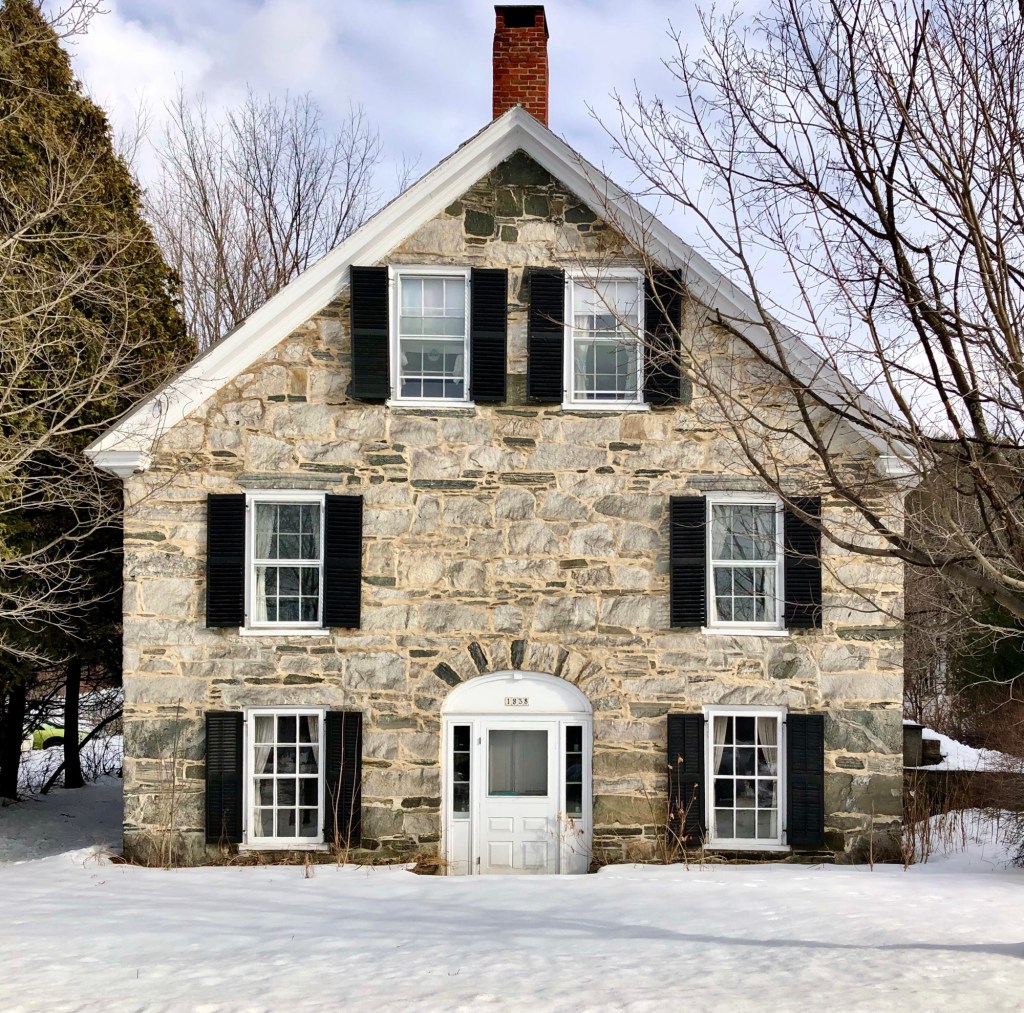
The Stone Village of Chester, Vermont, is said to be the largest collection of stone buildings in the state. Built around 1838, Granville and Aurora Spaulding House is one of a few dozen “snecked ashlar” buildings in the region, where rubblestone is laid up with mortar using small long stones called “snecks” to tie an outer and an inner wall together. The construction method is said to have been brought to the area by masons from Scotland and Ireland which is known there as ‘Celtic Bond’. Oral tradition state that Scottish masons from Canada introduced the technique to local masons while erecting a mill in nearby Cavendish in 1832. Local Chester resident, Dr. Ptolemy Edson became such a fan of the building that in 1834, he had his home, the first stone building in Chester, built in this method. He then would influence the rest of the North Village of Chester, where many of his neighbors, as well as the church and schoolhouse, built their structures in snecked ashlar. The Spaulding House is unique in that the main entrance does not face the street, as it fades the south east (side) facade. The couple married in 1839 and moved into this recently completed house to raise their family and work their farm. Like many other early stone houses built nearby in the 1830s, the Spaulding house blends Federal and Greek Revival motifs from the gable end facing the street and eaves returning to serve as a pediment as a nod to the emerging Greek Revival style, while retaining an arched entry off the street which echoes Federal period taste.
The Stone Village of Chester, Vermont, is said to be the largest collection of stone buildings in the state. Built around 1836, the Gideon Lee House is one of a few dozen “snecked ashlar” buildings in the region, where rubblestone is laid up with mortar using small long stones called “snecks” to tie an outer and an inner wall together. The construction method is said to have been brought to the area by masons from Scotland and Ireland which is known there as ‘Celtic Bond’. Oral tradition state that Scottish masons from Canada introduced the technique to local masons while erecting a mill in nearby Cavendish in 1832. Local Chester resident, Dr. Ptolemy Edson became such a fan of the building that in 1834, he had his home, the first stone building in Chester, built in this method. He then would influence the rest of the North Village of Chester, where many of his neighbors, as well as the church and schoolhouse, built their structures in snecked ashlar. The first residence besides Dr. Edson’s home built this way in the village was this home, built nextdoor for Dr. Edson’s friend, Gideon Merrick Lee (1811-1880). Designed in a more vernacular version of the Federal style with emerging Greek Revival side-hall form, the Lee House features a charming entry with sidelights and a blind fan over the door.
The Stone Village of Chester, Vermont, is said to be the largest collection of stone buildings in the state. Built in 1834, the Dr. Ptolemy Edson House is one of a few dozen “snecked ashlar” buildings in the region, where rubblestone is laid up with mortar using small long stones called “snecks” to tie an outer and an inner wall together. The construction method is said to have been brought to the area by masons from Scotland and Ireland which is known there as ‘Celtic Bond’. Oral tradition state that Scottish masons from Canada introduced the technique to local masons while erecting a mill in nearby Cavendish in 1832. Local Chester resident, Dr. Ptolemy Edson became such a fan of the building that in 1834, he had his home, the first stone building in Chester, built in this method. He then would influence the rest of the North Village of Chester, where many of his neighbors, as well as the church and schoolhouse, built their structures in snecked ashlar. Designed in the Federal style, the Edson House is a vernacular, five-bay, two-story residence with central entrance and arched fanlight transom over the front door.