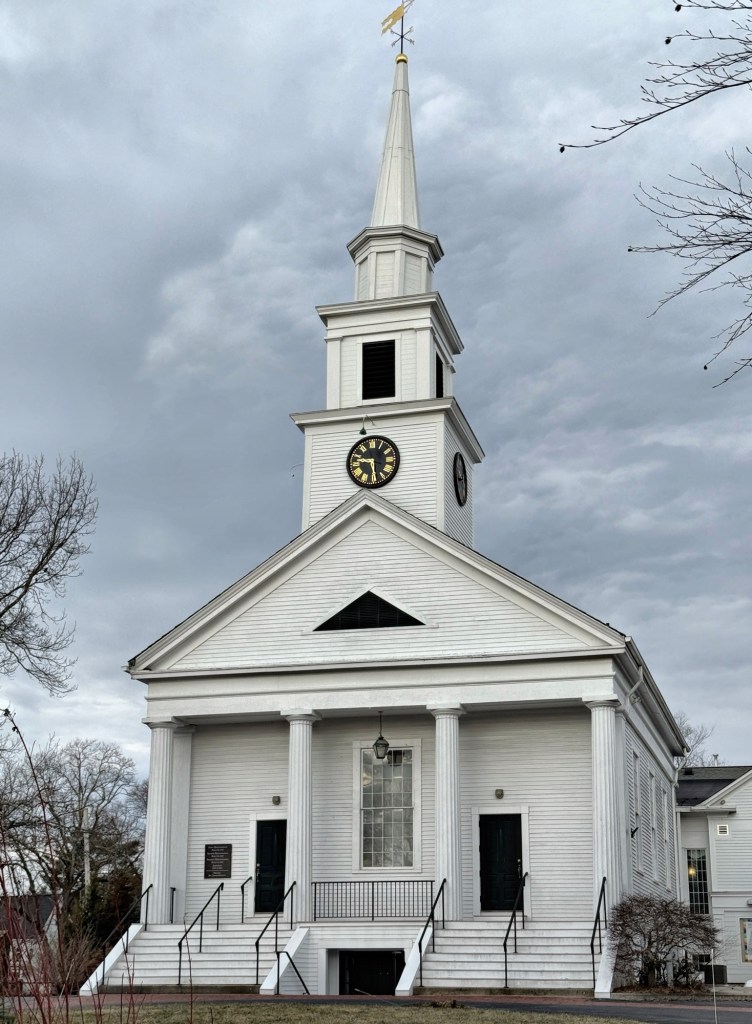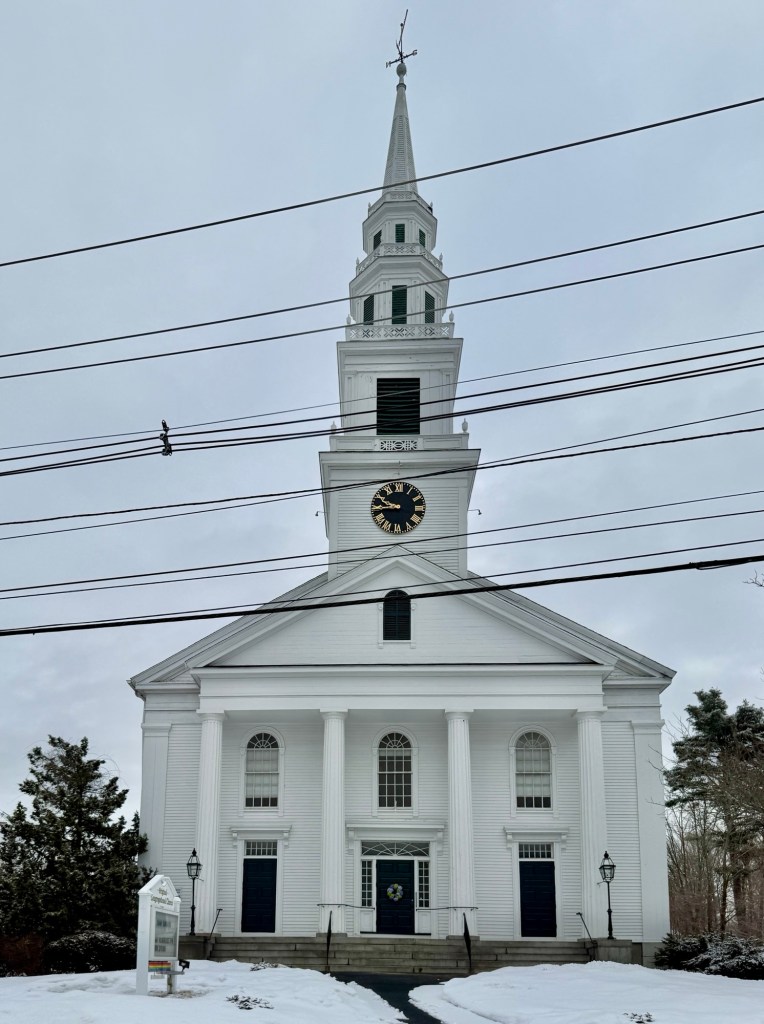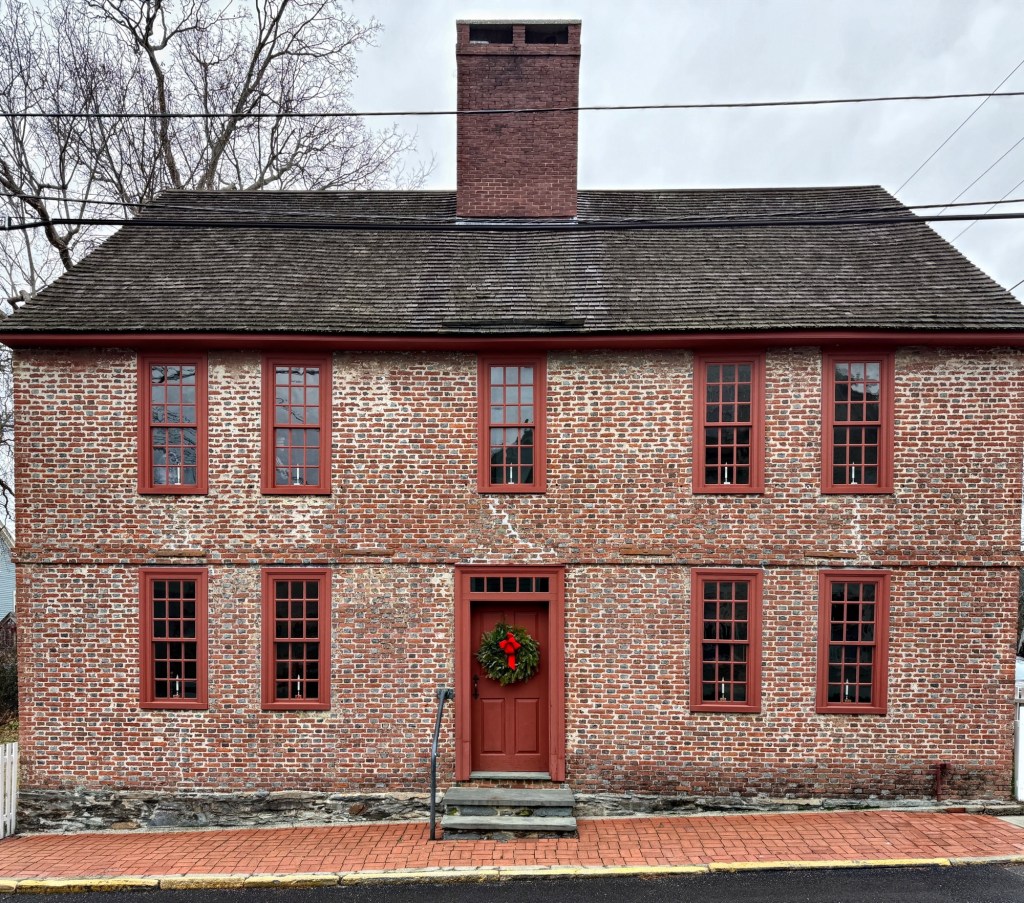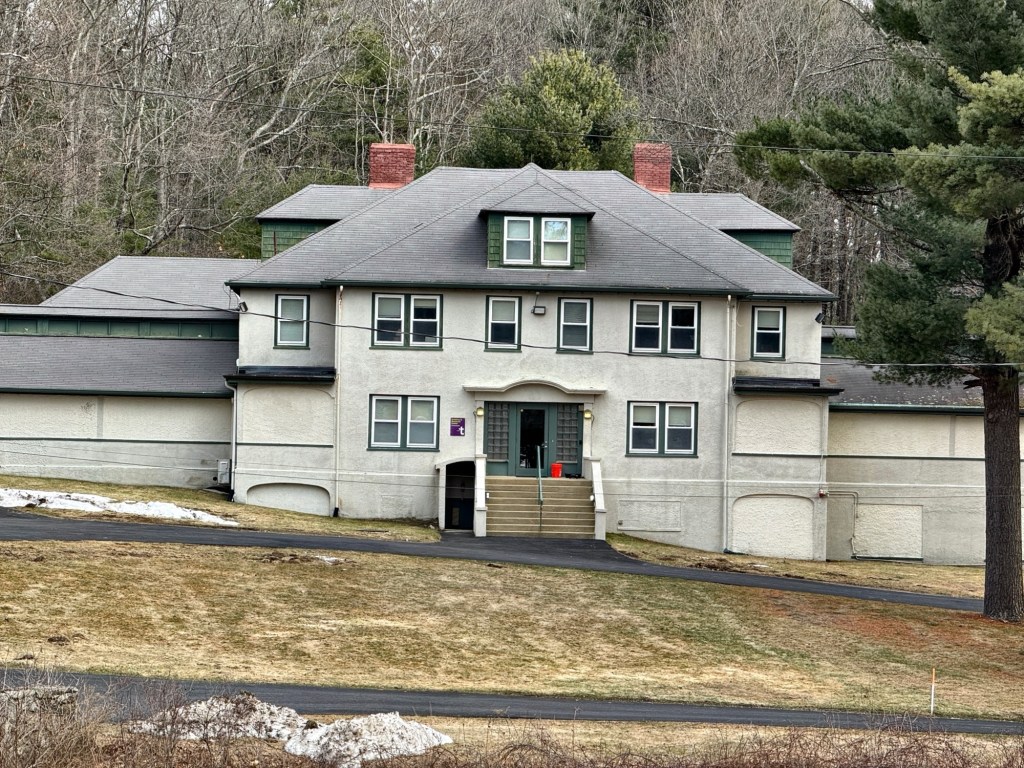
Chester Meetinghouse // 1793

The Saybrook Colony was established in 1635 and covered a large geographic area near the mouth of the Connecticut River in Connecticut.  This area was later subdivided into different towns after colonial era villages were established, each with their own church congregations. As was common in the colonial era, these divisions were centered on the establishment of separate church congregations. The Fourth Ecclesiastical Society of Saybrook in what is now the town of Chester, Connecticut, was established in 1742. As the town grew, this building was constructed in 1793 as Chester’s second meeting house and served as a church until 1846, when the third Meeting House was built. In 1847, the Town of Chester acquired this old meetinghouse and from that date until 1960, it was used as the Town Hall. In 1876, the old meetinghouse was renovated with a new, projecting main entrance added to the south side of the building when the Old Town Hall enjoyed its heyday as a theater and concert hall. The Old Town Hall witnessed many events under its roof, including hosting P.T. Barnum’s Tom Thumb, who performed here, as did musical events, high school proms, and school graduations. The building had become threatened following the construction of the new Chester Elementary School, which better-hosted events, in the 1960s. Luckily, in 1970, the newly formed Chester Historical Society acquired the building and restored it as a significant piece of the town’s rich history.

Deep River Town Hall // 1893

The town of Deep River, in Middlesex County, is located in the lower Connecticut River Valley and was originally colonized as part of the Saybrook Colony. The community was incorporated in 1859 as Saybrook and renamed Deep River in 1947. An early shipbuilding and quarrying town, it later manufactured wire goods, lace, glass, ivory combs, and piano keys and is today a small community of just over 4,500 residents. The original town hall for Saybrook (Deep River) was used until it was destroyed by fire in 1891. The community, which was bolstered by a vibrant industrial community, began planning for a new, stately town hall at a triangular lot at the corner of Elm and Main streets. Plans were completed by Springfield architect, Francis R. Richmond, who laid out the flatiron building with town offices on the ground floor with an auditorium/opera house space on the upper floors. The Romanesque Revival style building features prominent rounded corners with arched openings, a granite string course, and overhanging bracketed eaves.

Graham Apartments // 1904

This handsome, and unique example of a three-decker in the English Revival style is located on a corner lot at 128 Davis Avenue in the Emerson/Brookline Village neighborhood of Brookline, Massachusetts. Built in 1904 from plans by architect and genealogist, J. Gardner Bartlett, whose work focused on colonial New England and the English origins of colonial families. Trained as an architect at MIT, he gave up architecture for genealogy, but still occasionally designed buildings in the Boston area. The building here was developed for Richard Graham, an Irish immigrant, who along with his wife, operated a laundry business in the village. The use of a shingle and stone entrance porch and entrance bay with stucco half-timbering and diamond-pane casement windows stand out architecturally as one of the few examples of a three-decker built in this style in New England.

Happy Hollow Siphon House, Weston Aqueduct // 1903

The Weston Aqueduct was designed to deliver water from the Sudbury Reservoir in Framingham to the Weston Reservoir in Weston, Massachusetts. Built between 1901 and 1903, the aqueduct was designed to provide water to the suburbs north of Boston. All of the buildings that shelter the aqueducts above-ground elements, including this structure in Wayland, were designed by the architectural firm of  Shepley, Rutan and Coolidge, with landscaping along the route and at the reservoir designed by the Olmsted Brothers, landscape architects. This siphon house, known as the Happy Hollow Siphon House was built in 1903 and was an important part of the aqueduct system, as it transferred water through varied elevations using gravity and pressure to move the liquid without a pump. The aqueduct route is now a long, linear path and remains owned by the Massachusetts Water Resource Authority.

Mellen Law Office // c.1829

Samuel H. Mann (1801-1838), a lawyer, acquired the Dr. Ebenezer Ames House on Cochituate Road in 1829, only a month before his marriage to Isabella Ross. At about that time, Mann built this small law office across the road from his home, where he would practice law. It is not clear why, but within a year, Mann sold the house and this law office to Judge Edward Mellen (1802-1875), who was appointed Chief Justice of the Massachusetts Court of Common Pleas in 1855 and practiced law in Wayland until his death in 1875. After his death, the law office sat largely vacant until during World War II, when a newsletter to soldiers, The Village Bugle, was published here. After this, a couple of businesses used the former law office in the 1950s and 1960s until the owner donated the lot to the Town of Wayland in 1971. The diminutive building is a charming, and well-preserved example of a vernacular, Federal period professional office building that mimics the form and materials of the Ames House to which it was long affiliated with.

Sterling Opera House // 1889

The Sterling Opera House in Derby, Connecticut, is a landmark performing arts venue and civic center in the state and significant as a rare and well-preserved building constructed in the Italian Renaissance Revival style. Built in 1889, the building is named for Charles A. Sterling, founder the former Derby-based Sterling Piano Company, who paid for much of the costs of construction and design for the building. For his namesake building, Charles Sterling hired architect H. Edwards Ficken, who also  assisted with the designs for the famous Carnegie Hall in Manhattan, New York, to furnish plans for the unique building. The Opera House was built to serve both political and entertainment needs for the community, with the lower two levels and the basement serving as City Hall offices and the police station from when it opened up until 1965. The auditorium was used for hundreds of shows and live musical performances in its day, with many world-famous performers such as Harry Houdini and Red Skelton taking the stage at the Sterling. Shows were held up until 1945 when the curtain closed for the last time. In the past decades the building has been largely vacant and kept alive by grants and a dream by the city to preserve this significant landmark, possibly for reincorporation as the City Hall. 

Lancaster Town Hall // 1908

The Town Hall of Lancaster, Massachusetts, was built in 1908 and is one of four religious and civic buildings framing the village’s bucolic town green. The Town Hall was built opposite the Charles Bulfinch-designed First Church of Lancaster and replaced an earlier town hall building that was constructed in 1848. The building was largely funded as a gift from wealthy Lancaster-native, Nathaniel Thayer’s sons, following their late-father’s death. Boston architect, Alexander Wadsworth Longfellow, the nephew of poet Henry Wadsworth Longfellow, was hired to furnish plans for the building, which is Colonial Revival in style, a perfect compliment to the historic New England town.

Chester Depot // 1872

The first public train arrived in Chester, Vermont, on July 18, 1849, and in December, the Rutland & Burlington Railroad opened the first rail line across Vermont linking the Connecticut River valley at Bellows Falls and Lake Champlain at Burlington. A fire destroyed the first station in 1871, and the Vermont Central Railroad built the current station within a year. The State of Vermont purchased the line in 1963, leasing it in part to the Green Mountain Railroad. Exceptional in Vermont, this brick station retains its high-style Italianate design and continues in railroad use. The station can be classified as Italianate/Romanesque in style and has a corbeled cornice, windows capped by brick hood moldings, and a projecting trackside awning. It appears that the station is not in active use, does anyone know more?

Old Stone Bank // 1896

The Old Stone Bank was founded in 1819 as the first savings bank in Providence, Rhode Island, but originally under the name, Providence Institution for Savings. A constantly growing volume of business influenced the erection, in 1854, of a building for the exclusive purposes of the bank at 86 South Main Street, near College Hill. Designed by C.J. and R.J. Hall, the original stone bank stood one-story tall with a gable roof. Success and further expansion of the institution led to the erection, in 1896, of the present building, which served as the main office. Designed by the local architectural firm of Stone, Carpenter & Willson, the present domed banking structure is said to have incorporated parts of the 1854 building, and expanded the rest to the landmark we see today. The Beaux Arts/Neo-Classical banking structure is constructed of granite, with a Classical pedimented entry of monumental Corinthian columns atop the staircase, but the highlight of the building has to be the gold-leaf-and-copper domed roof which partially served as a skylight for the banking hall inside. Offices relocated to a new building in the late 1960s. The banking institution closed in the 1980s and following acquisitions and insolvency, the main bank was sold in 1995 to Brown University for $1.15 million to house the Haffenreffer Museum of Anthropology‘s collection of Native American artifacts. Years later, Brown decided it was unfeasible to house the collection in the building as the necessary alterations would have altered the historic character of the building, they then sold the building to an LLC in 2009. The Old Stone Bank is now a single-family home. Yes, you heard that right. The new owners have lovingly preserved this architectural marvel for all to enjoy as they stroll the city.

C & J Mauran Company Warehouse // c.1820

In Providence, even industrial warehouses are architecturally interesting to look at! This is the C & J Mauran Company Warehouse at 369 South Main Street in Providence’s East Side neighborhood. The building was constructed around 1820 for brothers, Carlo (1779-1844) and Joshua Mauran (1782-1847), who were wealthy merchants who stored goods from their ships trading in the Indies here. Before all of this, the site was home to an earlier structure from the 1770s, built by Deacon Joseph Sheldon, and the site was occupied by a warehouse, later owned by his son, Christopher Sheldon, and was known as the “Slave Pen” for its use of holding and transporting enslaved people. The “slave pen” burned in 1801 and the structure was later rebuilt by the Earle Brothers, and then again (the current structure) by Carlo and Joshua Mauran. Later in the 19th century, a brick façade and storefront were added to the building as the street shifted firmly to commercial uses, with noxious industrial buildings moving further to the periphery of the established College Hill neighborhood. From 1856 to 1939, the Ferry Coal Yard Company and the National Coal Company stored coal in the building After WWII, the City of Providence took the building and adjacent block by eminent domain to make way for urban renewal, and luckily for us, the building was rehabilitated rather than demolished at this time. The structure was converted to office use, and was again restored in the 2010s by Newport Collaborative Architects.