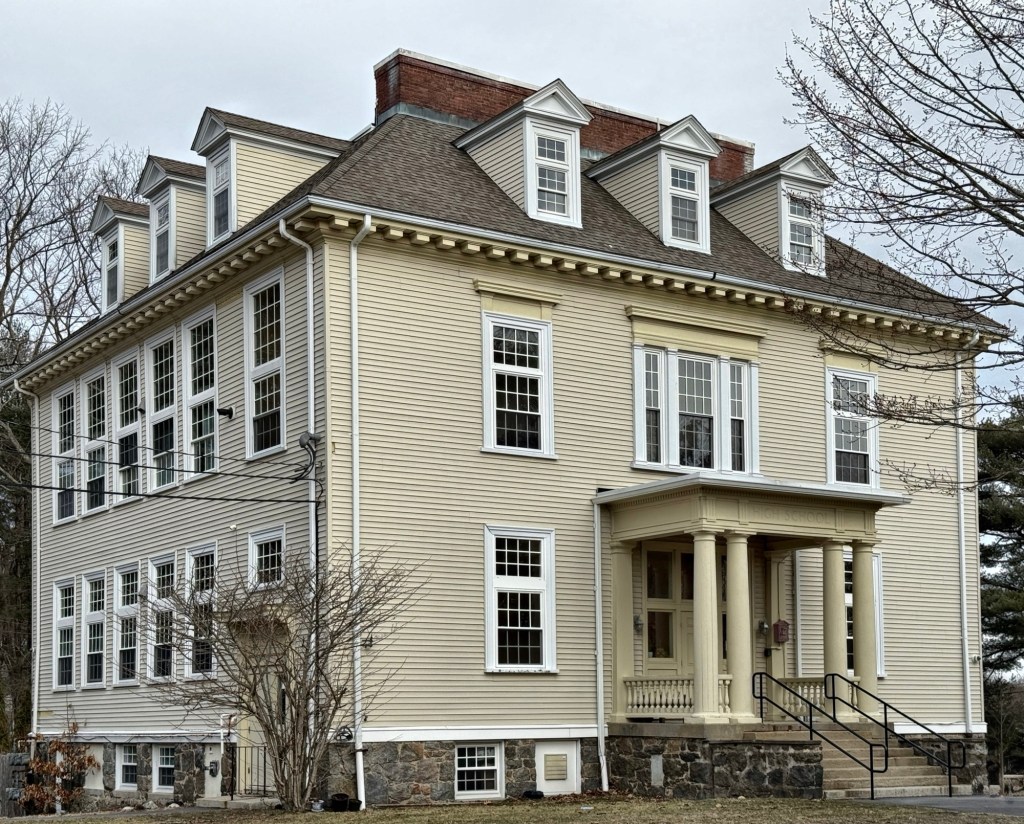
Druce-Francoeur House // c.1787

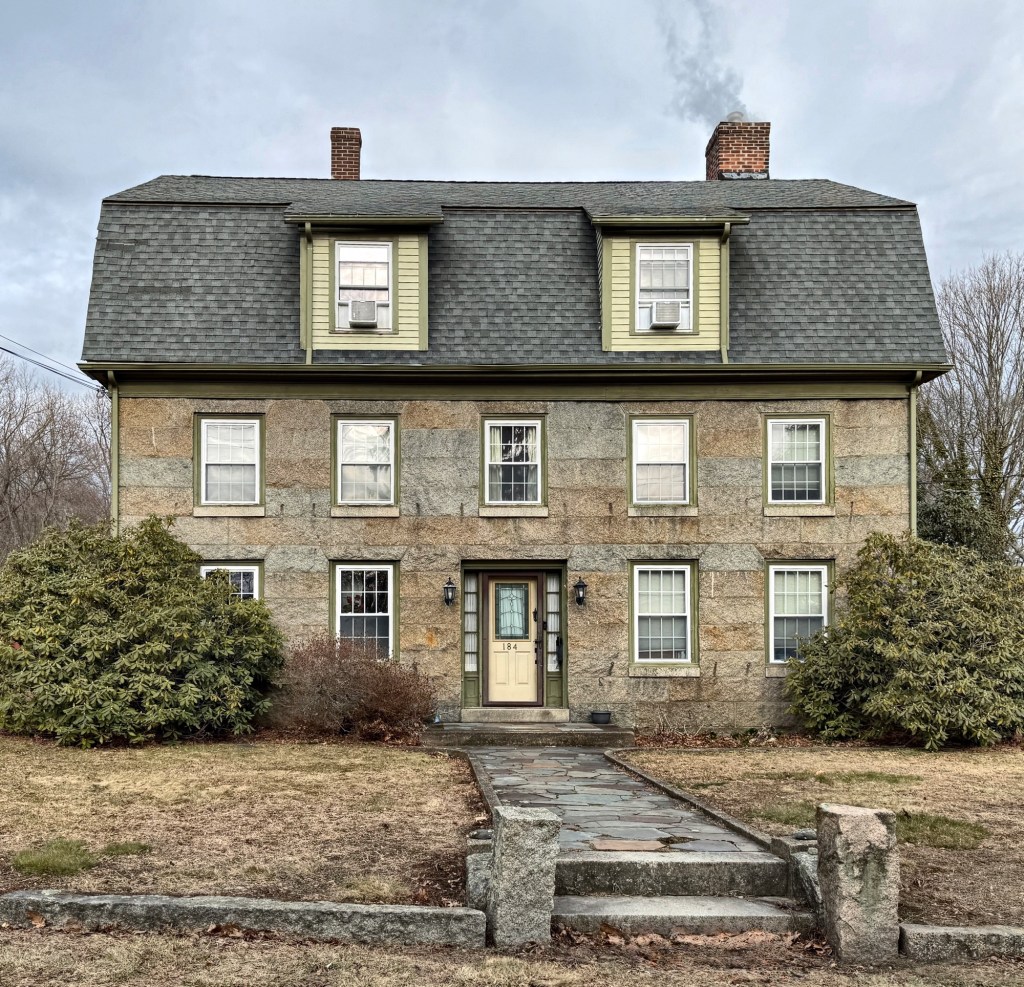
In 1787, Oliver Druce (1760-1797) married Sarah “Sally” Kollock (1764-1789) and had this large residence built overlooking the Town Common in Wrentham, Massachusetts. The young couple raised one daughter here until Sarah died in 1789 at 25 years old, followed years later by Oliver, who died in 1797 at 37 years old. By the turn of the 19th century, the late-Georgian residence was owned by John Francoeur, a French Huguenot. The Druce-Francoeur House is one of the finest Georgian style residences in Wrentham, which retains its magnificent doorway framed by fluted Ionic pilasters with broken scrolled pediment above.

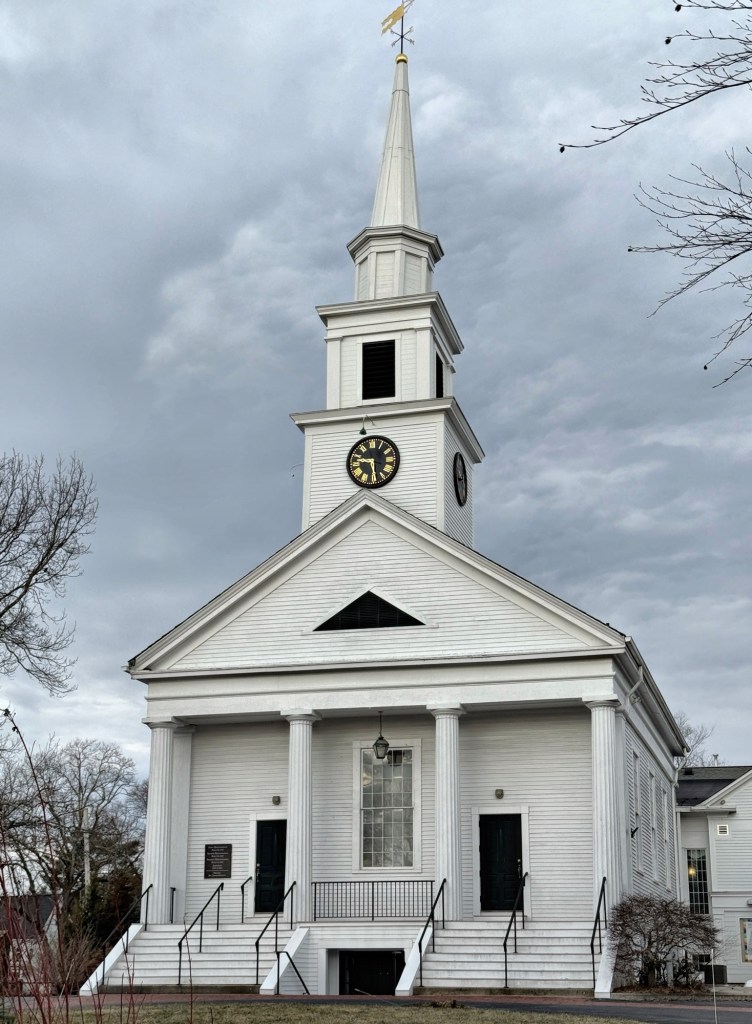
Wrentham Congregational Church // 1834

The Wrentham Congregational Church is the oldest house of worship in the suburban community, and the fourth consecutive meetinghouse for the congregation at the town center that was originally established in 1692. The frontier town grew slowly as a largely agricultural community and three houses of worship were built nearby the town common until 1833, when it was decided that a church worthy of its historic congregation be built. It is not clear who designed the Greek Revival church, but timbers were transported to town in 1834 for the new edifice which was completed that year. Over the following century, the church was expanded and modernized, all-the-while retaining its historic character. The four-stage steeple toppled during the New England Hurricane of 1938, and was rebuilt. The congregation remains active in the community and is a visual landmark at the town center.

Boyden-Clark House // c.1725

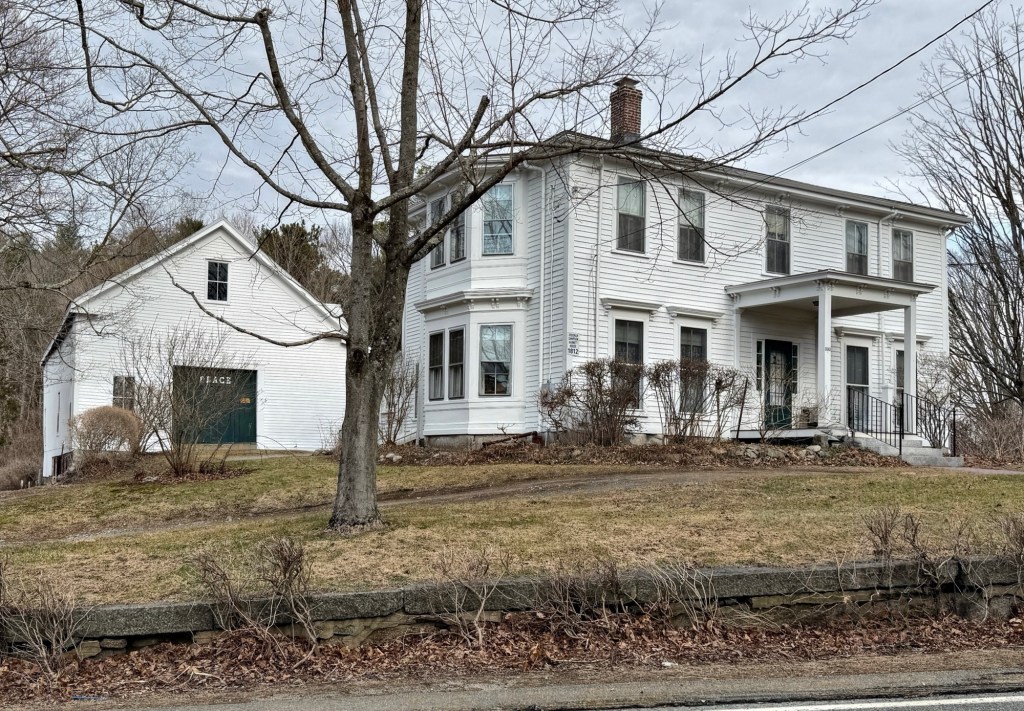
Wrentham, Massachusetts, was originally known as Wollomonopoag, roughly translating to “place of shells” a name given by the native tribes living here, referencing to area lakes as a food source for the people living here for over 8,000 years before European settlement. The area was settled by colonists in 1635 and became part of Dedham, when it was established in 1636. In 1673, the General Court allowed for the separation of what is now Wrentham, to incorporate as its own town. The community adopted the name Wrentham after the town in Suffolk County, England, a small village of just under 1,000 residents. About 50 years after incorporating, this historic Georgian farmhouse off Cumberland Road, not far from the Rhode Island state line, was built. The Boyden-Clark House is among the few pre-Revolutionary era homes remaining in the suburban community and retains its rural character. The house is said to have been built for Thomas Boyden (1681-1771) and wife, Mary (Clark) Boyden around 1725. The Boyden’s enslaved laborers who worked the farm here for decades. The property was later owned by Stephen Clark who farmed the land and likely added the stone well in the front yard. The house retains its gambrel roof and central chimney, hallmarks of the Colonial era.

Charles F. Roper House // c.1890

Charles Frederick Roper (1847-1916) was a machinist and inventor who moved to Hopedale, Massachusetts, where he found employment from the Draper Corporation. His inventions were important for the company, and included loom machinery, air supply for motors to prevent overheating, and grinding machines. Before his death, Charles Roper had over 100 patents and from his success, he afforded one of the finest Victorian homes in Hopedale. In around 1890, Charles Roper had this Shingle style residence built on Freedom Street from plans by Robert Allen Cook, a Milford-based architect who was a favorite of the Drapers. The residence sits on a rubblestone first floor with cedar shingles above.

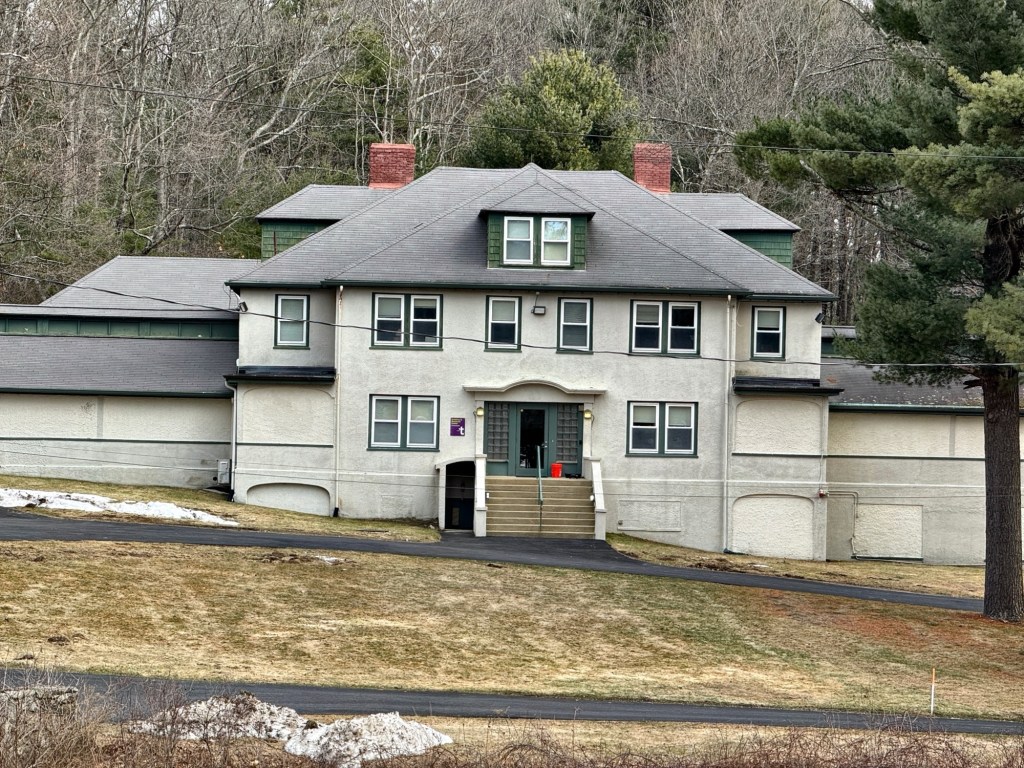
The Larches // 1910

George Otis Draper (1867-1923) was born in Hopedale and attended MIT to prepare to help run the extremely successful family business, the Draper Corporation in town, which was experiencing a period of rapid growth and expansion of factories. With his position at the company, his wealth afforded him the ability to build a massive country estate known as The Larches. The shingled Colonial Revival style home featured a massive crenelated tower and appeared like a castle in the countryside. George O. Draper sold this home to his aunt Hannah Thwing Draper Osgood in 1909, and within a month, the home burned to the ground. She began construction on the “new Larches“, a shingled mansion with a stunning blending of Colonial Revival and Craftsman styles. The home was likely designed by Robert Allen Cook, who was based out of nearby Milford, MA. The property today is run by Crossroads Clubhouse, an employment and recovery center that offers people with mental health conditions opportunities to achieve their full potential.

Hopedale Unitarian Church // 1898

The Hopedale Unitarian Church, also known as the Draper Memorial Church, is located in the former industrial village of Hopedale, Massachusetts, and is one of the finest examples of the Neo-Gothic style in the state. The church was funded by brothers George Albert and Eben S. Draper of the Draper Corporation, the largest employer in town, offering to build the new edifice as a memorial to their parents, George and Hannah Draper. The church replaced an earlier, wood-frame church, built on the site in 1860 by supporters of Adin Ballou, a founder of the Hopedale Community, a utopian community that eventually failed. The Drapers hired Boston architect, Edwin J. Lewis, an active Unitarian who had designed several churches around New England by this time. His plan was “English Gothic of the Perpendicular period” made of Milford granite with Indiana limestone trimmings and a roof of green slate. At the interior, roof trusses were left exposed “as in the old English Parish churches” with oak finishes and flooring and memorial stained glass windows by prominent artists. The church remains a visual and historical landmark for the community with an active congregation who preserve the significant building.

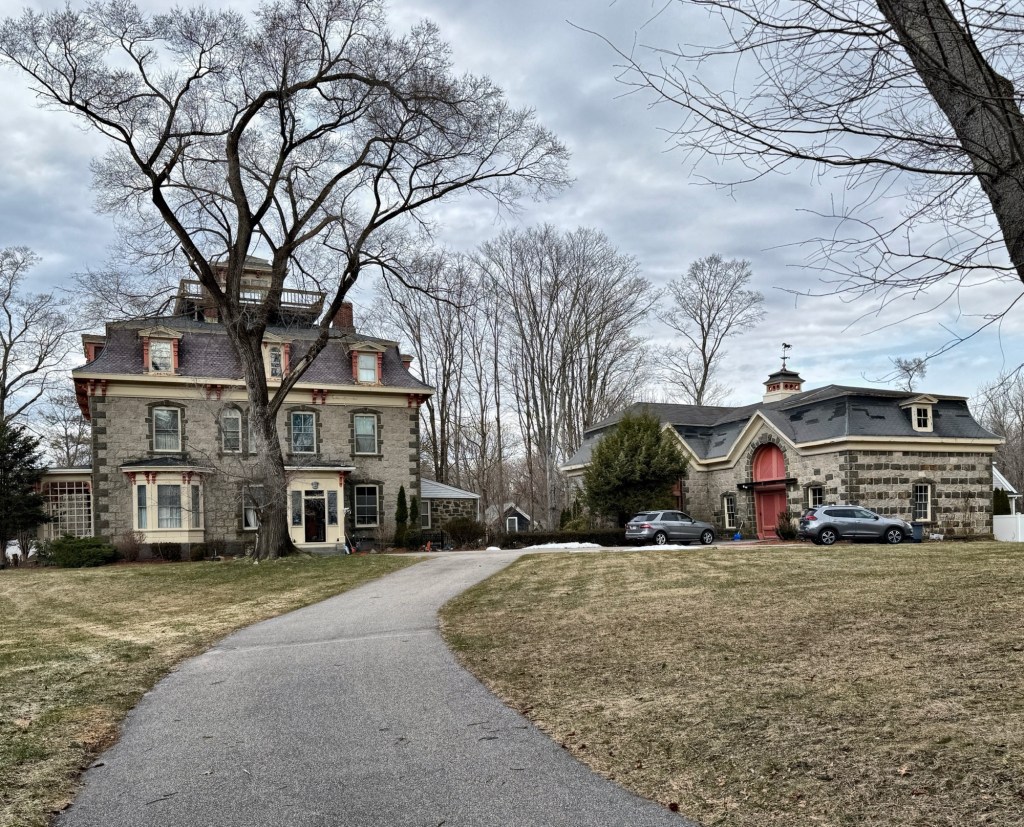
Eben S. Draper Stable // c.1900

Located next to his Tudor Revival style mansion, Eben Sumner Draper’s stable on Adin Street in Hopedale, Massachusetts, is one of the finest examples of the type in New England. It is possibly that the stable was built before the mansion was built in 1926 for Eben Sumner Draper Jr. (1893-1959), the son of Massachusetts Governor and Draper Corporation executive, Eben Sumner Draper. Little is known about this building, which stands at the end of a drive and is accessed over an arched bridgeway. The building has its first floor in stone with half timbering above. Two rounded towers with conical roofs frame the center entry, which may have been used for horses and carriage, or for personal automobiles, of which, Mr. Draper would surely have one of the first in the state. The building has been owned by the Ledges LLC, who operated a community for developmentally disabled adults.

Eben S. Draper Mansion // 1926

Built in 1926 for Eben Sumner Draper Jr. (1893-1959), the son of Massachusetts Governor and Draper Corporation executive, Eben Sumner Draper, this massive Tudor Revival style mansion in Hopedale, provided a secluded country estate for the wealthy industrialist. The home was designed in 1926 by Boston architects Bigelow & Wadsworth, and replaced Eben’s father’s Shingle style country mansion “The Ledges“. The new Draper mansion was highlighted in numerous architectural magazines shortly after it’s construction, which highlighted the amazing brickwork, layout, and interior finishes, all of which remain to today! This spectacular home is over 14,000 square feet and has 17 bedrooms, several located in the staff wing, 10 full-baths and four half-baths, an in-ground swimming pool, gazebo, tennis court, and landscape design attributed to the notable landscape architect Warren Manning. In the 1960s, the home sold out of the family and was used as a home for adults living with developmental disabilities, mental illnesses, physical disabilities, the facility has since sold the Draper mansion and occupies the former carriage house on the grounds.

Hopedale Village Cemetery Tool House // 1894

At the heart of the Hopedale Village Cemetery, this diminutive historic tool shed and office showcases that even for functional buildings set within a cemetery, high-quality materials and good design can enhance the landscape. The cemetery was laid out in 1845 in connection with Hopedale’s Utopian settlement, but expanded later in the 19th century as a formal landscaped cemetery in about 1887. The growth and investment of the cemetery coincides with the growth of the community as it prospered with the success of the Draper Corporation factories in town. Landscape architect, Warren Henry Manning updated the landscape here, with scenic vistas and hills, which followed the popular Rural cemetery movement of the 19th century. The cemetery contains many graves and mausoleums of the wealthy factory managers and benefactors of the community, which dot the sprawling landscape. In 1894, architect, Robert Allen Cook, designed this stone tool shed, which may have also contained a small office with cemetery records. The one-story, hip-roofed building features rough rubblestone walls with an eyebrow dormer centered on the façade, and has been preserved by the community for well over 100 years.

Bancroft Memorial Library // 1898

The Bancroft Memorial Library on Hopedale Street in Hopedale, Massachusetts, was built in 1898 and is one of the finest examples of a Romanesque Revival style library in New England. The library’s benefactor, Joseph Burbier Bancroft (1821-1909), moved to Hopedale and joined the Hopedale Community in 1846, where he became connected with the Hopedale Machine Company founded by the Draper Family. Shortly afterward Mr. Bancroft entered into a partnership with Ebenezer and George Draper, and was put in charge of the cotton machinery department of the Draper Corporation. Joseph married Sylvia W. Thwing, sister of the wives of Ebenezer and George Draper. As he rose through the ranks of the Draper Company, he decided to fund a library as a gift to the company town. Designed by architect, C. Howard Walker of the Boston architectural firm Walker & Kimball, the library is constructed of granite and features arched entry at the facade with carved stone panel above. Before the building was completed, Sylvia died, and the library became a memorial in her memory by Joseph Bancroft.