Trinity Episcopal Church of Wrentham // 1872

Overlooking the Town Green in Wrentham, Massachusetts, the Trinity Episcopal Church of Wrentham stands as the town’s finest example of Victorian Gothic architecture and the community’s oldest Episcopal church. Episcopalians in Wrentham first began worshipping in 1863 and in less than ten years, quickly grew in numbers from just two members to so many that a church building was needed to house the congregation. The site on East Street was purchased and architect, Shepard S. Woodcock, was hired to furnish plans for the new building. Completed in 1872, the Victorian Gothic design features all of the hallmarks of the style, including the steeply pitched roof, pointed arch windows and entry doors, buttresses, and towering steeple.

Wrentham Village Hall – Daniel Cook Store // 1853

Arguably the most recognizable and beloved building in Wrentham, Massachusetts, is this eclectic mid-19th century commercial building, known as the Wrentham Village Hall. The structure was originally constructed for Daniel A. Cook where he operated a store in the ground floor retail space and rented a meeting hall to local organizations above. The building was constructed around 1853 as a more vernacular building, but given its current appearance decades later when the ornate Stick style porches were added to the facade. While the building has served many uses over its history, the structure is suffering from some deterioration, which hopefully will not impact the rare surviving exposed porch framing and trusses, which give the building so much character.

Samuel Hawes House // c.1742

The Hawes’ in Wrentham, Massachusetts, were a prominent local family that largely settled in the western part of the town, building large farmhouses with properties bounded by rustic stone walls. This residence on Spring Street dates to the mid-18th century and was likely built for Samuel Hawes (1713-1795) around the time of his marriage to Priscilla Ruggles in 1741. After the death of both Samuel and Priscilla in 1795, the couple’s only son, David, bought out his two sisters value in the property and lived here with his family. The property was passed down through members of the Hawes Family until the 20th century, though later owners have still maintained and preserved this significant home for future generations.

Kentuck Farm // c.1740

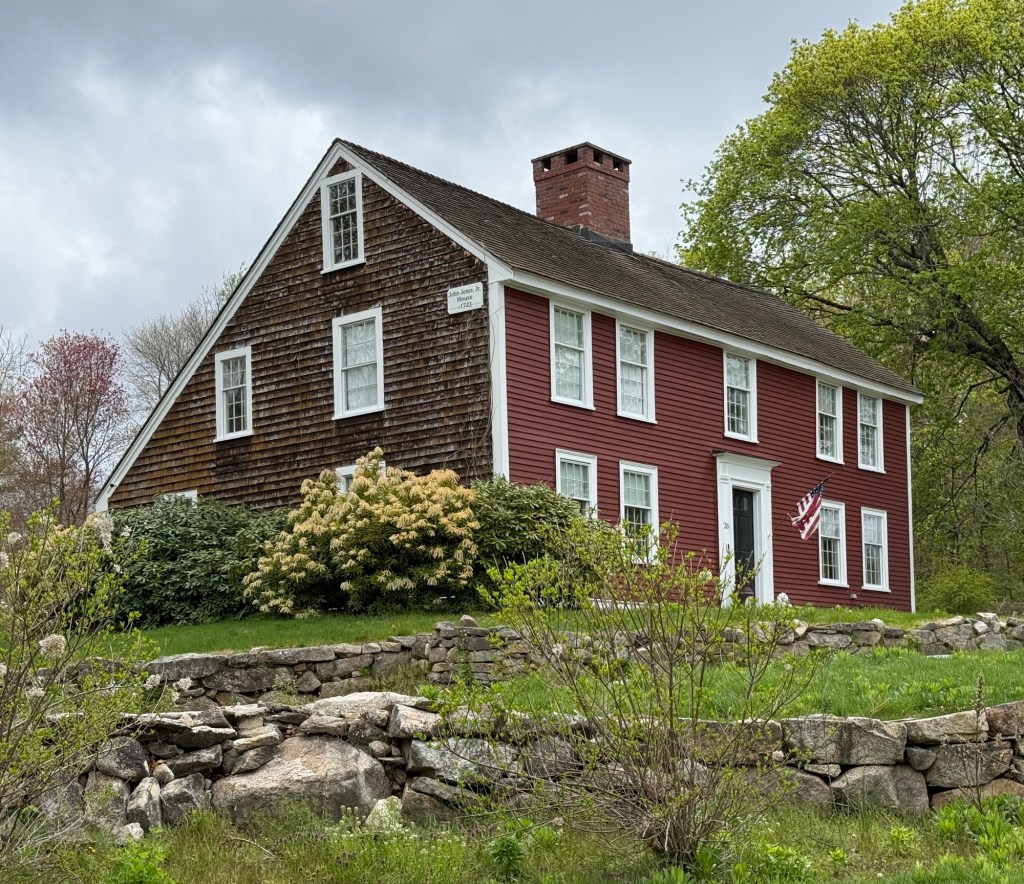
Located on West Street in the rural part of Wrentham, Massachusetts, this historic farmhouse is among the finest homes in the community. Early records are sparse, but the dwelling appears to have been built in the first half of the 18th century by Joseph Grant and later expanded and inherited by other members of the Grant Family who owned the property in the mid-19th century and other nearby farms. Through the 19th century, the farm was owned by George Grant and later by his son, Charles Albert Grant. In the 20th century, the farm was owned by Wentworth and Anne Massie, who operated the property as an apple orchard, known as Kentuck Farm. The home has been restored by current owners and retains its large, central chimney, classical door surround, siding and windows.

Guild-Kollock House // c.1714

The Guild-Kollock house on East Street in Wrentham, Massachusetts, is one of the oldest and best-preserved historic homes in the suburban community. In 1674, John Guild of Dedham, was granted this lot by the proprietors and later willed the property to his son, Deacon John Guild Jr. (1649-1723). John Guild Jr. had the home built between 1682 and 1714, the first recorded document that acknowledges the existence of this dwelling, giving the home a definitive “built by” date. The Colonial farmhouse remained in the Guild family until 1804, when it was purchased by Cornelius Kollock, a Revolutionary War veteran, surveyor, Justice of the Peace, Town Clerk, Town Treasurer, and Representative to the General Court. The significant early Guild-Kollock House was documented inside and out as part of the Historic American Buildings Survey (HABS) in 1962 and has been lovingly preserved for over 300 years since its construction.

Plimpton-Winter House // 1868

Only in New England will you find a historic 19th century house converted into a bank! The Plimpton-Winter House is located at 127 South Street in Wrentham, Massachusetts, and is among the finest Italianate style houses in the community. The residence was built in 1868 for Francis Newton Plimpton (1828-1913), who worked as a cashier and town treasurer, later becoming President of the National Bank of Wrentham. Two years after Plimpton’s death, in 1915, the house was bought by Murray Winter, who moved to Wrentham with his two brothers and established the Winter Brothers Tap and Dye Factory. The company manufactured gauges and valves during the early 20th century, quickly becoming the town’s largest employer until WWII. In the 1980s, the home was purchased and rehabilitated by the Foxboro Savings Bank to serve as its Wrentham Branch location. Today, the Plimpton-Winter House stands as a TD Bank Branch, where the exterior of the Italianate style residence is preserved, down to its bracketed cornice, ornate trim, bay window, and entry with paired wooden doors. How cool is that?


Druce-Francoeur House // c.1787

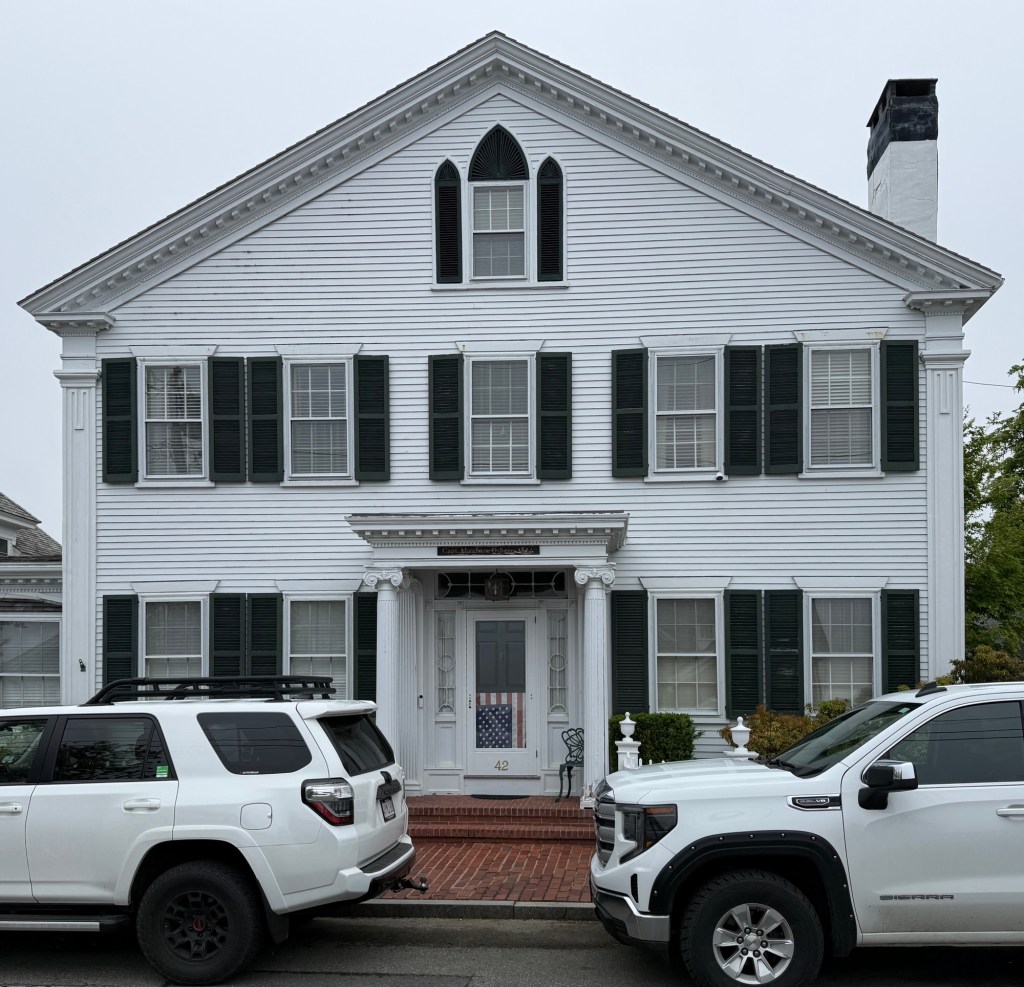
In 1787, Oliver Druce (1760-1797) married Sarah “Sally” Kollock (1764-1789) and had this large residence built overlooking the Town Common in Wrentham, Massachusetts. The young couple raised one daughter here until Sarah died in 1789 at 25 years old, followed years later by Oliver, who died in 1797 at 37 years old. By the turn of the 19th century, the late-Georgian residence was owned by John Francoeur, a French Huguenot. The Druce-Francoeur House is one of the finest Georgian style residences in Wrentham, which retains its magnificent doorway framed by fluted Ionic pilasters with broken scrolled pediment above.

Wrentham Congregational Church // 1834

The Wrentham Congregational Church is the oldest house of worship in the suburban community, and the fourth consecutive meetinghouse for the congregation at the town center that was originally established in 1692. The frontier town grew slowly as a largely agricultural community and three houses of worship were built nearby the town common until 1833, when it was decided that a church worthy of its historic congregation be built. It is not clear who designed the Greek Revival church, but timbers were transported to town in 1834 for the new edifice which was completed that year. Over the following century, the church was expanded and modernized, all-the-while retaining its historic character. The four-stage steeple toppled during the New England Hurricane of 1938, and was rebuilt. The congregation remains active in the community and is a visual landmark at the town center.

Boyden-Clark House // c.1725

Wrentham, Massachusetts, was originally known as Wollomonopoag, roughly translating to “place of shells” a name given by the native tribes living here, referencing to area lakes as a food source for the people living here for over 8,000 years before European settlement. The area was settled by colonists in 1635 and became part of Dedham, when it was established in 1636. In 1673, the General Court allowed for the separation of what is now Wrentham, to incorporate as its own town. The community adopted the name Wrentham after the town in Suffolk County, England, a small village of just under 1,000 residents. About 50 years after incorporating, this historic Georgian farmhouse off Cumberland Road, not far from the Rhode Island state line, was built. The Boyden-Clark House is among the few pre-Revolutionary era homes remaining in the suburban community and retains its rural character. The house is said to have been built for Thomas Boyden (1681-1771) and wife, Mary (Clark) Boyden around 1725. The Boyden’s enslaved laborers who worked the farm here for decades. The property was later owned by Stephen Clark who farmed the land and likely added the stone well in the front yard. The house retains its gambrel roof and central chimney, hallmarks of the Colonial era.

Charles F. Roper House // c.1890

Charles Frederick Roper (1847-1916) was a machinist and inventor who moved to Hopedale, Massachusetts, where he found employment from the Draper Corporation. His inventions were important for the company, and included loom machinery, air supply for motors to prevent overheating, and grinding machines. Before his death, Charles Roper had over 100 patents and from his success, he afforded one of the finest Victorian homes in Hopedale. In around 1890, Charles Roper had this Shingle style residence built on Freedom Street from plans by Robert Allen Cook, a Milford-based architect who was a favorite of the Drapers. The residence sits on a rubblestone first floor with cedar shingles above.