Maine State Building // 1893

The Maine State Building is a one-of-a-kind landmark located in the Poland Springs Historic District of Poland, Maine, though it was not originally built in this location! The Victorian structure was built in 1893 at the Columbian Exposition in Chicago (aka the Chicago World’s Fair) as one of the State Buildings constructed by each U.S. state to highlight their history. Designed by Chicago architect Charles Sumner Frost, a Lewiston, Maine native and MIT graduate, the building was constructed of granite with a slate roof. After the close of the fair, the Ricker family of Poland Spring, purchased the building from the state. They had it dismantled, moved to Maine, and rebuilt on their resort, which brought even more visitors to their property. In Maine, it reopened in 1895 as a library and art gallery for their hotel guests. Along with the Norway Building in Norway, The Dutch House in Brookline (a personal favorite), the Palace of Fine Arts (now the Museum of Science and Industry) and World Congress Auxiliary Building (now the Art Institute of Chicago) in Chicago, the Maine State Building is one of the few remaining buildings from the 1893 World’s Fair, and the only State Building remaining. It has been lovingly preserved and operated by the Poland Spring Historical Society, who operate the building as a museum.

Ashby Public Library // 1902

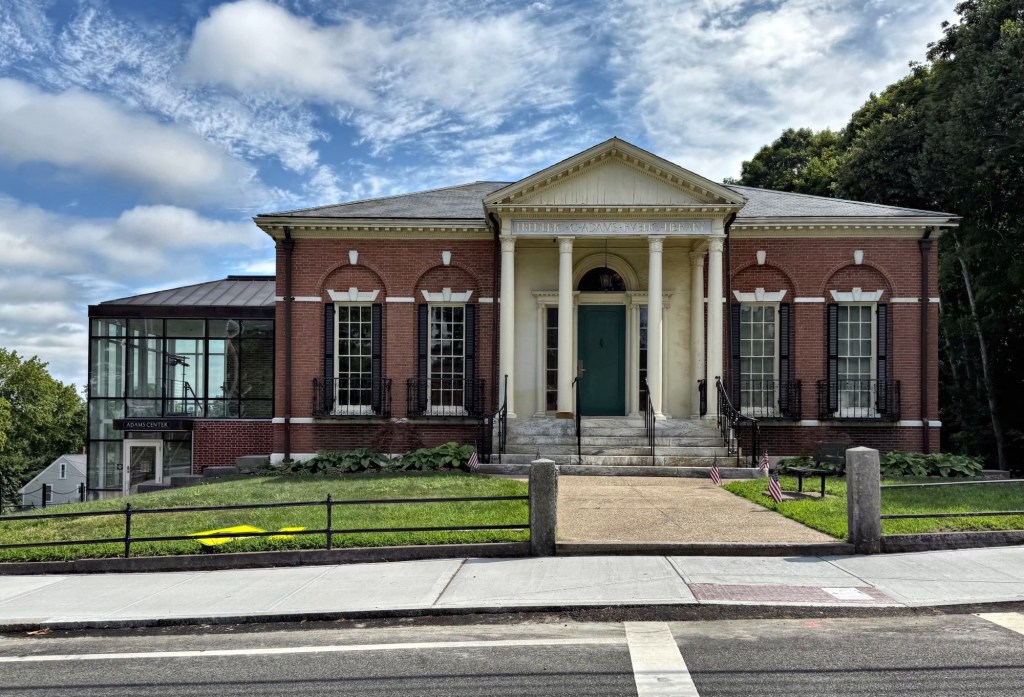
The Ashby Public Library in Ashby, Massachusetts, was built in 1902, completely funded by a donation from Edwin Chapman (1841-1915) who lived across the street from the new library. Mr. Chapman was raised in Ashby and became a wealthy Boston-area merchant in the meat trade by the late 19th century. Before this library was built, the town’s library collection was housed in the Wyman Tavern. The building was designed by architect Henry M. Francis in the Neoclassical style with Romanesque detail in brick and brownstone to make the building fireproof. The library was added onto in the rear in 2006 by The Galante Architecture Studio, which is recessed and mostly visible from the rear parking area. The addition is Modern in style to distinguish itself from the main library building.

Boston Flatiron – The Boxer Hotel // 1900

The interesting street-layout of the Bulfinch Triangle area of Boston created some oddly shaped triangular building lots which for decades, saw only small, modest wood-frame structures built upon them. By 1900, Boston’s own Flatiron Building (built two years before New York’s more iconic example) was constructed on this site and it has been an icon ever since. The structure was built by ownerCharles Pelham Curtis III (1860-1948), who was born in Boston and graduated from Harvard Law School and became a police commissioner and attorney in the city before moving into real estate development. He hired architect Stephen Codman to design this commercial block, which was rented out to local businesses and professional offices. The building has been home to a hotel for a number of decades, with a major renovation undertaken beginning in 2000, 100 years after the building was constructed. Three floors were added to the top of the original six-story, which are Modernistic in design with large expanses of windows within three center bays that align with the bays of the original building and which are defined by brick piers. The hotel today, The Boxer Hotel, perfectly blends the history of the building with modernity and style. What a gem of a building!

Tarbell Building // 1896

Similar to the Heywood Brothers & Wakefield Co. Building on Portland Street in the Bulfinch Triangle Historic District, the equally stunning building here was also designed by the same architect in a matching style. The building was constructed in 1896 by owner Catherine E. Tarbell , and the Boston branch of the National Casket Company moved in as tenants soon after its completion as part of its national expansion. The company would become the largest manufacturer and supplier of caskets in New England by 1906. The Tarbell building was designed by Stephen Codman in the Beaux-Arts style and is notable for its use of oxeye windows, rounded corners, and engaged pilastered facades. The company held its regional headquarters and sales offices from this building, which benefited from rail access for shipping caskets all over the region. The building is one of the finest examples of the Beaux Arts and Classical Revival styles in Boston.

The Last Tenement // c.1870s

Originally built in the 1870s, and largely remodeled in the early 1900s, this charming building has been known locally as “The Last Tenement” of the old West End of Boston. Once part of an unbroken a row of 30 brick tenements along the east side of Lowell Street, this building typified much of the West End of Boston, a vibrant and dynamic immigrant neighborhood. Dwarfed by larger, modern apartment towers and highway off-ramps, this stand-alone building is a survivor, and should really be preserved! Here is a little history on The Last Tenement that I found. The building was originally built as a three-story residence just after the Civil War by furniture dealer, George M. Rogers. The building was rented to four families in the 1880 census, showing the diversity of the region with 20 people residing in the building of Irish, English, and German-Jewish backgrounds. At the turn of the century, an elevated rail line was laid out down Lowell Street. After WWII, the neighborhood would see a terrible demise, that has been widely told. City leaders effectively considered the vibrant immigrant neighborhood a slum, and in an effort to redevelop it to bring back middle-class families (and their tax dollars) handed much of the neighborhood to developers to start over, with little more than lip service for the displaced. This building, now with an address of 42 Lomasney Way, was occupied for some time by “Skinny” Kazonis, a low-level Mafia associate of the Angiulo Brothers, which was a leading gang in the North End until the Winter Hill Gang decided to run rackets in the area. The property sold, and residential units have been rented and the building maintained, with the assistance of a billboard for additional income for the owner. The Last Tenement showcases the strength and resilience of the old West End and will hopefully remain as a reminder of the vibrant neighborhood that was razed and replaced with mediocrity.

Old Pierce School // 1855

Located in the heart of Brookline Village, the old Pierce School sits tucked away behind the Brookline Town Hall and other municipal and institutional buildings. The school was built in 1855 at a cost of $15,000 and later expanded in 1904 from plans by Julius Adolphe Schweinfurth, a prominent local architect. Julius had two brothers who also were architects:  A. C. Schweinfurth, who worked out of California and Charles F. Schweinfurth, out of Ohio. The Pierce School was named after Reverend John Pierce, noted pastor of the Walnut Street church during the mid 19th century. He and his wife, Lucy Tappan Pierce, were active leaders in the abolition movement in Brookline. The school was expanded a number of times until the 1970s, when the present Pierce Elementary School was built, in an unsympathetic Modern design that does little to enhance the busy street. As expected, the 1970s school will soon be demolished and replaced by a new, $212 million school. The old Pierce School will be incorporated into the new development.

Norwood Theatre // 1927

The Norwood Theatre was built in 1927 as a high-style showpiece for the re-invigorated downtown of Norwood, Massachusetts. Built at the same time as the Norwood Town Hall building, the building was constructed at a time of great development in the town, as local entrepreneur and philanthropist, George Willet and landscape architect Arthur A. Shurcliff, created a plan to evolve Norwood from a sleepy rural town to a commercial center. Architect William G. Upham is credited with designing the theatre and he enjoyed a prolific career which encompassed the design of masonic temples, commercial blocks, theatres, homes, and of course, the Norwood Town Hall. The Norwood Theatre was designed in a high-style Spanish Renaissance Revival style and was designed for motion pictures but also included a stage for possible vaudeville and theatrical productions. By the mid-20th century, a Modern sign covered much of the original facade, and lasted until the building came under its current ownership in 2010. A careful two-year restoration brought the theatre back to its former glory.

Norwood Town Hall // 1928

Norwood Town Hall represents the achievement of landscape architect Arthur A. Shurtleff and local financier, George Willet, to transform the village center of Norwood, Massachusetts from a sleepy rural village to a thriving commercial and cultural center of town. Plans for the municipal building began as early as 1919, with this building serving as both a town hall and memorial to the Norwood men who died in all previous wars. The building would not be completed until 1928. Designed by Norwood architect, William Upham, the building is a landmark example of the Neo-Gothic Revival style and its main feature, the 110-foot bell-tower which houses a 50-bell carillon, towers over the town common.

Point Allerton Life Saving Station // 1889

The United States Life-Saving Service was a United States government agency that grew out of private and local humanitarian efforts to save the lives of shipwrecked mariners and ship passengers. It began in 1848 when the congress appropriated $10,000 to establish unmanned lifesaving stations along the New Jersey coast south of New York Harbor. That same year the Massachusetts Humane Society also received funds from Congress for lifesaving stations on the Massachusetts coastline. It was decided to establish a life saving service station at Point Allerton after 61-year-old Joshua James and his crew rescued 29 people from four vessels wrecked in the Boston Harbor during the great storm of November, 1888. The United States Corps of Engineers had this Queen Anne style life saving station built at the northern shores of town, overlooking the Boston harbor. Joshua James became the Keeper of the station at 62, seventeen years past the mandatory retirement age of 45 for a federal appointment with the new U.S. Life–Saving Service. The station is the best-preserved of 32 stations that once lined the Massachusetts coast (most have since been demolished or adapted to other uses). It is now operated as the Hull Lifesaving Museum.

Rockport Lime Kilns // c.1800

During the 19th Century, Rockport, Maine, (then named Goose River as a village in Camden) was a major supplier of lime to East Coast markets. These kilns near the harbor converted limestone rock supplied by 15 local quarries into lime used to make mortar & finish plaster. The burned lime was packed into wooden casks and shipped by schooner to cities all down the coast. In 1817, three hundred casks of lime from Rockport were sent to Washington, D.C. for use in the rebuilding of the United States Capitol, which had been damaged by the British during the War of 1812. In 1852, the citizens of Goose River voted to change their village’s name to Rockport for its rocky terrain. In 1891, Rockport split off from Camden, taking its industry and lucrative harbor with it. A disastrous fire destroyed many of the lime kilns here in 1907, which occurred about the time that cement began to replace lime in building construction. After a few years the kilns were shuttered and remained here as fossils of industry ever since. Local residents in the 1970s gathered together and advocated for the preservation of these significant local structures and gathered funds to stabilize the kilns.

A. M. Donna end House // 1928

Abraham Malcolm Sonnabend was born in Boston on December 8, 1896, the son of Esther and Joseph Sonnabend. Sonnabend graduated from Harvard College in 1917 in order to enlist at the outbreak of the Great War. At the end of World War I, Sonnabend joined his father’s real estate organization. He married Esther Lewitt in 1920, and by 1927, he had increased his real estate holdings to a net worth of $350,000. Just before the 1929 stock market crash, Sonnabend hired Boston architect Sumner Schein to design this Tudor Revival style home, on a site formerly occupied by a larger Queen Anne style residence. Built in 1928, the Tudor Revival house features clinker brick walls with cast stone trim and a two-story castellated bay all capped by a slate roof. The enterprising A. M. Sonnabend would eventually outgrow this modest Tudor home after he got into hotels as investments. In 1944, Sonnabend (with seven partners) acquired a package of Palm Beach, Florida hotels for $2.4 million including the Biltmore, Whitehall and the Palm Beach Country Club. He would sell the Biltmore to Conrad Hilton for a massive profit. In 1956, Sonnabend created the Hotel Corporation of America (HCA) and grew the business to new heights. The 1928 Sonnabend House is significant architecturally and as the first purpose-built property by the late-developer.

Derby Line Village Hall // 1887

This small wood-frame structure sits in the middle of Derby Line Village and is a good example of a local meeting hall embellished with Classical details. This structure was originally built as an Odd Fellows Hall in 1887, where local and regional members could hold events and meetings. In 1940 the IOOF Hall was moved back on its lot so that It had a similar set back to other buildings on the street, and it was renovated to a village hall for all residents, a use that remains to this day.

Yale University – Linsly Hall // 1906

Just 15 years after the Chittenden Memorial Library (last post) was constructed to provide overflow space for Yale’s Old Library, the college overseers sought to expand yet again. Linsly Hall was built in 1906 as an addition to the 1880s Richardsonian Romanesque Chittenden library building, but in the Collegiate Gothic style, which was quickly becoming a preferred architecture style for the campus. Linsly Hall was built as a connector between the two library buildings with a tunnel-like passage between the structures. This was quickly deemed inadequate for a college of this stature, and the 1930s Sterling Library was built outside of the yard decades later. Architect Charles C. Haight designed Linsly Hall following the same design elements as his popular Vanderbilt Hall, built 10 years prior nearby. Today, the Linsly Hall (and the adjoining Chittenden Hall) is classroom space.

Broad Street Association Building // 1805

One of the few remaining Federal period buildings in Downtown Boston is this survivor located on Broad Street, one of the best streets in the city! The building was constructed for the Broad Street Association, which was made up of members: Uriah Cotting, Harrison Gray Otis, Francis Cabot Lowell and other prominent Boston entrepreneurs with the goal to upgrade Boston’s waterfront south of Long Wharf which comprised of an outdated system of individual wharves. The organization hired the esteemed Boston architect, Charles Bulfinch to furnish plans for the building, of which they paid him $100. While this modest example of the Federal style is not Bulfinch’s best work, is is notable as he was largely responsible for changing the architectural face of Boston, not only through own designs, but also through influence on other architects and builders of the time. This building was long owned by Francis Cabot Lowell and was rented out to commercial ventures, including some of the later decades of the 1800s when it was occupied by C. D. Brooks, a maker of pickles and preserves. The building was restored by CBT Architects in 2005 as part of a larger redevelopment of the block which includes a mid-rise apartment building, Folio.

Westover School // 1909

At the heart of the rural community of Middlebury, comprised largely of Connecticut farmers, far from the hustle and bustle of the world, Mary Robbins Hillard (1862-1932) sought to create a girls school to “provide young women with a liberal education in a community which would contribute to the development of their character, independence and sense of responsibility.” To accomplish this, they needed a school, and Mary hired her good friend (and architect) Theodate Pope Riddle to design the private girl’s school campus and main buildings on a site fronting the town green. The school opened in 1909 with125 pupils, slightly over capacity. For the design Theodate Pope Riddle – who was one of the first American women architects and a survivor of the sinking of the RMS Lusitania – took inspiration from English Arts and Crafts and historical precedence in English schools with large open courtyard plans. Originally finished in a gray stucco, the building enclosed a quadrangle at the rear. Inside, administration offices, reception rooms, living rooms, a library, gymnasium, chapel, dining rooms, infirmary, and (of course) classrooms lined the interiors on a closed loop to allow students and teachers access to all parts of the building without ever stepping outside in the cold New England winters. The Westover School remains active and one of the highest ranked private schools in the area today, and with a more cheery yellow coat!