Ashby Public Library // 1902

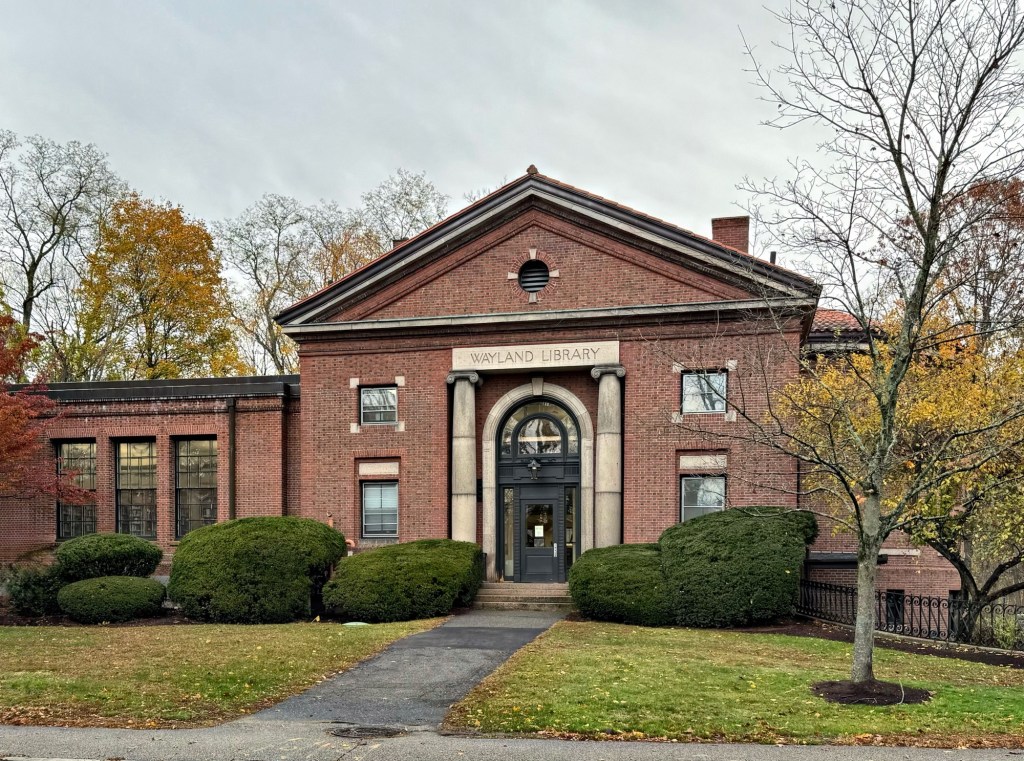
The Ashby Public Library in Ashby, Massachusetts, was built in 1902, completely funded by a donation from Edwin Chapman (1841-1915) who lived across the street from the new library. Mr. Chapman was raised in Ashby and became a wealthy Boston-area merchant in the meat trade by the late 19th century. Before this library was built, the town’s library collection was housed in the Wyman Tavern. The building was designed by architect Henry M. Francis in the Neoclassical style with Romanesque detail in brick and brownstone to make the building fireproof. The library was added onto in the rear in 2006 by The Galante Architecture Studio, which is recessed and mostly visible from the rear parking area. The addition is Modern in style to distinguish itself from the main library building.

Lyman School – Ashby Town Hall // 1903

Originally built in 1903 as the central school for the town of Ashby, Massachusetts, the significant Colonial Revival style Lyman Building is one of the most significant and well-preserved buildings in the village. The building was designed by architect Henry M. Francis of Fitchburg and educated pupils in town from grades 1-12. The two-story, hip-roofed building displays a symmetrical facade with a central section displaying five arched upper story windows, flanked by two pediment-topped pavilions atop projecting, flat-roofed arched entrance vestibules with quoined corners. The symmetry of the original design was preserved when the identical side wings constructed in 1922. Ashby public schools merged with Pepperell and Townsend and this building was later converted to the town hall. I love when towns value their historic buildings and retrofit them for new uses!

Asa C. Everett House // c.1824

The Asa C. Everett House on Allen Road in Ashby, Massachusetts, was built around the time of the wedding of Asa Cutter Everett, a saddle- and harness-maker, and Rowena Spaulding in 1824. The house was built of brick and in the Federal style with a shallow hipped roof and symmetrical facade, and was “modernized” in the late 19th century. Victorian-era alterations include the entrance porch with turned posts and spindle frieze and two-over-two sash windows. Blending of vastly different architectural styles can be tough to pull off, but this example really looks great! What do you think?

Ashby Congregational Church // 1835

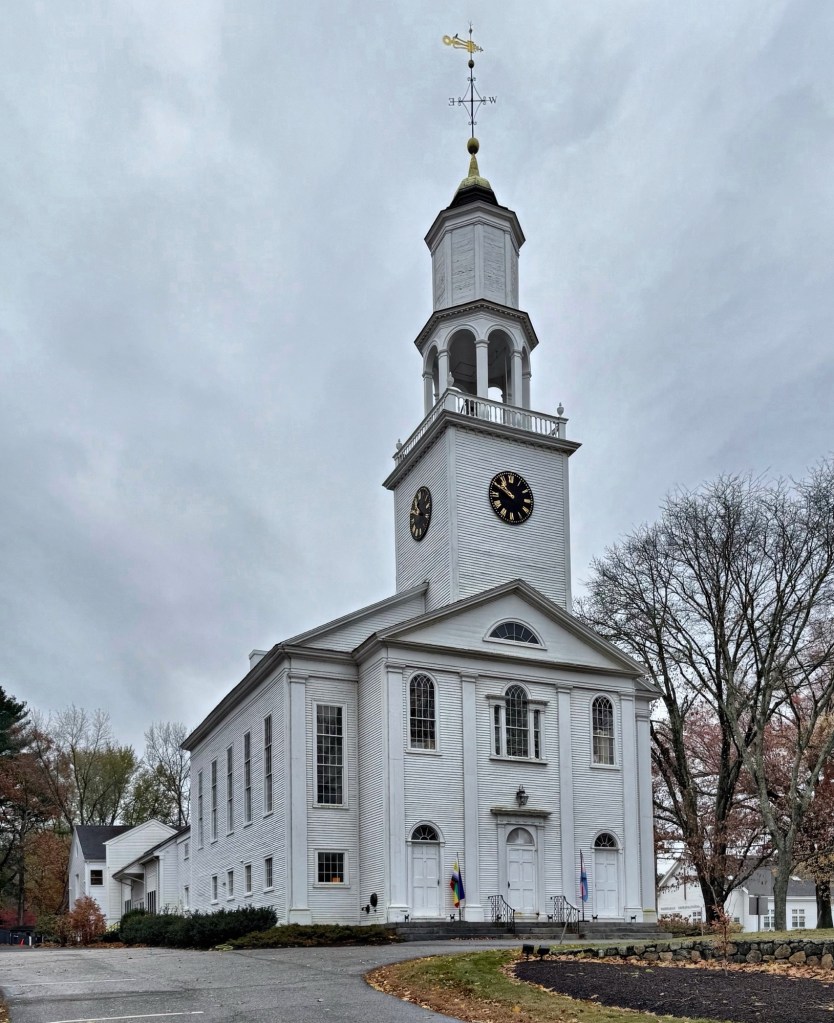
Combining Greek and Gothic revival styles, the 1835 Ashby Congregational Church in Ashby, Massachusetts, is a significant building showcasing the transitional tastes of ecclesiastical architecture in 1830s New England. The church had its beginnings in 1818, when a group of church members disillusioned to the current teachings separated from the town’s Unitarian roots and the accompanying meeting house, the First Parish Church. In 1820 a church for the Congregationalists was built on the opposite end of the town common. In 1835 it was sold and this, the current church building was constructed on a new site facing the Common. The original 1820 church building became the Ashby Academy and is now a Grange Hall. The design of the Ashby Congregational Church shows the leaning towards Gothic detailing wit its prominent pointed arch detailing, yet retains some traditional Greek Revival features like the two-story pediment and pilasters at the belfry.

Old Ashby Academy – Ashby Grange Hall // 1820

In 1819, less than a decade after the First Parish Church in Ashby, Massachusetts was built, a group of parishioners split to form their own congregation, erecting this Federal style building as its new house of worship a year later. The congregation grew and eventually would build a new church, the Ashby Congregational Church, in 1835. The building was soon after, sold to a group of citizens interested in starting an academy. In 1836 they opened Ashby Academy, which offered education beyond the eighth grade for those who could afford it. Ashby Academy closed in 1860 and the Town of Ashby purchased the building in 1864 for a high school and town offices, a use that remained until a new school was built in 1902. Since the 1970s, the building has been occupied as a local grange hall, and maintained by a local group, the Friends of the Ashby Grange Hall. The building is a significant, transitional Federal/Greek Revival style building in town with its pediment and elliptical windows.

Wyman Tavern // c.1780

This large Colonial house sits on the Ashby town common adjacent to the town’s meetinghouse. The structure was built by Abijah Wyman, a Captain in the American Revolution, in about 1780 as a family home. In 1803 a turnpike was established and was well travelled by heavy wagons and stagecoaches travelling between Boston, NH, and VT. Taking advantage of the location, Abijah’s son John expanded the building and began operating a tavern from the house. It would become a drinking establishment, post office, and inn during the 19th century. Later owners modified and expanded the building further, adding a porch and connecting the tavern to the barn. The building is now occupied by commercial uses including the local post office!

First Parish Church of Ashby // 1809

Welcome to Ashby, Massachusetts; a rural and historic town that was first settled in 1676 but due to the continued threat of native hostilities, permanent European settlement in the town did not occur until about 1750. The town incorporated in 1767 and was reputedly named for the abundance and quality of white ash trees found in the area by early settlers. Today, the town has just over 3,000 residents. At the center of the town village, the First Parish Church of Ashby stands as a significant Federal-period meetinghouse, and an integral piece of the town’s history. The present building was constructed in 1809, replacing an earlier structure from 1771. Carpenters for the building were Joseph Kendall and Darius Wellington of Ashby, who utilized plans from Asher Benjamin’s American architectural pattern book of 1797. Facing the town common, the church is a two-story gable front building with a three-stage tower including an octagonal open belfry rising from the pedimented front pavilion.

Former West Acton Universalist Church // 1868

This beautiful church in Acton, Massachusetts was built in 1868 by the Universalists of West Acton who sought a house of worship closer to their homes, rather than taking horses to the other part of town every week. The building exemplifies the influence of both Gothic Revival and Italianate styles on rural churches of the time. Gothic elements include the double pointed lancet windows with quatrefoil ornament, buttresses, and pointed lancet panels on the tower and belfry. Italianate elements include the rusticated base and the corbel table at the eaves. Religious services ceased in 1925. At that time, the church building was bought by leading men in the village who gave the building to the West Acton Women’s Club, which began in 1890 by Lucy Mead (the wife of Oliver Mead, who built the Mansard home nearby). In the 1950’s, the church was used as a community center. It is now home to a local performing arts center, Theatre III Box Office.

West Acton Citizens Library // c.1845

Old houses adapted for other uses always deserves a highlight! The West Acton Citizens Library was originally constructed in 1840 as a small, one-story Greek Revival style cape house either for or purchased by Phineas Wetherbee, a farmer and early landowner in the village. The modest house features little detailing besides the recessed entrance composed of wide, flat pilasters and a lintel decorated with square corner blocks and a central keystone. In 1883, Phineas Wetherbee met with thirty-nine others to form the Citizens Library in West Acton. The organization accessioned the collection of the former Farmers Club Library. When Mr. Wetherbee died in 1895, he bequeathed his house to the library, who later moved into the house by 1900. Today, the house remains a library space for the West Acton village.

Edgar Hall House // 1889

Another of Acton’s amazing old Queen Anne homes is the Edgar Hall House, an 1889 gem on Windsor Avenue. The house was built for Edgar Henry Hall and his wife Angelina who raised their daughter, Alice, in the home. Edgar and his brother inherited the family business from their father, Enoch Hall, and they produced wooden pails, tubs, clothing racks, and other wooden goods. The company employed over 30 workers in the early 20th century until it closed during the Great Depression. Edgar retired and relaxed from this stunning Victorian home until his death in 1954.

Oliver Mead Mansion // c.1870

Acton, Massachusetts is one of the more underrated Massachusetts towns for great old buildings, many of which are well-preserved and taken care of by their owners. The Oliver Mead Mansion in West Acton Village is among the largest in this part of town and is a stellar example of the Second Empire style. The house and adjacent carriage house was built around 1870 for Oliver Mead (1823-1912), who co-owned the A. O. W. Mead Company with his two brothers, a successful produce marketing company where they sold poultry, eggs, cheese, fruit, and other goods from farms in Acton and Boxborough to their shop on Market Street in Downtown Boston. The company did well, and Oliver and his brother Adelbert built matching mansions in West Acton after the Civil War and business picked up. The house exhibits a central projecting tower bordered by quoins and topped by a mansard roof with iron cresting on top. The original carriage house remains in a great state of preservation as well. The Adelbert House and Carriage house nextdoor were demolished in the 1950s for the fire station on the site.

Enoch Fuller Octagon // c.1850

Oh the Octagon! The very rare Octagon house was a unique house style briefly popular in the 1850s in the United States and Canada. The style can generally be traced to the influence of one man, amateur architect and phrenologist Orson Squire Fowler. In his book, The Octagon House: A Home for All of 1848 (and reprinted with more photos in 1853), Fowler advocated for the shape’s benefits for buildings in that the octagon allowed for additional living space, received more natural light, was easier to heat, and remained cooler in the summer. These benefits all derive from the geometry of an octagon: the shape encloses space efficiently, minimizing external surface area and consequently heat loss and gain, building costs etc. Some were convinced and built Octagon houses, but the style and its brief period of popularity, died by the 1860s. This example in Stoneham, Massachusetts was built around 1850 for and by Enoch Fuller, a close personal friend of P. T. Barnum, founder of the Barnum & Bailey Circus. Fuller visited Barnum’s octagonal home in Bridgeport, Connecticut and he decided to construct an octagon house in Stoneham. The home was owned by Col. Gerrry Trowbridge not long after completion. The home was built with a fireplace in every room, a spiral, “flying” staircase, and a sweeping veranda.

Doucette Ten-Footer // c.1850

Here is a building type many of you may not know of… the Ten-Footer! This 10 x 10-foot square building is a well preserved example of a kind of shop historically used by many shoemakers in the late-18th to mid-19th centuries. In Stoneham during the 19th century there were many such shops scattered throughout the town as the area became a sort of hub for shoemaking. In the age before and just after the Industrial Revolution, many Massachusetts residents had home shops in the yards where family and neighbors could earn extra part-time money by doing piece work on shoes. These cottage industry shoe workers were paid for each pair of shoes delivered to the local distributor. Usually, the owner-shoemaker worked alone or with family members in the cramped space with materials like leathers, rubber, and straps stored in the attic space in a loft in the gable. This ten-footer was built in the mid 19th century and later owned by Peter Doucette, who ran a shoe shop here. The small building was eventually acquired by the Stoneham Historical Society and was moved behind their building, restored and it can better tell the story of the town’s rich shoemaking history.

First Baptist Church of Stoneham // 1892

In 1891, the Baptist Society of Stoneham, Massachusetts unveiled that it had acquired funding and approved the plans for its first purpose-built church building in town. The organization met in a shared chapel in town since its founding in 1870. The new church would be unique in the Boston suburb as the only in town to be of the Queen Anne/Shingle style. A prominent site on South Main Street was acquired and work began in 1892 to erect the new house of worship. The design of the church is credited to the firm of L.B. Volk & Sons, a firm who specialized in church buildings with commissions all over the country. The church is complex in plan and combines brick and shingle siding in its construction with a prominent two-story tower with rounded corners and stained glass rondels (round windows).

Stoneham Fire Station // 1916

Fire stations are some of the most recognizable and iconic buildings in any city or town, but to find historic fire stations is becoming less and less common as larger trucks and facilities put a strain on the older buildings. The two-story brick Renaissance Revival fire station in Stoneham, Massachusetts was built in 1916 and continues to serve as the town’s central fire station. Its most prominent feature is its four-story hose drying tower, which is reminiscent of Italian Renaissance-era towers. The building was designed by architect Penn Varney and has been well-maintained by the town for over 100 years.