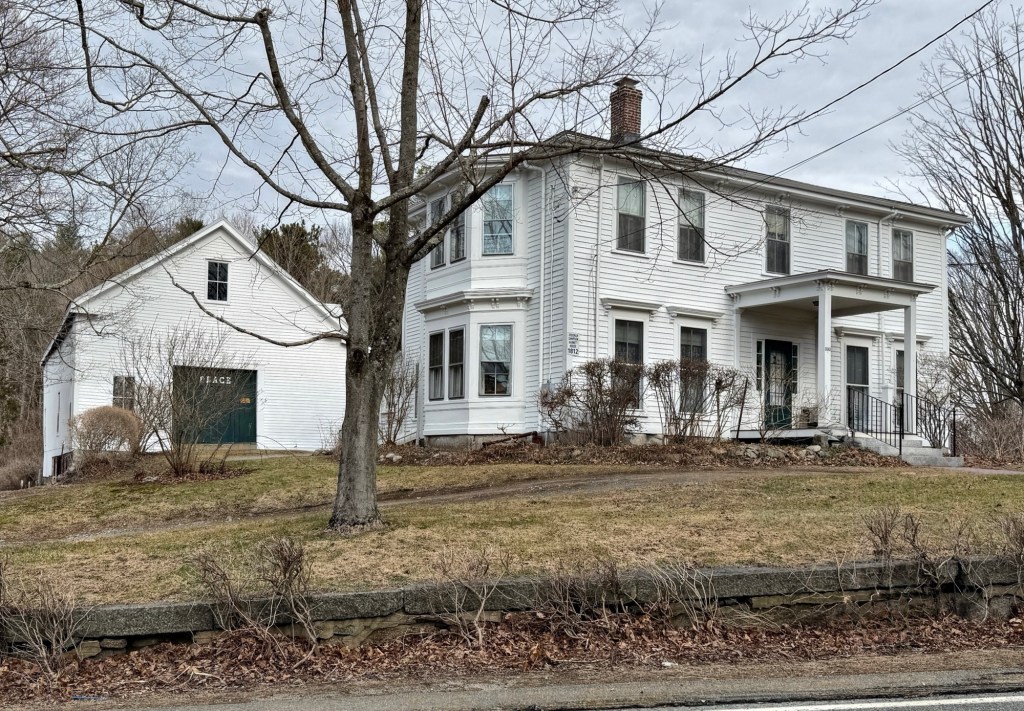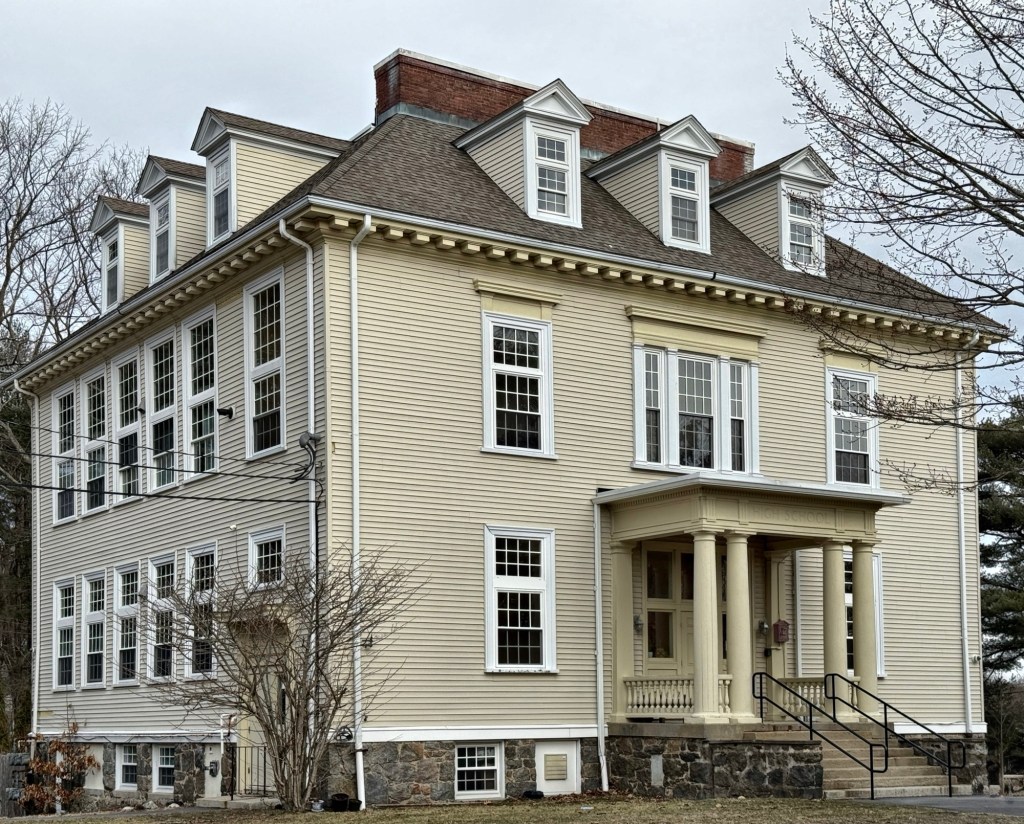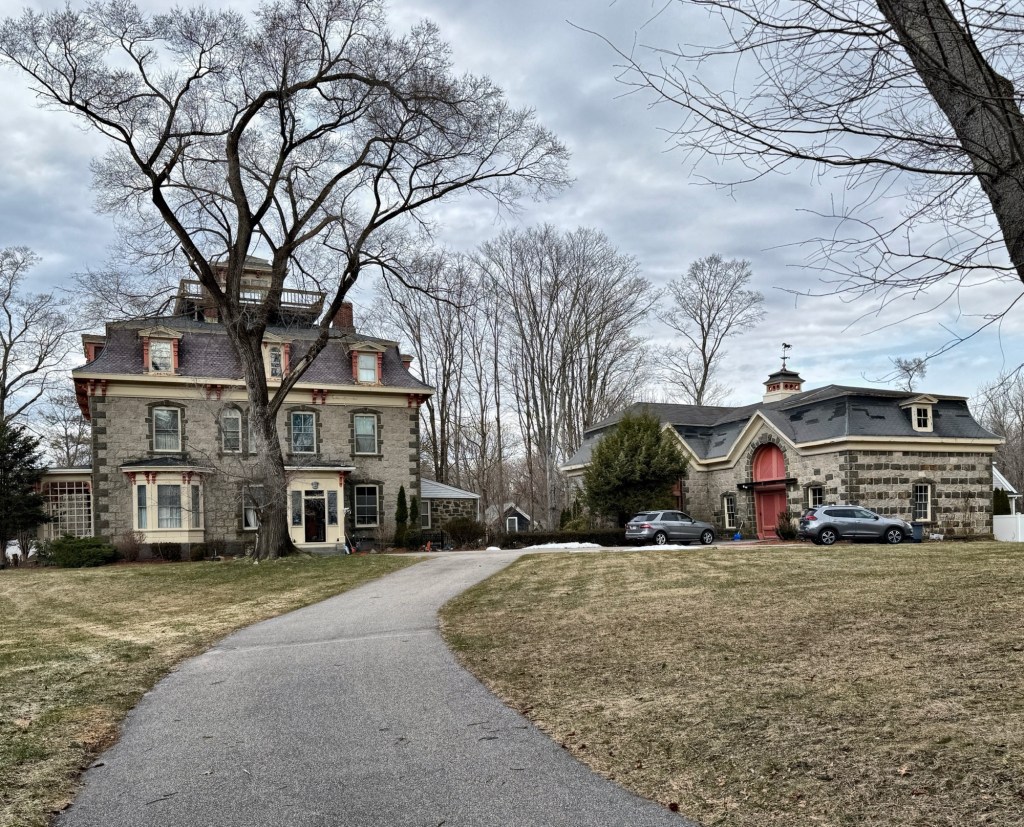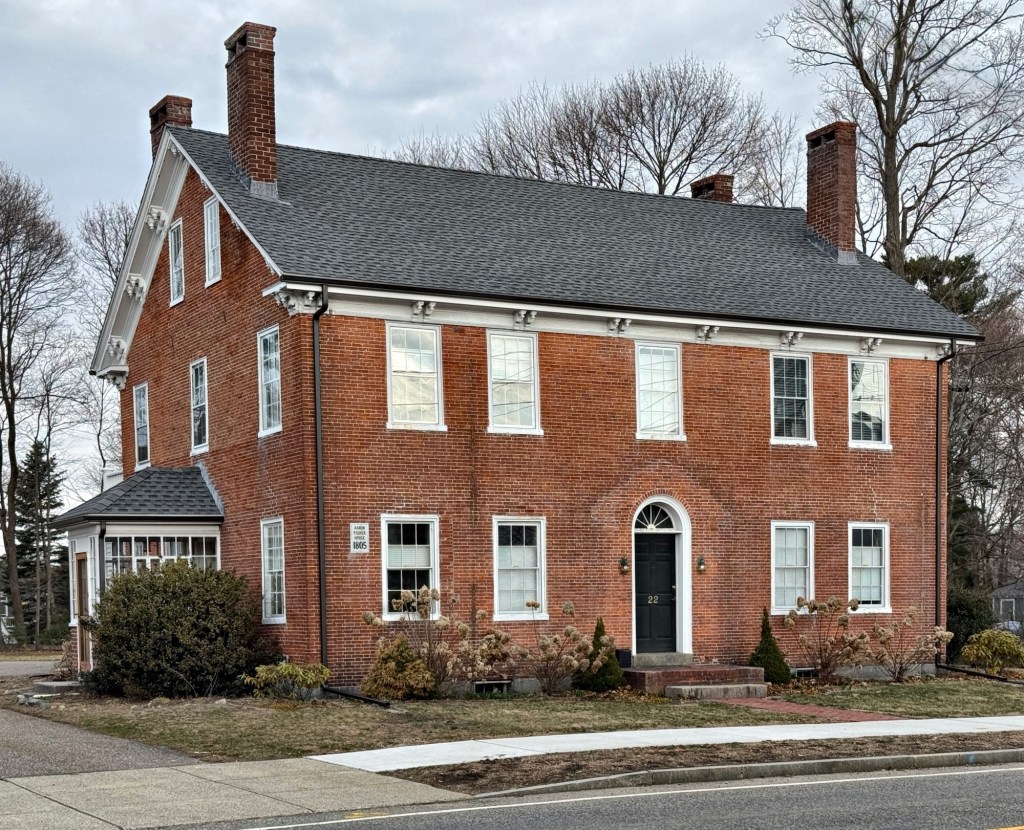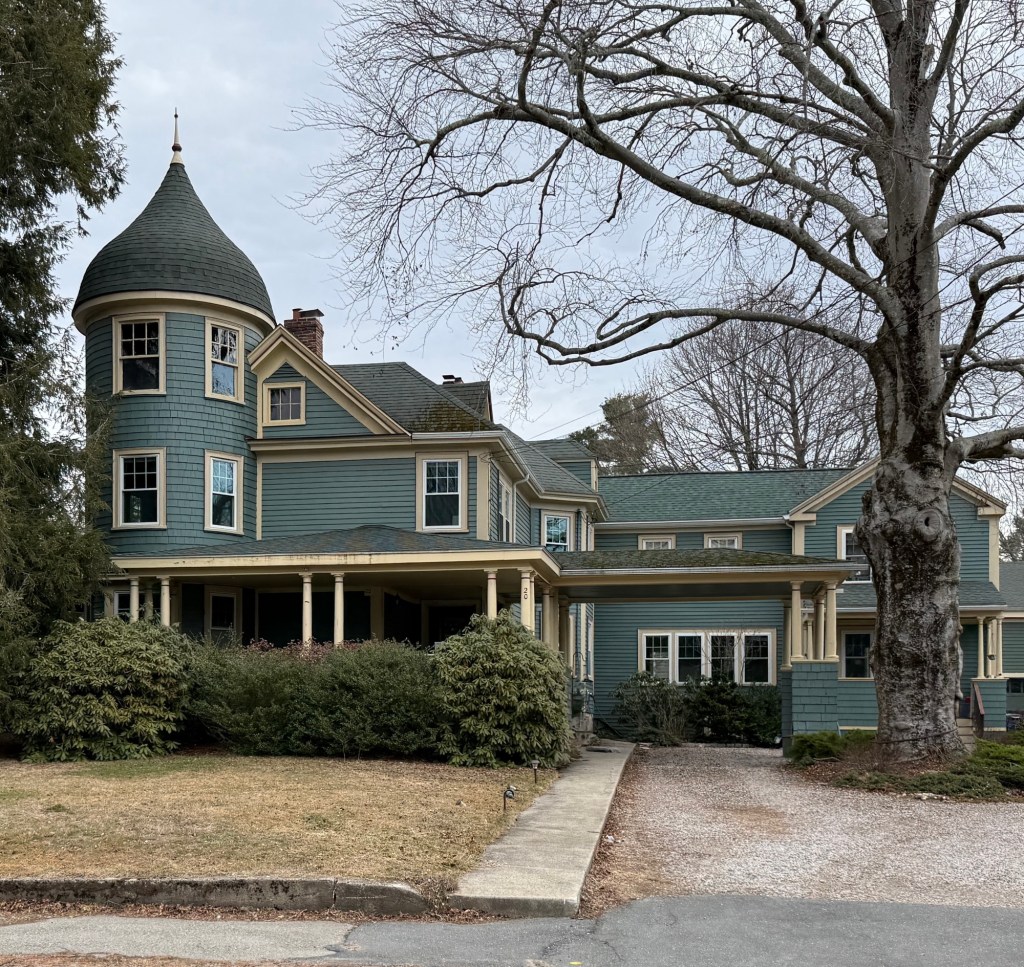
Lewis T. Hoar House // c.1800

While a part of this Warren, Rhode Island, home may date from as early as the late 18th century, it was completely “modernized” in the mid-19th century by owner, Lewis T. Hoar, a successful housewright, giving us the playful design we see today. Lewis Thomas Hoar (1810-1881) worked in partnerships, building many of the stately Italianate style residences in the village of Warren before entering politics, where he was elected as a state representative. Rather than building his own home from scratch, Lewis updated an earlier Federal period house, retaining its Federal-era hipped roof with monitor, but added the more intricate bay windows and porch, embellished with carved balustrade, brackets and ornament. The large property even retains a Second Empire style stable or barn, which has been preserved by later owners. 

George Cole House // c.1863

This stunning Italianate style residence with ample front yard on Cole Street in Downtown Warren, Rhode Island, was built for a prominent member of a prominent local family. William Bradford Cole, a local housewright and builder, constructed this handsome residence for his brother, George Cole, around 1863, just before he enlisted to fight for the Union in the Civil War, ultimately giving his life for his country in New Orleans in 1865. George Cole was the owner and proprietor of the famed Revolutionary-era Cole’s Hotel located a short distance up Joyce Street at the corner of Main Street until it burned in 1893. The George Cole House exhibits many of the hallmarks of the Italianate style, including: a low pitched roof with overhanging eaves and a bracketed cornice, an entry porch, and proportionally narrow windows capped with shallow hoods.

Warren Foundry & Manufacturing Co. // c.1895

The Warren Foundry and Manufacturing Company began manufacturing metal goods in the 1870s in Warren, Rhode Island. The company was started by Benjamin Miller Bosworth, and at first, the company only made wrought iron goods, but later expanded into producing iron and brass items. Its location next to the railroad tracks made the site perfect for importing raw material and shipping out finished products to markets all over New England. The original factory and smelting facility burned down in 1892, but Bosworth’s son, Walter, rebuilt the facility with this present building by 1895. The business closed by the 1920s and the unique wood-frame building with unique tower, has been adaptively reused as “The Mill at Warren Junction”, containing office and manufacturing space for small businesses.

Charles Wheaton Jr. House // c.1815

Charles Wheaton (1761-1863) enlisted in the his local militia at just 14 years old and served in Colonel Robert Elliott’s Regiment of Artillery to protect Narragansett Bay. After the war, Charles settled in Warren, Rhode Island, and married Abigail Miller. They would have at least nine children, with one of their children, Charles Wheaton, Jr., (1791-1863) marrying Abiah Goodwin Turner in 1815, the daughter of a wealthy sea captain. Around the time of their marriage, they built this house on Liberty Street in Warren in the Federal style with a three bay facade, monitor on hip roof, and portico at the entrance with Ionic columns. By the end of the 19th century, the house was enlarged and a bay window was added over the entry portico.

Liberty Street School // 1847

The Liberty Street School building in Warren, Rhode Island, was built in 1847 as only the third high school building constructed in the state, and is the oldest survivor of its style. Architect Thomas Alexander Tefft, one of the nation’s first professionally trained architects, designed the school when he was just 21 years old in the Italianate style, with a two-story form, center entrance set within a round-arched surround and a central projecting gable-end pavilion. The young architect would later take an excursion around Europe in the mid 1850s, but would fall ill with a fever in Florence, Italy and he died there in 1859. He was just 33 years old when he died. The Liberty Street School was remodelled as an elementary school at the turn of the 20th century and continued as a public school until the 1970s. The historically and architecturally significant building has sat vacant for years. The building is still owned by the Town of Warren, and after over decades of planning studies and proposals, the building remains vacant and deteriorating. What would you like to see as the future of the Tefft-designed Liberty Street School?

Salisbury-Johnson House // 1823

One of the great Federal style homes in the charming downtown of Warren, Rhode Island, the Salisbury-Johnson House at 43 Miller Street features many of the hallmarks of the prominent architectural style. The main body of the house was constructed by 1823 after Theophilus Salisbury (1781-1835) purchased the house lot at the corner of Union Street, possibly being moved from another site to the present location at this time. The two-story, five-bay façade is detailed by quoined corners and an exceptional center entrance with sidelights and large, elliptical blind fan carved from a single piece of wood. After later owners, the property was purchased by Rodolphus B. Johnson (1816-1884), a wealthy shipping agent who owned whaling ships and ran a wharf at the foot of Johnson Street nearby.

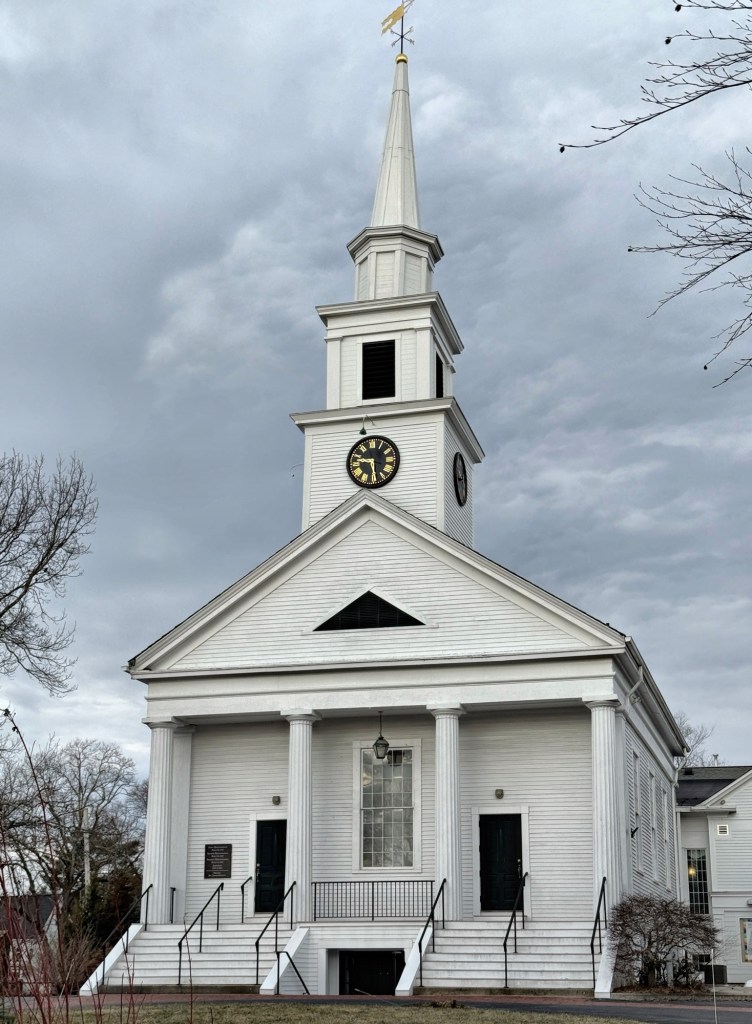
Warren Baptist Church // 1844

The Warren Baptist Church on Main Street in Warren, Rhode Island, is a landmark example of an ecclesiastical building in the Gothic Revival style completed in stone. Like many communities in Rhode Island, Baptists in Warren, were the first and largest denomination in the community, dating back to the 18th century. The congregation’s first purpose-built church was constructed in 1764 and was burned by the British in 1778 as they left Warren. Its replacement (1784) was demolished for the present building sixty years later. Interestingly, this site is significant additionally as the site of the founding of Brown University. as when Reverend James Manning was called in 1764 to take over the congregation and its new church building, he did so with the proviso that he could open a school for the training of Baptist ministers because all existing colonial colleges at the time provided for training only in the Congregational and Episcopal ministries. The school was located behind the present location of the church and it spent its first four years here in Warren, holding its first commencement in that church until the new school (and Reverend Manning as president) were lured to Providence, where Brown University has remained ever since. The present Warren Baptist Church was built in 1844 and was designed by famed Rhode Island architect, Russell Warren, who is best-known for his work in the Federal and Greek Revival styles, but here shows his expertise and skill in the Gothic mode. The building is notable for its lancet-arched windows and belfry with narrow lancet arched louvered windows set below the clock faces set in triangular trefoil tracery. The congregation also maintains Tiffany windows donated by members of the church.

Maxwell-Barton House // 1803

Built in 1803 for Captain Level Maxwell (1754-1828), this five-bay, Federal style house built of brick, is located on Main Street in Warren, Rhode Island, and has ties to the community’s maritime past. The original owner, Level Maxwell, was a member of the wealthy Maxwell Family who built their wealth in shipbuilding and the triangle trade. Level Maxwell was a captain and invested in ships, including the schooner Abigail, which would become Warren’s first slave ship in 1789, two years after slave trading had been declared illegal for Rhode Island residents. The Abigail was designed with a middle deck less than five feet high, where the kidnapped Africans would be imprisoned, with sources stating that 64 African men, women and children were forced onto the ship and then imprisoned for two months on the journey across the Atlantic. Eleven enslaved people died on the journey and were likely thrown overboard into the open sea, with the surviving 53 people sold into slavery in the Caribbean, with the Abigail returning home with the profits. It is unclear if Level Maxwell lived in this house or built it for sale, but the property was owned in the mid-19th century by George A. Barton, a merchant. The property was owned in the late 20th century by Mary King, who restored the old house and operated her antique store from the residence. Architecturally, the home exhibits many features of the Hazard-Gempp House nearby on Liberty Street, and was likely constructed by the same builder.

Hazard-Gempp House // c.1800

This elegant brick Federal style residence in Warren, Rhode Island, was built around the turn of the 19th century, sometime after Liberty Street was laid out in the mid-1790s. An excellent example of the Federal style finished in brick, the three-bay residence features a projecting belt course between the first and second stories, corbels and flared lintels at the windows, a hipped roof surmounted by a small, centered platform, and an elaborate entry with pediment and elliptical fanlight transom. The builder is not known at this time, but the house was owned by George C. Hazard and later inherited by his son, George G. Hazard and later by Mary Jane Hazard, who remarried to Lucius Warner. In the early 20th century, the property was purchased by Gottlieb and Louise Gempp, proprietors of the local American-German Club. Despite having its brick painted, the Hazard-Gempp House remains as one of the town’s great and well-preserved Federal period homes built of brick.

Joyce Street School // 1903

Built in 1903, the Joyce Street School in Warren, Rhode Island, is an excellent example of an early 20th century public school building constructed in the Colonial Revival style. To keep up with a growing population town officials hired architect, Albert Humes, to furnish plans for a new primary school on a lot behind the Town Hall. The handsome school is constructed of brick with a stone foundation and trim of marble and granite with a projecting entrance pavilion, and segmental-arch windows at the second floor. In 1940, the Joyce Street School became a grammar school to house grades 5 to 8, and the building was completely renovated in 1950. The Building was decommissioned as a school in the mid-1970s and later went through a $2.5 million renovation with an addition at the rear to house the Central Fire Station and the Police Department in the former school, a use that remains today.