Chamberlain Cottage // 1940

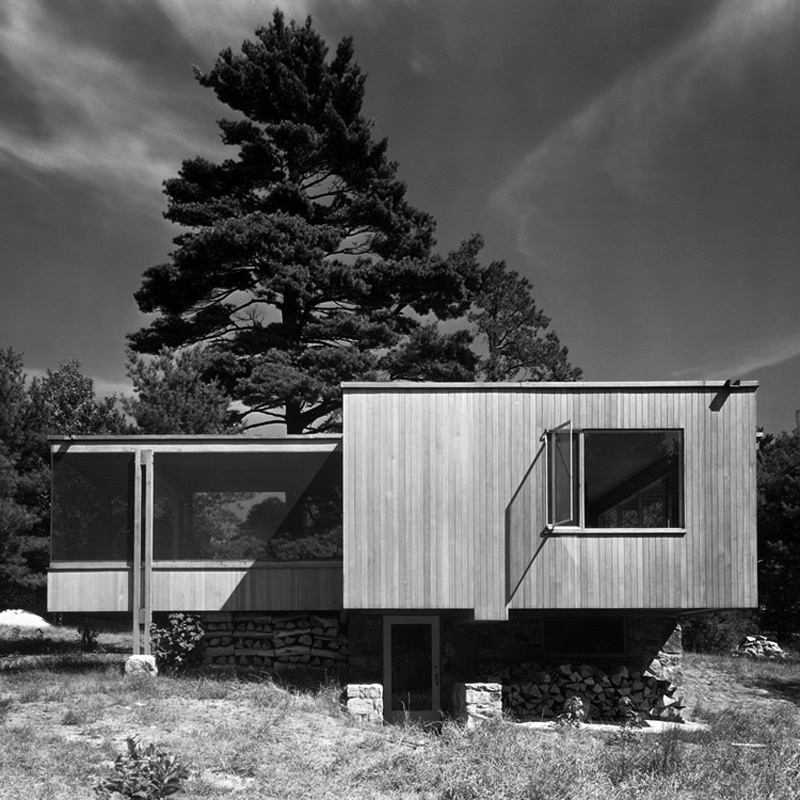
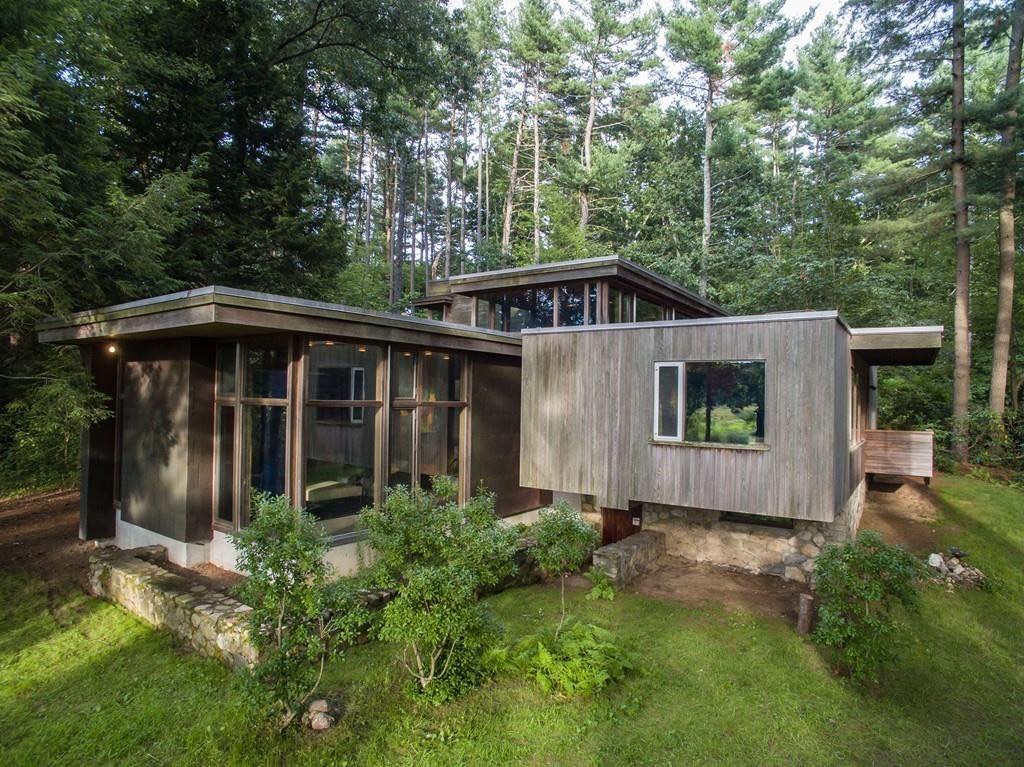
Nestled into the forests of Wayland, Massachusetts, one of the most significant examples of early Modernist architecture, the Chamberlain Cottage, represents the European Bauhaus style adapted to the American landscape and New England vernacular. Designed in 1940 and completed in 1941, the house was commissioned by Harvard Economics professor, Henry Chamberlain and his wife, Margareth, as a weekend retreat from Cambridge. Professor Chamberlain commissioned Marcel Breuer and his mentor, Walter Gropius, then Dean of the Harvard Graduate School of Design, to design a home with a specific request for a screened porch similar to Gropius’ residence in nearby Lincoln. For the Chamberlain Cottage, the design responds to the uneven terrain and the potential for river flooding by two distinct parts: a grounded stone base and a cantilevered wooden volume above. The lower stone level functioned as a foundation while providing storage for a canoe and housing a fireplace that extends vertically through the structure; with the upper wooden volume containing living spaces. Despite its compact size for weekend visits, the upper level is well planned and includes a living space, kitchen, a single bedroom, and the porch. Due to its small scale and siting, the one-bedroom cottage was not easily adaptable for modern living. After falling into disrepair in the 1980s and ’90s, the home was purchased by architects Sidney R. Bowen and Angela Watson, who expanded the structure over the course of a decade to its current size of 3,742 square feet. It has been occupied and lovingly maintained by later owners. It remains a private residence.

Nourse-Sawyer House, Bolton Historical Society // c.1805

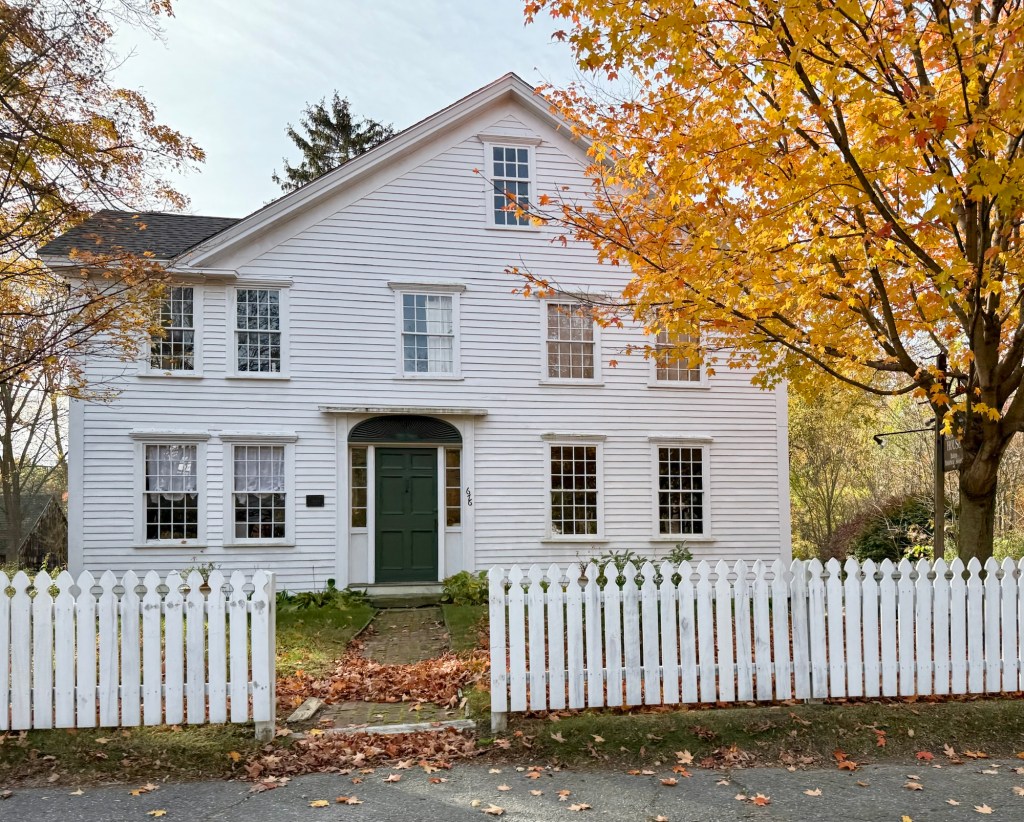
The building that became the Bolton Historical Society in Bolton, Massachusetts had unusual beginnings. According to town records, this residence-turned-historical society was built around 1805 as an addition to the famed Holman Inn, which stood in town from 1767 until its demolition in the 1870s. The wing contained a ballroom on the first floor, and guest chambers on the second. The main part of the inn was eventually torn down in 1874, but the east wing, this structure, was moved down the street to the present site, where it was converted to a house by owners Charles S. Rich, a Civil War veteran, and his wife Mary. In 1904, the house was bought by Arthur H. Nourse, who enlarged the property by purchasing adjacent land from his uncle, and bought two small buildings from the Town of Bolton, the historic engine house and old hearse house, which he moved to the site. The house was purchased in 1923 by Perley and Florence Sawyer. Mrs. Sawyer was a charter member of the Bolton Historical Society at its founding in 1962, and later, by 1970, she gave the house, with over three acres of land, to the Society. The property is still owned by the Historical Society, which operates it as a house museum and a repository for local historical documents.

Nathaniel Thayer Mansion // 1902

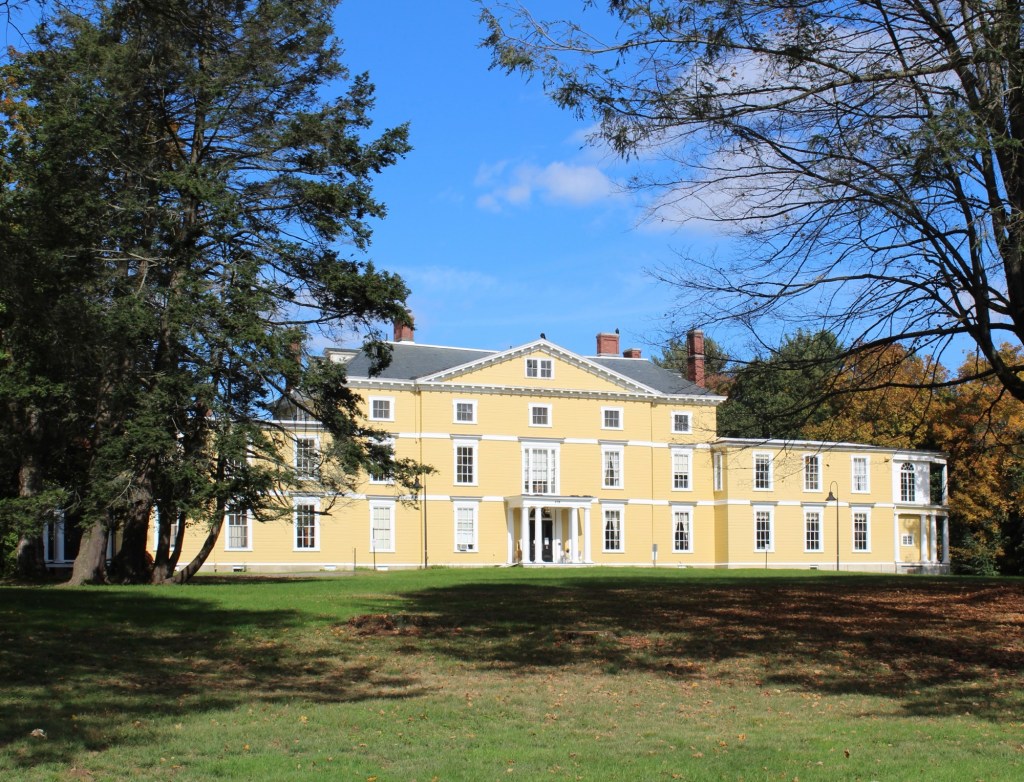
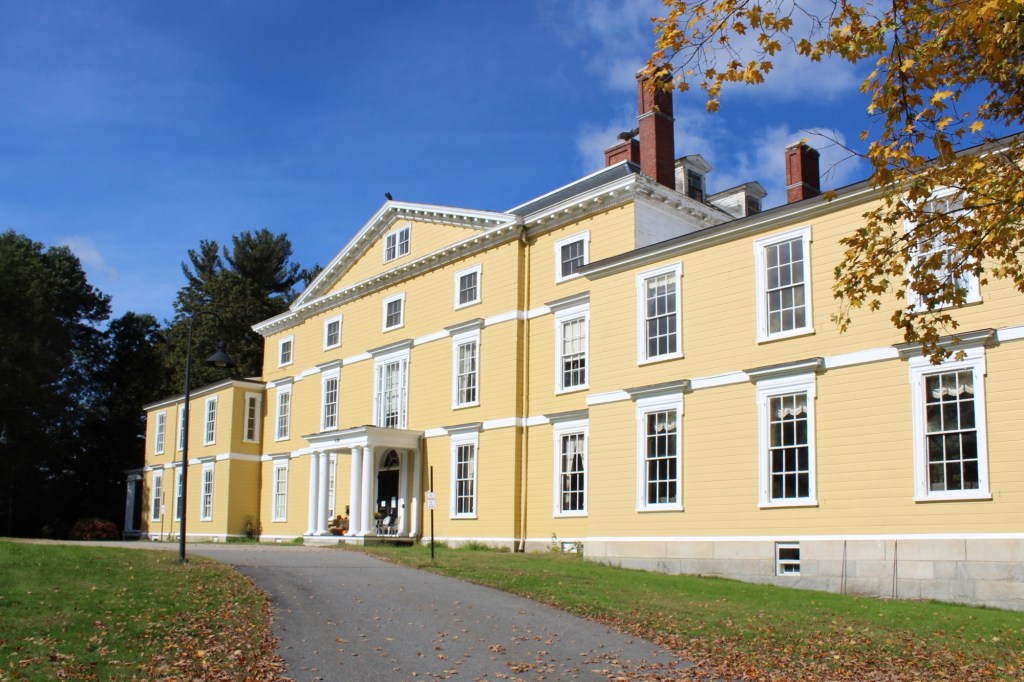
The Thayer Family is one of the most prominent and well-connected families of New England, and that stature comes with handsome estates. Nathaniel Thayer (1801-1883) was born in Lancaster as the son of Reverend Nathaniel Thayer (1769–1840), a Unitarian congregational minister. Nathaniel Thayer Jr. made his fortune in businesses and held deep ties to his hometown, despite spending most of his time in Boston. He took down the original Thayer home on this site and developed the estate in the 1850s. After his death, the property was inherited by his son, Nathaniel Thayer III (1851-1911), and the house was enlarged and remodeled in the Georgian Revival style in 1902 by the architect and interior designer Ogden Codman Jr. The mansion served as a summer home to Nathaniel, who too spent much of his time in Boston. After his death, the 46-room mansion was sold out of the Thayer family with many of its furnishings sold at auction. The Nathaniel Thayer Mansion house was sold to Atlantic Union College in 1943 at a cost of $12,500. It was used as the school’s administration building between 1945 and 1951, and then as a dormitory until about 1970. From 1973 to present-day, the estate has been home to Thayer Conservatory, Center for Music and the Arts, who do a great job at preserving this significant landmark.

Edward Stanwood House // 1880

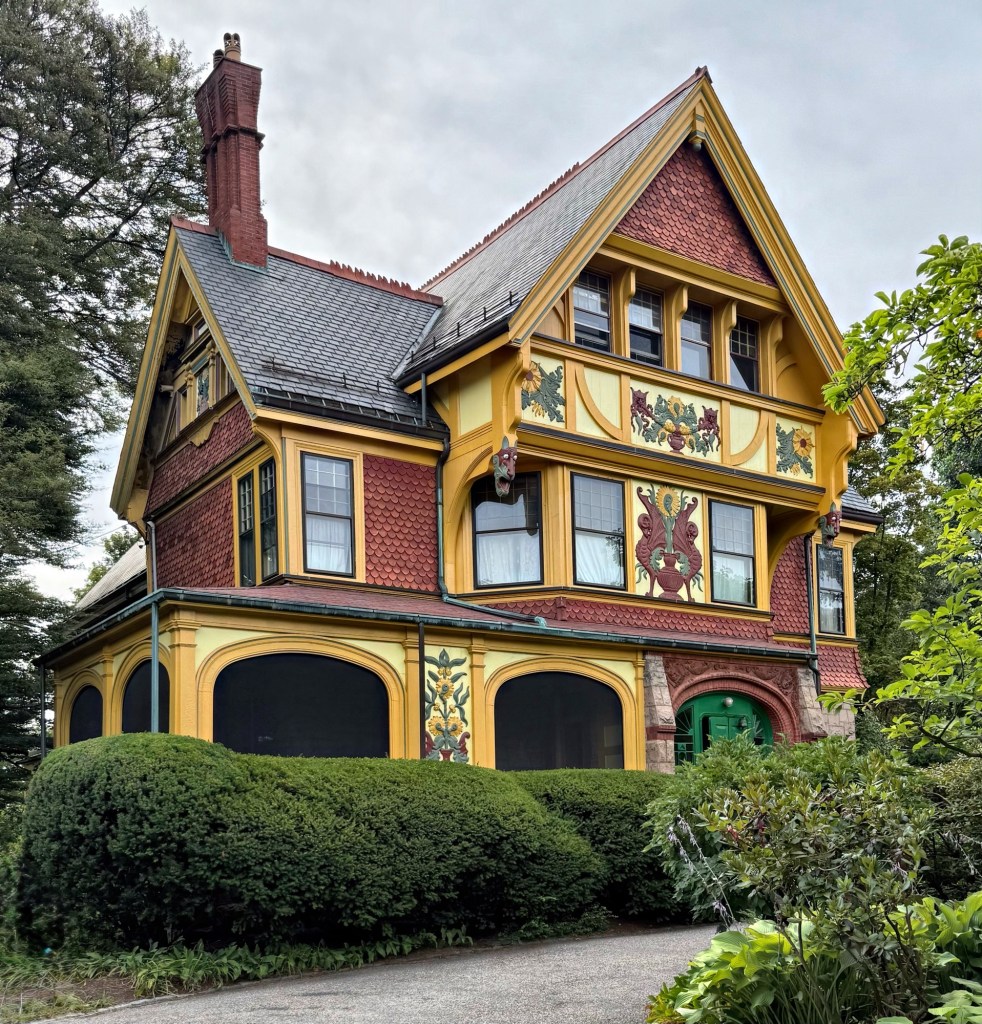
The Edward Stanwood House at 76 High Street in Brookline, Massachusetts, is one of the finest and exuberant examples of the English Victorian Queen Anne style, notable for its varied wall textures and materials, unique form, and applied ornament. The house was built in 1879-1880 for Edward Stanwood, who was for many years the editor of the Boston Daily Advertiser, and a children’s magazine, The Youth’s Companion. The ornate residence was designed by Clarence Sumner Luce, with interiors by Thomas Dewing. The Stanwood House features a well-preserved exterior and period-appropriate paint scheme, highlighting the bas-relief sunflower ornament and gargoyles. Of particular note is the use of hung tile siding, overlaid to give the appearance of fish scales and the roof cresting.

Larkin-Ladd House // c.1813

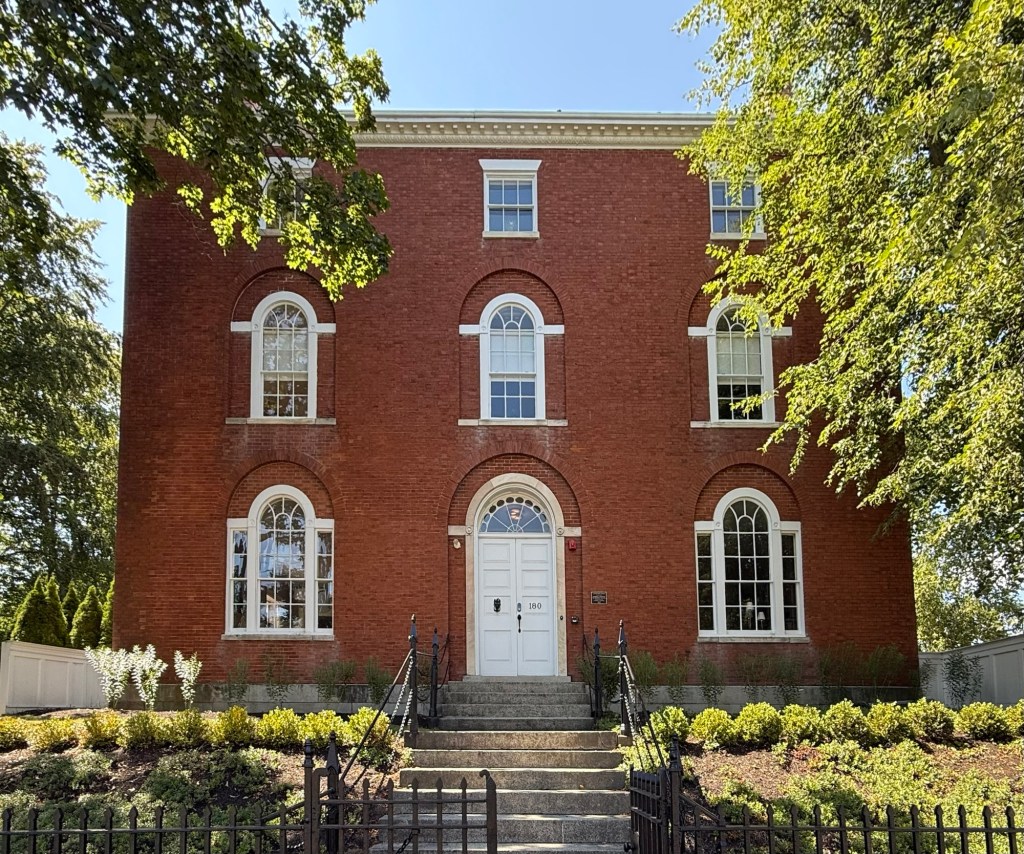
The Larkin-Ladd House at 180 Middle Street in Portsmouth, New Hampshire, is a three-story, masonry Federal-style residence with symmetrical facade, built for one of the city’s wealthiest merchants. Samuel Larkin (1773-1849) was born in Charlestown and moved to Portsmouth, marrying Ann Jaffrey Wentworth, a daughter of Col. Joshua Wentworth. During the War of 1812, Samuel Larkin made his fortune as an auctioneer, selling the contents of English ships captured by local privateers. It is believed that fourteen privateers and their crews worked out of Portsmouth Harbor and are said to have captured an estimated 419 British ships! With the profits from stolen goods from these British ships, Larkin purchased lots on Middle Street and began construction of this stately residence. He (and mostly his wife), had twenty-two children, although roughly half of them died before reaching adulthood. By the late 1820s, financial hardship fell on Larkin and he sold this property, moving into his house next door, which before this was his original residence and later rented to boarders. The Federal style mansion was later owned by Henry H. Ladd, a prosperous Portsmouth shipping merchant, who also served as President of New Hampshire Bank and Portsmouth Savings Bank. The Larkin-Ladd House is undoubtedly one of the finest Federal style residences in New England, and stands out for its entrance, flanked by Palladian windows and the slightly recessed elliptical surrounds at the first and second floor windows. Additionally, the historic stable, also from the 1810s, maintains much of its architectural integrity.

General John Thomas House // c.1761

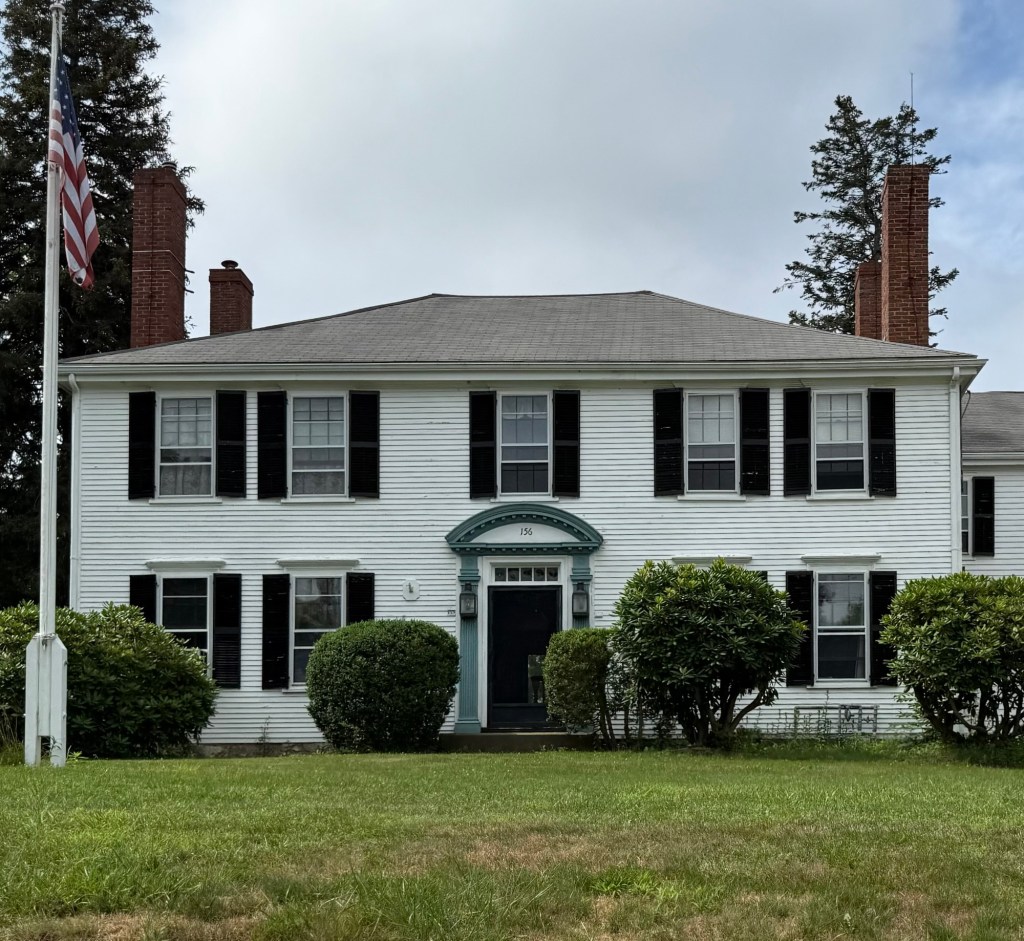
The General John Thomas House at 156 Main Street in Kingston, Massachusetts, is significant as a pre-Revolution Georgian style residence and for its connections with a notable Patriot. General John Thomas (1724-1776) was born in Marshfield and later studied medicine, completing his studies in 1746 at the age of 22. He practiced medicine until being appointed in March 1746, as assistant surgeon by Governor William Shirley in Samuel Waldo’s regiment. Liking military service, in 1747 he traded his post as surgeon for that of a lieutenant. By the time of the French and Indian War he had risen to colonel in the militia. After the war, he married Hannah Thomas in 1761 and either built or moved into this house in Kingston, where he practiced medicine. In the years leading up to the American Revolution, John Thomas was a Brigadier, and briefly resigned from the ranks, disappointed that while four major generals were named, he was not on the list. Congress was then trying to name no more than one major general from each state, and Artemas Ward was given preference. George Washington implored him to remain, and John Thomas returned to service. The Congress resolved that he would be given precedence over all other brigadiers in the army. On the night of March 4, 1776, he led his division to fortify the Dorchester Heights, overlooking the south harbor at Boston, by using cannon that Henry Knox had brought from Fort Ticonderoga. From that position, he threatened the British fleet and the British were forced to withdraw, evacuating Boston on March 17. Thomas was finally named a major general. Soon after, Thomas was assigned to command in Canada and take charge of the Canadian invasion. He joined the army besieging Quebec and remained there until he died of Smallpox in June 1776, not living long enough to see a free America. The John Thomas House is a lasting and important physical vestige of his legacy.

Joshua Orne House // c.1750

Joshua Orne (1708-1772) was born in Marblehead and attended local schools there. He would marry Sarah Gale, and they had one son together, Azor Orne, who would become a merchant, politician and patriot, fighting in the American Revolution. Sarah Gale died in 1743 and Joshua would remarry to Annis Stacey, having one child together, Joshua Orne Jr., who was a Patriot and fought in the Revolution, fighting alongside his half-brother, Azor. Joshua Orne and Annis owned a c.1663 house on this site and appear to have completely rebuilt the house or greatly modernized it around 1750. Joshua was a cordwainer and shipowner and later got involved with discussions of revolution and liberation from England. He likely inspired his sons to follow-suit and shared the same beliefs and values, though Joshua Sr. would die in 1772, not seeing the beginning of the War, nor freedom from tyranny. The house would be inherited by Joshua Jr. and later deeded to his son-in-law, John Bubier Prentiss, a shipmaster, who likely added the Federal period doorway and pedimented dormers.

Highfields Estate // 1821

Constructed in 1821 for Joshua King (1783-1849), this Federal style mansion is one of the last country estates in Abington, Massachusetts. Joshua King was a Deacon of a local church and a well-to-do citizen in town, living nearby until a hurricane blew the roof off of his former house. Seeking to rebuilt a new, more substantial family home, it is said that Joshua required that this house would be built to last centuries, with some residents stating that the roof structure itself had enough timber to build a second home. The Federal style mansion has three chimneys with 12 fireplaces inside, and is set amongst rolling fields bounded by old stone walls, likely giving the property its name, “Highfields”. The property was later converted to a duplex, but retains much of its original design at the exterior. 

Edward Waldo House // c.1715

The Edward Waldo House in Scotland, Connecticut, is a vernacular Georgian house with saltbox roof and wings which from its erection about 1715 until 1971 was owned by members of the Waldo family. Edward Waldo (1684-1767) purchased land here along the Shetucket River in 1702 and by 1715, erected this house. The saltbox house which Edward Waldo built was one of the first houses in the town of Scotland and would remain in successive generations of the family for centuries. The house was the birthplace of Samuel Lovett Waldo (1783-1861), a portraitist who was a founder of the National Academy of Design as well as Daniel Waldo, chaplain of Congress, 1856-1858, and was one of seven Revolutionary War veterans who, having survived into the age of photography, were featured in the 1864 book The Last Men of the Revolution. The last Waldo owner, Miss Ruth Waldo died in1975. She insured the preservation of her family homestead by bequeathing the house, its contents, and about 15 acres of land to the Antiquarian & Landmarks Society of Connecticut Inc. and the surrounding acreage to the Connecticut Forest and Park Association, creating an enduring legacy for centuries to come. The house, set amongst a quiet country road, is evocative of early days in Scotland, Connecticut, and is one of the finest-preserved Colonial homes in this part of the state. 

Huntington Homestead // c.1715

The Huntington Homestead in Scotland, Connecticut, was the birthplace and boyhood home of Samuel Huntington (1731–1796), a Founding Father, a signer of the Declaration of Independence and a distinguished statesman during the Revolutionary War and early Republic. The remarkably well-preserved site includes an eighteenth century house on its original foundation surrounded by acres of farmland and is now protected as a museum. The house was built sometime between the transfer of land in 1715 from Deacon Joseph Huntington to his son Nathaniel, and Nathaniel’s marriage in 1723 to Mehetabel Thurston. As originally constructed, the house consisted of a two-story structure with an end chimney on the west end and one large room on each floor. By the time of Nathanielís death in 1767, the house had been doubled in size with the addition of two rooms west of the chimney, giving the house its current five-bay form. The Georgian style Colonial-era home features a symmetrical facade, twelve-over-twelve windows, and a saltbox roof and is one of the finest Colonial-era homes in this part of the state.