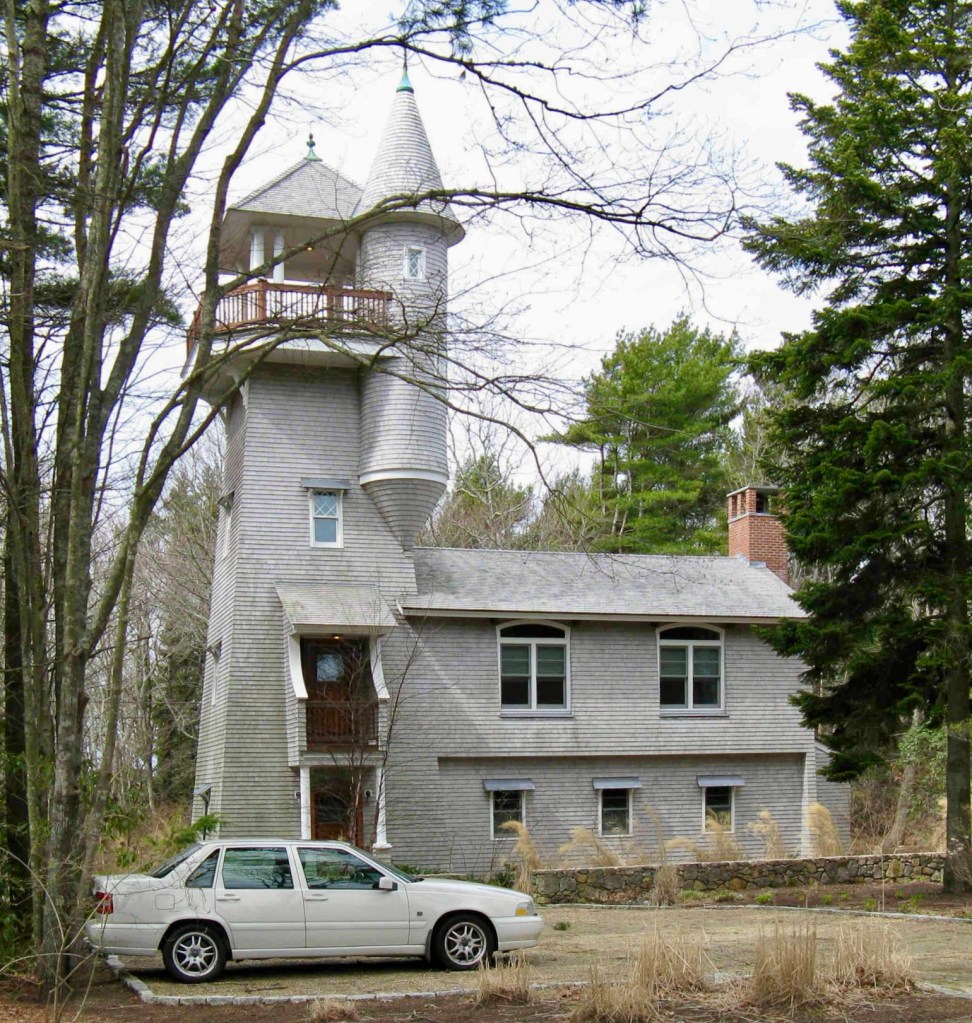
At the tip of Converse Point, a peninsula in Marion, Massachusetts, jutting into Buzzards Bay, a once great estate was built at the turn of the 20th century as the community saw many wealthy summer cottages built. One of these owners was Harry Elisha Converse (1863-1920), who purchased land here in 1898 and razed earlier cottages to build The Moorings Estate. Harry E. Converse was President of the Converse Rubber Company, which produced winterized rubber-soled shoes and boots and later shifted to make footwear for the military, and is today known simply as Converse, the internationally known footwear and apparel company. In 1902, Converse hired architect, Tristam Griffin to design his new summer “cottage”, the Moorings, which was said to be the largest residence in Buzzards Bay at the time and rivaled the size of many area hotels. Part of the estate included a carriage house, cottages for family and friends, and this building, which was constructed as a bell tower and observatory near the entrance of the property that provided sweeping views of the grounds and surrounding coast. The 40-foot tower was designed in the Shingle style like the main house and featured a one-ton bell at the top. It was eventually connected to electricity and later provided a fire alarm for the entire estate. After the death of Harry E. Converse in 1920, the property was conveyed to three of his children, who subdivided the property which became too much to maintain as a summer home. The former observatory was acquired by Parker Converse and later converted into a residence, by him or his son, Courtland Converse. The unique structure is a lasting remnant of what was once the largest estate in this part of Massachusetts.