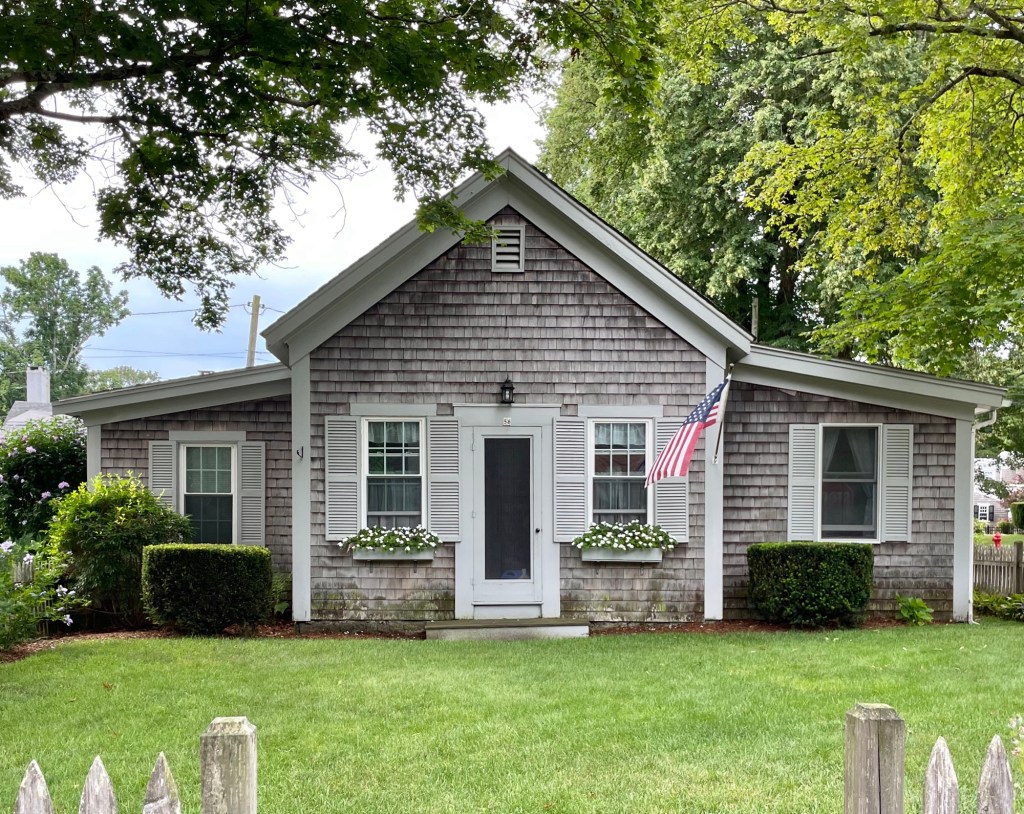
Built around 1830, this little cottage is among the many photogenic buildings found along the idyllic Main Street in Marion, Massachusetts. The structure is said to have been originally located behind the Congregational Church and moved to its current location after 1855. By 1879, the structure was converted to a residence and owned by Ms. Sarah Ryder, then the widow of John C. Ryder. The vernacular cottage is sheathed in weathered shingles, which enhances its beauty and connects it architecturally with the coastal community.
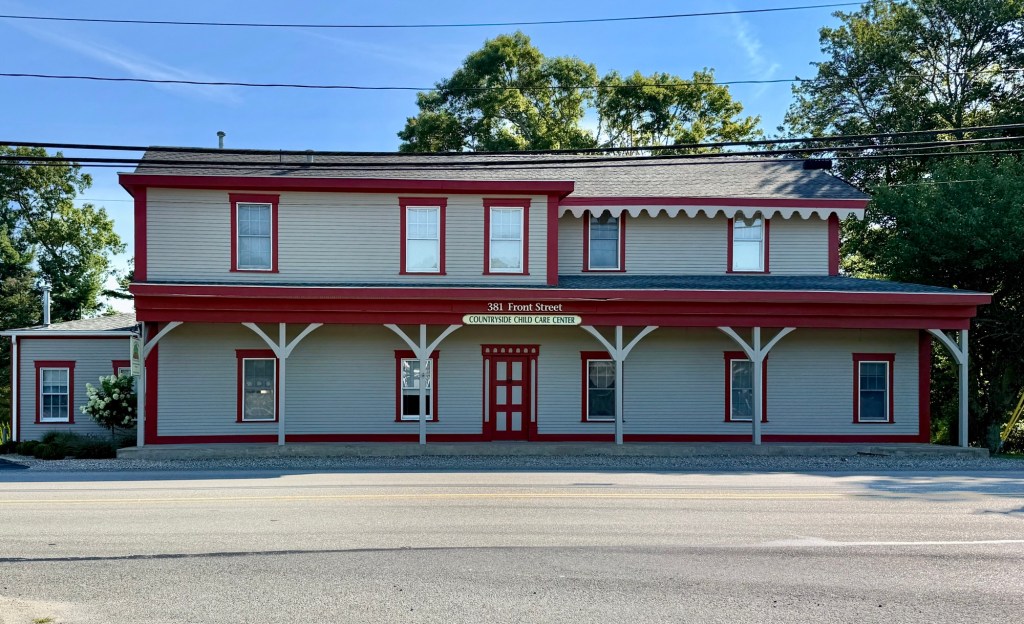
The Marion Railroad Station was built in about 1855, around the time of the arrival of the first passenger rail service to Marion, Massachusetts, a new town which incorporated just three years prior. While no train service runs through the town today, historically, the community was well-connected to Boston, Cape Cod, and towns all over the South Coast of Massachusetts. The Fairhaven Branch Railroad was incorporated in 1849, chartered in 1851, and built from 1852 to 1854 to connect Fairhaven with West Wareham and lines beyond in Cape Cod and Boston. This station was built by the time the line opened and it stands as a larger, two-story Victorian station which serviced the area’s passenger and freight travel here. The New Bedford and Taunton Railroad bought the line in 1861, which too merged into the Old Colony Railroad in 1883. As use of rail travel declined, passenger service ended in Marion by 1935, followed by freight service in 1953.The former station was sold to private owners and since 1988, has housed a childcare center. Despite the second story addition and later renovations, the building still retains its unique character and bargeboard detailing.
Reportedly built in 1790, this stately Federal period residence on Main Street in Marion and overlooks the sheltered harbor sharing strong connections to the sea. Known colloquially as the House of the Two Captains, this residence was built as a double house and known for its connections to sea captains, Elisha E. Luce (1786-1850) and Noble E. Bates. Captain Luce moved into this house shortly after his marriage to Jane Hiller, daughter of a local Deacon. Particularly note-worthy is the main facade’s center entrance, which exhibits unusually fine surrounds, including fluted Doric pilasters and a pediment enlivened by dentils. Inside, the house is said to have hidden passages behind a large fireplace. The captains used part of the house as a crockery and supplies store. Captain Elisha E. Luce’s best-known ship was the Persia, which made numerous profitable trade missions to the Far East. This house was also the birthplace of the Universalist Church in Marion, when during the early 1830s, Universalists met in Captain Bates’ half of the house to organize a religious society and plan the construction of the church. The Luce and Bates families co-owned this house until the mid-19th century and the residence remains one of the finest in the harbor village.
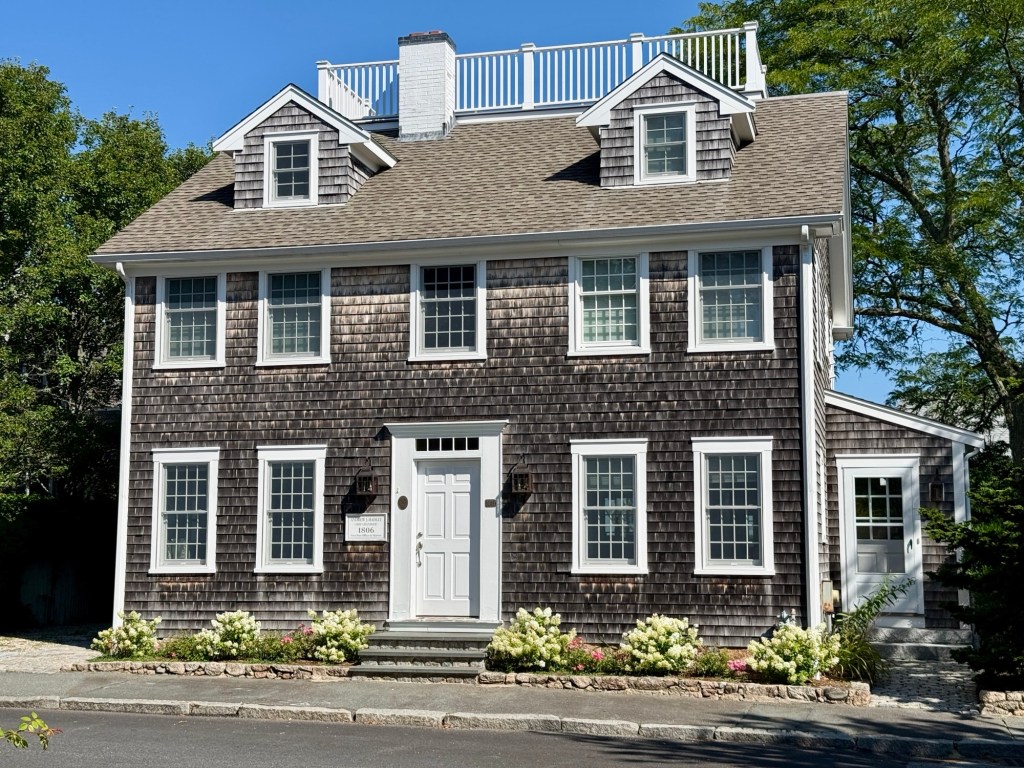
This late-Georgian style residence on Main Street in Marion’s Wharf Village is a stone’s throw from the harbor and has been conveniently located near the town’s Long Wharf since it was constructed around 1806. The building was constructed as a store for A. J. Hadley, where ships were outfitted for voyages. While Hadley’s store occupied the eastern half of the first story, the left side of the ground floor was Marion’s first post office. The second floor served as a clothes-making factory with the top floor operating as a sailmaker’s loft. By 1855, the structure was converted to a residence and owned by Sumner Ryder, who served as the Town Clerk and later joined the ranks of the Union Army during the Civil War. During the early 20th century, the property, with its widow’s walk, was owned by members of the Harwood family, including Ms. Sarah W. Harwood, who lived here with Margaret French (1860-1935) who was listed in the Census for decades as her partner, housemate, and boarder.
Tucked into the woods in Marion, Massachusetts, the Marconi Wireless Transmitter Station stands as one of coastal New England’s most remarkable and now largely forgotten technological landmarks. Built in 1914 by the Marconi Wireless Telegraph Company, the Transmitting Station in Marion served as an important piece of the American half of a transatlantic relay system, sending powerful signals across the ocean to a receiving partner in Stavanger, Norway, through a sister station in Chatham. At the height of its operation, the site bristled with fourteen 400-foot tubular steel masts arranged in a rectangle stretching nearly a mile, a feat of engineering so audacious that contemporaries dubbed it a “wonder of the twentieth century.” The station in Marion included a cluster of buildings including: a powerhouse, an operating building, cottages, and an employee “hotel” pictured here that housed unmarried staff, were all built to service the towering steel structures, of which only one remains. The site was taken by the U.S. Military during WWI and WWII and later sold to a private owner and the property was subdivided and sold-off with the majority of the original 144 acres of land comprising the station donated to the Sippican Lands Trust in 1986. Scattered remnants of equipment remain on this mostly-wooded conservation land, including wires, concrete mast footings, and cables. The single remaining tower serves as a cell tower today. The old Employee Hotel is now used for offices.
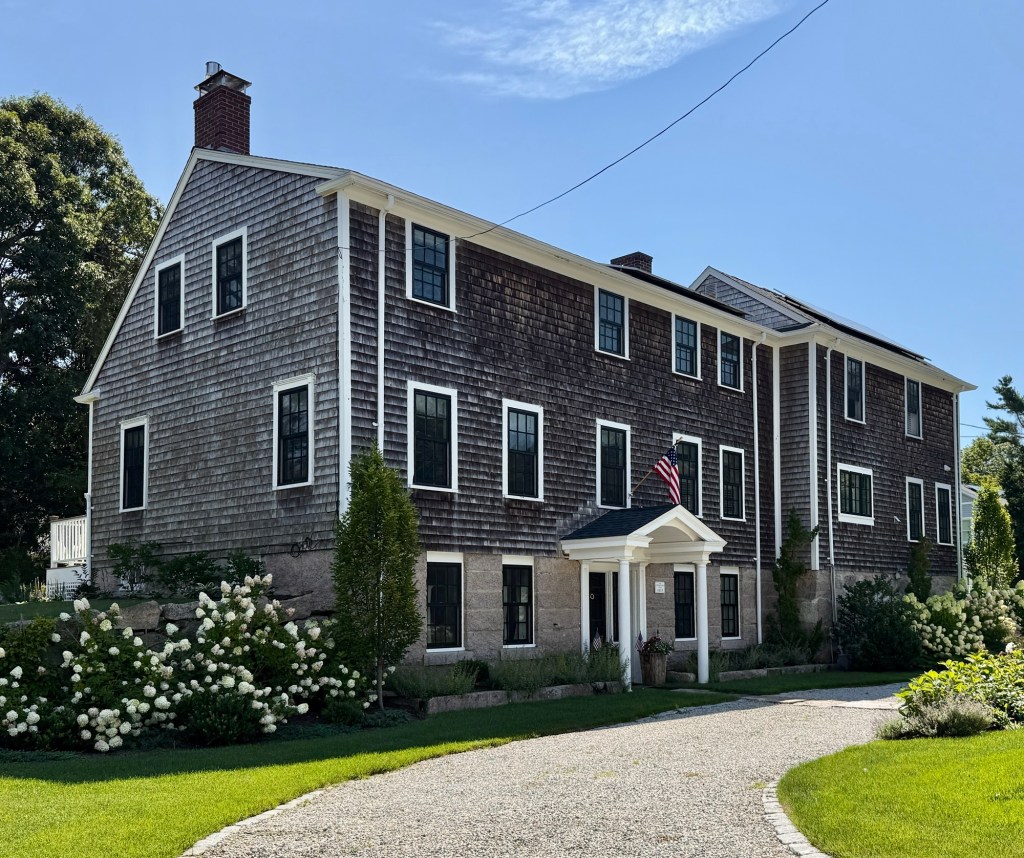
Known as the “Old Parsonage” this historic house in Marion, Massachusetts, was built in 1813 by Capt. John Pitcher (1788-1867) around the time of his marriage to Catharine Clark. John Pitcher was the brother of Elizabeth Pitcher Taber, a major benefactor of the town of Marion. The residence is unique in that the primary facade is actually facing away from the street, with the prominent three-story facade being the historic rear of the home. The Federal period house sits on a raised stone foundation with a central door and shingle siding above. Behind his home, a large pasture was grazed by sheep and cows until the land was sold off and subdivided for residential development later in the 19th century. When Capt. Pitcher died, he left his house to the Congregational Church, which used it as a parsonage for many years until 1966, when the church sold the property to Lawrence P. and Edith G. Pangaro, who co-founded the Marion Sentinel and the Sippican Publishing Company. The home was recently renovated.
Built in 1841, the Congregational Church in Marion, Massachusetts, is a stellar example of a mid-19th century ecclesiastical building designed in the Greek Revival style that represents the town’s evolution and prosperity through today. During the 18th century, area residents had to travel all the way to Rochester Center on Sundays to worship as this village was a part of Rochester until 1852, when it set off as its own town. Instead of keeping the Wampanoag name Sippican, meaning ‘land of many waters’, the people of present-day Marion chose their name in honor of General Francis Marion, a Revolutionary War hero from South Carolina who became a celebrated military leader during the American Revolution. The original 1799 Meeting House was replaced by this handsome structure, when ten Marion sea captains each contributed $1,000 towards its construction. The church’s completion in 1841 marked the beginning of the nine year co-pastorate of Rev. Oliver Cobb and his son, Rev. Leander Cobb at the height of prosperity for the coastal community. The church is characterized by its boxy, rectangular form with its primary facade treated as a portico in antis crowned by a closed pediment and the iconic multi-stage clock tower which remains an important landmark in town.
Tucked into the heart of Wharf Village, the main village in the charming coastal community of Marion, Massachusetts, this building which is known today as the Marion General Store, wears its history quietly beneath a deceptively simple Greek Revival facade. The structure was constructed in 1799 as Marion’s first Congregational Meeting House, where religious services of the congregational church were conducted before the separation of church and state. The construction of this wood-frame building did more than give the faithful a place to worship, it anchored Wharf Village as the commercial and civic center of town, setting in motion the currents that would eventually set Marion off from its mother-town, Rochester in 1852. By the 1830s, the old meeting house was in poor condition, and along with the push for a separation of church and state and tax dollars no longer going to the Congregational Church, a grander Greek Revival church was built across the street. The Old Meeting House was also renovated in the Greek Revival style and operated as Delano Hall, a store with dance hall and meeting space on the upper floor. The building lives on today as the Marion General Store, with its old clapboards and pilastes holding the layered history and architecture of the seaside community that grew up around it from working port town to wealthy coastal village.
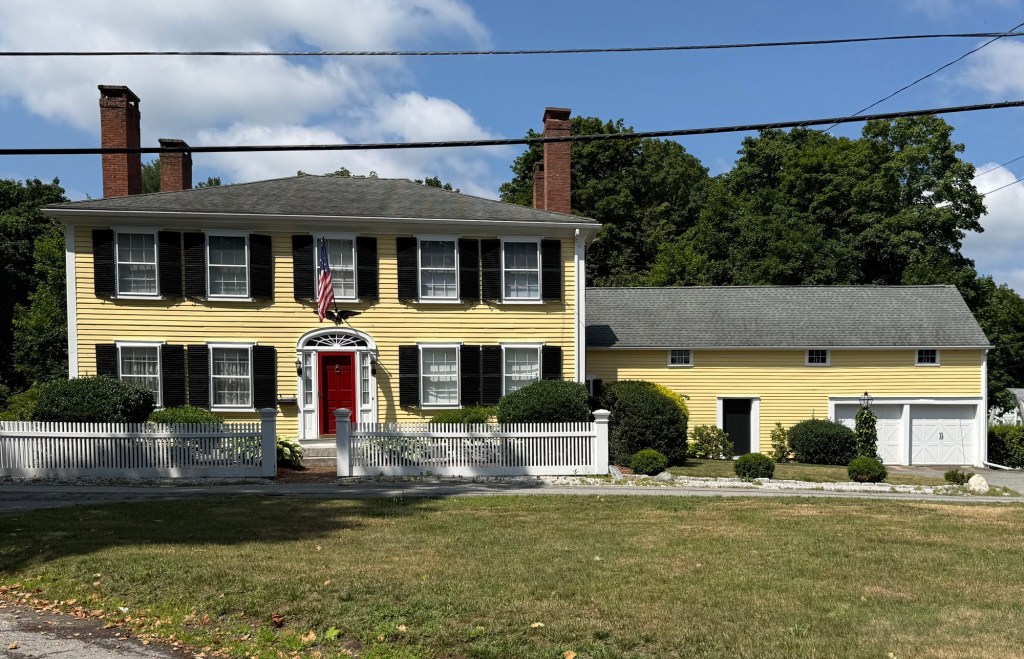
One of the oldest extant homes in Newton, Massachusetts, can be found in the Oak Hill section of town on Dedham Street as a 18th century farmhouse with central chimney. This area was settled by members of the Stone Family as far back as the 1600s. The house is said to date to at least 1788 when it was owned by Ebenezer Stone (1757-1800), but given its form and historic map documentation, it is likely that the home dates to 1724 when the property was owned by Jonathan Stone. The farmhouse remained in the family for generations until it was sold out of Stone family in the 1880s. By 1919, the property was owned by Pietro Volante (1881-1953) a gardener and produce dealer, who built several outbuildings on the property and added porches to the old home. The property was formerly set back farther off the street, but was moved to its current siting and restored in 2017, to allow for a separate dwelling to be built behind. The old Stone Farmhouse was landmarked by the Town of Newton to preserve this important property.
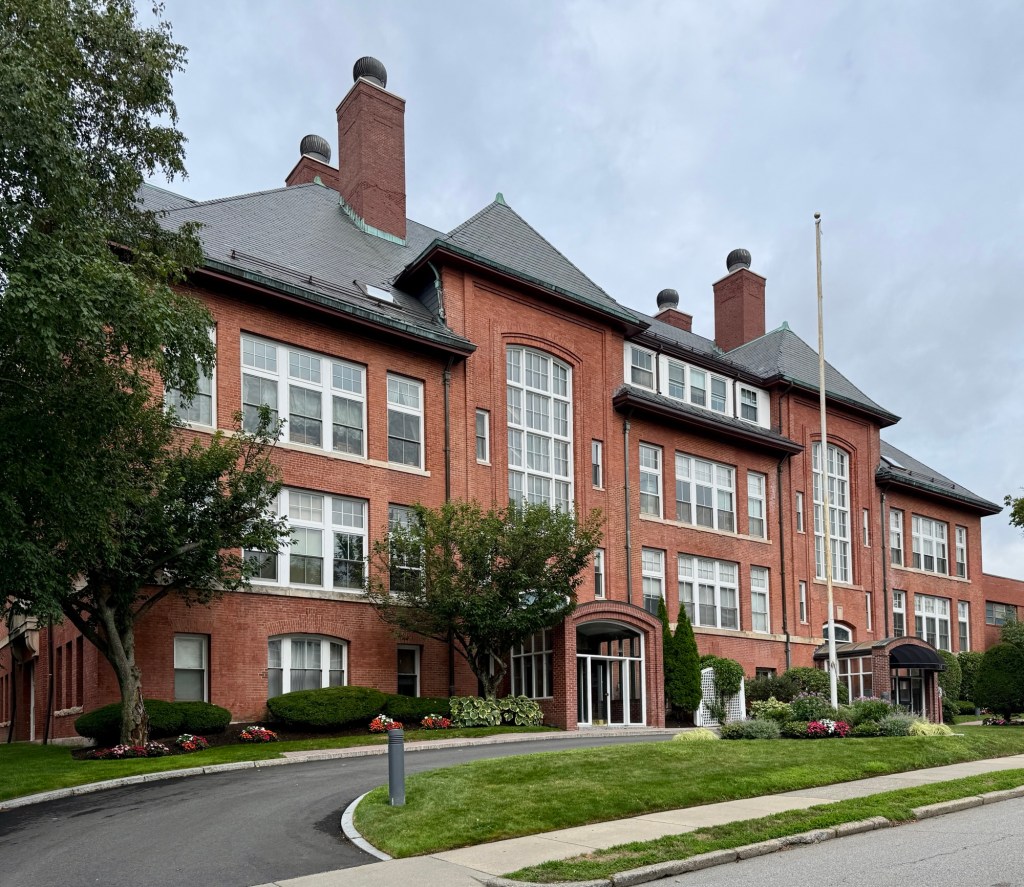
The Ralph Waldo Emerson School in Newton’s Upper Falls village was built in 1904 and dedicated a year later serving as the main school building in the industrial village. The brick school building was constructed adjacent to the Levi C. Wade School, a large Second Empire style wood-frame school constructed in 1869. The Wade School was razed for a 1950s addition to the Ralph Waldo Emerson School. The substantial school building was designed by the prominent architectural firm of Hartwell Richardson & Driver, at a time when the Upper Falls Village continued to expand due to the well-established cotton manufacturing mills and the Gamewell Fire Alarm Company. The large structure is hard to classify architecturally, as it blends elements of the Renaissance Revival, Arts & Crafts and Classical Revival styles, but with its massive chimneys, hipped roof with projecting eaves, and large arched windows, the building is an architectural statement for the relatively vernacular industrial village it is located in. By the end of the 20th century, school enrollments and consolidation of village schools saw the closing of the Emerson School, but luckily, the building lives on after it was converted to condominiums, with the 1955 addition now serving as a day care center, a senior citizen room and gymnasium-hall for the community.
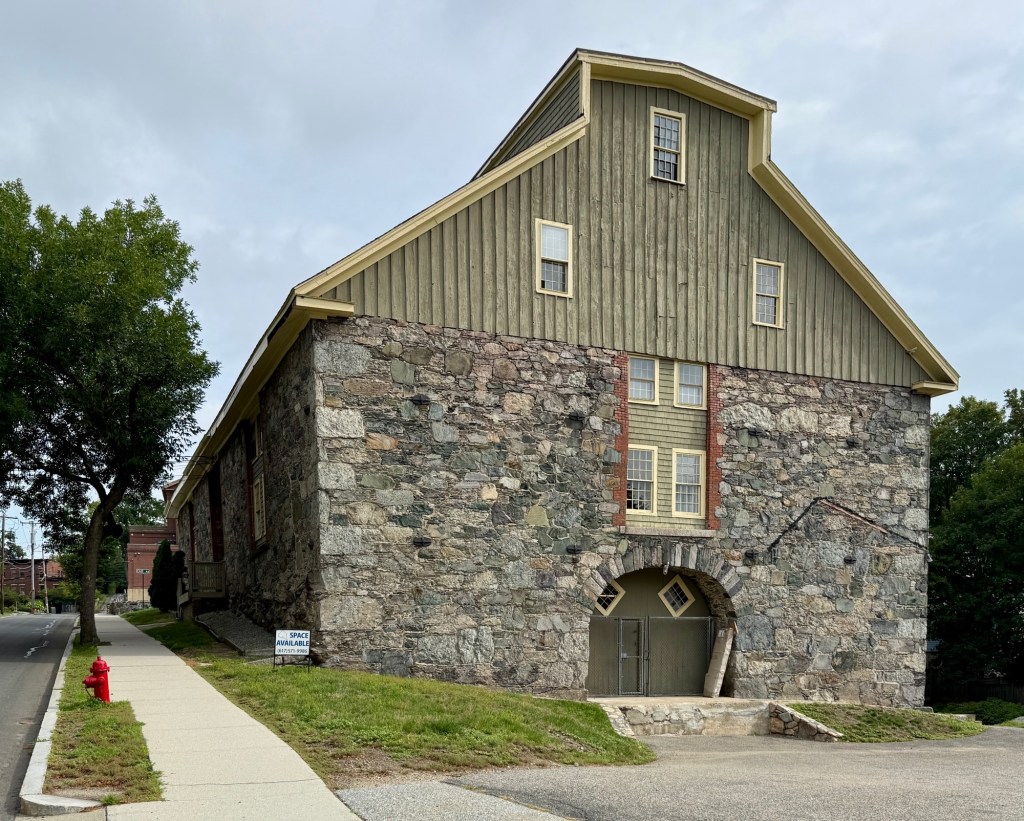
This historic stone barn in Newton’s Upper Falls village is representative of the ingenuity and resourcefulness of this once thriving nineteenth century mill village. Known as the Pettee Stone Barn, the structure dates to 1839 when Otis Pettee (1795-1853), who managed an iron foundry and machine-works for cotton machinery, built this structure as a warehouse. The barn was said to have been used additionally as a location for raising silkworms by Pettee’s company. After the business closed, the handsome barn was used later in the 19th and early 20th century as a carriage and horse barn for a shipping company and today, is rented to local businesses. Architecturally, the barn is significant for its use of fieldstone walls with door and window surrounds of cut stone and brick. A monitor roof runs the length of the gable ridge and illuminates the interior spaces. The Stone Barn remains remarkably preserved today and is a landmark in the community.
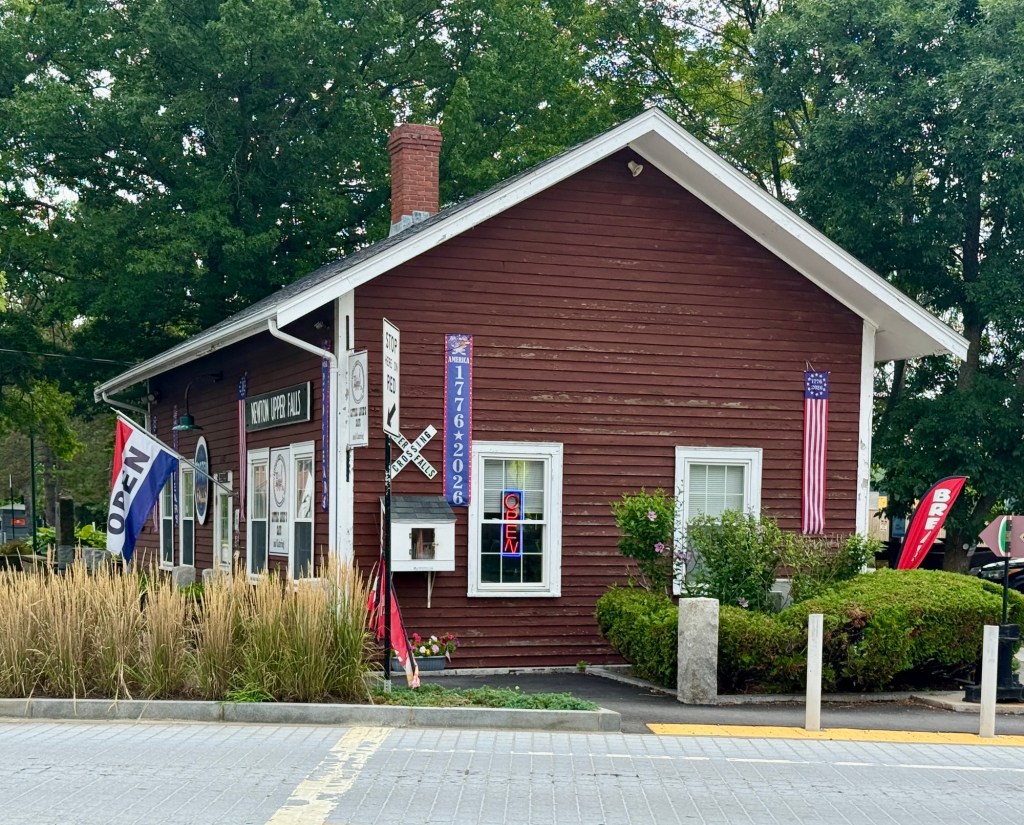
When the short-lived Charles River Railroad opened in 1852, first connecting the Boston and Worcester Railroad in Brookline to Newton’s Upper Falls village, the small community here saw immediate prosperity and turned into a thriving industrial village. In 1847, a petition was filed with the Legislature of Massachusetts to build a rail line linking greater Boston to the Rhode Island border. While a more direct route was easier, Otis Pettee (1795-1853), who owned an iron foundry called Pettee Works where he manufactured cotton machinery, seems to have been the principal promoter for the line to pass through the village of his factory. Pettee died soon-after the line was finished, but his persistence for this track served two additional benefits. Firstly, it opened up development into other Newton villages for early suburban development, and secondly, it served as a major line to bring gravel from Needham to fill the Back Bay, opening that iconic Boston neighborhood to development. The Upper Falls Depot dates to about the time that the initial line opened in 1852 and is a typical, vernacular train depot in New England from this period. The Charles River Railroad merged with the New York and Boston Railroad in 1855 and was later sold to the Boston and Albany Railroad. Following the near death of the railroad system in the United States in the latter half of the 20th century, much of the former Charles River Railroad today has survived despite the abandonment of much of the rest of the former New York and New England Railroad lines. This section is currently a part of the D-Branch of the MBTA’s Green Line.
A fine example of a Federal style brick-ender, the Farmer-Colson House in North Billerica is a stately and well-proportioned residence of its type in Massachusetts that has been lovingly preserved inside and out for over 200 years. The house was built in 1803 by Oliver Farmer (1760-1839) on land he acquired from his wife, Hannah’s father. The house was later inherited by Oliver and Hannah’s daughter, Rachel, and her husband Israel Colson. Israel Colson arrived in the mill village in about 1830 from Rhode Island and was a farmer by trade but became engaged in the development of the locks for the Middlesex Canal on the Concord River in the village. Architecturally, the house retains its symmetrical facade with center entrance adorned by a fanlight transom and sidelights, massive end chimneys, and an attached barn/stable.
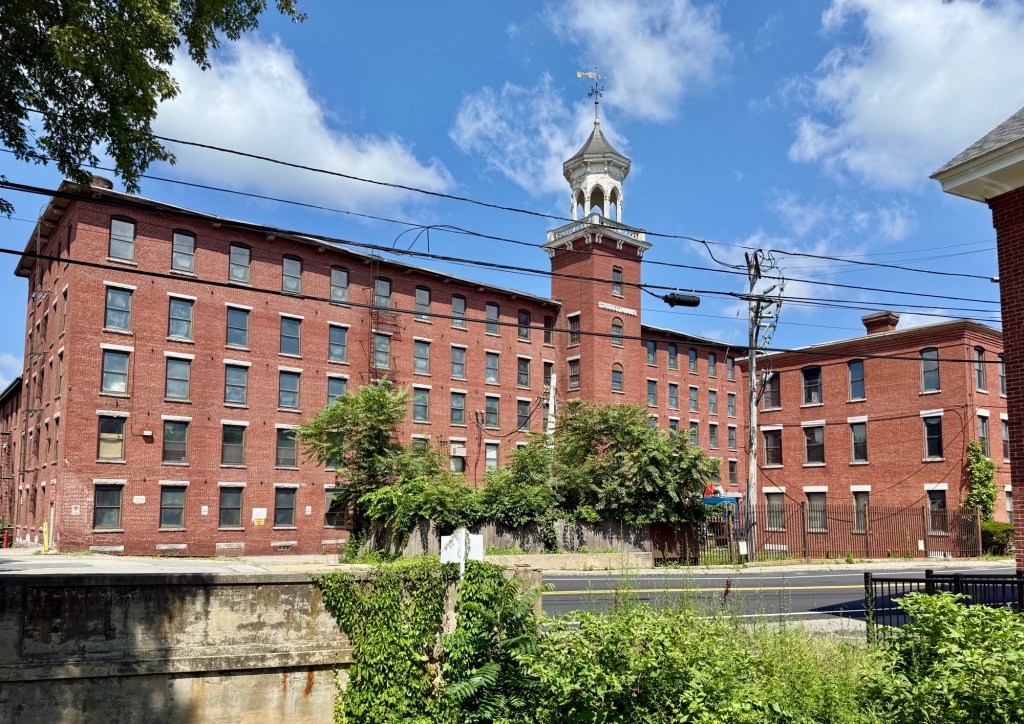
The Talbot Mills in North Billerica were built in 1857 by Charles and Thomas Talbot, who produced flannels, woolen goods, and later military and later, military drab. The brothers had connections in Lowell and eventually built a new manufacturing company in Billerica on the banks of the Concord River. Charles Talbot oversaw much of the day-to-day business, while Thomas Talbot began to pursue politics, serving first as state senator, lieutenant governor, and eventually Governor of Massachusetts in 1878. When built, the Talbot Mills were originally powered solely by water, but as the company’s manufacturing facilities doubled in 1880, a boiler-engine house was built. During the 1920s, at its peak, the mill employed 450 workers, many of whom lived in worker’s housing developed and rented by the corporation. During the 1960s, the company suspended operations and the building had been rented out to tenants ever since, now occupied by Pace Industries. The main (and earliest) building of the Talbot Mill complex was built in 1857 and rises five stories with a prominent entry tower with a balustrade, octagonal open arcaded belfry call capped by a weathervane. The wooden tower is a rare survivor and hopefully will remain another 150 years.