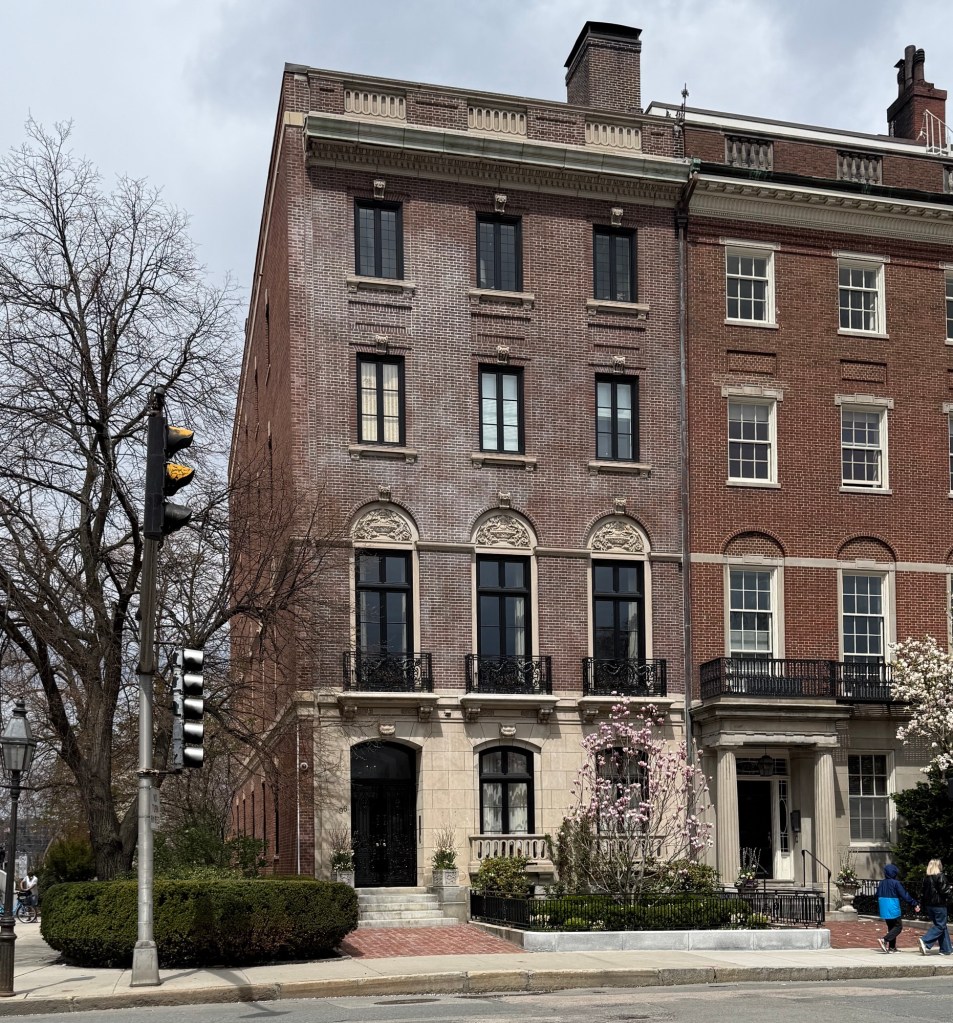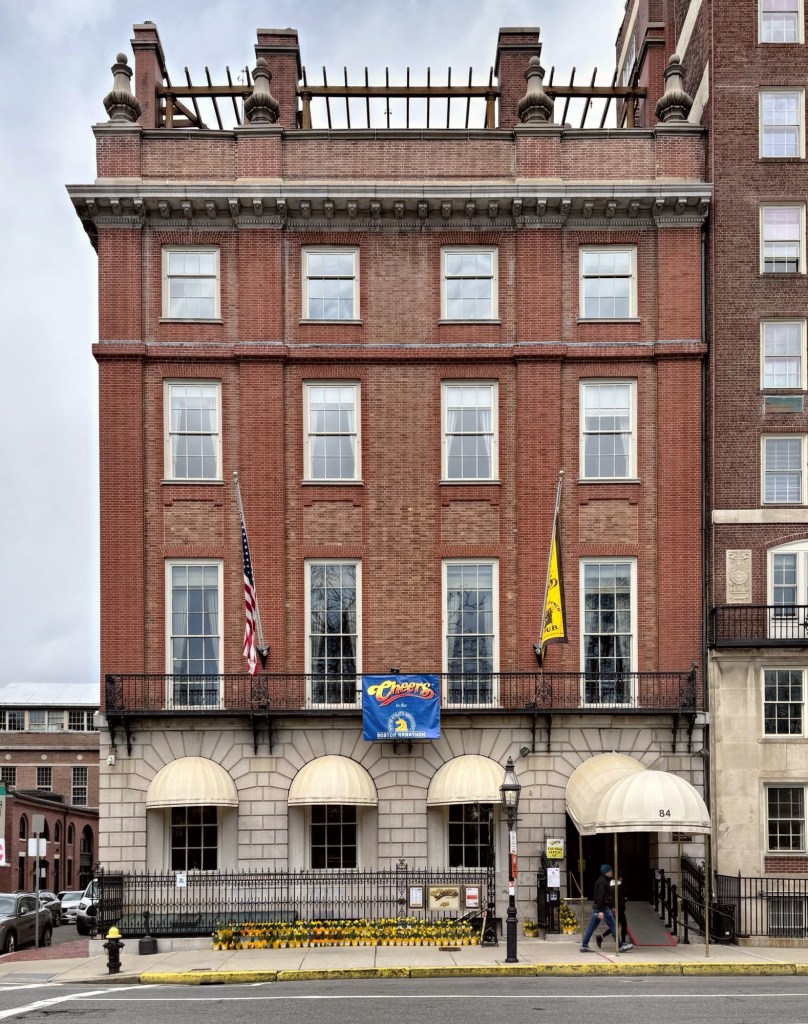
Bayard Thayer House – Hampshire House // 1911

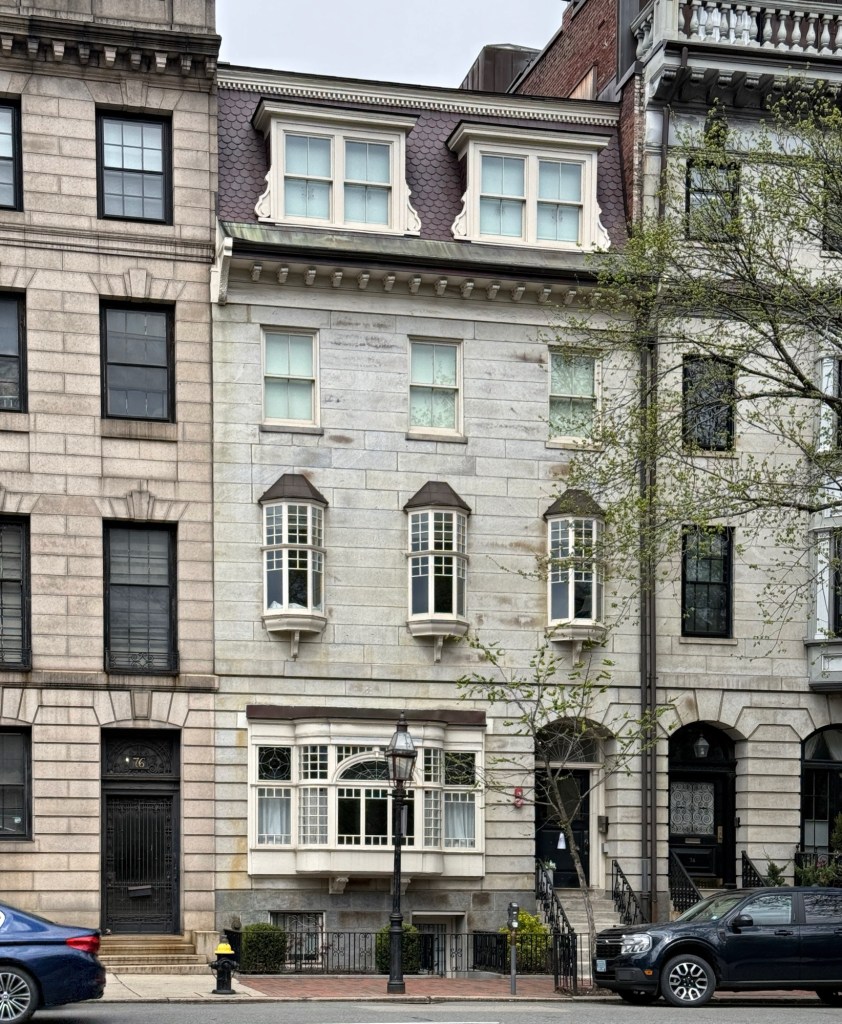
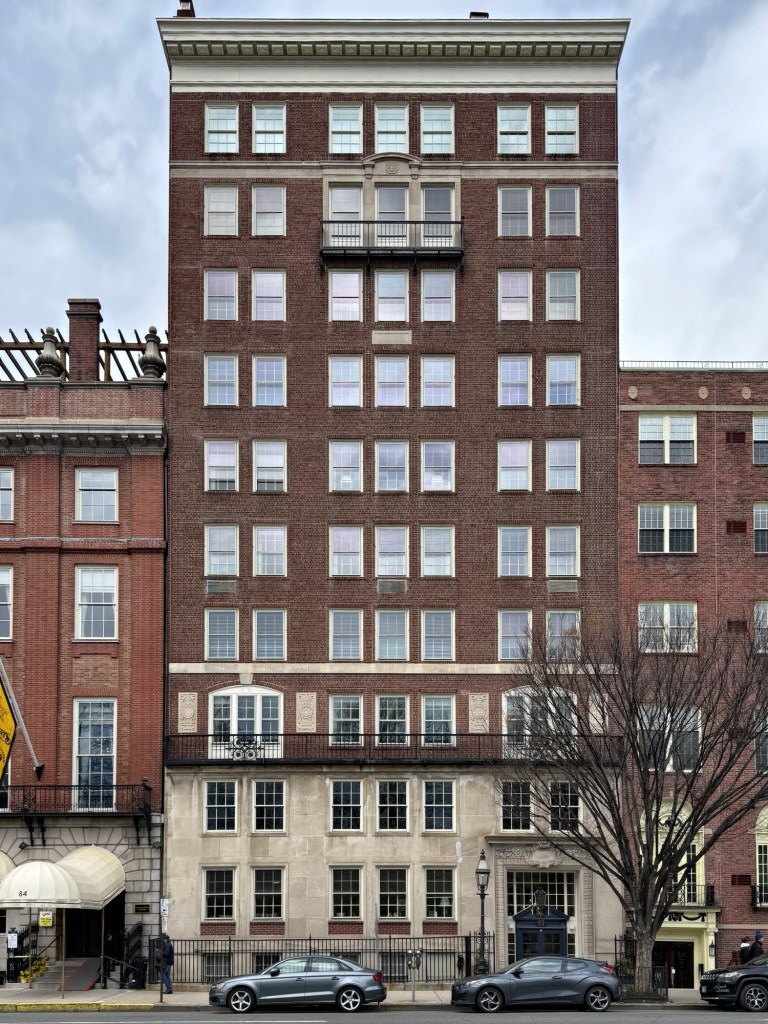
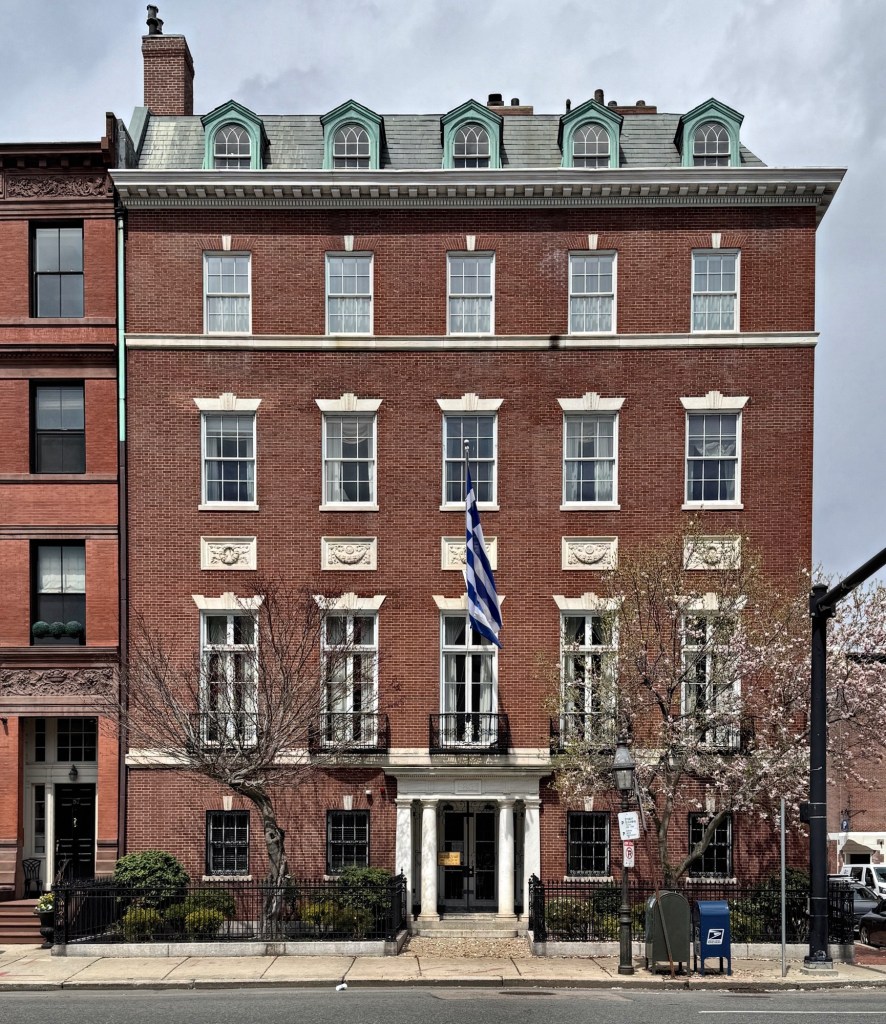
This iconic building at 84 Beacon Street in Boston’s Beacon Hill neighborhood, is best-known for its bar, which in 1982, became world-famous as the locale for the bar in the television sitcom Cheers, one of the most-watched programs in television history; but its history begins earlier. This five-story building was constructed in 1911 as a mansion for Bayard Thayer (1862-1916), who split his time between Boston and his country estate in his home-town of Lancaster, Massachusetts. Thayer hired architect, Ogden Codman Jr., a favorite designer of Boston and New York high-society, to design his Boston mansion, which is an expressive and overscaled example of a Colonial Revival style townhouse. Bayard Thayer died in 1916 and his widow, Ruth Simpkins Thayer, lived here with her granddaughter, Ruth, and nine domestic servants. After Ruth Thayer’s death in 1941, the property was conveyed to the Colonial Properties Trust in 1944, operating the building as a small luxury apartment hotel. From this point on, the hotel became known as Hampshire House. In about 1969, the basement space in the Hampshire House opened as the Bull & Finch Pub, which later became the inspiration of the iconic sitcom Cheers. Pictures of the exterior of the building were used in the show’s credits and scene changes, and the interior was faithfully replicated from the set in Hollywood, where the show was actually filmed. The Bull & Finch Pub has permanently been renamed Cheers Pub and visited by many who wish to visit the place where “everybody knows your name”.

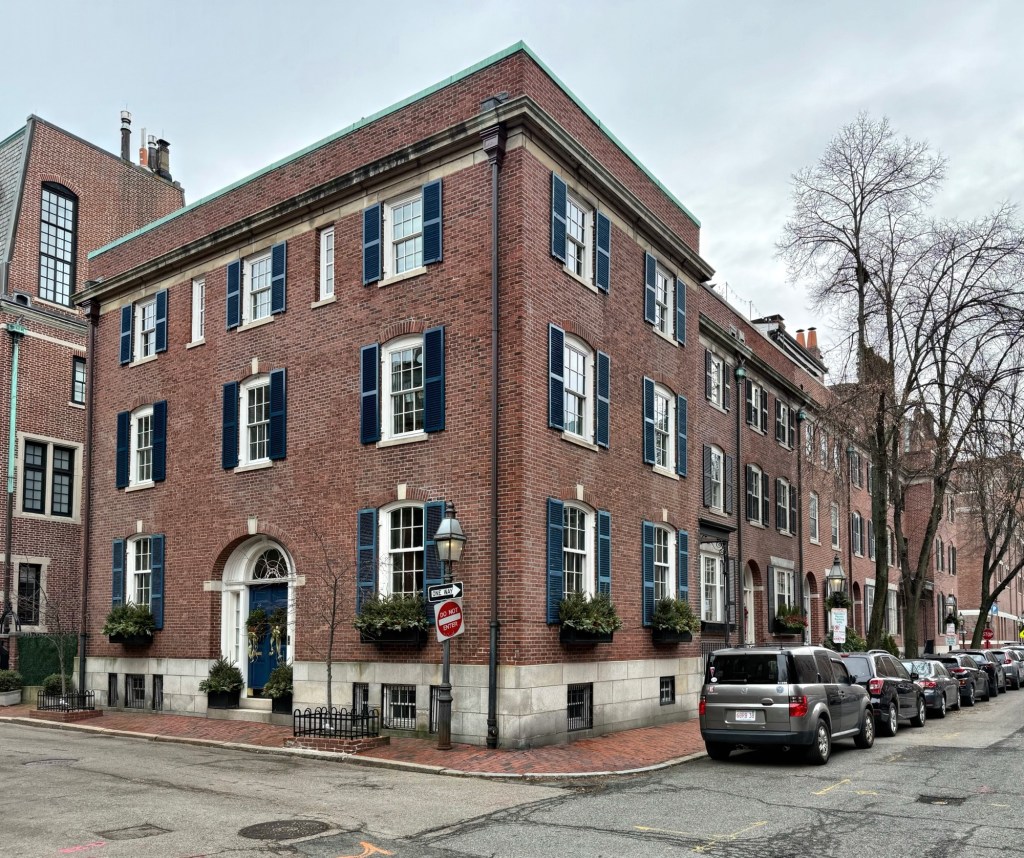
Brimmer Street Terrace // 1912

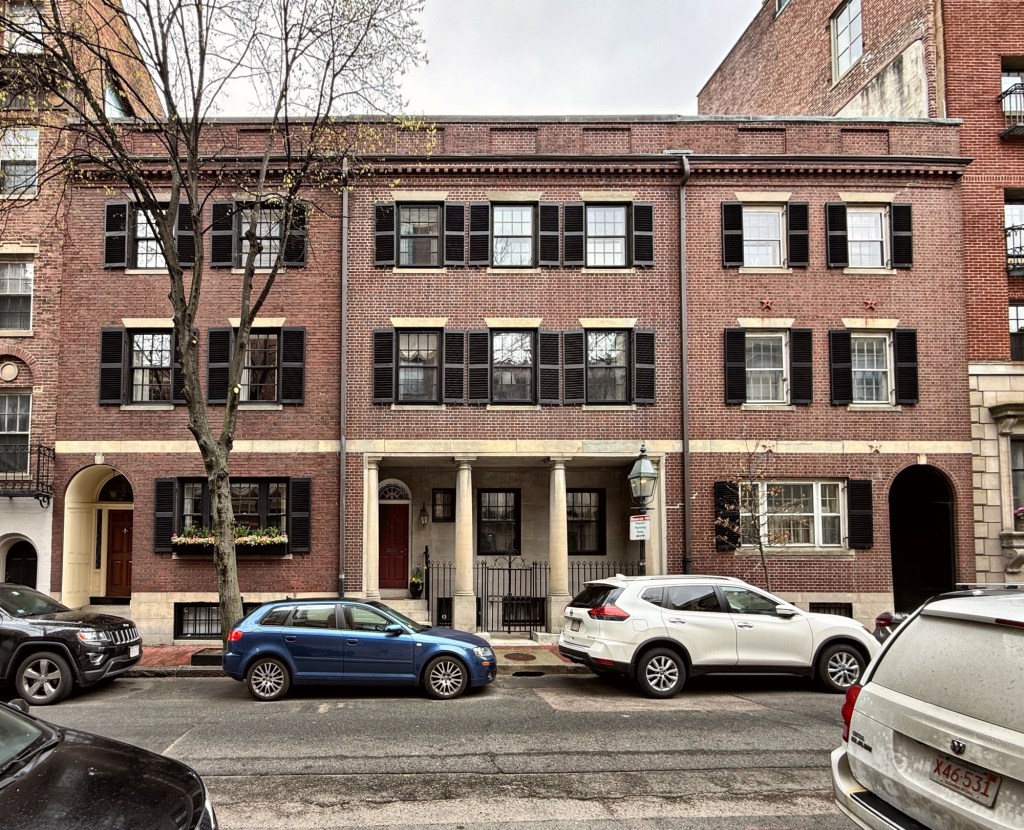
An interesting ensemble of seven rowhouses running along Brimmer Street in Beacon Hill, the Brimmer Street Terrace development showcases the rebirth the “Flat” of Beacon Hill encountered in the early 20th century from livery stables and carpentry shops to high-end housing and artist’s studios. Built on the site of a large livery stable, Brimmer Street Terrace was developed in 1912 by Gerald G. E. Street and William C. Codman, developers who sought to enhance this section of Beacon Hill and protect it from unsympathetic development, and hired architect Richard Arnold Fisher to design the houses. The rowhouses were originally rented to upper-class families but later were sold off as individual properties. Colonial Revival in style, the row is built of the iconic Boston red brick, Federal Revival style fanlight transoms over the entrances, include shutters, and all sit atop a stone basement. The row is anchored on each end by residences facing north and south with large symmetrical facades with the five more narrow rowhouses connecting them along Brimmer Street. 

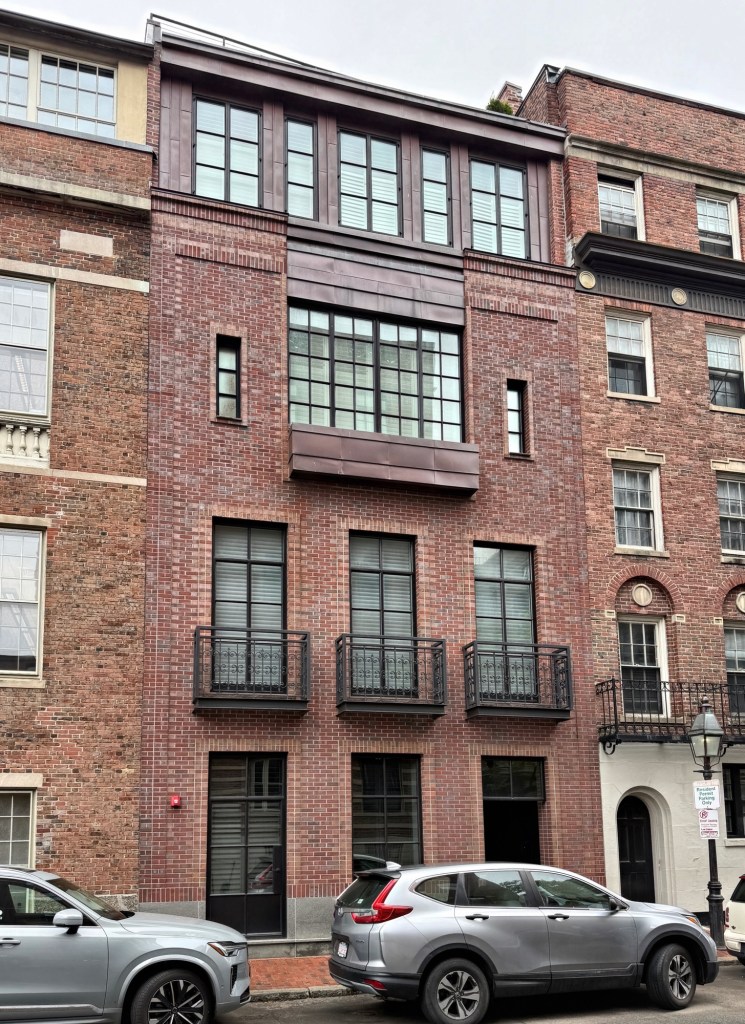
Chestnut Street Townhouse // 2016

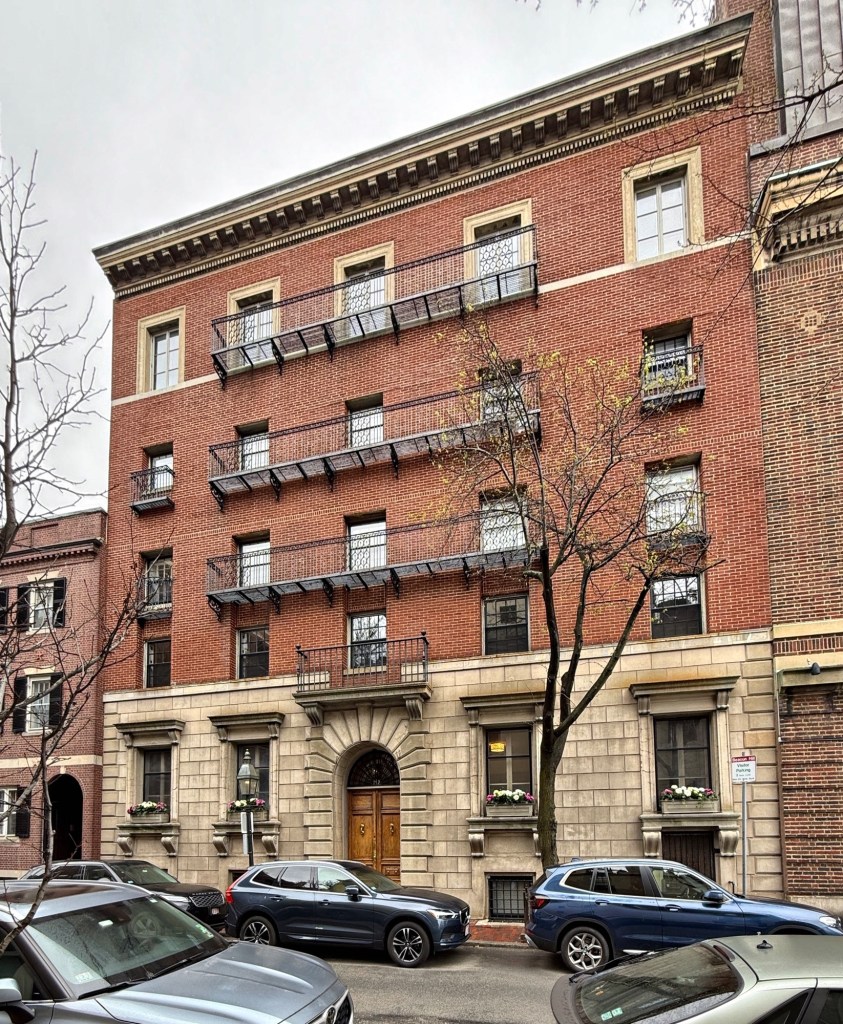
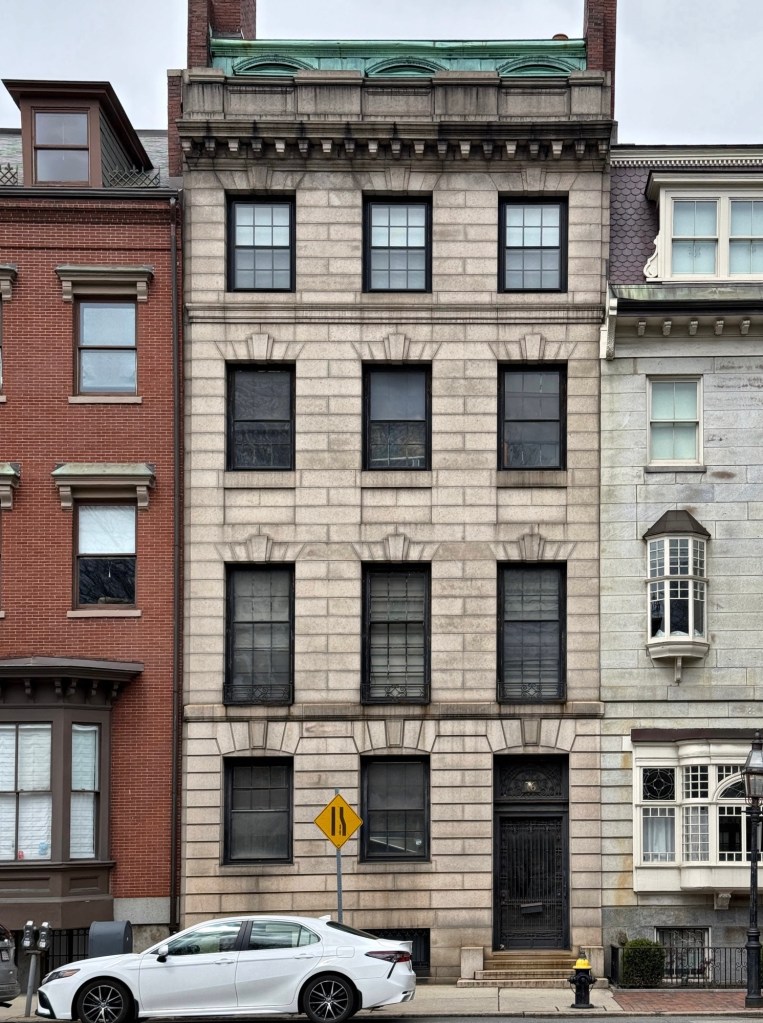
It is uncommon to see new construction in Boston’s historic Beacon Hill, but when it happens, hundreds of eyes closely scrutinize and analyze the design to belong in one of America’s most coveted neighborhoods. The rare opportunity for infill construction occurred on this site on Chestnut Street. An 1860s stable building that was later converted into a residence and art studio in the 1920s as Beacon Hill Flat gentrified as an artist enclave, was listed for sale in 2013. The townhouse featured leaded-glass windows and Tudor elements at the interior and on its rear facade and was purchased by a developer who, after inspection, noted structural deficiencies in the building. After inspections by the City and a request to the Beacon Hill Architectural Commission, it was approved for demolition, but the replacement design would be scrutinized. Hacin, architects, brought forward plans for a new townhouse, which employed similar materials, massing, and fenestration typical for this area of Beacon Hill, but with contemporary finishes that blends old with new in a way that the new structure does not stand out nor detract from the surrounding streetscape. Through hearings, details like the window types and color of the brick were analyzed to slightly deviate from the existing fabric of the neighborhood, distinguishing the new construction as contemporary. What do you think of this new townhouse on the Flat of Beacon Hill?

Carpenter’s Shop – Fishelson House and Store // c.1860

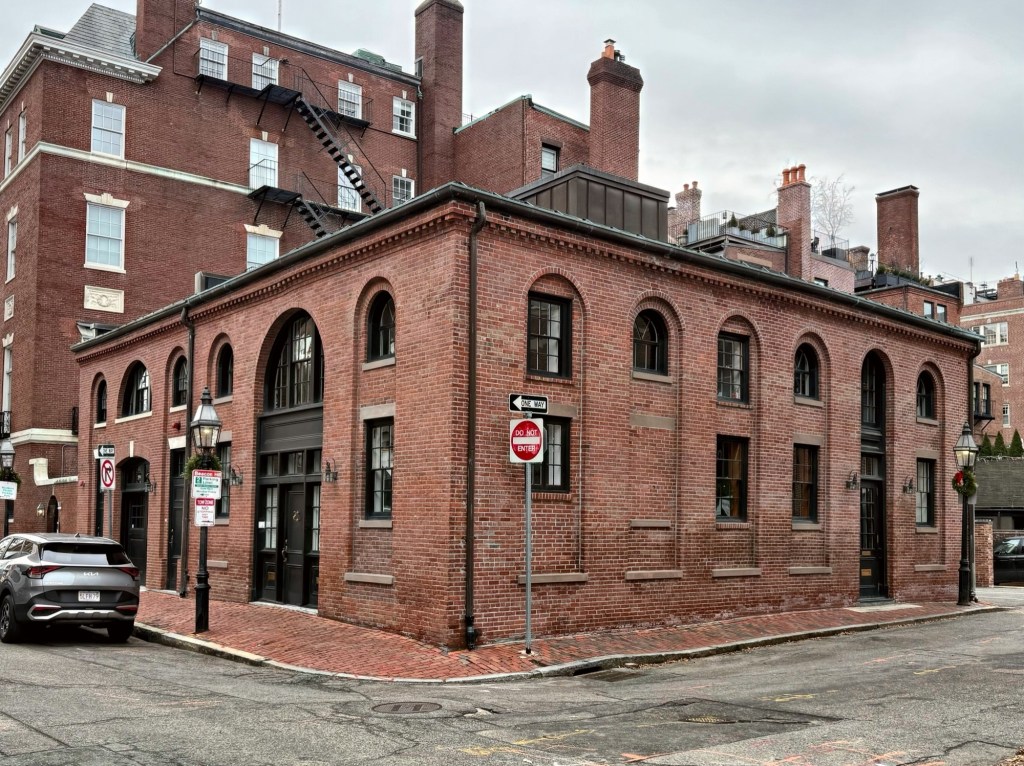
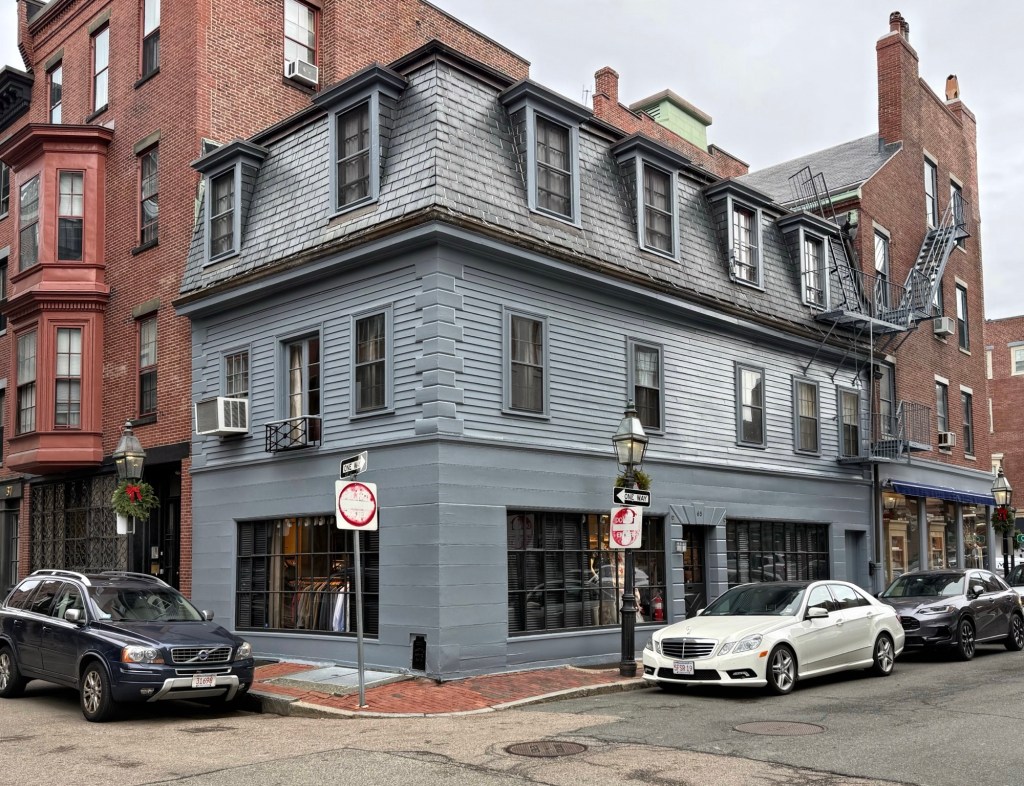
A rare extant wood-frame building in Beacon Hill, this Second Empire style building at the corner of Chestnut and River streets is one of the neighborhood’s most charming. It is likely that some of the wood-frame structure was originally a rear ell to the 1830s Greek Revival house it adjoins at 34 Charles Street. By the 1860s, the building was renovated for use as a carpenter’s shop, with the mansard roof, quoins, and loft door added at that time. City records indicate that the house on Charles Street housed tradesmen and it was listed as “Temporary Home”, the predecessor to the city Overseers of the Poor Temporary Home, a charitable organization providing lodging and food to those in need. From the late 1920s, the property was owned by Max and Rebecca Fishelson, who resided in and operated their florist shop here. In 1936, the former carpenter’s shop was renovated to contain a retail store on the ground floor with a two-family dwelling above, one for the Fishelson’s and one for their daughter. for a renovation of the wood frame annex on
Chestnut Street, which involved changing the occupancy of that section from a store and carpenter shop to a store and two-family dwelling: one for the Fishelsons and one for their daughter.

Hotel Lincolnshire // 1924

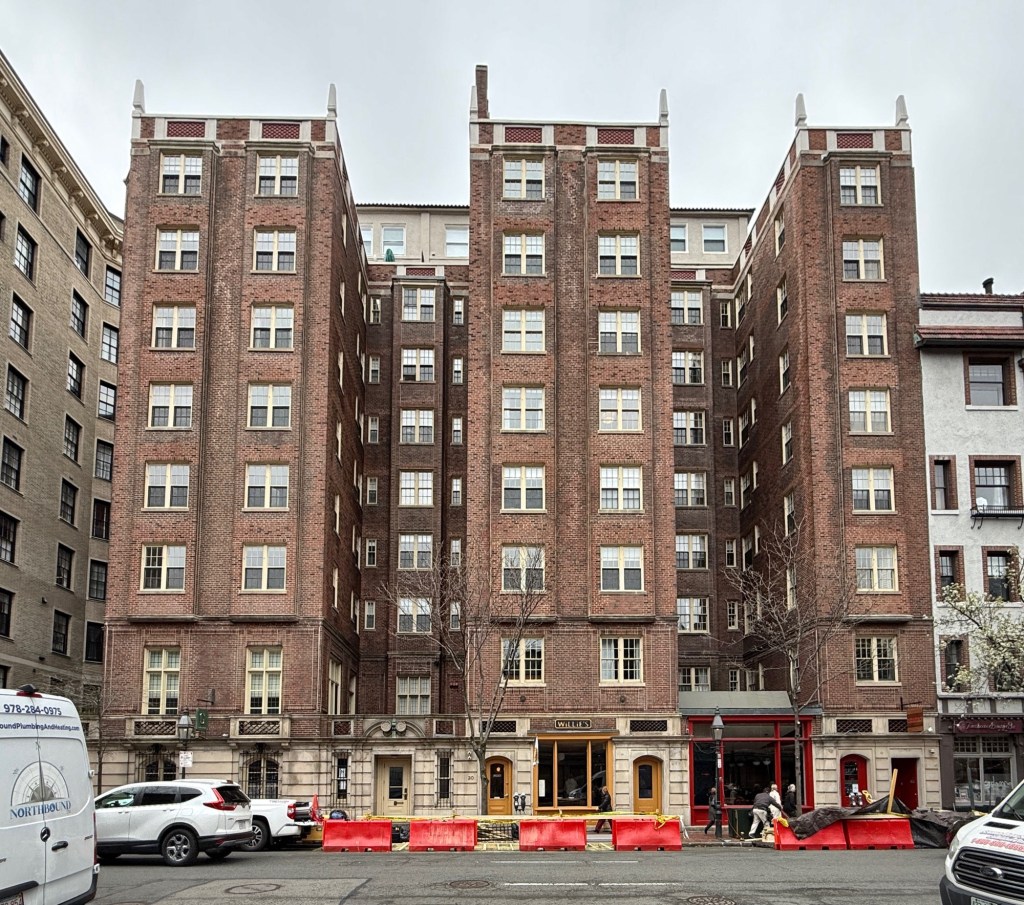
The Hotel Lincolnshire is a stunning eight-story apartment building on the west side of Charles Street in Boston’s Beacon Hill neighborhood. The building was developed in 1924 by William Coombs Codman, a real estate developer and member of the Beacon Hill Associates, a group of preservationists who bought and resold properties in the neighborhood with the aim to limit unsympathetic development. The group helped the Beacon Hill Flat area, which was a higher concentration of former stables west of Charles Street, a gentrified artist and residential enclave. The Hotel Lincolnshire was marketed as a residential apartment hotel, with furnished and unfurnished apartments with greater amenities than a traditional apartment building. Beacon Hill resident and architect, Richard Arnold Fisher, was responsible for designing the building, where he employed the use of courtyards (similar to his design nearby at 101 Chestnut Street) and walls of brick with cast-stone details. Of special interest is the use of perforated terracotta panels laid in half-round forms and the stone pinnacles at the parapet.

Public Garden Apartments // 1917

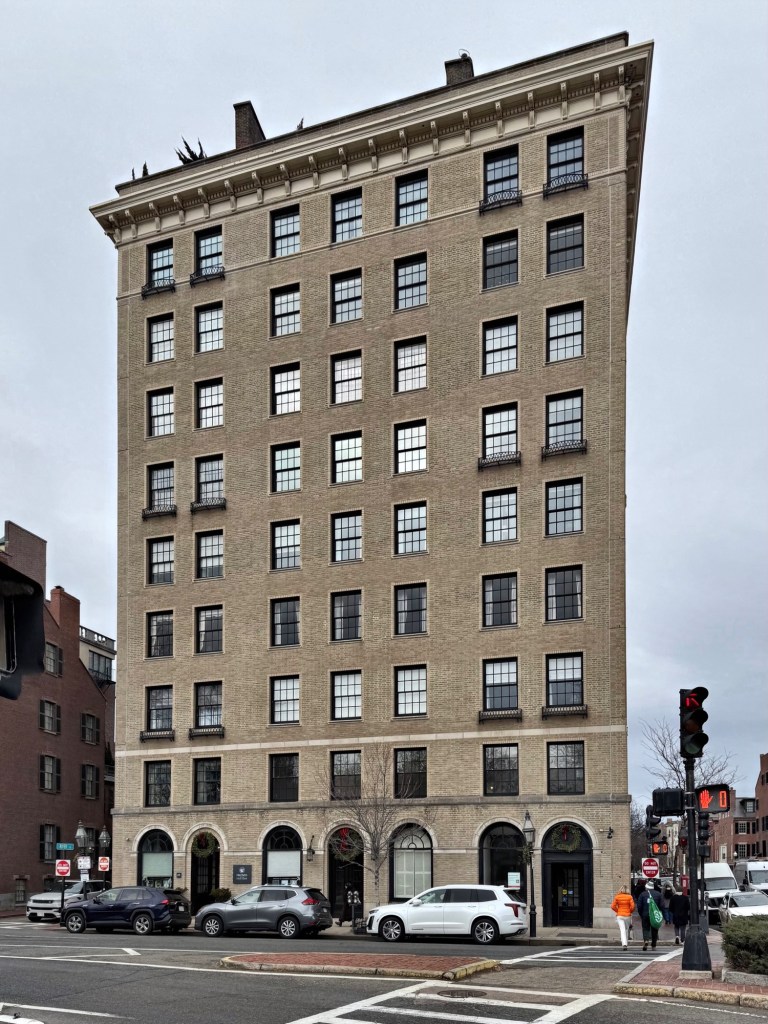
Located on the prominent corner of Beacon and Charles streets in Beacon Hill, the aptly named Public Garden Apartment Building overlooks one of the best shopping streets and public parks in the country. The handsome nine-story apartment building was constructed in 1917, replacing four townhouses previously on the site, and was developed by the legendary newspaper magnate, William Randolph Hearst (1863-1951), who had acquired three Boston-area newspapers in the early 20th century and for some reason, engaged in Boston real estate development, though he spent most of his time in New York and California. The building originally included a 15-room penthouse apartment on the top floor of the building, with the other floors divided into two apartments per-floor, suggests that Hearst may have thought to make it his Boston residence, though it is not clear if he ever did. Hearst hired architect, Harold Van Buren Magonigle, who apprenticed under Calvert VauxRotch & Tilden, and McKim Mead & White, before opening his own practice in 1903, to design the Public Garden Apartments. The apartments inside were rented to upper-class residents, typically small, older families including widows and their unwed children almost all of whom, according to census records, employed between one and four live-in domestic servants to maintain their homes. The handsome multi-family building has walls of buff-colored brick masonry and sits upon a granite foundation with arched openings on the ground floor and bracketed cornice. Today, the building is a co-op and rents out space to the Friends of the Public Garden, one of the oldest public-private partnerships in the nation established in 1970, that takes care of, and advocate for the Boston Common, Public Garden, and Commonwealth Avenue Mall for everyone to enjoy. 

Studio Building, Beacon Hill // 1914

The Studio Building on Charles Street in Boston’s historic Beacon Hill, is a unique, Arts and Crafts style building constructed of brick with stucco walls and a red tile roof. Built in 1914 by William Coombs Codman, a real estate developer and member of the Beacon Hill Associates, a group of preservationists who bought and resold properties in the neighborhood with the aim to limit unsympathetic development. The group helped the Beacon Hill Flat area, which was a higher concentration of former stables west of Charles Street, a gentrified artist and residential enclave. Codman hired the young architectural firm of Loring & Leland, to design the Studio Building, which in its original configuration, contained three stores at the ground-level, two dwellings, offices and artist studios with oversized windows. Just years after the building was completed, Charles Street was widened in 1920, chopping ten feet off the facades of all buildings on the west side of Charles Street, including this building. Charles G. Loring was retained by Codman to oversee the renovations to the new facade and storefront, likely replicating what was once there. After 1920, the building was largely occupied by apartments for single women of means and remains one of the neighborhood’s most iconic and enchanting buildings.

Miss Grace Nichols House // 1913

Located at the western end of Chestnut Street in the Flat of Beacon Hill, you will find this stucco residence, one of the finest mansions in Boston. The four-story residence with two entrances is built of brick and covered with stucco and was constructed for Miss Grace Nichols (1874-1944), the daughter of John Howard Nichols, who worked for John Lowell Gardner (the husband of Isabella Stewart Gardner) as a merchant transporting goods between Boston and Chinese markets, before overseeing mills. As a single woman, Grace inherited much of her parents wealth upon their deaths, and in 1913, hired architect, William Chester Chase, to design her Beacon Hill home in the Italian Renaissance Revival style, similar to Isabella Stewart Gardner’s Fenway Court mansion (1903). Grace Nichols married Richard Pearson Strong, a Harvard professor and medical researcher, in 1936 and the couple lived here with servants until their deaths in 1944 and 1948 respectively. After their death, the building was either purchased by or willed to the Boston Society of Natural History and the New England Museum of Natural History, which moved out of their Berkeley Street location in 1946. The Nichols Mansion served as the new Boston Museum of Science until 1951, when the new and current museum was built between Boston and Cambridge. Today, the former Nichols mansion is five condominium units, with owners having one of the most enchanting and unique properties in the exclusive Beacon Hill neighborhood.

Elizabeth G. Evans – Edward A. Filene House // 1883

This unique brick house at 12 Otis Place in Beacon Hill was built in 1883 by the architect, Carl Fehmer for attorney Glendower Evans and his wife, Elizabeth Gardiner. Mr. Evans died in 1886 of Hodgkin’s Disease at just 30 years of age. His widow, Elizabeth Glendower Evans (1856-1937) was greatly influenced by her husband during their brief marriage, even taking her husband’s first name as her middle name after his death. Elizabeth Glendower Evans became a prominent social activist, studying child labor conditions in the South and took up the cause of women’s suffrage and the associated problems of tenements and factory work arising from disenfranchisement in the late 19th and early 20th centuries. In 1915 Evans served as a delegate to the International Congress of Women at the Hague. She was the first National Organizer of the Woman’s Peace Party. From 1920 until 1937 she served as a national director of the American Civil Liberties Union. In the 1910s, Elizabeth sold the home to Edward Albert Filene (1860-1937), who, together with his younger brother Abraham Lincoln Filene, reorganized his father’s department store into “William Filene’s Sons Company”, which would later become Filene’s. He was a supporter of credit unions to help ordinary American workers to access loans at reasonable rates and allow workers to save their money so that when hard times hit, they were prepared.

William and Octavia Apthorp Mansion // 1885

This unique four-story brick townhouse on Otis Place in Beacon Hill, Boston, was built in 1885 by the architectural firm of Rotch & Tilden for Mrs. Octavia L. Apthorp and her husband, William F. Apthorp. Elevated on a tall brick basement, the exterior of the house is richly detailed with masonry decoration in what has become known as the “panel brick” style; with an elaborate brick entrance archway, paneled pilasters at the third floor, and vertical brick lintels above the windows. Over the ground floor windows near the entrance, iron grates with spear-like finials give the design a Medieval/English Queen Anne presence. William F. Apthorp was the only son of Robert Apthorp, a prominent Boston attorney and abolitionist who lived across the street at 2 Otis Place. William was a pianist and teacher at the New England Conservatory of Music and writer who married Octavia (sometimes spelled Octavie) Loir Iasigi in 1876, she was also from a well-connected Beacon Hill family.