Deep River Town Hall // 1893

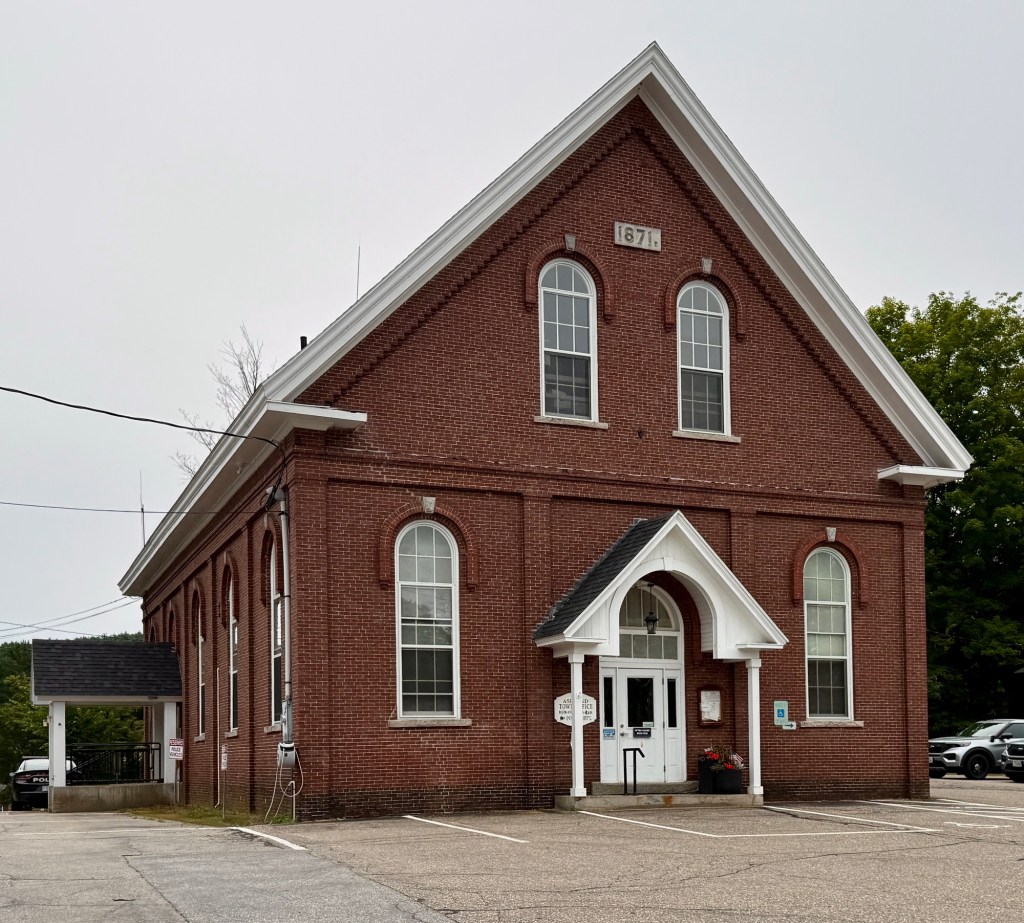
The town of Deep River, in Middlesex County, is located in the lower Connecticut River Valley and was originally colonized as part of the Saybrook Colony. The community was incorporated in 1859 as Saybrook and renamed Deep River in 1947. An early shipbuilding and quarrying town, it later manufactured wire goods, lace, glass, ivory combs, and piano keys and is today a small community of just over 4,500 residents. The original town hall for Saybrook (Deep River) was used until it was destroyed by fire in 1891. The community, which was bolstered by a vibrant industrial community, began planning for a new, stately town hall at a triangular lot at the corner of Elm and Main streets. Plans were completed by Springfield architect, Francis R. Richmond, who laid out the flatiron building with town offices on the ground floor with an auditorium/opera house space on the upper floors. The Romanesque Revival style building features prominent rounded corners with arched openings, a granite string course, and overhanging bracketed eaves.

Graham Apartments // 1904

This handsome, and unique example of a three-decker in the English Revival style is located on a corner lot at 128 Davis Avenue in the Emerson/Brookline Village neighborhood of Brookline, Massachusetts. Built in 1904 from plans by architect and genealogist, J. Gardner Bartlett, whose work focused on colonial New England and the English origins of colonial families. Trained as an architect at MIT, he gave up architecture for genealogy, but still occasionally designed buildings in the Boston area. The building here was developed for Richard Graham, an Irish immigrant, who along with his wife, operated a laundry business in the village. The use of a shingle and stone entrance porch and entrance bay with stucco half-timbering and diamond-pane casement windows stand out architecturally as one of the few examples of a three-decker built in this style in New England.

Brookline Public Library // 1910

The Brookline Public Library in Brookline Village opened in 1910 and was designed by R. Clipston Sturgis, one of the great 20th century architects in the Boston area. Taking his cue from the south facade of the Queen’s House at Greenwich, England, Sturgis designed a modest expression of Palladianism in red brick and limestone. The building is the second library on the site, replacing an 1869 mansard roofed building that was outgrown and demolished for this building. The Brookline Library was expanded in 1974 by Integrated Design Services Group and renovated again by Perry, Dean & Rogers.

Happy Hollow Siphon House, Weston Aqueduct // 1903

The Weston Aqueduct was designed to deliver water from the Sudbury Reservoir in Framingham to the Weston Reservoir in Weston, Massachusetts. Built between 1901 and 1903, the aqueduct was designed to provide water to the suburbs north of Boston. All of the buildings that shelter the aqueducts above-ground elements, including this structure in Wayland, were designed by the architectural firm of  Shepley, Rutan and Coolidge, with landscaping along the route and at the reservoir designed by the Olmsted Brothers, landscape architects. This siphon house, known as the Happy Hollow Siphon House was built in 1903 and was an important part of the aqueduct system, as it transferred water through varied elevations using gravity and pressure to move the liquid without a pump. The aqueduct route is now a long, linear path and remains owned by the Massachusetts Water Resource Authority.

Mellen Law Office // c.1829

Samuel H. Mann (1801-1838), a lawyer, acquired the Dr. Ebenezer Ames House on Cochituate Road in 1829, only a month before his marriage to Isabella Ross. At about that time, Mann built this small law office across the road from his home, where he would practice law. It is not clear why, but within a year, Mann sold the house and this law office to Judge Edward Mellen (1802-1875), who was appointed Chief Justice of the Massachusetts Court of Common Pleas in 1855 and practiced law in Wayland until his death in 1875. After his death, the law office sat largely vacant until during World War II, when a newsletter to soldiers, The Village Bugle, was published here. After this, a couple of businesses used the former law office in the 1950s and 1960s until the owner donated the lot to the Town of Wayland in 1971. The diminutive building is a charming, and well-preserved example of a vernacular, Federal period professional office building that mimics the form and materials of the Ames House to which it was long affiliated with.

Sterling Opera House // 1889

The Sterling Opera House in Derby, Connecticut, is a landmark performing arts venue and civic center in the state and significant as a rare and well-preserved building constructed in the Italian Renaissance Revival style. Built in 1889, the building is named for Charles A. Sterling, founder the former Derby-based Sterling Piano Company, who paid for much of the costs of construction and design for the building. For his namesake building, Charles Sterling hired architect H. Edwards Ficken, who also  assisted with the designs for the famous Carnegie Hall in Manhattan, New York, to furnish plans for the unique building. The Opera House was built to serve both political and entertainment needs for the community, with the lower two levels and the basement serving as City Hall offices and the police station from when it opened up until 1965. The auditorium was used for hundreds of shows and live musical performances in its day, with many world-famous performers such as Harry Houdini and Red Skelton taking the stage at the Sterling. Shows were held up until 1945 when the curtain closed for the last time. In the past decades the building has been largely vacant and kept alive by grants and a dream by the city to preserve this significant landmark, possibly for reincorporation as the City Hall. 

Lancaster Town Hall // 1908

The Town Hall of Lancaster, Massachusetts, was built in 1908 and is one of four religious and civic buildings framing the village’s bucolic town green. The Town Hall was built opposite the Charles Bulfinch-designed First Church of Lancaster and replaced an earlier town hall building that was constructed in 1848. The building was largely funded as a gift from wealthy Lancaster-native, Nathaniel Thayer’s sons, following their late-father’s death. Boston architect, Alexander Wadsworth Longfellow, the nephew of poet Henry Wadsworth Longfellow, was hired to furnish plans for the building, which is Colonial Revival in style, a perfect compliment to the historic New England town.

Fullerton Inn // 1921

The Fullerton Inn, overlooking the Town Common in Chester, Vermont, is an imposing Colonial Revival style hotel that has been in operation through many iterations, and contributes to the strong commercial character of the Chester Village streetscape. The inn was first developed here following the arrival of the railroad to Chester, which brought new business and travellers to the formerly agrarian and light industrial community. The original 1862 inn building, known as the Ingraham House, was destroyed following a large fire in the village, and its replacement burned as well in January 1920. Within a year, the present building was built from the ashes in a style typical of the early 20th century, Colonial Revival. Dominated by the large slate-shingled gambrel roof and projecting front veranda, the building’s most iconic feature is said to be inside, a fireplace inside the lobby which contains 27 stone varieties from the area.

Chester Congregational Church // 1828

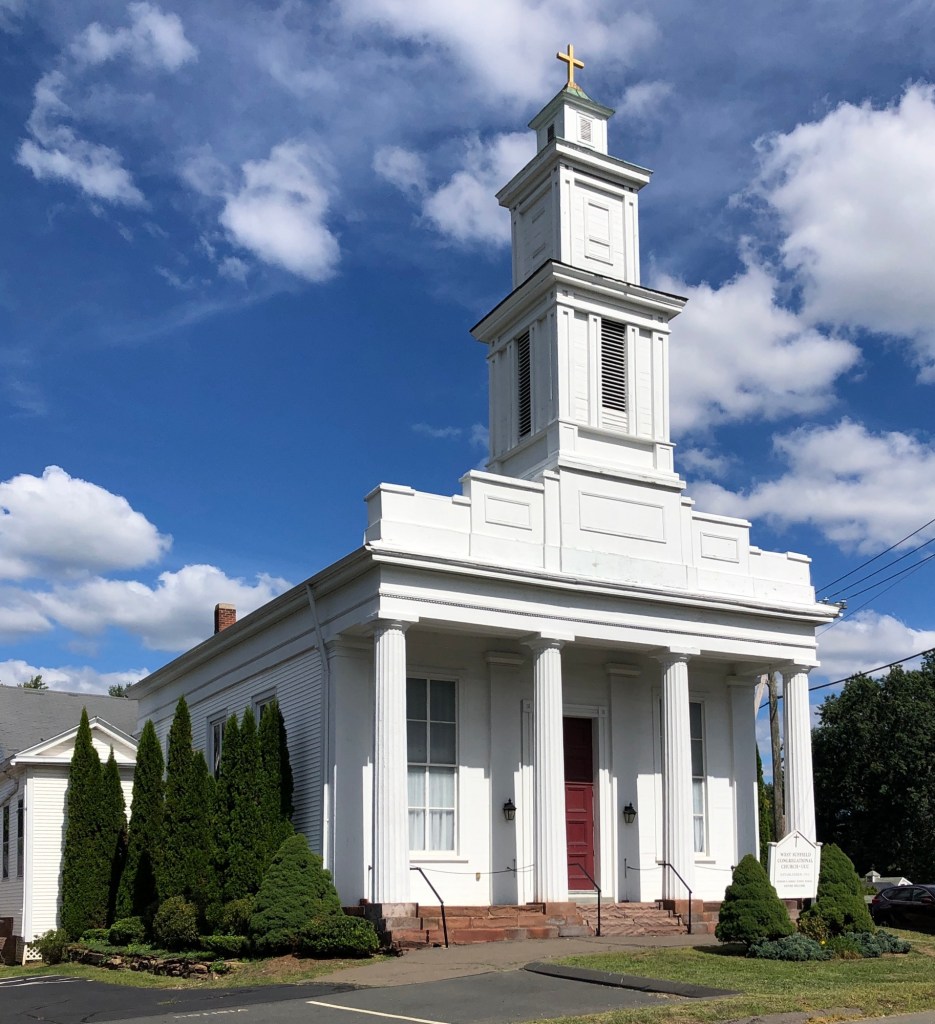
A significant landmark in Chester, Vermont, the Congregational Church of Chester is a sophisticated interpretation of ecclesiastical Federal architecture. Built in 1828, the soaring, five-stage clock-and-bell tower with bellcast cap and weathervane rises above a pedimented three-bay entrance pavilion with semi-elliptical fanlight, a common motif in the style. It is believed that local carpenters, Comfort Carpenter Dresser and his son, Charles Dresser, built the church, likely from planbooks for specific details. The church originally served as the Union Meeting House for Congregational, Methodist, and Universalist parishioners until around 1848, when other churches set off to build their own structures, after this, the Congregationalists remained here. Today, due to years of dwindling membership and a small population in the surrounding area, the church is “replanting” to reactivate membership and realign with community needs. Hopefully this significant church will be preserved in the future, possibly through preservation grants!

Robbins & Marsh Store // c.1858

Located in the Chester Depot Village, a commercial and civic assortment of buildings constructed in the mid-19th century between the often feuding North and South villages in Chester, Vermont, this handsome commercial building contributes to the character and history of the once thriving commercial center of town. Built across the tracks of the Central Vermont Railroad from the town’s depot, this Italianate style building dates to about 1858 when a P. H. Robbins opened an all-in-one store, selling everything from groceries to hardware and building products. Mr. Marsh was later joined by Frederick W. Marsh, who entered into the business, then named the Robbins & Marsh Store. The business thrived with the close proximity to the railroad depot with later alterations to the building including the addition of plate glass storefronts and a massive side awning porch. Business slowed after WWII, as rail service slowed and ultimately stopped in town. Today, the handsome building remains as an important visual anchor to the depot village. 

Chester Depot // 1872

The first public train arrived in Chester, Vermont, on July 18, 1849, and in December, the Rutland & Burlington Railroad opened the first rail line across Vermont linking the Connecticut River valley at Bellows Falls and Lake Champlain at Burlington. A fire destroyed the first station in 1871, and the Vermont Central Railroad built the current station within a year. The State of Vermont purchased the line in 1963, leasing it in part to the Green Mountain Railroad. Exceptional in Vermont, this brick station retains its high-style Italianate design and continues in railroad use. The station can be classified as Italianate/Romanesque in style and has a corbeled cornice, windows capped by brick hood moldings, and a projecting trackside awning. It appears that the station is not in active use, does anyone know more?

Old St. Stephen’s Church – Barker Playhouse // 1840

The old St. Stephen’s Episcopal Church in Providence’s Fox Point neighborhood is an architecturally distinctive Greek Revival style church building located on charming Benefit Street. The church had its beginnings in 1839, when the newly established congregation called on 29-year-old Francis Vinton to serve as their first pastor. The congregation funded this small church which broke ground in 1840, and before it was completed, Rev. Vinton resigned as Rector. The building, built of stone and covered in stucco, once had a spire and belfry above the main entrance. The congregation grew over the next decade and it was soon realized that a larger and more central church should be built for members, many of whom were wealthy residents with mansions surrounding Brown College. In 1860, the parish purchased a lot on George Street, and hired architect, Richard Upjohn to design the new church in the Gothic style. For reasons of location, and possibly social class, twenty-two men and women remained here at the less fashionable church and formed a new parish, the Church of the Saviour. The smaller, mission church with its stucco walls, remained until the property was sold in 1932 to house the Barker Playhouse, reputed to be the oldest continuously operating little theatre in the United States.


Rhode Island Hospital Trust Building // 1917

Located at the eastern edge of Downtown Providence, the Rhode Island Hospital Trust Building is significant as one of the city’s finest examples of the Beaux Arts style of architecture and as the headquarters of what was once the largest banking institution in the state of Rhode Island. The Rhode Island Hospital Trust incorporated in 1867 as the first trust company in New England. It owes its unique name to the fact that it was chartered by the board of trustees of Rhode Island Hospital, founded four years earlier, with the trust company established to help finance operations of the hospital. The original, purpose-built bank was constructed in 1891, and quickly outgrown as the institution grew exponentially into the early 20th century. In 1916, the trust hired the New York architectural firm of York & Sawyer to furnish plans for the present structure. Construction began in 1917, and after delays caused by WWI, the building finally opened in 1919. The 11-story U-shaped building was designed in an exaggerated form of Renaissance palazzo, with steel-framed construction that is faced with marble on the two lower levels and limestone elsewhere. After a series of mergers throughout the 20th century, the building was owned by FleetBoston, who donated this pristine building to the Rhode Island School of Design (RISD), which was renovated into a dormitory by RISD-alumni and architect Nader Tehrani of NADAAA Architects. It is today known as the Mandle Building.

Reed Community Center // 1926

Tucked away behind the 1898 Adams Library in Kingston, Massachusetts, this shingled building has important significance to the community and is about to celebrate its 100th birthday. The Reed Community House began in 1926, when Edgar Reed (1852-1930), donated funds to the town for the construction of a community house to be built adjacent to a public playground site behind the town’s library. Edgar was a descendant of Jesse Reed, a successful Kingston inventor and tack-maker. Jesse Reed had worked in Maiden prior to coming to Kingston where he invented a ship-steering device, a luggage winch, freeze-proof water pumps, and other improvements for looms and weaving methods. The Reed family was one of several Kingston families that had relocated to Worcester, but kept close ties to their hometown. The Reed Community House was designed by Sidney Lincoln Rhodes of Worcester in the Colonial Revival style. The best part of the building is the north elevation, facing the playgrounds as the two-story portico looks over the fields. During the 1930s, the community house was used for a nursery school holding between 48 to 60 preschoolers. The Red Cross also used the building during World War II for some of its programs including first aid classes. The building continues to be an important community facility to the present day and is the home to the Kingston Recreation Department

Frederic C. Adams Library // 1898

Built in 1898 in the heart of Kingston’s village center, the Frederic C. Adams Library was designed by renowned architect Joseph Everett Chandler and is one of the finest Colonial Revival style libraries in New England. Chandler, famed for his dedication to historic forms, created a one-and-a-half-story masonry gem, complete with a gabled roof, dentilled cornice, and a grand four-column Corinthian portico at the entry. The building’s story began with a bequest from Frederic  C. Adams, a Kingston native whose $5,000 gift in 1874 helped break ground on a dedicated library. Its elegant Colonial Revival look recessed panel windows, stone keystones, and symbolic half-round arches, echoes America’s early architectural traditions with a refined late‑19th‑century flourish. The library was eventually outgrown, and relocated across the street, to a contemporary building. After an award‑winning restoration, the building reopened in 2012 as the Adams Center, now housing Kingston’s Local History Collections in a climate‑controlled room and hosting community events upstairs. The Contemporary addition, paired with the restoration work all by Spencer Preservation Group, blends old with new in a pleasing way.